Search
To search for an exact match, type the word or phrase you want in quotation marks.
A*DESK has been offering since 2002 contents about criticism and contemporary art. A*DESK has become consolidated thanks to all those who have believed in the project, all those who have followed us, debating, participating and collaborating. Many people have collaborated with A*DESK, and continue to do so. Their efforts, knowledge and belief in the project are what make it grow internationally. At A*DESK we have also generated work for over one hundred professionals in culture, from small collaborations with reviews and classes, to more prolonged and intense collaborations.
At A*DESK we believe in the need for free and universal access to culture and knowledge. We want to carry on being independent, remaining open to more ideas and opinions. If you believe in A*DESK, we need your backing to be able to continue. You can now participate in the project by supporting it. You can choose how much you want to contribute to the project.
You can decide how much you want to bring to the project.
Balkan film history, as part of the broader history of southeastern Europe, is profoundly gendered, marked by silence, systematic erasure, and power-driven narrative construction. It is less a history of what is told than of who is permitted to tell it. Situated within a perpetual contested geopolitical space, film production in the region has evolved amid shifting authoritarian regimes, dominant ideological frameworks, war, and ongoing disruption.
Women filmmakers continue to play a central role in shaping both historical accounts and the broader cinematic practice and memory, even as their authorship and labor remain largely excluded from canonical histories and institutional recognition. They seek to reclaim cinematic space, not merely as an instrument of historical truth, but as a medium of embodied experience that challenges hegemonic narratives and fosters reflection and critical engagement.
Kosovo-Albanian filmmaker Blerta Basholli exemplifies this in her film Hive (2021), which brought renewed international attention to Kosovo after being shortlisted for the Oscars among the Academy’s 15 international feature films announced in late 2021; this followed an earlier milestone, when the short film Shok (2015), directed by Jamie Donoughue, received an Oscar nomination. Basholli situates the aftermath of the 1999 Kosovo War within a gendered framework, exploring how widowed women such as Fahrije Hoti (Yllka Gashi), the film’s protagonist, negotiate economic and social survival amid patriarchal norms and fragile post-conflict institutions. By foregrounding embodied labor and collective agency, Hive reconceptualizes political memory as lived experience, revealing the salience of women’s attempts in post-war reconstruction and state formation.
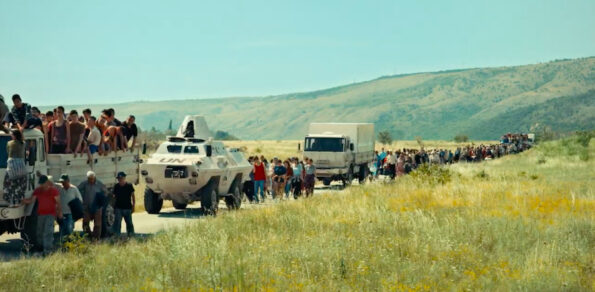
Similarly, Bosnian film director and screenwriter Jasmila Žbanić interrogates the gendered dimensions of conflict in her film Quo Vadis, Aida? (2020), which was likewise nominated for an Oscar for Best International Film. The movie reconstructs the events of July 1995 that culminated in the Srebrenica massacre and genocide through the perspective of Aida Selmanagić (Jasna Đuričić), a UN translator whose position exposes war as a fatal, male-driven game, the consequences of which women are left to navigate and endure. By centering Aida’s experience, Žbanić transforms historical atrocity into a site for examining the intersection of political violence, gendered labor, and the struggle for surviving with dignity. It exposes how women are made responsible for absorbing the structural burdens amid political catastrophe while being excluded from authoritative accounts.
She previously explored these themes in her feature film Grbavica (2006), where, through the characters of Esma and Sara, she uncovers stories buried by patriarchal shame and institutional oppression —such as rape used as weapon of war and the children born of sexual violence in Bosnia and Herzegovina during the 1990s. Methodologically, Žbanić, like Basholli, conveys feminist historiography through fiction, simultaneously exposing structures of violence that extend beyond war and reconstructing history as a relational, lived experience. Thus, cinema becomes both a medium and a site of feminist intervention, where memory is both expanded and critically interrogated.
It is important to recognize that these gendered approaches do not fall into the trap of merely reproducing heteronormativity. Contemporary feminist filmmaking in the Balkans expands its scope beyond traditional narratives, embracing an openness and diversity of experiences that have long been muted or deemed forbidden. This finds a clear articulation in Blerta Zeqiri’s The Marriage (2017). She deconstructs the dissolution of Yugoslavia and the Kosovo-Albanian experience in it through the love affair between her two male protagonists, Bekim (Alban Ukaj) and Noli (Genc Salihu).
Zeqiri not only challenges prevailing cultural assumptions about gender and sexuality, but also situates personal narratives within broader socio-political histories, demonstrating that regional feminist cinema can confront structural oppression while articulating the multiple, often overlooked experiences embedded within specific historical events. But, as Zeqiri expands the feminist gaze to include marginalized sexualities, other regional filmmakers, despite sharing the same methodological concerns, move from fictional, queer-inclusive historiography to documentary and archival staging.
Serbian filmmaker Marta Popivoda in her documentary Yugoslavia: How Ideology Moved Our Bodies (2013) emphasizes that “memory is never an instrument of surveying the past. It is an instrument for surveying the theater of the past,” underscoring a shared methodological commitment: the discrepancy between official, ideologically constructed history and the realities of those who experienced it. Albanian filmmaker Ermela Teli adopts a similar approach in her documentary In the Socialist Paradise (It Never Rains) (2025), where she examines the tension between public ideology and private life in communist Albania. Both documentaries are constructed from previously unseen archival footage and organized around temporal ruptures. Popivoda structures her film across four key periods —the 1940s, 1960s, 1980s, and the violent Yugoslav dissolution that followed through the late 1990s up until the early 2000s —while Teli’s analysis focuses on Albania from the 1960s through the 1980s, critically tracing the evolution of ideological control and its impact on everyday life.
“I wanted to make a film about the contradictory relationship of man with ideology,” Teli states at the opening of her film, “about how, in an autocratic system, man is forced to become someone else in order to survive.” Both prioritize understanding over resolution. “History gives a clear answer, but I don’t,” reflects Popivoda. “I’m asking questions.” She stages a performative critique of ideology and archival authority, contrasting state spectacles with lived experience to examine how the ideals of collective unity and brotherhood devolved into a spectacle of horror unmatched in Europe since WWII. This spectacularization of reality through film and state propaganda, to borrow Guy Debord’s terminology, is precisely what Popivoda and Teli dismantle —not as a performative act of historical justice, but as a way to reclaim the capacity to understand reality and one’s own authentic experience within it. This, in turn, releases memory from totalitarian and propagandistic ideological frameworks, allowing humanity and dignity to be restored.
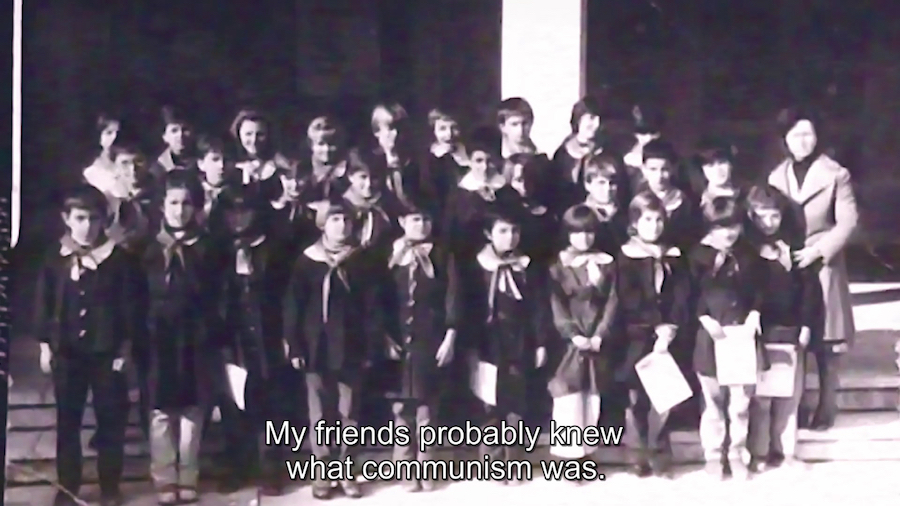
Filmstill from documentary In the Socialist Paradise (It Never Rains), 2025, by Ermela Teli
In a region still marked by nationalism, ideological control and contested memory, the work of Basholli, Žbanić, Popivoda, and Teli reveals how cinema can create inclusive spaces for questioning and dialogue where history and authoritarian governance have sought to impose silence or distortion. Beyond that, it serves as a testimony to feminist labor and the reclamation of spaces long structured to exclude women, making visible the experiences they were denied the authority to tell.
However, despite the fact that their films engage in a dialogue that situates local histories within the broader Balkan context, these filmmakers remain marginalized from transnational circuits of production and scholarship, a consequence of entrenched nationalist divisions, unresolved history, semi-authoritarian governance, and institutional gatekeeping that affects the film industry too. Thus, art, especially feminist art-making, opens pathways for dismantling the invisible structures that otherwise remain intact, mobilizing shared themes and methodologies driven by a demand for historical closure through justice, dignity, and freedom. Contemporary Balkan cinema can therefore be understood as a cinema of political struggle as much as one of artistic imagination.
(Imagen de portada: Filmstill from Quo Vadis, Aida?, 2020, by Jasmila Žbanić)

Gresa Hasa is a PhD researcher at the Faculty of Law and the Centre for Southeast European Studies at the University of Graz. Her research focuses on EU rule of law conditionality and justice reform in Albania. She holds a degree in Southeast European Studies, with a specialization in law and politics, from the University of Graz and the Central European University, as well as a degree in Political Science from the University of Tirana. Hasa is the co-founder and editor-in-chief of the Albanian feminist magazine Shota, and in addition, has over a decade of experience in grassroots political organizing and independent journalism across Albania and the Western Balkans.
Media Partners:








"A desk is a dangerous place from which to watch the world" (John Le Carré)