Search
To search for an exact match, type the word or phrase you want in quotation marks.
A*DESK has been offering since 2002 contents about criticism and contemporary art. A*DESK has become consolidated thanks to all those who have believed in the project, all those who have followed us, debating, participating and collaborating. Many people have collaborated with A*DESK, and continue to do so. Their efforts, knowledge and belief in the project are what make it grow internationally. At A*DESK we have also generated work for over one hundred professionals in culture, from small collaborations with reviews and classes, to more prolonged and intense collaborations.
At A*DESK we believe in the need for free and universal access to culture and knowledge. We want to carry on being independent, remaining open to more ideas and opinions. If you believe in A*DESK, we need your backing to be able to continue. You can now participate in the project by supporting it. You can choose how much you want to contribute to the project.
You can decide how much you want to bring to the project.
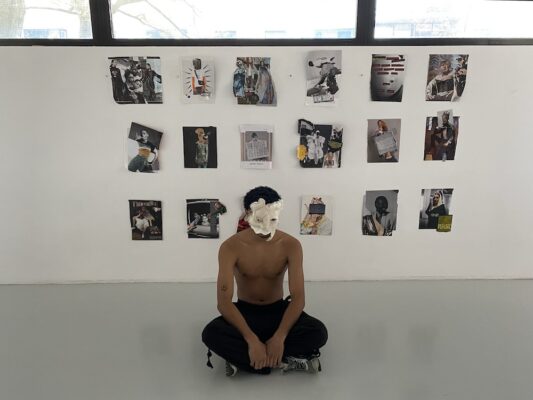
When the flesh speaks how do we hear [1]*hir is taken from Anne Leckie’s Ancillary Justice (2013) and is an unspecified or non-binary gendered pronoun or possessive determiner. hir when I am mediated, saturated by the vestibular (Spillers 74) of the imperial and colonial ongoing material reality. What effort does it take to remove the layers or at least sit with and alongside them to peek underneath and see the scale and range of damages done to my body as there is no flesh here to be found (Spillers 67). What certainties for speaking does this practice in decolonial unpacking and reflecting offer me when I attempt to gather my thoughts on and around the question of embodied pedagogies?
What I learnt from my own body — under duress — in the wake of the ongoing captivity (Hartman 21) are the ways in which it seeks to lance this pressure by finding ways to release and acknowledge the damage being done to me and others like me. To find spaces/places where those of us who need to relieve this constant interminable pressure can make our own pressure as comfort, antidote whereby our bodies sit in togetherness. This is a pedagogy of the fascia as it finds room to expand and settle — to let go with others, heartbeats aligning if only for a while in the liminal spaces we inhabit.
As Walsh testifies, we learn in the cracks of the colonial, where we absorb and immerse ourselves in the knowledge the wise ones, our elders have passed on — the gift of knowing that the captive in the enclosure will always find a way to live within and without. That it has been done before and we too will persist in our refusals, in our desire to dismantle the ongoing structures that harm us. Understanding its many permutations is a way to learn from our fleshly presences.
This means we must grieve, we must mourn, mourning and rememory are as Morrison demonstrates a pedagogy of the soul. Our grief a means of travelling to spaces of divergent relations as we are nourished and the spirit is freed to wander again. We gather and we speak of other times, we acknowledge our pasts as they sit with and alongside us informing our understandings of who we have been and are. Hersey (67) speaks of napping as resistance as a way to regain our connection with the DreamSpace, as we embrace rest as a healing spiritual practice. An act of refusal as we acknowledge our fleshly need to disengage from the relentless demands of the capitalist production line of personal presentation and consumerism amid the toxicities of products designed to separate us, to be suspicious and guard against the other. There is much to do and one of the spaces in which this work can be done is within the institution the one offering education to all. We know it is a lie but this is where I have chosen to start to continue the work of the elders in the oral tradition of my ancestors, engaging with those in this village.
I perhaps need to say something about this village as they all have their traditions, this one is built on the foundations of a modernity of the West in the West which eschews how its own “reservoir of knowledge and affects based on four hundred years of Dutch imperial rule plays a vital but unacknowledged part in dominant meaning-making processes, including the making of the self, taking place in Dutch society” (Wekker 2). This I have noted in my work with students at an art and design school in the Netherlands [2]My reflections in this piece of work are from working in an art and design university in the Netherlands for the last ten years teaching autotheory to a wide range of queer, straight, black, white … Continue reading leads to some bodies finding it easier to examine and explore the impact of being in their own bodies and many, many, others who practice their own refusal. By either not wishing to understand or explore what this means for how they get to move in the world or how the world opens up for them in ways that feel good. This unquestioned cushioning stands in stark contrast to those students who I have spoken with over the years who speak of an understanding of yourself disrupted and disturbed. Remembering her first-year experience [3] A pseudonym Elif recalls:
“Ah in the first year, I remember, it was like, the worst thing ever, if you had an assessment, the first assessment, I will never forget, we were all like shivering. And people would come out crying, and they would say, they told me to sign out while I still can, like, drop out of school while I still can, because this is not my place.”
So, what to do when the spaces you have chosen to occupy are not meant for you, the body shivers because it is warning to us, a sign, not something to be ignored, to be subsumed by tales of meritocratic visions of our performances judged on standard criteria none of which have been interrogated for there underlying loyalty to our colonial, imperial past. The notions of creative ability, critical thinking and risk taking as neutral competences available to all bodies underwrites this mode of thinking. These competencies in a Dutch context — not only — are most largely inculcated in specific bodies and habitus (Bourdieu 86), this too is embodied knowledge but in the instance of translation to creative talent it becomes lifeless.
This is pattern work, some bodies do their work silently for them others are hypervisible, it is felt, it is micro/macro aggression, it becomes racial battle fatigue, it is:
“The question and problem of who is afforded a voice – of which voices are heard as speech and which voices are heard as noise (if they are even heard at all) – is connected to an epistemological project rooted in the making of categorical distinctions, a project that brings with it the violent processes of racial categorization and racialization, as well as class stratification, gender binarization, and patriarchal heteronormativity.” (Navin Brooks 5)
Bearing all this in mind, knowing what we know, that our experiences of and within the neoliberal managerial turn that higher education has become are not meant to fit the hallways and classrooms we walk along. This is the context. We enter with our armour on. How then can we ask these students to do this work when their classmates and teachers refuse?


Within the context (visual) arts education many other scholars of colour have written about their experiences at a variety of levels. Walters (2020) recounting her efforts to hear more about the cultural and academic experiences of Black students at UAL (University of the Arts London) discovered staff resistant to conversations about racial identity, their pedagogical approach — the predominance of Euro-Western perspectives in their classes. Walters found this to negatively impact students of colour’s work and confidence. Smith (2019), writing in ArtNet about her experience of being the only black student at an elite art school, noted how art school reputations are inimically entwined with student success whereby their tutors “promoted and privileged the work of white male artists over all others”. Others (Dash 2010, Theuri 2016, Stevens 2015) problematize students of colour entry into an overwhelming white canonical context where they will have to manage a curriculum which does not include them. Sales argues that design educators “are so indoctrinated in Swiss design…that we don’t properly cultivate the talent of Black designers” (Berry 171). Sales explains that it was her experience of teaching at an HBCU (Historically Black Colleges & Universities) that “forced me to confront the concept of the Black aesthetic and its contentious relationship with European graphic design” (Berry 172).
McKittrick writes, “I know well the tension between modernity and race and gender and blackness” (14). Embodied pedagogy is a break in the storm of colonial binaries if by that we mean the capacity to hear ugly things and sit with their impact in the room — on us. If by that we are willing to address the complexities, messiness that arises when looking at our flesh and the ways in which we have been told our skin works — as a form of separation rather than comfort. hooks (1994) work is my well-thumbed manual to engage with students who have been programmed to leave most of their knowledge and experiences outside of the classroom. In her writing she emphasises the notion of ‘praxis’ — action and reflection. Her work is also a method for me, a process of self-actualisation (11), to be able to create a setting where embodied praxis and healing is possible. Where tutor and teacher share practices in radical complicity troubling disciplinary hierarchies. Where emotions and knowledge are shared, where “identity is extended through a relationship with the Other” (Glissant 142). Disrupting an education system built increasingly on efficiency and excellence is essential to the always incomplete project that seeks to eschew abstraction and extraction and embrace abundance, intimacy and joy.
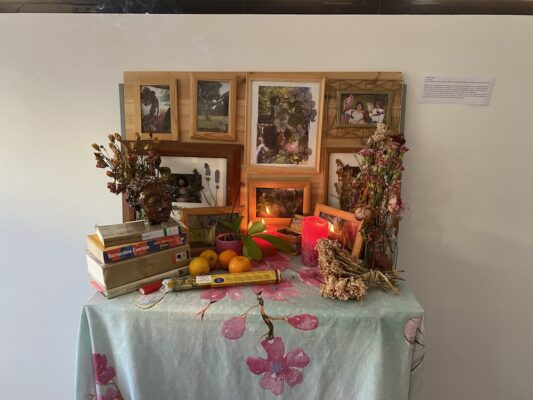
Mo Futures. Minor Cultural Diversity. Final Presentation Work
Works cited
Bourdieu, Pierre, and Tony Bennett. Distinction : A Social Critique of the Judgement of Taste. Translated by Richard Nice, Routledge, 2010.
Dash, Paul, and Brill Online. African Caribbean Pupils in Art Education. Brill, 2010, https://doi.org/10.1163/9789460910500.
Glissant, Édouard. Poetics of relation. University of Michigan Press, 2022.
Hartman SV. Scenes of Subjection : Terror, Slavery, and Self-Making in Nineteenth-Century America. Oxford University Press, 1997.
Hersey, Tricia. Rest is resistance: A manifesto. Hachette UK, 2022.
Louissaint, Renald. The Black Experience in Design : Identity, Expression & Reflection. Edited by Anne H. Berry et al., Allworth Press, 2022.
McKittrick, Katherine. Dear Science and Other Stories. Duke University Press, 2021, https://doi.org/10.1515/9781478012573.
Morrison, Toni. Playing in the Dark : Whiteness and the Literary Imagination. Picador ed, Picador, 1992.
Navin Brooks, Andrew. “Fugitive Listening: Sounds from the Undercommons.” Theory, Culture & Society, vol. 37, no. 6, 2020, pp. 25–45, https://doi.org/10.1177/026327642091962.
Theuri, S., and University of Salford. Black African Students and the Art and Design Education Space : Narratives of Journeys to Higher Education Art and Design. University of Salford, 2016, http://usir.salford.ac.uk/38061/.
Smith, Melissa. “You start the game tired: What it’s like to be one of the few Black students at an elite art school.” Art World: Artnet (2019).
Spillers, Hortense J. “Mama’s Baby, Papa’s Maybe: An American Grammar Book.” Diacritics, vol. 17, no. 2, 1987, pp. 65–81, https://doi.org/10.2307/464747.
Stevens, Samantha. “Arts-based education for social justice.” (2015).
Mignolo, Walter D., and Catherine E. Walsh. On decoloniality: Concepts, analytics, praxis. Duke University Press, 2018
Wekker, Gloria. White Innocence : Paradoxes of Colonialism and Race. Duke University Press, 2016, https://doi.org/10.1515/9780822374565.
[Featured Image: Denzel Veerkamp. Minor Cultural Diversity. Final Presentation Work]
| ↑1 | *hir is taken from Anne Leckie’s Ancillary Justice (2013) and is an unspecified or non-binary gendered pronoun or possessive determiner. |
|---|---|
| ↑2 | My reflections in this piece of work are from working in an art and design university in the Netherlands for the last ten years teaching autotheory to a wide range of queer, straight, black, white and people of colour as part of my own practices of decolonial pedagogy. |
| ↑3 | A pseudonym |
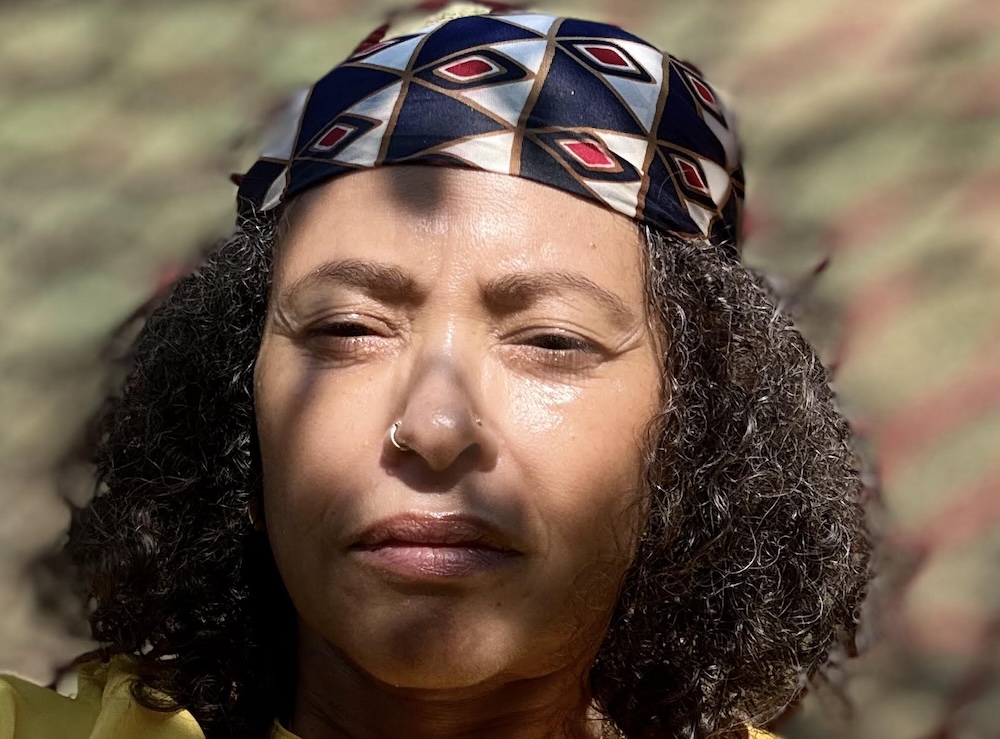
Teana Boston-Mammah has a BA (Hons) in sociology, lived and worked as a sociology lecturer in London before moving to the Netherlands. She studied Gender Studies at Utrecht University and obtained an MSc in Urban Studies and Policy at Erasmus University Rotterdam in 2012. She has worked for more than ten years in Rotterdam for diverse non-governmental foundations whose focus is gender empowerment, civil participation, diversity and inclusion. In 2015 she returned to teaching and research by taking up a post as lecturer at the Willem de Kooning Academy (WdKA) in Rotterdam. Other responsibilities include redeveloping the minor Cultural Diversity programme for bachelor students, highlighting EDI concerns in her writing and setting up extracurricular programmes such as the Brown Bag Lunch and Black Book Club. Her areas of interest are decoloniality, black studies and inclusive pedagogy. Teana is now awaiting the defence of her PhD at Erasmus University Rotterdam — an ethnography on antiblackness in higher art and design education in the Netherlands.
Media Partners:







"A desk is a dangerous place from which to watch the world" (John Le Carré)