Search
To search for an exact match, type the word or phrase you want in quotation marks.
A*DESK has been offering since 2002 contents about criticism and contemporary art. A*DESK has become consolidated thanks to all those who have believed in the project, all those who have followed us, debating, participating and collaborating. Many people have collaborated with A*DESK, and continue to do so. Their efforts, knowledge and belief in the project are what make it grow internationally. At A*DESK we have also generated work for over one hundred professionals in culture, from small collaborations with reviews and classes, to more prolonged and intense collaborations.
At A*DESK we believe in the need for free and universal access to culture and knowledge. We want to carry on being independent, remaining open to more ideas and opinions. If you believe in A*DESK, we need your backing to be able to continue. You can now participate in the project by supporting it. You can choose how much you want to contribute to the project.
You can decide how much you want to bring to the project.
Technological dystopias constitute one of the most influential and persistent forms of the contemporary collective imagination. They arise as a critical response to the confidence in scientific progress and the idea, present since modernity, that technology can help shape more advanced and free societies. In contrast to this optimistic narrative, technological dystopias spark debates, especially in a context as complex as the present. What happens when technical systems cease to serve people and impose their logic, forcing an economic and social reorganization?
It’s important to remember that this process did not emergeoutofnowhere. The hopes placed in the collaborative and seemingly democratic internet of the 1990s were dashed after the attacks of September 11, 2001. Governments and large corporations jointly deployed their power, reviewing and classifying any activity or event on the network. Censorship and control over citizens were imposed. Projects like Blacklists (2015-2017) by the multidisciplinary collective DISNOVATION.ORG (2015-2017) reflect the erosion of our rights by compiling a list of censored websites, available in a web format and as a 13-volume encyclopedic work of 666 pages each. Its content allows us to reconstruct the cultural and sociological model of what is inaccessible.
During the COVID-19 pandemic in 2020, digital tools associated with large companies in the sector were massively implemented. What seemed like something that would drastically reduce the digital divide and improve our communication became a trap that had been set beforehand. Plans for the expansion and implementation of certain methodologies, formats, and static approaches that homogenize fundamental aspects of our social and professional lives as we currently understand them were accelerated.
During this period, innovative, non-profit initiatives based on open-source tools gained particular prominence in the cultural sphere (helping to disseminate debates, content, and events). After the exceptional period, many of these initiatives were abandoned or sidelined in favor of commercial options, weakening the free culture movement.
Authors such as Shoshana Zuboff, Eric Sadin, and Kate Crawford analyzed and warned us about the dark recesses of technological power, its methodologies, and strategies, designed by those who are now part of its oligarchy. Their texts dissect how these algorithmic structures manage to impose their models on social organization, and how they act outside ethical principles on global politics and economics, disregarding the power of states and their laws, and even undermining seemingly representative and stable democracies. Crawford, along with Vladan Joler, document this vast network in Calculating Empires (2023), a representation of the evolution of the connections between technology and power from 1500 to the present day. They avoid oversimplification and the easy solutions prevalent when managing information, and invite the public to see, reflect and propose new ideas for the future.
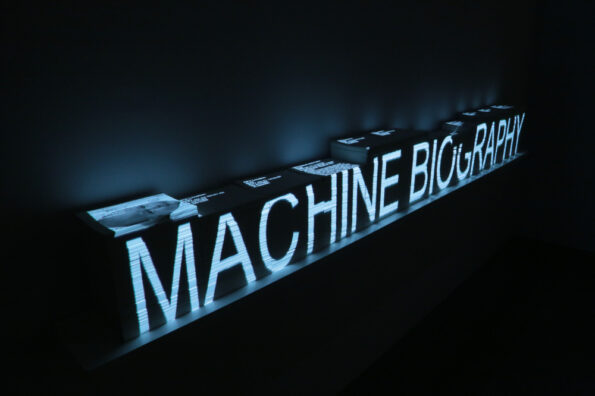
The concentration of technological power is coupled with the growing investment in artificial intelligence. The intensive use of data has led, paradoxically, to the need to increase both its capture and analysis capacity. Its use is present in our applications through recommendations, voice assistants, chatbots, and facial recognition systems. This evolution is evident in projects such as Machine Biography (2019-2022) by Clara Boj and Diego Díaz, in which the authors generated a predictive biography for 2050 based on all their digital activity collected during 2017 using a commercial app designed to spy on mobile phones. The amount of data obtained led to two previous projects: the publication of 365 printed books (Data Biography (2017)), and a 24-hour visual narrative (Data Biopic (2018)). Machine Biography questions the predictive capacity of artificial intelligence and its social impact.
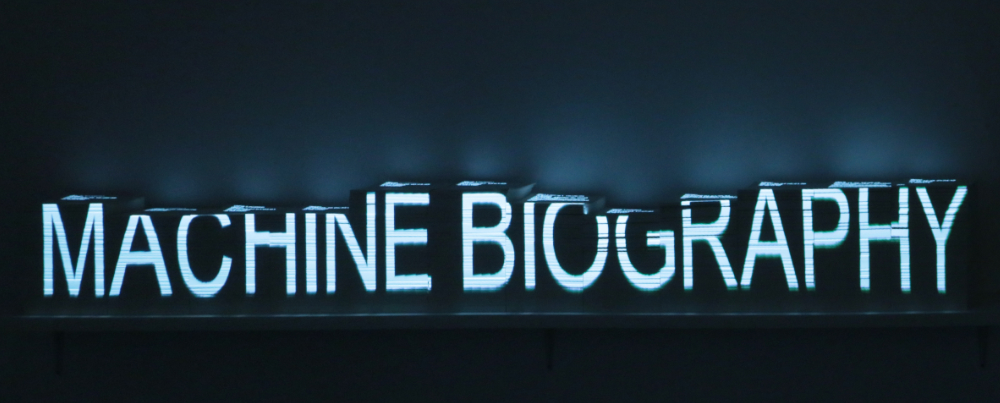
Machine Biography by Clara Boj and Diego Díaz. Courtesy of the authors.
Private technology companies have taken over the infrastructure on which modern society is based. We have accepted the rules imposed by multinational corporations in the sector, and digital life has devoured real life. The two dimensions of our existence and identity become blurred and fused in all kinds of decisions, considerably limiting our possibilities for social interaction.
We are glued to our devices when we work, socialize, or consume content of dubious origin. As a viral meme explains, “we went from being connected all day to a 15-inch screen to relaxing in front of a 55-inch one.” Access to free content at the expense of our privacy and affordable platforms impose their offerings with increasingly limited competition. Faced with the avalanche of data, an unquestioning attitude in terms of the processes, veracity, and ethics behind what we consume has spread.
In their work, artists like Aram Bartholl and Dries Depoorter reveal our disposition toward this situation. In Perfect Beach (2018), Bartholl employs performance art (and sometimes Photoshop), using three large prints of tropical beaches to conceal their actual saturation in the images. Depoorter, for his part, shows in The Follower (2023) the manipulation of influencers on Instagram by comparing their posts with screenshots taken at the exact moment the photos were taken. The realities in both projects differ from what is shown on social media. In The Flemish Scrollers (2021-2026), he uses artificial intelligence and facial recognition to automatically tag Flemish politicians distracted by their screens during live streams of their meetings. The images of this monitoring are published with the tags on Instagram and X. With these captures, he manages to caricature the political class, and by extension, all those who view them.
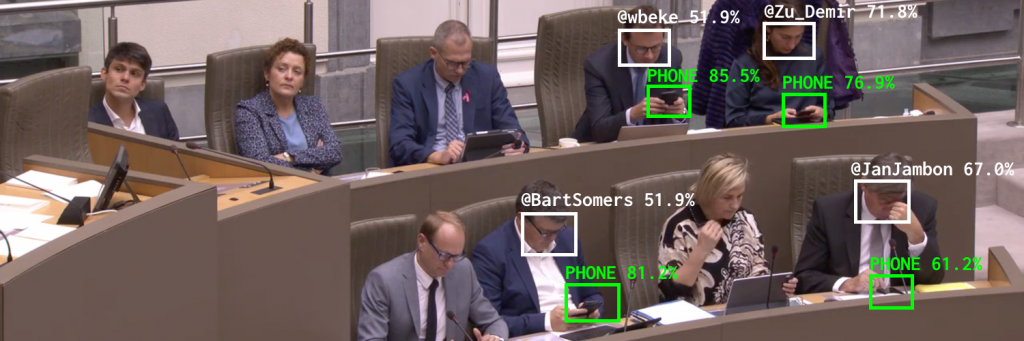
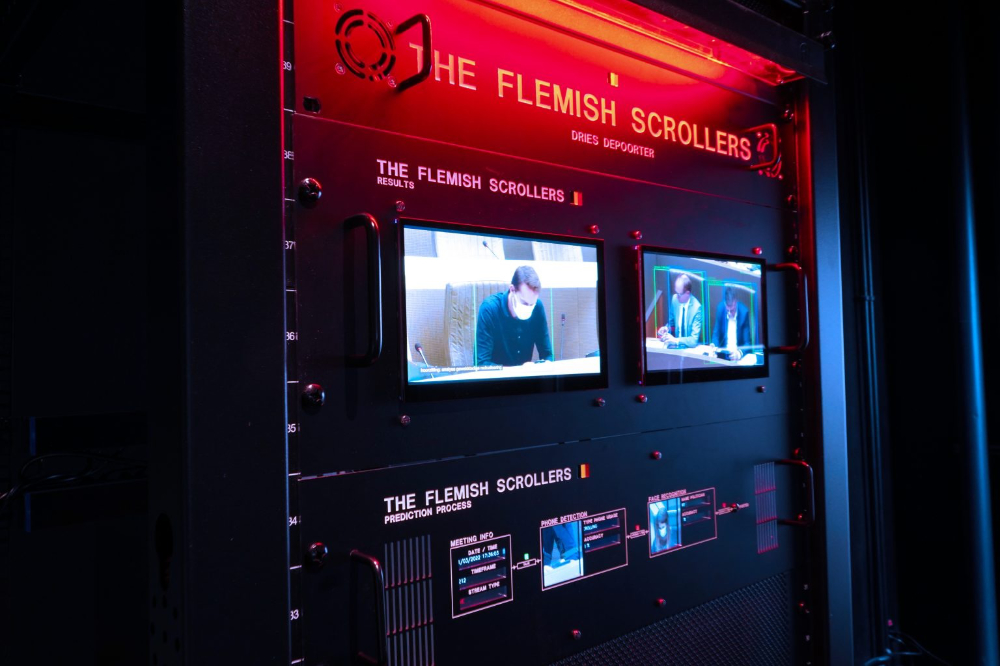
Images of The Flemish Scrollers (2021-2026) by Dries Depoorter (Author: Dries Depoorter)
Our attention has been captured at the expense of our senses. Nothing stands out, nothing surprises. The algorithmic flow offers us more products, faster and faster, that align with our preconceived notions. It’s no wonder, then, that experimentation in design has become marginal across all fields, even in digital creation. The research that was prevalent two decades ago has mutated into a new paradigm of homogenization and repetition, in which critical or non-conformist proposals are rendered invisible. This is why it is more necessary than ever to showcase and disseminate pieces that generate alternative narratives about established models. Let’s consider, for example, the works of Estampa, focused on understanding and showing the viewer how AI works, generating new poetic narratives about the impossibility of translating words into images and vice versa. Or the works and texts of Hito Steyerl, denouncing the surveillance and precariousness behind technology. Or the interrelationships between the real and the artificial present in Anna Ridler’s image collections.
Approaching critical digital culture can be a stimulus against induced individual apathy, but first we must look at ourselves, recognize ourselves, to stop our inertia. Let’s use their same strategies and confront the facts, and not confuse information with opinion.
It’s time to decide our own movements and to perhaps slow ourselves down in the technological realm in order to rethink interdisciplinary proposals about care and our environment. It’s difficult, but not impossible.
[Imagen destacada: Machine Biography, de Clara Boj y Diego Díaz. Cortesía de los autores]
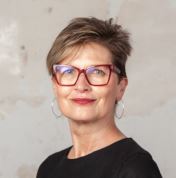
Paloma González Díaz is a researcher and lecturer in design, arts, and technology at the UOC (Open University of Catalonia). Her work focuses on critical and multidisciplinary approaches at the intersection of art, design, technology, and society. Specializing in digital creation, interaction, and the dynamics of power and technological control, she has taught at institutions such as Escola Massana, BAU, Elisava, CITM, and EINA. Since 2007, she has written the blog Uncovering Ctrl, dedicated to digital art, surveillance, and privacy.
Media Partners:




"A desk is a dangerous place from which to watch the world" (John Le Carré)