Search
To search for an exact match, type the word or phrase you want in quotation marks.
A*DESK has been offering since 2002 contents about criticism and contemporary art. A*DESK has become consolidated thanks to all those who have believed in the project, all those who have followed us, debating, participating and collaborating. Many people have collaborated with A*DESK, and continue to do so. Their efforts, knowledge and belief in the project are what make it grow internationally. At A*DESK we have also generated work for over one hundred professionals in culture, from small collaborations with reviews and classes, to more prolonged and intense collaborations.
At A*DESK we believe in the need for free and universal access to culture and knowledge. We want to carry on being independent, remaining open to more ideas and opinions. If you believe in A*DESK, we need your backing to be able to continue. You can now participate in the project by supporting it. You can choose how much you want to contribute to the project.
You can decide how much you want to bring to the project.
It has now been four years since we wrote the text for the book “Neutopías” in which we discussed Reuse as a subversive act. Not merely as a strategy for extending the life of objects or optimising resource consumption, but as a way of questioning the logic of production and use that shapes our daily life.
That collective discussion, based on various dialogues among those of us who were part of Makea at the time, concluded with two open-ended questions that still resonate today:
“How can we transfer design tools to help transform society within planetary boundaries and social justice parameters?
And how can we transform, through practice, the very practice of design itself?”
We still don’t have a definitive answer to these questions, but we dared to put forward a few hypotheses that we perhaps did not express so clearly back then.
In these turbulent times of information overload, post-truth, techno/theocracies, virality, uncontrolled warlords, artificial intelligence, neo-fascist algorithms, hyper-commodification of life, fractured societies, monitored purchases, strained coexistence, isolation from empathy and extremely thin-skinned people… it seems that the majority of the limits that defined a democratic and distributive status quo have been blown to smithereens.
From our current perspective we believe that the issue is no longer solely about designing more sustainable objects, nor even about speculating on desirable futures through design. Perhaps the challenge is something more basic and fundamental: rebuilding the vital conditions that allow us to exist and do things together.
—
When we think of the word utopia we tend to imagine a distant horizon, an ideal place that does not yet exist. However, in recent years, as we have observed our everyday reality heading towards the least desirable scenario, we have often had the feeling that some of the elements that make up that desirable world had already been present in our lives. These elements had been slowly building up in our cities and neighbourhoods for a long time, even though we were not always aware of them until they began to disappear.
Not so many decades ago, the everyday landscape included a fairly extensive network of distributed knowledge and trades: repair shops, hardware stores, small carpentry workshops, shoe stores, dressmakers, electricians or garages that kept the objects, care and machinery of daily life running. When something broke, the usual course of action was not to replace it with something new, but to try to repair it and, in many cases, improve it. And in order to do so, there was knowledge, places, tools and, especially, people who knew how to fix whatever had broken or malfunctioned.
It was not a utopia. But it contained something we are beginning to miss nowadays: an ecosystem of knowledge and practice that allowed us to have a different relationship with the material world. Objects were opened, disassembled, adapted or transformed, they were not thrown away. And when something stopped working, it was relatively easy to find someone who knew what to do. Knowledge circulated and there were spaces where one could learn by observing, asking questions or helping. To be clear, this reflection does not intend to romanticize the idea that there were better times, but rather to acknowledge where we come from so as to underpin where we are headed as a society.
—
The productive and cultural ecosystem of making has been gradually disappearing. The design of increasingly closed-off products, the programmed obsolescence, the growing technological complexity, the relocation of production or the simple lack of generational succession in many trades have drastically reduced the ability to intervene in our surroundings. We have specialized in assembling and arranging certain things ‘at our discretion’.
Our cities are losing the places where such practices could take place. Workshops, manufacturing spaces, small repair shops, associations and informal learning spaces have been steadily disappearing, displaced by property development, economic concentration or the loss of profitability of activities that sustained during decades much of our everyday material culture.
This results in a loss of values and a profound transformation in our relationship with our environment.
We are surrounded by increasingly sophisticated objects and technologies, yet we are becoming gradually less able to comprehend how they work, to alter them or to adapt them to our needs. The material world has become progressively more opaque and we lack the capacity to find our own solutions.
—
It may seem like a simple technological or economic shift, but its effects go far beyond that. When the people who repair things disappear, so do their workplaces, their knowledge and the opportunity to learn from them by observing, asking questions or experimenting. And with that, our sense that things can be changed also vanishes.
Something similar happens on an individual level. When we stop repairing or creating things, we also stop seeing ourselves as people capable of shaping our environment and our mental relationships. We have got used to interacting with objects as users or consumers, not as agents of their transformation. When we need something, we settle for whatever we find in our local variety store, we know the quality is not good, it does not meet our expectations, it does not work, yet we still buy it because it’s the only option we have.
A basic example that might help us understand this is: what happens when a chair starts to creak, wobble or its legs start to bend slightly?
For a long time, the usual reaction would have been to try to fix it. Turn it over, see how it is put together, check if any joints have loosened or if it just needs a few screws tightened or something reglued. Perhaps add a small wedge, adjust the legs or replace the broken piece. That seemingly trivial gesture entails pausing for a moment to look closely at the object and try to understand how it works.
This process activated small bits of everyday knowledge: recognising a type of joint, knowing how to use a screwdriver and what the different types of glue are, deciding whether a piece can be adjusted or needs replacing. Sometimes it also meant asking someone who had specific knowledge or going to a hardware store to find the right screw. These were modest gestures, but they formed part of a shared material culture in which objects were not necessarily definitive nor closed off, but rather things that could be maintained, adjusted or repaired––in short, allowed to continue living.
Nowadays, however, things are usually handled differently. We replace the chair with a new one and put it out on the kerbside on bulky waste pickup day for it to be collected, thus feeling that we are contributing to reducing our environmental impact.
What may seem like an insignificant action is actually part of a much broader chain of transformations. It carries multiple social and material implications and impacts. Every time we replace an object that could have been repaired, the entire production system that makes it possible is reactivated: raw material extraction, industrial manufacturing, global transport, packaging and distribution. At the same time, we lose the chance to activate practical knowledge, to learn about how things are made or to keep alive small local economies linked to maintenance and repair. Instead, another, rather paralyzing form of knowledge is triggered: scrolling on our devices searching for the best deal that fits our “designer” life.
It’s not just about a chair.
—
This transformation does not only affect objects. It also affects our collective capacity to imagine alternatives and real opportunities for change. Because doing things is not merely a technical activity. Testing, dismantling, repairing or building are also forms of knowledge and ways of connecting with each other. These actions allow us to understand how things are made and, at the same time, to discover they could be made in a different way, to find out where do the materials come from, and to learn under what conditions they were produced.
It impacts our coexistence, our societal values, our collective intelligence and our ability to overcome unforeseen situations caused by climate change, which are increasingly pressing us with greater frequency and severity.
When a group of people experiment with materials and tools, questions, mistakes, improvised solutions, unexpected combinations and, sometimes, new forms of collective organization arise. This process creates insights that are not only related to technique, but also to the way we interact with resources, time and other people.
Without these spaces for experimentation, the world becomes more and more closed off. We go from taking part in the construction of our environment to becoming consumers of solutions designed by those in higher positions of power. And when that happens, our ability to imagine different futures also disappears.
—
Based on our experience working for years on design processes aimed at collective construction, this relationship between making and imagining has become increasingly necessary. This is not to say that all design should be oriented in that direction, but rather to acknowledge that there are practices which seek to bring back those spaces where material experimentation becomes possible once again.
In our case, over time we have come to understand our job as designers less as an activity focused exclusively on producing objects and more as a way of creating the conditions so that other people can analyse their context, experiment with materials and develop collective responses to specific issues.
When that happens, small exchanges of knowledge and transfers of power take place, and the capacity for action is put into practice. People stop interacting with objects and spaces as something fixed and unchangeable and begin to perceive them as something that can be altered, repaired or reinvented. And for us that is when micro-utopias become a reality.
These micro-utopias tend to be fragile, temporary and sometimes even troublesome. They are not ideal communities or perfect scenarios, they are lessons that guide us towards a specific direction. Because rebuilding the culture of making is not a romantic nor an idyllic process. It entails changing deeply ingrained habits, questioning consumption models we take for granted and rediscovering abilities we had stopped practising. It also involves accepting mistakes, trial and error and collective negotiation as part of the process.
In that sense, utopia does not appear as a pleasant landscape we will one day reach, but as a collective reconstruction process that takes place in the present. It emerges when we create shared spaces, tools and knowledge that allow people to engage with the world we live in.
Perhaps that is why imagining different futures does not depend so much on our ability to speculate about them, but rather on something much more specific such as protecting or rebuilding places where we can bring about change once again, and if we can do it together, all the better.
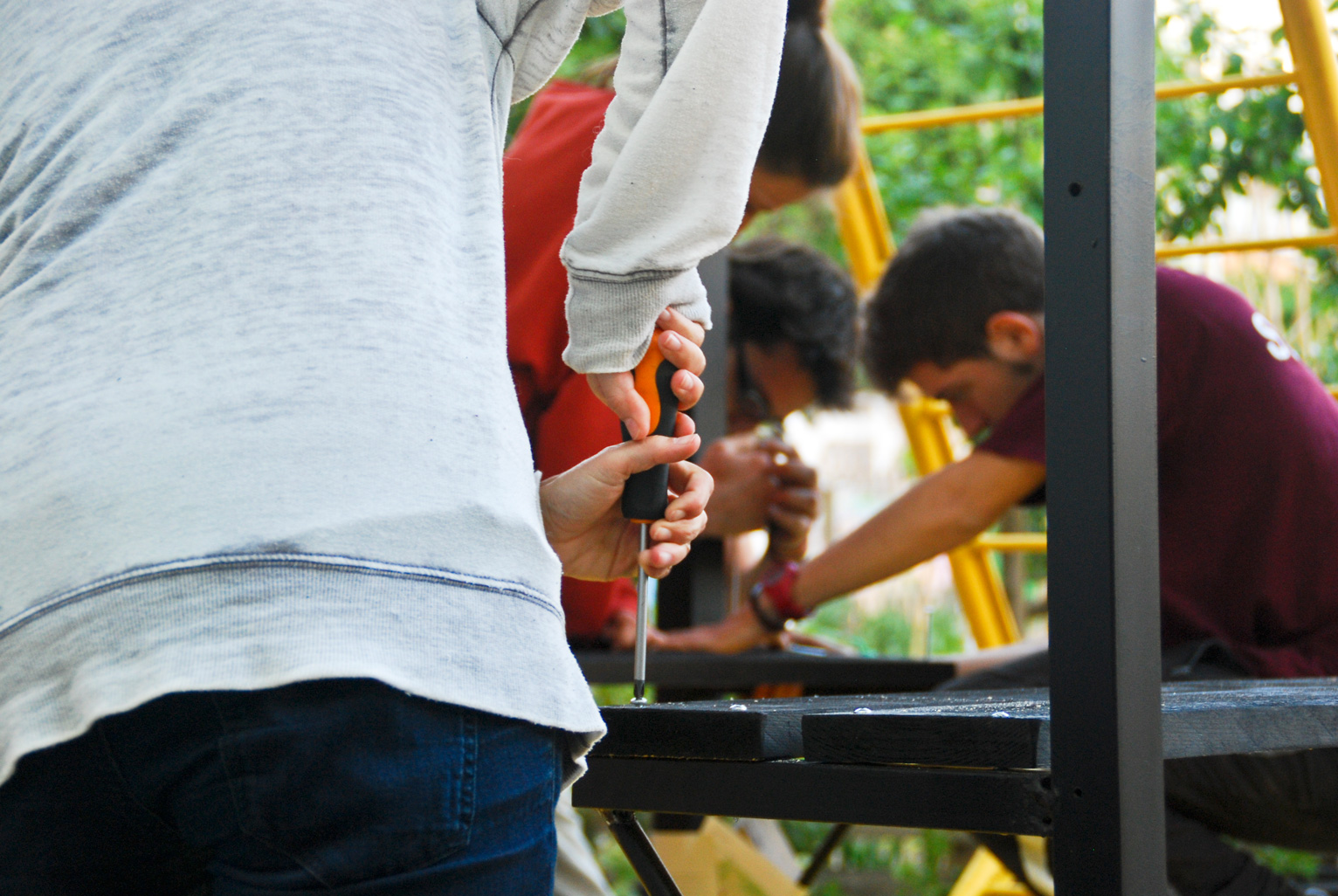
Repair process of the O.B.N.I. mobile unit – Ocupació Barrial No Invasiva – Solar Germanetes de Barcelona. Recreant Cruïlles. May 2015
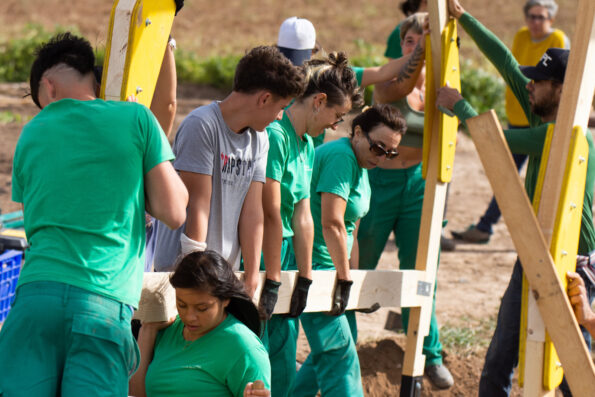
[Featured image: Process at Tornallom. Construction of the Open Classroom with students from the Agroecology program at IES La Garrigosa in Meliana (Valencia). September 2023]
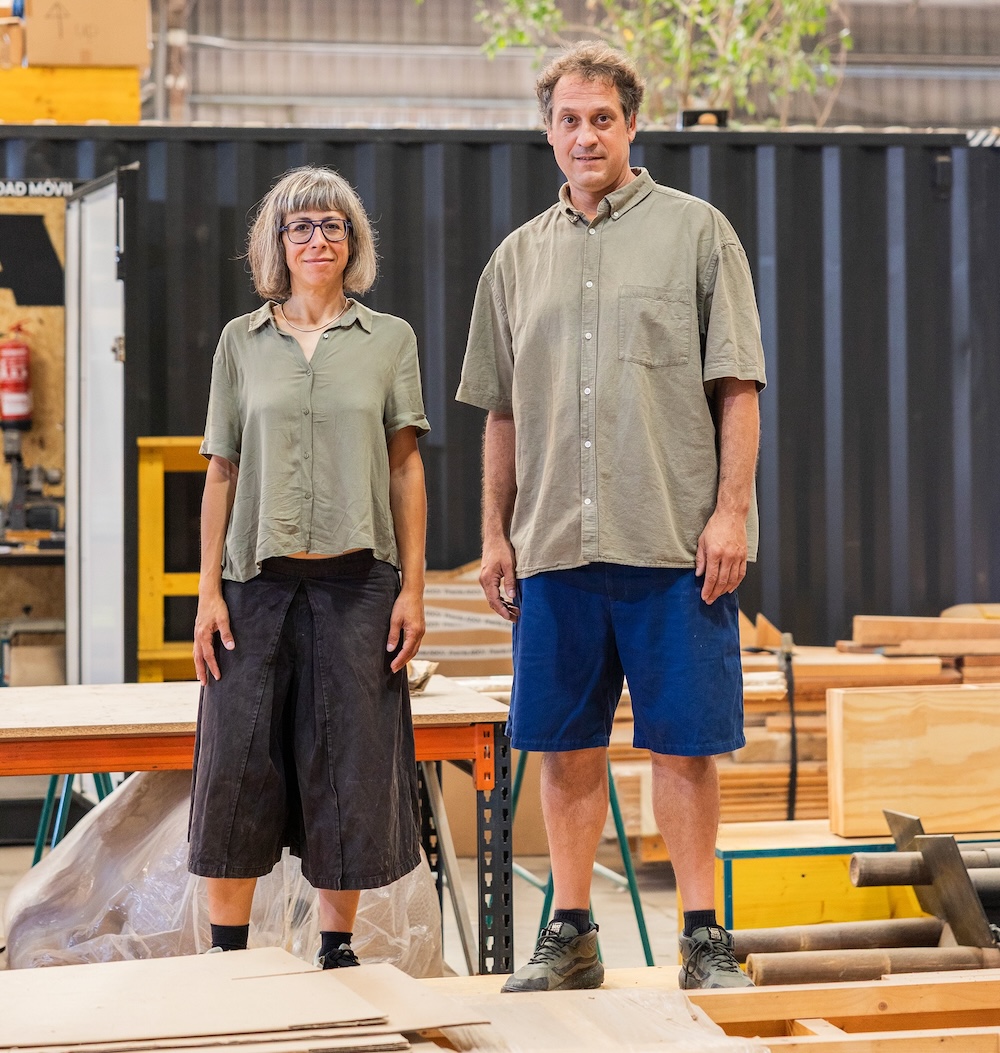
Makea is a social and educational cooperative that promotes the role of design in social transformation. Its work lies at the intersection of design, ecology, and education. With 20 years of experience, Makea has worked on countless collective processes with grassroots citizen groups such as neighborhood associations, social centers, cultural centers, community centers, distributed production networks, and learning communities, as well as transferring its methodologies through training programs and workshops at higher education institutions such as the Polytechnic University of Valencia, the Autonomous University of Barcelona (UAB), Elisava School of Design, ESDAPC, Escola BAU, the University of Catalonia (UIC), and the Open University of Catalonia (UOC), among others.
They have spearheaded projects in collaboration with cultural and educational institutions, public administrations, and third-sector organizations, and their projects have been exhibited in national and international exhibitions, such as ACVIC, CC São Paulo (Brazil), and the Corcoran College of Art and Design in Washington, D.C. (USA). They recently participated in the exhibition Time is Present. Designing the Common at the Porto Design Biennial (Portugal). https://makeatuvida.net
(Photo: María Mira)
Media Partners:






"A desk is a dangerous place from which to watch the world" (John Le Carré)