Search
To search for an exact match, type the word or phrase you want in quotation marks.
A*DESK has been offering since 2002 contents about criticism and contemporary art. A*DESK has become consolidated thanks to all those who have believed in the project, all those who have followed us, debating, participating and collaborating. Many people have collaborated with A*DESK, and continue to do so. Their efforts, knowledge and belief in the project are what make it grow internationally. At A*DESK we have also generated work for over one hundred professionals in culture, from small collaborations with reviews and classes, to more prolonged and intense collaborations.
At A*DESK we believe in the need for free and universal access to culture and knowledge. We want to carry on being independent, remaining open to more ideas and opinions. If you believe in A*DESK, we need your backing to be able to continue. You can now participate in the project by supporting it. You can choose how much you want to contribute to the project.
You can decide how much you want to bring to the project.
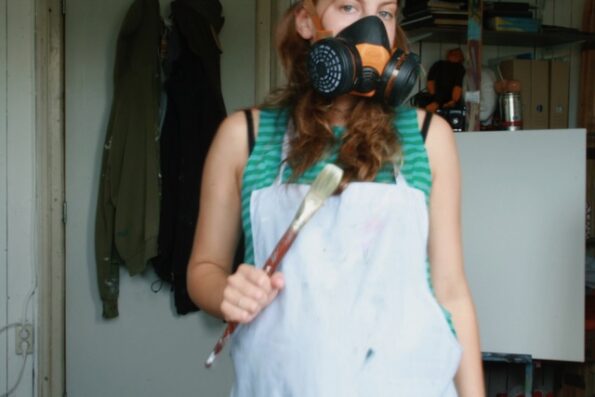
I never planned to become a teacher. My mother was one. She specialized in pedagogy for children with special needs—but I—no, I didn’t see myself in this role until later. Sometimes she joked to my sister and me that it was easier for her to teach children with special needs than us. Now that I have two children of my own—aged sixteen and ten—I realize she wasn’t joking after all. Teaching is tough, arguably one of the hardest jobs. The pandemic and homeschooling confirmed that this is truly the hardest it can be. When I was a teenager, I wanted to be a competitive swimmer. After years of training and while finishing primary school, I realized I would never reach the top level. I decided to study art instead. I first enrolled in a specialized high school in Poland, where I learned traditional arts and crafts techniques. Later, I moved to the Netherlands to discover my interests in curating and organizing. My mom used to tell me, “Don’t worry, you will always be the best artist among swimmers and the best swimmer among artists.” This simple, silly sentence helped me then, and it still applies today: having multiple roles is possible without sacrificing one for the other.
At twenty-five, after earning my bachelor’s degree, I had my first child. While studying for my master’s, in 2012, I founded a non-profit gallery called Upominki, which means “gifts” in Polish, my native language. What started as an experimental project inspired by reciprocity and gift-giving rather than a transactional exchange has grown into a recognized art space. Reflecting on that time, I realized how professional expectations conflicted with my personal experiences, shaping my view of motherhood as both an artist and an individual. This awareness has driven much of my work, something I understood only later.
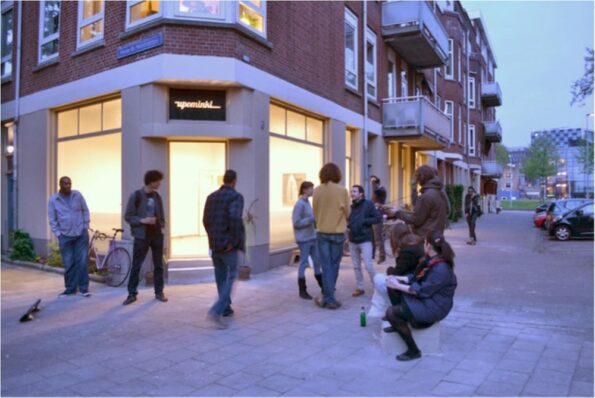
Upominki, 2012
Working on Upominki allowed me to merge my personal and professional worlds, challenging the traditional view of motherhood as incompatible with artistic practice—a belief that adds to the historical exclusion of female artists. I took my son to meetings when he was little or during exhibition installations. He was there during the events, waiting for my partner to pick him up after work. By the time he started school, I adjusted my schedule to work around the school pick-up times, which created new challenges. Many artists and colleagues I worked with were critical of this disrupted work rhythm, especially during exhibition build-ups. As the years passed, my role expanded, and while managing the space, I started coordinating an MA program at the art academy in The Hague, only to find out three months later that I was pregnant with my second child. During this time, I encountered Sara Ruddick’s scholarship on maternal thinking. For Ruddick, maternal thinking is neither biologically bound nor exclusive to women, but rather a set of practices developed within caring relationships. It offers an ethics of care that influences social norms, values, and community dynamics, making it particularly relevant to pedagogical roles.
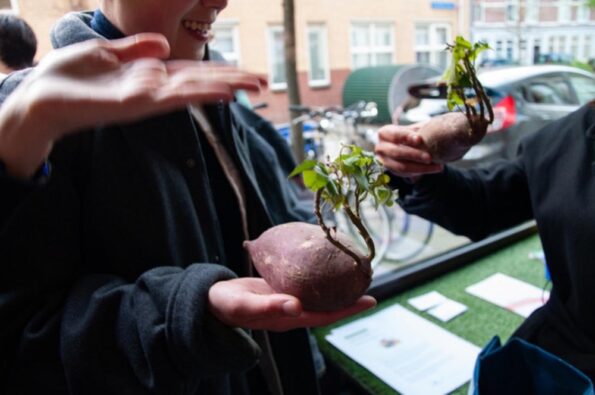
Seed to seed 🍀 Gill Baldwin with Upominki and others, 2019
From the moment a woman becomes pregnant, she forfeits her right to privacy. As her body changes and her pregnancy becomes more visible to the outside world, she is subjected to comments and judgments, effectively turning her into a public figure. So here I was, a so-called young mother, faced with questions like “Was it planned?” and “Are you still with the father?” even from people whom I barely knew. Years later, reading Andrea O’Reilly, I realized I didn’t fit society’s patriarchal ideal of a mature, white, straight, cisgender, able-bodied mother. Because of my age, I was given a bad mother label.
As my children grew older and more independent, I found time to read, write, create, and even to travel. I started working with artists and researchers whose works sit within the field of motherhood studies. Through these connections, I learned how, beyond art, different academic disciplines intersect with motherhood as well. Almost simultaneously, I received an offer to teach at the academy where I used to study in Rotterdam. For the past 7 years, I have been the lead of an interdisciplinary BA program, now focusing solely on classroom teaching.
For researchers in motherhood studies, motherhood is more than just a personal or biological experience. They examine how social, cultural, political, and historical factors shape perceptions of motherhood. Using intersectional methods, this interdisciplinary field explores how race, class, and sexuality create diverse maternal experiences. It challenges stereotypes, amplifies marginalized voices, and views motherhood as a complex, evolving social role rather than a universal experience.
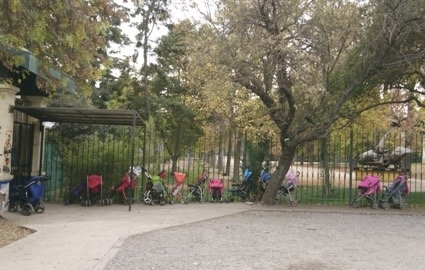
Santiago, Chile 2019
The academy where I work offers considerable freedom in teaching, allowing staff to bring their expertise and methods to the classroom. Yet for the first few years, I kept my research outside those walls. This caution was part of a larger pattern—it mirrored the time it took me to recognize that my experiences as a young mother and an artist have shaped my artistic practice. Working within a cultural context that emphasizes concepts like care, love, and relationality but, in practice, struggles to be inclusive—having historically devalued, dismissed, and excluded the practices and voices of artists with caring responsibilities—requires artists and caregivers to constantly code-switch. I remember past situations when, during professional art events, I’d have friendly conversations with women artists, curators, and colleagues, and never mention that I had children. Only to bump into the same person days later on the street while pushing a stroller.
Audio note #3, 2024
I faced hostility from the local art scene multiple times, and through organizing at Upominki and outside, I sought ways to change that. By working on my own terms—hosting events during the day and never answering emails or writing funding applications on weekends—I have set a rigorous schedule for my practice that also accommodates my family. But how can someone fully achieve and sustain this lifestyle?
Kim Brooks’ essay for The Cut went viral by capturing this paradox. She quotes a friend: “the point of art is to unsettle, to question, to disturb what is comfortable and safe. And that shouldn’t be anyone’s goal as a parent.” This view of artistic practice demands complete freedom from responsibility, unlimited time, and nearly monastic dedication—a model that conveniently excludes anyone whose life involves caregiving. It prompts an important question: who decides what ‘real’ artistic practice is, and whose art and way of living are valued in that decision?
This contradiction isn’t just a personal dilemma but reflects deeper structural problems in the field. A 2019 study by Mama Cash found that women’s position in the arts, across disciplines, is a significant issue. In the visual arts, women artists are underrepresented in major museums and exhibitions, earn less than men for similar work, and face more barriers to gallery representation and institutional support.
These disparities are not limited to a single region but are seen worldwide. Over the years, campaigns from the US (2016, 2025), research from the UK (2021), and across Europe (2021) revealed similar patterns: women make up most art school graduates, yet they are a minority of artists represented by galleries, holding tenured faculty positions, or having their work acquired by museums.
A 2024 survey of Dutch art institutions confirmed ongoing gender discrimination throughout the arts ecosystem. From education to professional practice, remuneration, and institutional support, women artists earn about 30% less than men, are half as likely to receive solo exhibitions at major institutions, and report experiencing gender-based discrimination in funding decisions and curatorial selection processes. As highlighted in another local 2025 study, parenthood—especially motherhood—remains a major liability in a professional artistic career. This continues the tradition of viewing motherhood as incompatible with a serious artistic pursuit—an idea that worsens the historical exclusion of female artists, as Linda Nochlin noted decades ago. Today, this view persists, confirmed by numerous statements from prominent women artists (2016, 2020, 2024).
The far-reaching repercussions, however, impact not only women artists but also mother-artists, artists with disabilities or neurodiversity, and artists of color, basically any artist who deviates from the ‘norm’. The intersectionality of these disadvantages intensifies: mother-artists experience what researchers call a “double bind,” where both their gender and parental status work against them, multiplying rather than simply adding up. Artists of color, disabled artists, and those from working-class backgrounds face similar compounded barriers.
Sepp Eckenhaussen (2021) notes that in the Netherlands, the difficulties newly graduated art students face today stem from curricula that ignore the complexity of life and work in the cultural sector and fail to account for the diversity of artistic roles. As teachers in an art academy today, it is our job to manage the students’ expectations that success means gallery representation and studio practice. Preparing them for the reality that most artists sustain themselves through teaching, community work, commercial projects, or social practice—roles often gendered and devalued within the art hierarchy. Yet the essential skills, such as self-organization, collaboration, and collective practices, aren’t enough without an understanding of the variety of artistic positions in which care is central as a living and artistic practice.
I never planned to become a teacher, but now I understand why I am one. Like my mother before me, I’ve found that teaching offers something the traditional art world couldn’t: the possibility of creating the change you want to see, one student at a time. And maybe that’s the most radical artistic practice of all—not disturbing what’s comfortable and safe but building something new where care and creativity can finally coexist.
[Featured image: Self-portrait, August 2009 ]
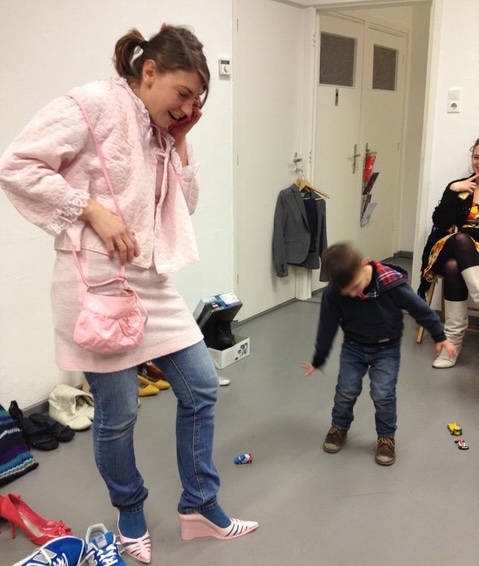
Weronika Zielińska-Klein works as an artist, researcher, and educator. She has been running Upominki (gifts in Polish), a project space in her family home in Rotterdam, formerly known as Guestroom, since 2012. In her work, she often explores various curatorial approaches in which gift-giving and hospitality are central. Zielińska currently serves as a Principal Lecturer and, until June 2025, was the leader of Autonomous Practices, an interdisciplinary BA program at the Willem de Kooning Academy, Rotterdam University of Applied Sciences. Zielińska is a PhD candidate at the University of Amsterdam, Faculty of Humanities, Amsterdam School for Heritage, Memory, and Material Culture (AHM). Her interdisciplinary PhD research in art history, theory, and artistic practice examines the intersection of pedagogy, feminism, and artistic research.
Media Partners:




"A desk is a dangerous place from which to watch the world" (John Le Carré)