Search
To search for an exact match, type the word or phrase you want in quotation marks.
A*DESK has been offering since 2002 contents about criticism and contemporary art. A*DESK has become consolidated thanks to all those who have believed in the project, all those who have followed us, debating, participating and collaborating. Many people have collaborated with A*DESK, and continue to do so. Their efforts, knowledge and belief in the project are what make it grow internationally. At A*DESK we have also generated work for over one hundred professionals in culture, from small collaborations with reviews and classes, to more prolonged and intense collaborations.
At A*DESK we believe in the need for free and universal access to culture and knowledge. We want to carry on being independent, remaining open to more ideas and opinions. If you believe in A*DESK, we need your backing to be able to continue. You can now participate in the project by supporting it. You can choose how much you want to contribute to the project.
You can decide how much you want to bring to the project.
In the 1% society and techno-feudalism, financial delusions erect castles of smoke to explain a bloodless reality. Computational time accelerates (un)productive processes and, with them, accelerates the social experience of time. In the midst of a climate emergency, the hegemonic economic mystique defends the curative properties of unrestrained growth. Amidst all this spectacle of augmented unreality, social imagination is paralyzed, if not captured, by the promises and renderings of billionaire escapism.
The capacity to project futures is unevenly distributed. Just as not everyone can construct “facts” (those undeniable things that underpin reality), neither does everyone have the same ability to produce visions of the future that are considered desirable or inevitable. Although a considerable portion of our species strives to project its agency toward a vibrant future, the planet’s agency stubbornly manifests itself. Even to those who still wish to escape, it reveals limits we refuse to understand.
Does the future have a material dimension? What role does it play in the present? The future is experienced in anticipation, which is an experience in the present. It emerges when we project ourselves into the future, transforms into anxiety in the face of negative uncertainty, and illuminates us when what is to come is awaited with joy. The future, therefore, has a lived condition that is expressed in expectations which, when shared, can coordinate social action to create the conditions for the realization of what is desired.
As Bifo Berardi says, we might be experiencing a “paradigmatic capture” in which current dynamics manage to reduce the multiplicity of emerging possibilities. Marina Garcés frames it as a “posthumous future.” After modernity designed futures for everyone and postmodernity celebrated an inexhaustible present for each individual, it now seems we do nothing more than survive, everyone against each other, in a stagnant time.
David Graeber and David Wengrow published The Dawn of Everything in 2021, a journey through the last 10,000 years of human history. They question fundamental assumptions, such as, that there is an original “good” or “bad” social form; that there was a time without social inequalities and political consciousness; that something happened to change that; that “agriculture,” “civilization,” and “complexity” always come at the cost of freedom; or that egalitarian relationships are only possible in small groups but cannot exist on a city or national level. With evidence, they refute these approaches and, by so doing, in addition to bringing us closer to more rigorous pasts, they broaden the range of possibilities, and reinforce the reality that we can always undo paths that do not serve us.
Faced with this “death of the future” and having witnessed the limitations of speculative design that is often sterile beyond stimulating the imagination, what can we do as design professionals? How can we put our practice at the service of radically better realities without reproducing the absolutist inertia of modernist design’s social engineering? How can these utopias be nurtured and co-evolve with the prefigurative imagination of social movements and other agents that care for common goods and all that sustains life?
In the 16th century, Thomas More wrote Utopia, a satirical work describing a society in which, among other things, land ownership was collective. This utopia, seemingly sunk today by real estate speculation, remains alive in many parts of the world. One example is the new wave of cooperative housing emerging in Catalonia, the Valencian Community, and the Balearic Islands. This model extends collective ownership of homes and land not just during construction but also throughout the entire cohabitation phase, thus removing housing from the speculative logic of the market and ensuring its affordability.
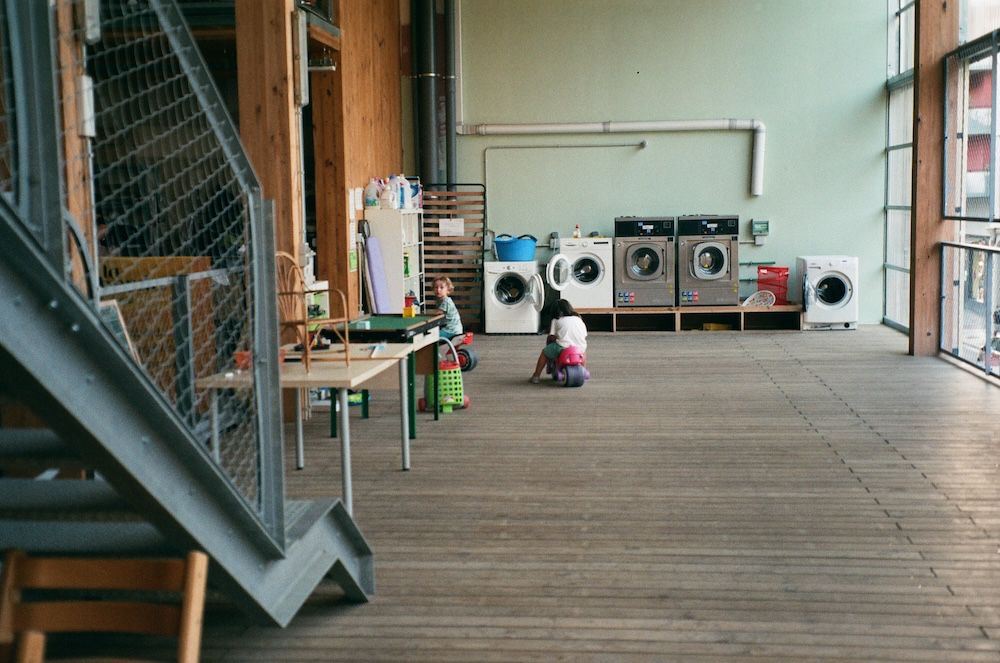
Another fundamental aspect is community life. While maintaining the private space of individual homes, space is reserved for shared services such as laundry, communal meals, guest rooms, babysitting, and support groups. The goal is to redistribute space and time, to share tasks, pool and conserve resources, and promote social interaction to facilitate daily domestic life.
Here we can observe a tangible need (the right to housing), an affective orientation (the desire to live more communally) and, at the same time, a desire for transformation that works to make this model popular, widespread, and affordable. It is precisely this orientation toward replicability and collaboration that moves away from the image of isolated islands in favor of an archipelago. This often invisible work of structuring transitions takes place in collective spaces, like the housing sector of the Solidarity Economy Network. It generates community tools, runs campaigns, and co-designs the playing field with the administration, considering regulations, incentives, and barriers. It is a small part of a dense network of people and community, cooperative, and public entities working to consolidate dignified access to the right to housing.
These initial experiences are, thus, utopian realities that are also transitional, tender and tentative, yet capable of establishing precedents. They don’t offer a designed future but rather a physical experience of a near present that you can literally visit. More than a non-place (utopia, not topos), they create new places, neutopias, that project possibilities of a practicable reality.
We can highlight two characteristics from this work of advancing transitions. On the one hand, they are about embracing everyday life as a key space from which to generate intimate shifts in the perception of what is achievable here and now. This can include an ordinary evening at a communal dinner, charging local products at the neighborhood cooperative supermarket to your membership account, or reading the cooperative’s renewable energy bills. These aren’t just gestures, for they materialize shared expectations and make the material experience of daily life proof of what is possible. We could say that they capture the best of the ethics of prefiguration, finding the path by walking, here and now.
On the other hand, they are about fostering social learning as the guiding thread of transitions (housing, energy, mobility, agriculture). Approaches to social “change” still predominate that seek silver bullets or that paralyze progress when the scale and magnitude of the challenge demand the involvement of all of society and several generations. In complex systems, it is increasingly obvious the need for an articulating perspective focused on learning from the system we conform. This requires social action and, in our practice as designers, above all, a need to seek the interrelation and alignment of local interventions to amplify collective impact. Challenging values and logic (housing as a right or as an investment asset) remains essential.
That said, it is important to admit that this ongoing process isn’t all joy. The anger at injustices and the sadness for lost life are mixed with the joy of living. Acting with dignity, here and now, means creating immediate presents that combine the attention to day-to-day realities of transitions with the social learning that sustains them.
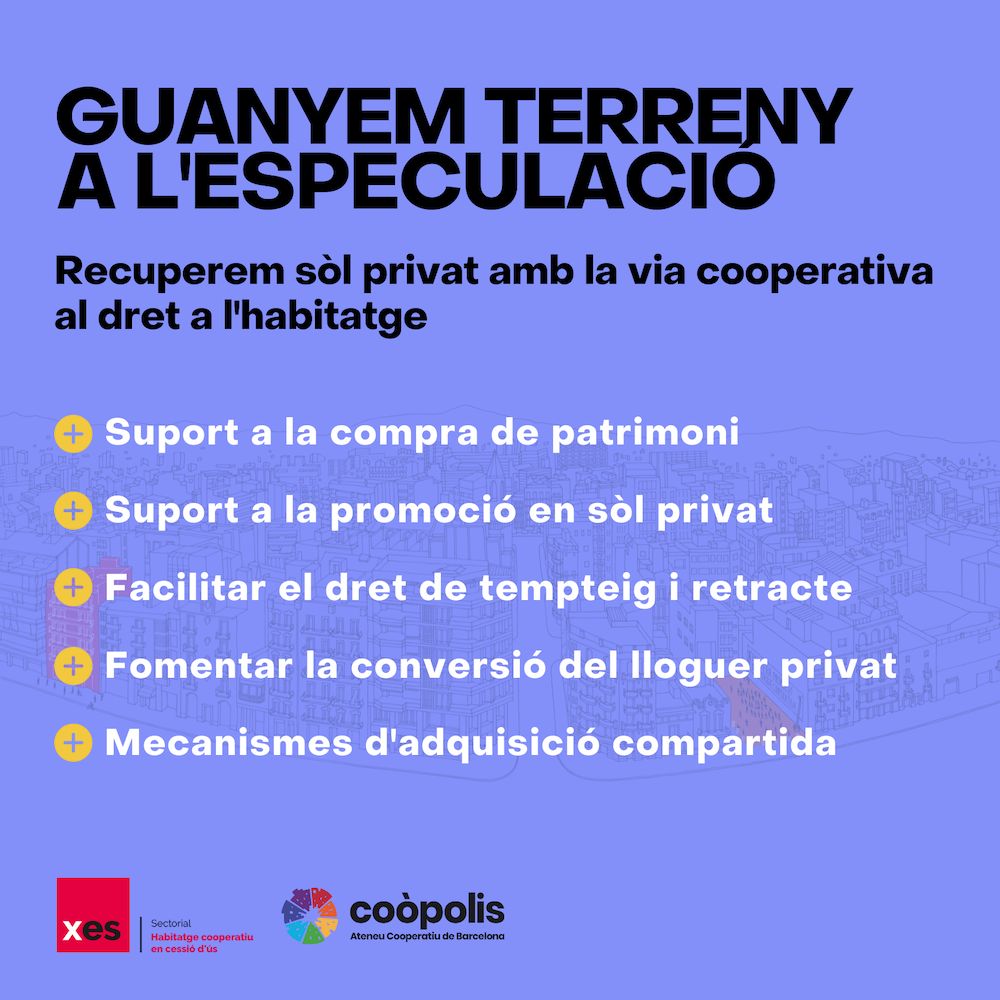
Image from Instagram for the campaign ‘#GuanyemTerreny a la especulación’ (XES)
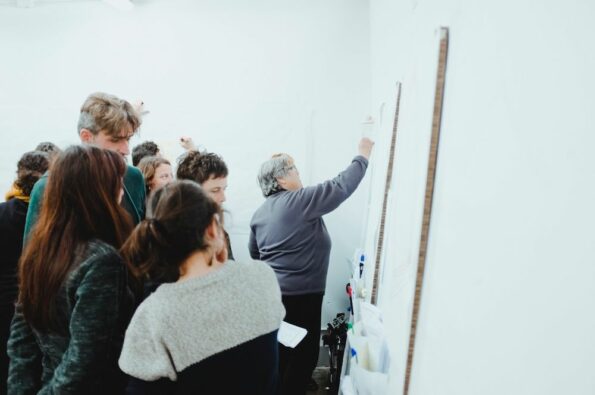
(Featured image: Co-design workshops for shared services at La Borda)
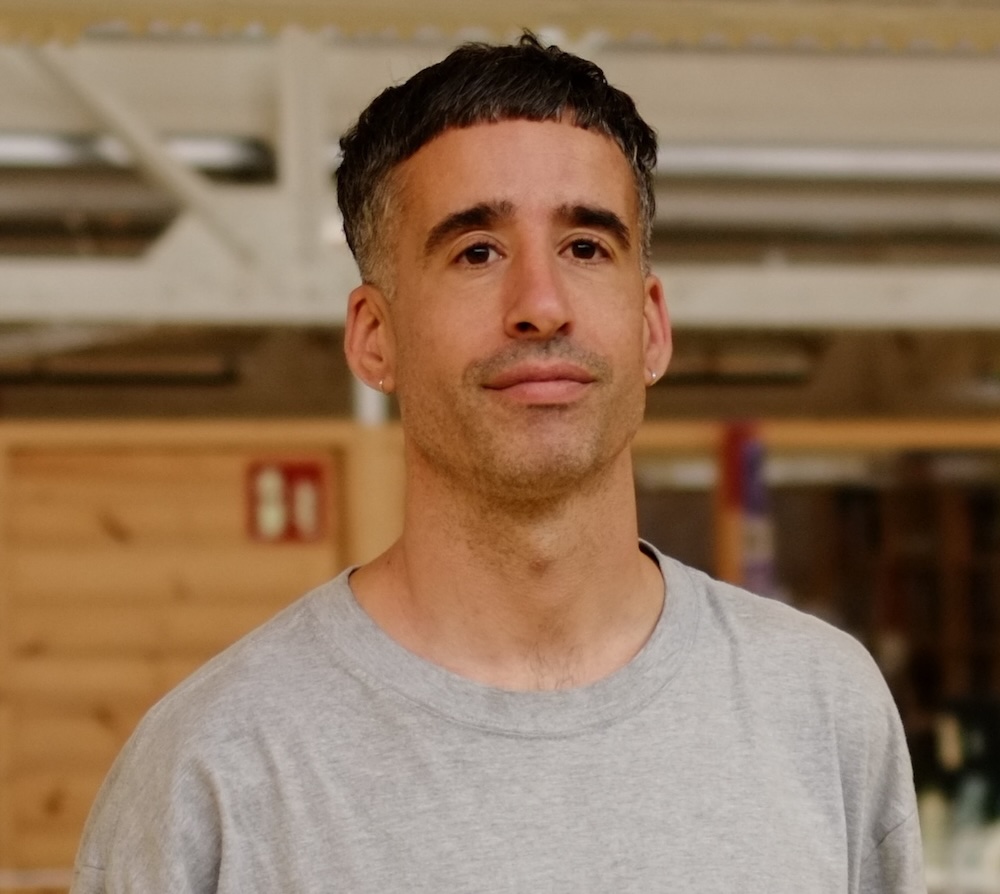
Adrià Garcia i Mateu is a designer and activist involved in projects enabling the everyday life of just sustainability transitions. He is a founding member of holon, a non-profit cooperative advancing the role of design in just sustainability transitions. Expert on transition design and more than a decade of experience in projects with organisations such as Interface Inc., UN Environment or La Borda Coop. Since 2010 he’s been involved in the education of more than 600 design students internationally and is a founding member of EDIVI, a catalan network of centers promoting design for social innovation and sustainability.
BA in Design by Eina, School of Design and Art of Barcelona, Catalonia (2009) Adrià took part of the EU LeNS Program in Polytechnic of Milan, Italy (2009), and holds a MSc. in Strategic Leadership towards Sustainability by the Blekinge Institute of Technology, Sweden (2012). In 2016 took the first course on Transition Design by the Schumacher College, UK. Doctoral student by IN3 program of the Universitat Oberta de Catalunya on policy design and transitions in the cooperative housing sector.
@adriagm @weareholon in social networks (linkedin, instagram, twitter)
Media Partners:




"A desk is a dangerous place from which to watch the world" (John Le Carré)