Search
To search for an exact match, type the word or phrase you want in quotation marks.
A*DESK has been offering since 2002 contents about criticism and contemporary art. A*DESK has become consolidated thanks to all those who have believed in the project, all those who have followed us, debating, participating and collaborating. Many people have collaborated with A*DESK, and continue to do so. Their efforts, knowledge and belief in the project are what make it grow internationally. At A*DESK we have also generated work for over one hundred professionals in culture, from small collaborations with reviews and classes, to more prolonged and intense collaborations.
At A*DESK we believe in the need for free and universal access to culture and knowledge. We want to carry on being independent, remaining open to more ideas and opinions. If you believe in A*DESK, we need your backing to be able to continue. You can now participate in the project by supporting it. You can choose how much you want to contribute to the project.
You can decide how much you want to bring to the project.

It is quotidian intimacy that forces us to realize the other as someone with whom we interact and have an impact upon; our acknowledgment of this connection represents the touch and its fruition. We do not create intimacy; it is there awaiting our recognition…. [W]e are bound intimately to others whether we realize or acknowledge such connection. The touch is the sign without a language to make it legible to “others.” (Holland, 2012, p. 104)
… leaning into nonseparable life. It’s about being able to respond to modes of life that do not necessarily conform to the ocularcentrism and linearity of whiteness; being able to feel the presence of alternative temporalities in the flesh, to become vulnerable to the complexity of life and breath. (Le-Phat Ho & Rose-Antoinette, 2017, para. 12)
Even more immediately than other perceptual systems, it seems, the sense of touch makes nonsense out of any dualistic understanding of agency and passivity; to touch is always already to reach out, to fondle, to heft, to tap, or to unfold, and always also to understand other people or natural forces as having effectually done so before oneself, if only in the making of the textured object. (Sedgwick, 2003, p.14)
In Touching Feeling, Eve Sedgwick (2023) articulates that the book holds an intuition that a particular intimacy subsists between textures and emotions; yet the same double meaning of the tactile plus the emotional is already present in the single word touching, just as it is internal to the word feeling. Sedgwick draws us into the implication that even to speak about affect “virtually amounts to cutaneous contact” (Sedgwick, 2003, p. 17). Her words carry us over a textured, layered field // landscape // zone of touch that implicates both the physical and the intangible elements of living and learning in proximity. Touch and intimacy are saturated with sensorial, political, and emotional information. Experiences touch us // our presence touches others.
If the multiplicity of touch, in corporeal tactility and immaterial potential, brings us to both the skin // the flesh // the meat of a subject, and simultaneously beyond it …
… what does this offer us when thinking about the palpability of race and its material and symbolic imprints?
Can we understand our knowledge of race and its touching as, what Sedgwick refers, a textured object?
What if we thought of whiteness itself as a textured object; something felt, accumulated, yet malleable and extended {far} beyond the boundary of the skin; one that shifts and shapes how we learn in proximity with all // other forms of life?
In 2015, as an effort to examine how race operates intimately in my life, I conducted The Touch Project. Over the course of two weeks, I textually and visually recorded every instance of touch I encountered. Staying present to how I used my body in contact with others, I documented my experiences: from being squished against strangers on the bus, to hands brushing mine in noticeable ways, to full-body hugs; from moments of repulsion—touch unavoidable // unwanted, to desires where touch was not permitted. I counted touching 31 individuals, including non-human beings I also came into contact with. In addition to these 31, there were five instances when I wanted to touch someone but could not, due to restrictions or circumstances. Of these 36 instances, I was able to photograph 13.
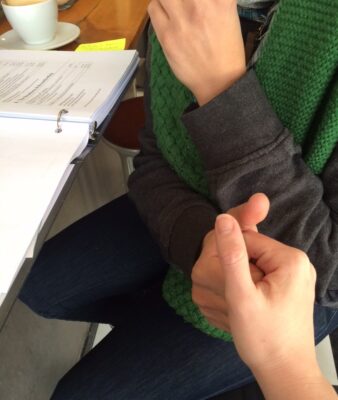
Shara
Attending to how my own body // a white female body reacted to and impacted the bodies and beings I touched, revealed just how difficult racial matter can be to grasp.
Knowledge-making is a non-liner process, one that unfolds through understanding ourselves in connection to what we brush up against // the locations we move in and out of. And within this, developing an intimate understanding of and with the body does not stop at the edge of the skin; “our body is like a shore: a mutable surface of exchange with a shifting boundary of interior and exterior, here and not yet arrived” (Maule-O’Brien, 2021, p. 128).
The images I took brought into relief pieces of my own constructed and embodied knowledge. They conveyed how touch and race operate as multisensorial experiences in the body, layered with memories and belief systems. Touch encompasses both violence and empathy at once as it “carries a message about the immediate present, the possible future, and the problematic past … [as it] crosses boundaries, in fact and imagination” (Holland, 2012, p. 100). Race and racism are historically produced through labor and economy, and continue to shape our lives through enduring structures. Within touch, race can be fluid and nuanced, yet the implications are deeply seated // the imprint never absent.

Erika
Though more than 10 years have passed since doing this autotheory research, I regularly (re)turn to the body of work and the embodied learning rendered in the process. The photos offer moments of my body in relation // a site to process emotive responses, shifting memories of conversations, and imagings of otherwise. They make visible the whiteness I hold, and with it its bloated histories and presence of control and terror. The images function as markers of intangible affect and trace invisible forces that impede, and restrict …
… simultaneously, illustrating how structural rules of racial ordering can falter in intimate encounters, especially when actively challenged. The narrow framing of hands or segments of the body confront racial touching // obscure racial lines and deny access to the ocular identity categories we rely on. So while race and racism shape our lives materially, they also depend on our trust in difference and disconnect (Holland, 2012). Our relational lives can shift and take alternate forms. // But is it not, at least in part, my whiteness that permits the act of an imagined erasure of race in my reading of the photos?
For those of us who teach within institutions, the classroom is a space we enter with students as co-learners; our lives come into contact. The embodied body is not singular; embodied pedagogies are communal, entangled, and layered meetings that move us toward (an)other(s). As an educator, I’m committed to critical and embodied pedagogies of transformation that transgress // intervene // puncture normative and restrictive forms of knowledge creation. My desire is to generate catalysis // to open space for the non-verbal dimensions of learning // to teach of the inseparability of life.
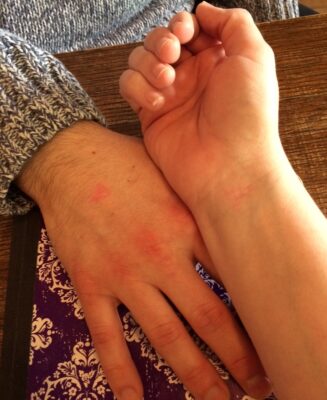
Mark
The Touch Project functions as an example of textured knowledge in proximity, foregrounding how our bodies are entangled with racial meaning and consequences. It demonstrates both intimacy making as a pedagogical tool and how the site of the intimate is one of embodied knowledge formation. In the project, the notion of intimacy extends beyond traditional relational definitions between people to include intimacy with ideas, objects, and non-human beings—encounters that are complex, sometimes conflictual, always rubbing up against our socially produced understanding of connection, belonging, and the self.
The use of intimacy in a critical // transformative pedagogical practice invites a touching and feeling of the textured boundaries we navigate living in this shared world. Sara Ahmed (2004) states this requires considering “the intimacy between” the embodied privileges we hold and the work we do. To confront // turn towards this “intimacy between” our lived realities and our pedagogy as a site of encounter and then to teach from this space is a durational // never finished process // one that is integral to not only race work, but for all social shifts.

Cuzmo
This is work of exposure // of touch // of feeling. It requires us to inhabit critique at length and to remain in what Ahmed (2004) calls an unfinished present. It is to develop an intimacy with a collapsing of time, where the sharp edges of colonial pasts pierce our contemporary lives, but where we may mend them to produce a different future.
Ahmed (2004) sees this facing of responsibility and accountability as a part of reparative work // moving our bodies in a “double turn.” She illustrates this as first turning towards the critique of whiteness and its implications, but to then turn again toward the other to face the intimate responsibility. Within this action she reads a potential for clearing some ground for alternative relational lives to emerge. I understand the double turn as a moment to linger in “the intimacy between” // to exercise deliberate vulnerability // to evoke an intimate learning through the knowledge we gain during exposure. Like the Touch Project, it is an embodied gesture to return to continually, repeating the double turn towards our self and then the other, and back again, and again. Each time something new unearthed // sensed // touched // felt // embodied.
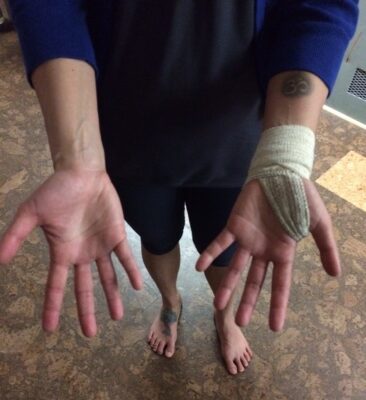
Yoga
References
Ahmed, S. (2004). Declarations of Whiteness: The Non-Performativity of Anti-Racism. Borderlands e-Journal, 3(2).
Holland, S. P. (2012). The erotic life of racism. Duke University Press.
Le-Phat Ho, S., & Rose-Antoinette, R. (2017, Fall). Intimating our ghosts [Editorial]. MICE Magazine (3): Ghost Intimacies. https://micemagazine.ca/issue-three/issue-03-editorial-ghost-intimacies
Maule-O’Brien, S. N. (2021). Intimate pedagogy: Visual explorations of race and the erotic (Doctoral dissertation). York University. http://hdl.handle.net/10315/38657
Sedgwick, E. K. (2003). Touching feeling: Affect, pedagogy, performativity. Duke University Press.
[All the images are part of “The Touch Project”, by Skye Maule-O’Brien]
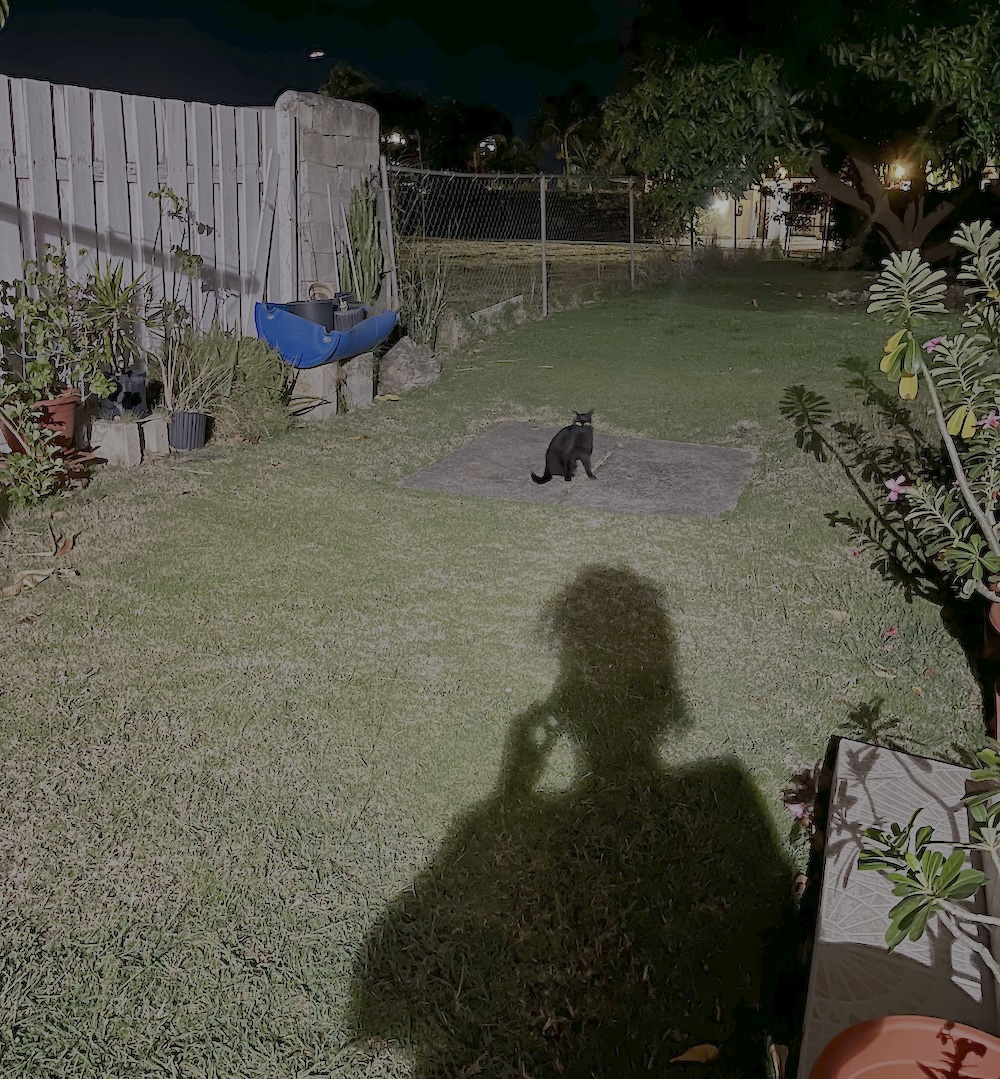
Skye Maule-O’Brien is an educator and artistic researcher living and working between Montreal, Barbados, and Rotterdam. Combining theory, narrative, and sensory methods, her collaborative practice engages with intimate pedagogy, a theory and method she developed that frames intimacy and vulnerability as central to transformative pedagogical knowledge production. She completed her PhD in Education at York University (Toronto), which included an academic exchange with the University of the West Indies, Institute for Gender and Development Studies (Barbados). She holds a BFA in Art History, with a minor in Adult Education, and a Master’s degree in Educational Studies from Concordia University (Montreal). Currently, she is working on a large-scale collective project and publication, Breath & Breeze: Tongueless Whispers of the Wind, which examines the Dutch colonial footprint in the Caribbean through the lens of wind. She works as a principal lecturer in the Theory Programme at the Willem de Kooning Academy, Rotterdam University of Applied Sciences.
Media Partners:








"A desk is a dangerous place from which to watch the world" (John Le Carré)