Search
To search for an exact match, type the word or phrase you want in quotation marks.
A*DESK has been offering since 2002 contents about criticism and contemporary art. A*DESK has become consolidated thanks to all those who have believed in the project, all those who have followed us, debating, participating and collaborating. Many people have collaborated with A*DESK, and continue to do so. Their efforts, knowledge and belief in the project are what make it grow internationally. At A*DESK we have also generated work for over one hundred professionals in culture, from small collaborations with reviews and classes, to more prolonged and intense collaborations.
At A*DESK we believe in the need for free and universal access to culture and knowledge. We want to carry on being independent, remaining open to more ideas and opinions. If you believe in A*DESK, we need your backing to be able to continue. You can now participate in the project by supporting it. You can choose how much you want to contribute to the project.
You can decide how much you want to bring to the project.
Daniele Porretta: According to Oscar Wilde, a world map without a utopia is not worth consulting, for they are the destiny that humanity always sets for itself. Once a utopia is achieved, it sets sail again in search of another. However, for Berdyaev, utopias have become dangerously achievable, and we should now be asking ourselves how to prevent them. So, what is the purpose of a utopia? The answer is not easy. Perhaps both Oscar Wilde and Nicola Berdyaev are right.
Laura Benítez Valero: Perhaps the very question of the functionality of utopia opens up a window of possibility for re-examining how we conceive utopias. Wouldn’t it be desirable for utopias to allow us to think beyond the instrumental dimension? What if the specificity of utopia lies precisely in its impossibility to be analyzed by measuring its purpose?
D: The success of a utopia lies precisely in its instrumental dimension, in having produced instructional manuals for transforming society through a narrative format, such as a novel. From T. More to A. Bogdanov, the basic idea is to present a perfectly functioning society that serves as a positive mirror for an unbearable reality. If a utopia can’t bring about revolution, what’s it for?
L: I don’t want to deny its instrumental dimension but rather to take the power of utopia and add a layer of complexity, not so much focused on the “why” but on the “how.” Attempts to create utopias that focus solely on the “why” have led, at least in part, to their impossibility. I’m sure you know the case of Viktor David Grünbaum, known as the architect of modern shopping malls, who had the perverse nickname the Architect of the American Dream.
D: That has to do with the “spatial game” that David Harvey talks about in Spaces of Hope. Utopia is associated with the design of a space because it is considered to have a transformative and moral function. Shopping malls are seen as “degenerate utopias,” as are theme parks such as Disneyland, conflict-free places that simulate real spaces but lack the characteristics of public spaces, such as, first and foremost, their being open to everyone. For this reason, they possess a certain unsettling and sinister quality.
L: Could this represent a failure of the “why”? In other words, if the “how” of this “why” was the North American model of economic expansion, wasn’t Grünbaum’s particular utopia a death foretold?
D: If we’re talking about failure, any attempt to implement a utopian project within capitalist society is destined to be co-opted and exploited. Isn’t that what happened with the Superblocks and green corridors of Barcelona? They were based on a legitimate need to alleviate traffic congestion, improve the city’s air quality, and to create more quality public spaces and new places for social interaction. They ended up becoming one of the factors driving the city’s gentrification.
L: Gentrification is not a side effect or an accidental consequence of certain urban interventions, but rather a structural logic embedded in the neoliberal model of the city, sustained by political decisions, legal frameworks, and a systemic and structural violence that commodifies both land and life. Asking whether the Superblocks can become the green promise of a city like Barcelona is, in itself, a problematic undertaking. Barcelona is a profoundly hostile urban environment, with alarming levels of particulate matter pollution, some of the highest noise pollution in Europe, and light pollution that affects both human health and non-human ecosystems. To pretend that a localized intervention in public space can reverse or even significantly counteract the impact of decades of atrocious urban planning and rampant neoliberalism is to operate from a naive mindset, typical of the idiocratic simplification models of worthless self-help.
D: So, what use is utopia to us in an urban context?
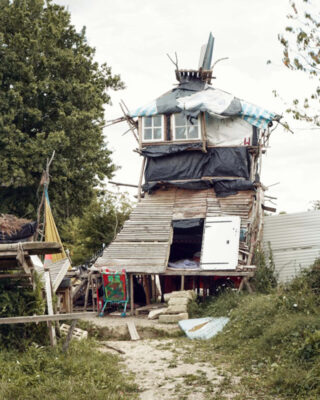
L: The “whys” of urban green utopia are exhausted almost before they are formulated. The promise of a more livable city is quickly neutralized when it is not accompanied by structural housing policies, control of the real estate market, redistribution of wealth, and a real (and radical) questioning of the tourism and economic model. And yet, the “how” remains a space of both friction and possibility. It is there that cracks open up that allow us to imagine other ways of inhabiting and (re)organizing common spaces, however fragile and threatened they are by the logic of capitalist capture. Without dismantling the extractivist model of infinite growth, green urbanism can easily become greenwashing, an aestheticization of sustainability that fails to question the root causes of ecological collapse. That is why I insist on shifting the focus. The “model” is not Superblocks but rather radically different experiences such as the ZADs (Zones à Défendre) or the so-called “forests in resistance.” These struggles, like those in Notre-Dame-des-Landes in France, Hambach in Germany, or Białowieża in Poland, do not merely mitigate the effects of ecological disaster but directly challenge the model of exploitation and extractivism. They are territories defended against airports, mining, or forestry infrastructure, embodying a material confrontation with fossil fuel and logistical capitalism. In these contexts, the defense of territory is inextricably linked to communal ways of life, self-management, the questioning of private property, and human exceptionalism.
D: Speaking of urban utopias today inevitably conjures up images of privileged enclaves: gated communities, elite residential neighborhoods, The Line. Unreal, conflict-free places like Seaside, the city where Truman Burbank lives. Conflicts are simply displaced elsewhere. If anything characterizes our era, it is the increase in inequality, and we will increasingly see the distinction between heaven and hell. The problems we face are systemic and the measures we need are structural. But let’s return to your initial question, what is the purpose of a utopia? Something I’ve always disliked about utopias is their authoritarian tendency, their lack of dynamism, and, at times, their oversimplification of reality. I believe we must reclaim their radical nature since we are facing something that requires more radical solutions. This is where we truly need to reclaim utopia, the utopia of socialist experiments in collective housing, alternative ways of understanding democracy, the search for alternatives to consumer-dependent leisure, and also the need to rethink our relationship with the planet. We must also make a leap in scale, avoiding the creation of micro-utopias for a privileged few.
L: I agree, reclaiming the “how” of utopia shouldn’t mean building islands of order amidst chaos, nor sterile refuges where conflict is hidden. Nor should it mean reducing it to a human, anthropocentric, or exceptionalist scale. The utopias of the early 20th century, including anarcho-naturalist proposals, fraught with tensions and contradictions, at least understood that transformation had to unfold across interdependent territories, collective bodies, and a different relationship on a planetary scale. Utopia only makes sense if it recovers its radical nature, not as a closed model or a promise of harmony but as a gesture of political imagination capable of creating cracks in the given order.
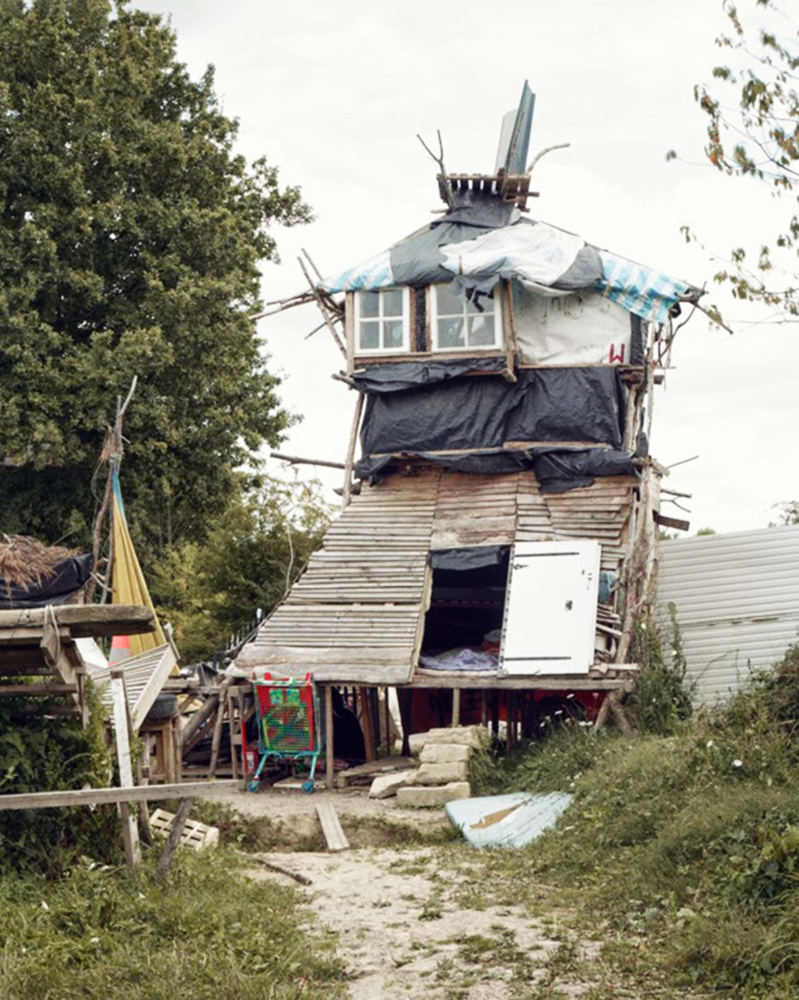
ZAD security tower of Notre Dame des Landes. Source Wikicommons.
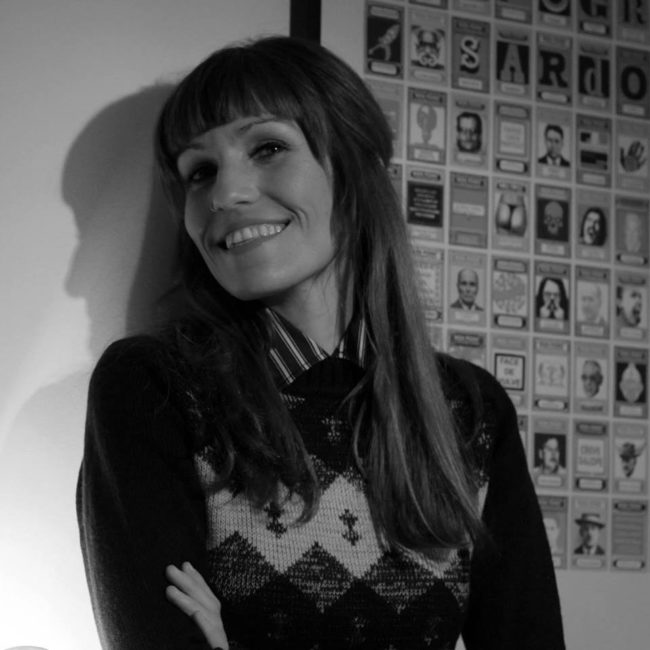
Laura Benítez Valero is a researcher and university lecturer. Her research connects philosophy, artistic practices, and technoscience. She is a professor in the Department of Philosophy at the Autonomous University of Barcelona. She has also taught at Elisava and co-directed the Master’s program in Design for Emerging Futures at the IAAC (Instituto de Arte Contemporáneo de Barcelona). She coordinated the Theory area in the Arts and Design degree program at the Escola Massana, where she no longer teaches for political reasons, but where she taught Critical and Cultural Studies. She has been a visiting researcher at the Ars Electronica Center and the Center for Studies and Documentation at the MACBA (Museum of Contemporary Art of Barcelona). She has also collaborated with international institutions such as the University of Art Linz (in the Interface Cultures Master’s program), the Sónar Festival (Barcelona/Hong Kong), the Royal Academy of Arts (London), and the University of Puerto Rico. Between 2019 and 2021, she directed Biofriction, a European project (Creative Europe) on bioart and biohacking practices, led by Hangar in collaboration with Bioart Society, Kersnikova and Cultivamos Cultura.
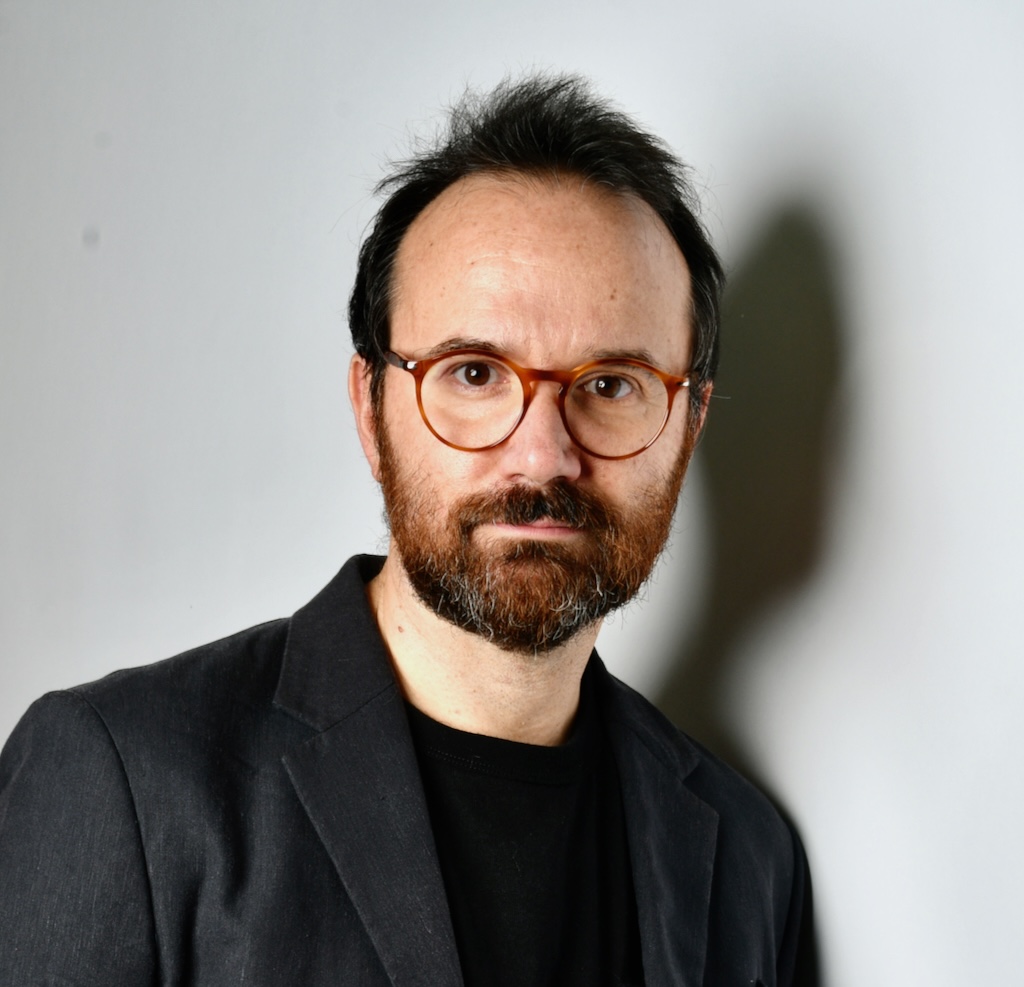
Daniele Porretta is an architect, holds a PhD in Architectural Theory and History, and teaches in the Design Degree program at Elisava, Barcelona. His research focuses on the relationship between the city and film and literature, particularly the construction of the image of the city of the future in popular culture, from the technological utopias of the late 19th century to the dystopias of social control in the 20th century. He is a member of Histopia, CSIC (Institute of History), a group that promotes the Transatlantic Network for the Study of Utopias, which carried out the research project ““Utopías trasatlánticas: imaginarios alternativos entre España y América, siglos XIX-XX (UtopiAtlantica)” [Transatlantic Utopias: Alternative Imaginaries between Spain and America, 19th-20th Centuries (UtopiAtlantica)] (2022-2025). In 2022, he published La otra Tierra. Marte como utopía [The Other Earth: Mars as Utopia] with Siruela, a book dedicated to the history of utopia on the planet Mars.
Media Partners:







"A desk is a dangerous place from which to watch the world" (John Le Carré)