Search
To search for an exact match, type the word or phrase you want in quotation marks.
A*DESK has been offering since 2002 contents about criticism and contemporary art. A*DESK has become consolidated thanks to all those who have believed in the project, all those who have followed us, debating, participating and collaborating. Many people have collaborated with A*DESK, and continue to do so. Their efforts, knowledge and belief in the project are what make it grow internationally. At A*DESK we have also generated work for over one hundred professionals in culture, from small collaborations with reviews and classes, to more prolonged and intense collaborations.
At A*DESK we believe in the need for free and universal access to culture and knowledge. We want to carry on being independent, remaining open to more ideas and opinions. If you believe in A*DESK, we need your backing to be able to continue. You can now participate in the project by supporting it. You can choose how much you want to contribute to the project.
You can decide how much you want to bring to the project.
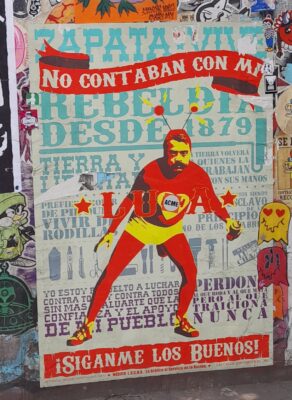
Some time ago, the book Neutopías (New Utopias and Designing Futures) was published. The book explored ways to envision future scenarios that avoid the hegemonic dystopia that seems to be gripping society. The need to escape from these apocalyptic scenarios is urgent. If we don’t believe that the future has meaning and that we can act upon it, by means of our own agency, we abandon the present to a kind of inertia of the past.
Being that some time has passed, this A*Desk issue seemed like a good opportunity to explore some of the threads that were sketched out in the book by different contributors who enriched Neutopías with diverse voices focused on various themes, such as technology, posthumanism, community action, and so on. Over the past few weeks, we have been able to read how these contributors update, refine, and evolve ideas that were published in the book back then.
The world has mutated very rapidly in recent years, even in recent months. The current scenario is even more dystopian and darker. Far from negating the book’s hypothesis (that is, the need to imagine alternative futures to those of the mass media), this shows the even more urgent need to collectively create spaces where we can draw up, test, speculate, and create prototypes and scenarios where life becomes possible, where beyond resilience we are capable of generating possibilities by means of architecture, design, technology and, above all, within our commonality. After exploring multiple options, it becomes clear that our slim chances of success to persist as a species hinge on concepts such as interdependence and multispecies contamination, as advocated by Lynn Margulis and Donna Haraway, mutual aid as articulated by Piotr Kropotkin, and the anticipatory design of the Spaceship Earth Operating Manual described by Buckminster Fuller. For in the end, as I heard at the Fiat Ars Pereat Mundus conference, organized in El Médol by Caldo de Cultivo, pessimism is a class privilege we cannot afford.
[Featured image: Poster on a street in Mexico City (March 2026). Photo: Oscar Guayabero]

Oscar Guayabero (Oscar Martinez Puerta), was born in the Raval of Barcelona in 1968. He studies Art and Industrial Design at the Escola Massana in this city. His work develops between theory, criticism and analysis of design and architecture. He currently combines teaching in the area of sustainability and history of design and the image of various schools in Barcelona, with external advice on communication for Barcelona City Council and curatorial-exhibition projects.
Media Partners:




"A desk is a dangerous place from which to watch the world" (John Le Carré)