Search
To search for an exact match, type the word or phrase you want in quotation marks.
A*DESK has been offering since 2002 contents about criticism and contemporary art. A*DESK has become consolidated thanks to all those who have believed in the project, all those who have followed us, debating, participating and collaborating. Many people have collaborated with A*DESK, and continue to do so. Their efforts, knowledge and belief in the project are what make it grow internationally. At A*DESK we have also generated work for over one hundred professionals in culture, from small collaborations with reviews and classes, to more prolonged and intense collaborations.
At A*DESK we believe in the need for free and universal access to culture and knowledge. We want to carry on being independent, remaining open to more ideas and opinions. If you believe in A*DESK, we need your backing to be able to continue. You can now participate in the project by supporting it. You can choose how much you want to contribute to the project.
You can decide how much you want to bring to the project.
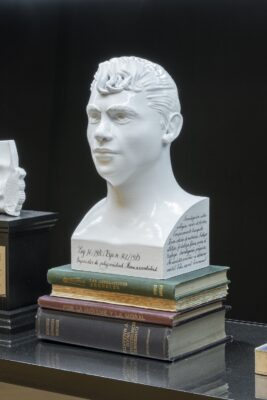
Michel Serres understood quasi-objects as unstable entities that are neither just things nor just relationships but rather elements that through their circulation reorganize connections and enable the emergence of the new. The new does not replace one order with another but rather weakens and exposes an order’s artificial nature. In Daniel Gasol’s exhibition Higiene pública: la sociedad como cuerpo enfermo (Public Hygiene: Society as a Sick Body), curated by Patricia Sorroche at ADN Platform, objects are not offered as evidence or as historical illustration but instead as quasi-objects that circulate between archive, body, and memory, piercing the fascist and patriarchal symbolic order inherited from the dictatorship and still effective today. By reappearing displaced, these objects do not restore but rather destabilize the narrative that sought to solidify itself with them, exposing the fragility and violence of an order that needed to pass itself off as natural in order to legitimize itself. The new emerges as a material interruption of historical time, a fissure where the past insists on being thought of in a different way.
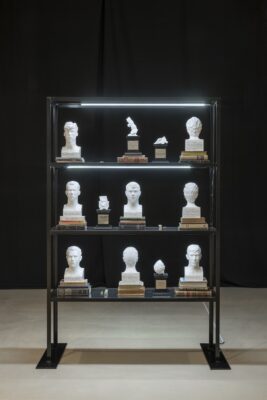
Daniel Gasol. Galería de anomalías patológicas, 2024 – 2025. Shelves with 3D lacquered ceramic busts and books
200 x 142 x 60 cm. Courtesy of the artist and ADN Galeria Photo: Roberto Ruíz.
All order is an illusion, a necessary fiction, a provisional gesture of containment in the face of the harshness of what is real.[1]Since Lacan, reality is not the real, reality is instead the codified order that makes the world governable while the real is that which this order fails to absorb. It is matter, body, emotions, the … Continue reading. The problem does not lie in the drive to order (ordering is, in a way, a form of orientating oneself) but in the fact that this drive forgets its own contingency. When order presents itself as natural and solidifies it becomes ideology, and thus drive becomes destiny, the tool becomes law, while the possibility of life becomes a death wish. At this point order no longer organizes or guides but rather excludes and governs, exercising its violence by erasing alternatives and passing off the historical as necessary and the constructed as inevitable.
Daniel Gasol’s work (displayed in both ADN Gallery and ADN Platform and on view from November 27, 2025, to March 18, 2026) forces us to confront the way in which fascist ideology, Christian morality, and heteronormative scientific thought articulated the same power apparatus against all life forms that refused to submit. This was an apparatus that employed text, archives, and bureaucracy (in addition to persecution, violence, and execution) as machines of social cleansing. Violence ceased to be the exception and became the procedure, the persecution of dissident bodies became public policy, and exclusion became a legitimate form of social order. Eliminating, correcting, and neutralizing difference became a threat to health and normality.
Thus, order reveals itself as a permanent emergency. The State deploys a biopolitics of control in which existence is only legitimate if it can be fully legible, manageable, and governable. Hygiene becomes the organizing principle of social space, language, bodies, and images.
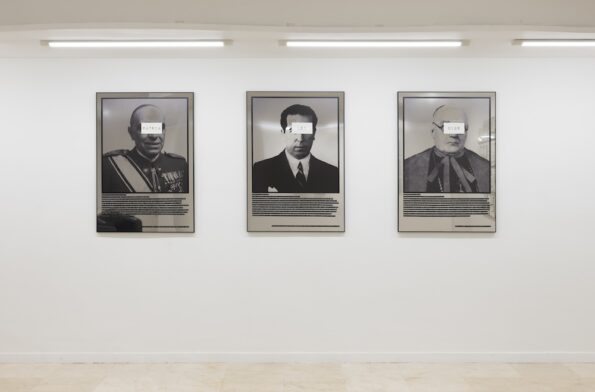
Daniel Gasol. Discursos correctivos, 2024 – 2025 3 images on surgical steel plates intervened with text in dymo.. 100 x 70 x 2 cm each. Courtesy of the artist and ADN Galeria Photo: Roberto Ruíz.
It is within this context that Daniel Gasol’s creative work is situated. His practice does not seek to escape the norm of the archive but rather to return to it and to enter its material and political density in order to ally itself with that which the archive itself fails to close. Archives cease to be a stable guarantee of historical narratives and become a field of disputed memories, overlapping temporalities, and unresolved conflicts. The exhibition does not merely denounce the regime of the directed image but also works from within its remnants, displacing its function. [2]Jussi Parikka sees the directed image as a type of image that is not made to be seen, interpreted, and contemplated, but rather to operate (classify, measure, predict, manage). PARRIKA, Jussi. … Continue reading
Directed images are produced by technical, scientific, and administrative systems, police records, medical photographs, diagrams, statistics, and legal files, with the goal of acting upon reality, that is, images made to govern. The archive that permeates Gasol’s work is composed of documents conceived to exert normative violence on bodies and suspend their operability. By displacing them into an artistic space, they are deprived of their function of classifying, correcting, and diagnosing, exposing them to another temporality and another economy of attention. They no longer serve the technical regime that produced them, but neither are they “free” images, remaining in an unstable state where their disciplinary power diffuses without disappearing. It is not a matter of opposing “good” and “bad” images, but of working with the remnants of the modern visual apparatus to show what it is made of and how every directed image potentially contains the possibility of deviation.
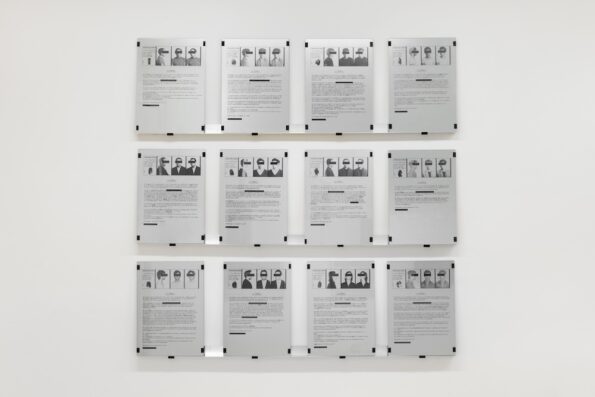
Daniel Gasol. Expedientes por homosexualismo de Peligrosidad y Rehabilitación Social, 2024 – 2025. Print on paper. Several documents with variable measures.. Courtesy of the artist and ADN Galeria Photo: Roberto Ruíz.
This is where imagination comes in as a counter-archive. Against the directed image, artistic objects open up an imagination that isn’t evasive but rather capable of recomposition, that is, it does not invent new images but reorganizes and decouples existing ones from their original function. Thus, the archive ceases to be a closed system of visual control and becomes a field of tension between directed image and imagination. This is not a plea to “liberate” these images but instead a creative operation that makes them fail and, in so doing, brings back their opacity, sluggishness, and ambiguity.
Artistic practice becomes an exercise in resistance against the logic of the One, against an order that seeks to reduce multiplicity to a recognizable, legible, and legal format. To ally oneself with the archive means to traverse it and force it to say more than it intended to establish. Art thus operates as a practice of material thought capable of opening fissures in the dominant regime of visibility and of sustaining difference as the very condition of life.
The exhibition Public Hygiene: Society as a Sick Body is structured as a carefully curated space of reflection that raises urgent questions: How does artistic practice allow us to think differently? How can difference be conceived in a world that accumulates reproductions and reiterations rather than creations? Under what conditions does an image cease to reinforce the visual order that generates it and begin to disrupt it? How can we ally ourselves with art to intervene in the material conditions of social communication?
[Featured Image: Galería de anomalías patológicas, 2024 – 2025. (detail) Shelves with 3D lacquered ceramic busts and books
200 x 142 x 60 cm. Courtesy of the artist and ADN Galeria Photo: Roberto Ruíz.]
| ↑1 | Since Lacan, reality is not the real, reality is instead the codified order that makes the world governable while the real is that which this order fails to absorb. It is matter, body, emotions, the unconscious remainder that precedes and constitutes us. The real is not situated outside the system but rather as its internal limit. For psychoanalysis, the real insists, disrupts, and exposes the fragility of every code. |
|---|---|
| ↑2 | Jussi Parikka sees the directed image as a type of image that is not made to be seen, interpreted, and contemplated, but rather to operate (classify, measure, predict, manage). PARRIKA, Jussi. (2025). Operational Images: From the Visual to the Invisual. |
Media Partners:




"A desk is a dangerous place from which to watch the world" (John Le Carré)