Search
To search for an exact match, type the word or phrase you want in quotation marks.
A*DESK has been offering since 2002 contents about criticism and contemporary art. A*DESK has become consolidated thanks to all those who have believed in the project, all those who have followed us, debating, participating and collaborating. Many people have collaborated with A*DESK, and continue to do so. Their efforts, knowledge and belief in the project are what make it grow internationally. At A*DESK we have also generated work for over one hundred professionals in culture, from small collaborations with reviews and classes, to more prolonged and intense collaborations.
At A*DESK we believe in the need for free and universal access to culture and knowledge. We want to carry on being independent, remaining open to more ideas and opinions. If you believe in A*DESK, we need your backing to be able to continue. You can now participate in the project by supporting it. You can choose how much you want to contribute to the project.
You can decide how much you want to bring to the project.
We live in a time when understanding has taken on a reassuring function. Everything seems to demand immediate translation, framing, mediation. Wherever something resists, a mechanism is activated that renders it legible. Opacity ceases to be a dimension of experience and becomes a problem to be solved.
This gesture responds not only to a pedagogical intention but also to an economy of meaning, that is, closing off is calming, ordering is peaceful. The answer functions as a guarantee of control. However, in this movement, something is deactivated. What doesn’t fit in doesn’t disappear, it just loses status. Contemporary culture doesn’t eliminate spaces without answers, it just makes them transitory, tolerable only as they move toward a form of resolution.
From a psychoanalytic perspective, Jacques Lacan came up with a precise formulation of this tension: when meaning closes off without any remainder, something of the subject is excluded. This is not an accident but rather a structural effect. There are dimensions of experience that cannot be fully integrated without losing their depth, and forcing their translation doesn’t clarify them, it only neutralizes them.
This diagnosis resonates today in contemporary readings that, from different perspectives, describe a culture marked by the expulsion of negativity. Byung-Chul Han, for example, has pointed out how transparency, fluidity, and positivity become imperatives that reduce friction. What doesn’t circulate, what isn’t shown, what doesn’t produce a clear return, becomes suspect. Silence is unsettling. Interruption is perceived as inefficiency.
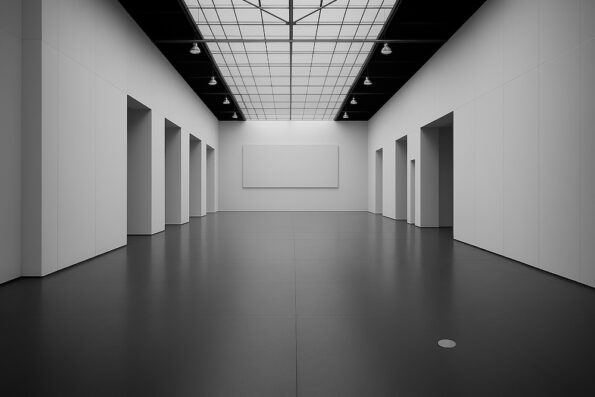
Absence 01. Digitally manipulated black and white photography. Victoria Pérez Quesada, 2025
In this context, certain artistic practices (though not all) continue to inhabit these residual spaces, not because they renounce meaning but because they don’t rush to close it off. They don’t operate by offering clear messages or stable positions but instead sustain a tension in which something that happens isn’t fully resolved. The experience doesn’t move toward a conclusion, it pauses, repeats, shifts.
This gesture cannot be reduced to an aesthetics of emptiness or a poetics of absence. Rather, it is a specific relationship with the contemporary demand for legibility. Where a response is expected, the work introduces delay. Where clarity is sought, it maintains an opaque zone. Not as a provocation but as form.
These spaces, however, do not belong solely to the realm of art. They also appear within symptoms, desire, certain forms of silence, and in experiences that are not immediately narrated. Symptoms are not merely something to be corrected, they are an unjustified insistence. Desire does not coincide with what is expected nor with what is offered. Silence interrupts the circuit of automatic explanation.
Far from being marginal, these spaces are constitutive. They mark a limit to the expansion of meaning and remind us that not every experience can be absorbed by the languages of clarity and effectiveness. When this limit is erased, the lack does not disappear but reappears as saturation, as weariness, as a generalized unease. Much is understood, but something remains unstable.
Inhabiting a space without answers doesn’t imply passivity or withdrawal. It implies accepting a form of exposure and enduring something that doesn’t close, something that doesn’t reflect back an image, something that doesn’t confirm. It implies assuming that loss isn’t a flaw in the system but rather a condition for the possibility of experience.
Perhaps the contemporary experience is not defined by the proliferation of discourses but by the growing difficulty of sustaining those spaces where meaning remains incomplete. Not as a promise or a program but as a practice, that is, maintaining an open zone of friction in a context that demands constant closure.
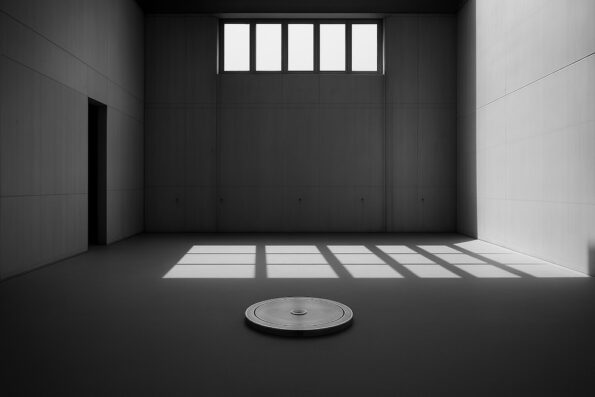
Absence 09. Digitally manipulated black and white photography.Victoria Pérez Quesada, 2025
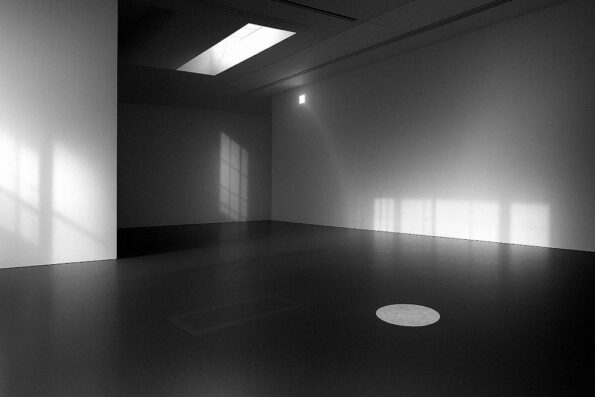
[Imagen destacada: Absence is everything. Digitally manipulated black and white photography.It reflects on the need to move through physical and mental spaces that do not offer immediate answers.”
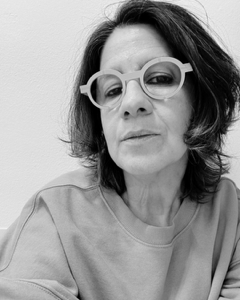
Victoria Pérez Quesada is a visual artist with a strong conceptual bent. Her practice revolves around concepts, language, and imagination as spaces for exploration, which sometimes leads her to use text as an independent or complementary form of work. She is interested in operating at the limits of meaning, where image and word do not fully converge, generating areas of friction and ambiguity. She conceives of creation as a field of experimentation in which thinking and doing intertwine.
Media Partners:




"A desk is a dangerous place from which to watch the world" (John Le Carré)