Search
To search for an exact match, type the word or phrase you want in quotation marks.
A*DESK has been offering since 2002 contents about criticism and contemporary art. A*DESK has become consolidated thanks to all those who have believed in the project, all those who have followed us, debating, participating and collaborating. Many people have collaborated with A*DESK, and continue to do so. Their efforts, knowledge and belief in the project are what make it grow internationally. At A*DESK we have also generated work for over one hundred professionals in culture, from small collaborations with reviews and classes, to more prolonged and intense collaborations.
At A*DESK we believe in the need for free and universal access to culture and knowledge. We want to carry on being independent, remaining open to more ideas and opinions. If you believe in A*DESK, we need your backing to be able to continue. You can now participate in the project by supporting it. You can choose how much you want to contribute to the project.
You can decide how much you want to bring to the project.
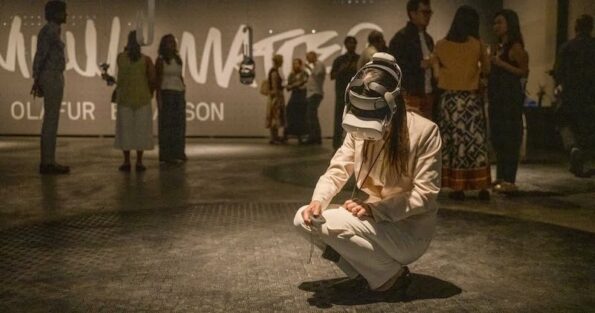
In Singapore’s industrial port —a space that for centuries circulated only goods— Padimai Art & Tech Studio has just opened its doors inside a refurbished warehouse in the Tanjong Pagar Distripark. It is the new digital art laboratory founded by Vignesh Sundaresan —aka Metakovan— the blockchain technologist and collector who burst onto the global scene in 2021 after purchasing Beeple’s NFT Everydays: The First 5000 Days at Christie’s. Padimai inaugurates its program with Your View Matter, an immersive installation by Olafur Eliasson that combines virtual reality and blockchain, commissioned by Sundaresan in 2022.
The piece occupies the center of the room. From the ceiling hang high-tech VR headsets positioned above seven circular environments, each four meters in diameter. Your View Matter —which also exists as an NFT— is grounded in the six Platonic solids, those perfect forms the ancients believed held the universe together. Visitors, wearing the goggles, navigate multilayered geometric environments whose walls shift and deform through moiré patterns—those optical vibrations produced when two grids overlap. Visual planes slide and distort depending on the angle of gaze and are accompanied by a minimalist soundscape composed by Eliasson himself. The virtual environment is also not fixed; it changes depending on the hardware and can be experienced both at Padimai and from any personal device. It is not a piece to be contemplated, but an interface that records every interaction.
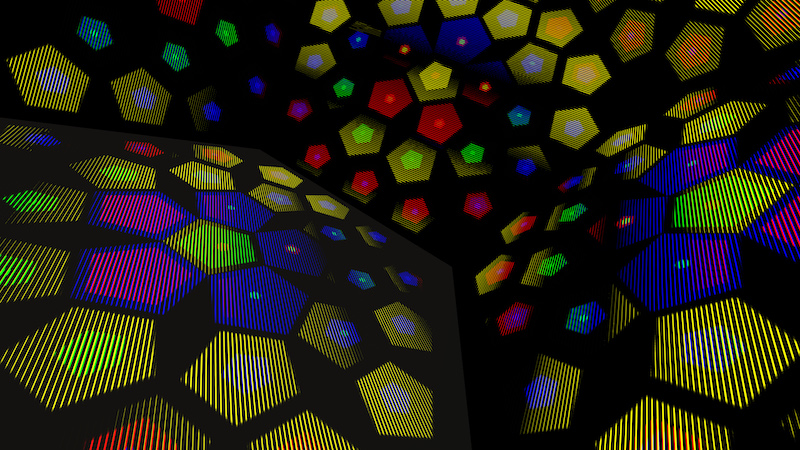
Olafur Eliasson, Your View Matter (dodecahedron), 2022. Virtual-reality installation, audio. Metakovan © 2022 Olafur Eliasson
The gesture is radical, every path taken, every glance inside Your View Matter produces a unique file stored in Metarium, the decentralized file system created by Sundaresan. To understand its scope, it is useful to dismantle the myth of the “cloud,” which today operates as an extractive infrastructure that filters and monetizes our experiences. Blockchain —so complex and impenetrable to outsiders— can be understood through one essential principle: its archival vocation. Simply put, it functions like a collective accounting ledger, distributed and practically immutable. Imagine a document not stored on a single server but replicated across thousands of computers, where every modification is recorded and must be validated by consensus. Nothing can be altered silently; if someone tries to modify a part, the entire network detects it. It is an organizational structure without a center.

Installation view of Olafur Eliasson, Your View Matter at Padimai Art & Tech Studio © 2025 Padimai Art & Tech Studio
If the modern museum functioned as a Foucauldian machine of classification and legitimation, an architecture of power that ordered objects and narratives, blockchain offers, at least in theory, a rupture with that regime. Not because it is intrinsically emancipatory, but because it hinders the concentration of control. Rather than a centralized archive, Padimai Art & Tech Studio operates as a rhizome, a network of nodes that verify collectively, that does not accumulate objects but relations, and that does not impose itself from above but it extends, it branches, and it replicates itself.
Your View Matter embodies this logic. Its “somatic vision” does not dissolve the body into the simulacrum but reconnects it with its perceptual agency. At the same time, its distributed archive challenges the logic of technofeudalism —that algorithmic Middle Ages ruled by platforms such as Google or Meta. Against their imperatives of transparency and extraction, Padimai asserts the glitch as a cultural right. It defends the right not to be fully legible to the digital panopticon, to preserve the singularity of experience outside the market.

Olafur Eliasson, Your View Matter (octahedron), 2022. Virtual-reality installation, audio. Metakovan © 2022 Olafur Eliasson
This claim to opacity is the first gesture toward an effective decolonization of cyberspace. Digital colonization does not operate solely through data extraction but through the imposition of a regime of obligatory visibility. To be processed by the algorithm, the subject must become transparent, convert their experience into readable, and therefore , exploitable data. Eliasson’s moiré distortions —patterns that form and deform in motion— are more than optical effects, they are technical metaphors of resistance. They blur the gaze of the algorithmic colonizer, introducing distortion to protect a space of irreducible autonomy.
In this context, Metarium’s distributed archive is not merely a preservation device; it is an act of political reterritorialization. It disputes the control over where cultural memory resides. While data-center colonialism concentrates archives in corporate giants —the contemporary Houses of Trade— distributing them means returning them to a community of nodes that no one controls exclusively. It is a form of digital restitution.
But the key question is Fanonian, what does it mean to decolonize a territory that is not physical? Does decentralization equate to the decolonization of cyberspace? Fanon insisted that decolonization is not a metaphor[1]The Wretched of the Earth, trans. Constance Farrington (New York: Grove Press, 1963), 1–2: “Decolonization is not a discourse, not a metaphor…”., it is a real redistribution of power. Translated to the digital sphere, it means questioning who designs the protocols, who owns the servers, which languages circulate, which histories persist or which ones are erased. The cloud, though abstract, is anchored to massive servers, submarine cables, and profoundly Western economic logics. Digital alienation is not inherent to technology but a consequence of these corporate infrastructures that exercise colonial control over experience. Decentralization, in this sense, is a decolonizing act, it redistributes power over creation, archiving, and memory. It is not technoutopianism; it is a material and political gesture that carves out spaces of autonomy within cyberspace.
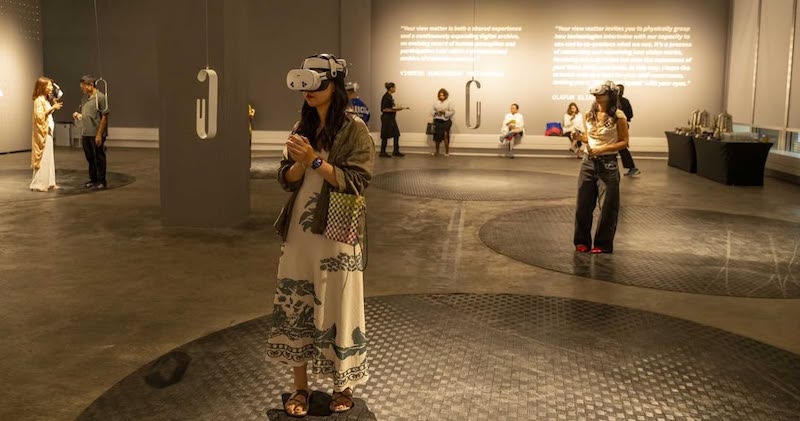
Installation view of Olafur Eliasson, Your View Matter at Padimai Art & Tech Studio © 2025 Padimai Art & Tech Studio
This operation has a constitutive dimension. Distribution does not merely transfer possession from A to B; it transforms the nature of what is possessed and redefines power relations. A centralized archive is an instrument of authority, whoever controls the center controls the access, and the narrative. A distributed archive is a relational structure where protocol replaces authority. At Padimai, the artwork ceases to be a object to be guarded and becomes a process to be collectively verified. Decolonization is not about handing the rod of sovereignty to someone else, but about dissolving the very rod of sovereignty and replacing it with an open code of collective, algorithmic, non-transferable sovereignty.
The fact that this laboratory emerges as a situated investigation in Singapore is significant. The city-state’s recent history is marked by accelerated cycles of colonization and liberation, by hyperconnectivity and strict social discipline. All within a compressed temporal fracture that becomes a lens through which to think another territory still in dispute: cyberspace. Just as Singapore redefined its identity outside colonial logics, the global digital infrastructure demands a revision of who controls, classifies, and distributes knowledge.
During the project’s presentation, Eliasson remarked that Sundaresan and Padimai represent “the future.” Not a future where artists simply use technology, but one where they participate in designing its governance structures. Padimai Art & Tech Studio is the prototype of that coming institution, a place where cultural memory is not legitimized by authority but emerges through cooperation; where preservation means building commons. Its goal is to transform human experience —fragile, precise, unpredictable— from raw material for technofeudalism into the foundation of a shared world.
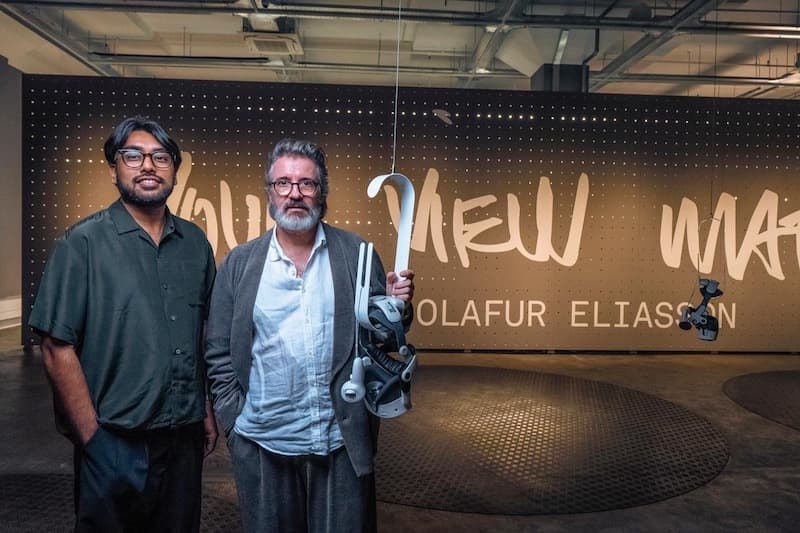
Olafur Eliasson and Vignesh Sundaresan during the opening of Padimai Art & Tech Studio. Photo: Selvaprakash Lakshmanan. Courtesy Padimai Art & Tech Studio.
(Cover photo: Installation view, Your View Matter at Padimai Art & Tech Studio © 2025 Padimai Art & Tech Studio)
Olafur Eliasson, Your View Matter
On view until March 31, 2026 at Padimai Art & Tech Studio, Singapore
| ↑1 | The Wretched of the Earth, trans. Constance Farrington (New York: Grove Press, 1963), 1–2: “Decolonization is not a discourse, not a metaphor…”. |
|---|
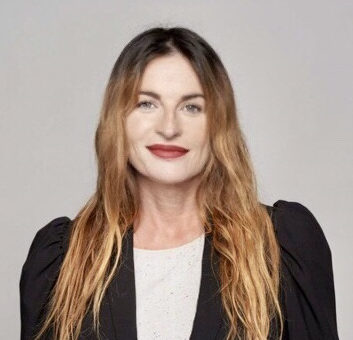
María Muñoz-Martínez is a cultural worker and educator trained in Art History and Telecommunications Engineering, this hybridity is part of her nature. She has taught “Art History of the first half of the 20th century” at ESDI and currently teaches the subject “Art in the global context” in the Master of Cultural Management IL3 at the University of Barcelona. In addition, while living between Berlin and Barcelona, she is a regular contributor to different media, writing about art and culture and emphasising the confluence between art, society/politics and technology. She is passionate about the moving image, electronically generated music and digital media.
Portrait: Sebastian Busse
Media Partners:




"A desk is a dangerous place from which to watch the world" (John Le Carré)