Search
To search for an exact match, type the word or phrase you want in quotation marks.
A*DESK has been offering since 2002 contents about criticism and contemporary art. A*DESK has become consolidated thanks to all those who have believed in the project, all those who have followed us, debating, participating and collaborating. Many people have collaborated with A*DESK, and continue to do so. Their efforts, knowledge and belief in the project are what make it grow internationally. At A*DESK we have also generated work for over one hundred professionals in culture, from small collaborations with reviews and classes, to more prolonged and intense collaborations.
At A*DESK we believe in the need for free and universal access to culture and knowledge. We want to carry on being independent, remaining open to more ideas and opinions. If you believe in A*DESK, we need your backing to be able to continue. You can now participate in the project by supporting it. You can choose how much you want to contribute to the project.
You can decide how much you want to bring to the project.
In the everyday stream of war images that constantly reaches us lies a principle of implausibility. An emptiness of meaning about what is happening unfurls behind every bombardment, every drone attack, every economic blockade. The informational logic of the media —the disruption of normalcy— prevents us from seeing beyond casualty figures, official statements, or the most viral reels, concealing, behind a powerful visual regime, the untold life that continues among the bombs. What we are usually given is nothing more than an infinite loop that turns pain into pornography
The exhibition Pedagogies of War, the first solo presentation in Spain of Roman Khimei and Yarema Malashchuk, displays the effort to build an effective counter-narrative from the very center of the war. Through four video installations produced since the beginning of the Russian invasion of Ukraine, these key figures of a new generation of Ukrainian visual artists bring us closer, with unsettling calm, to the images of the non-news in the city of Kyiv and other Ukrainian territories. Curated by Chus Martínez for TBA21 Foundation at the Museo Nacional Thyssen-Bornemisza, the project, through a series of carefully considered gestures, approaches the war from multiple standpoints: those who stayed, those who had to leave, and those who have already returned.
In their opening remarks, the artists explained that their work was first a testimony to tragedy, and only afterward art. This becomes apparent as soon as one enters the first room, which begins with The Wanderer (2022), a piece in which they use their own bodies to stage the postures of fallen Russian soldiers, blending into the landscape of the Carpathians. Inspired by Caspar David Friedrich’s Wanderer Above the Sea of Fog, the work reshapes the traditional visual appropriation of landscape established by Romantic modernism. The iconic images of suffering —such as Goya’s Disasters of War or Picasso’s Guernica— feel far away. Marking a return to the pictorial, what we encounter is an invitation to unlearn what we think we know about war.
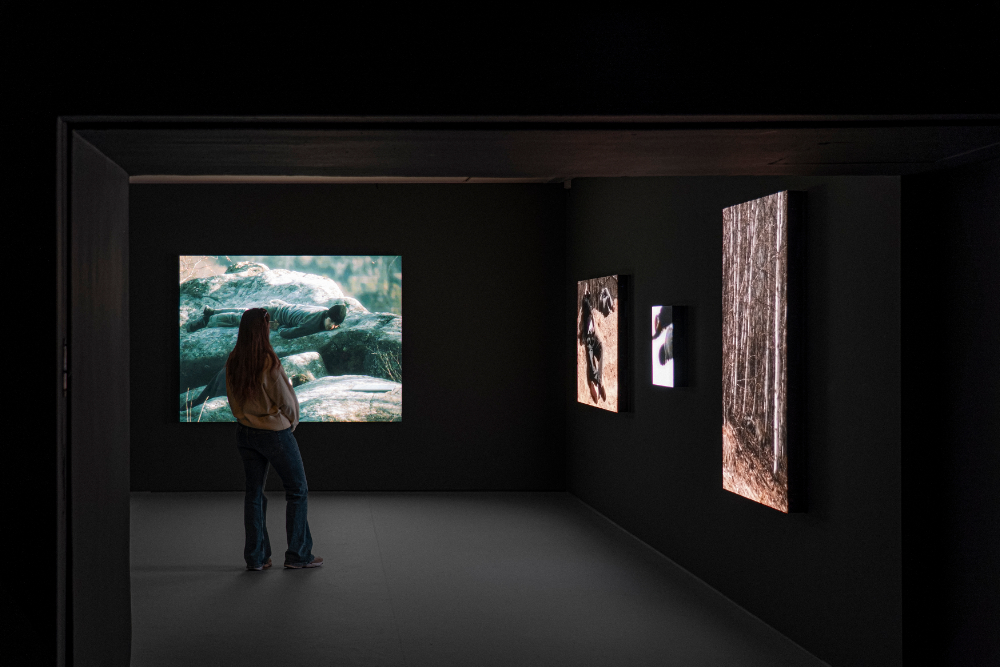
Installation view of The Wanderer, 2022. Museo Nacional Thyssen-Bornemisza, Madrid. March 2026. © TBA21–Thyssen-Bornemisza Art Contemporary. Photo: Maru Serrano.
If the nineteenth century conceived war as a moral spectacle, the twentieth century began to suspect the image. After World War II, artists such as Martha Rosler dismantled heroic rhetoric by bringing war into the domestic sphere, while Harun Farocki understood war as a system of images before it was a historical event. Today, Khimei and Malashchuk work along this line: contemporary war is a visual infrastructure before it is an event, and their work forces us to rethink the role of the viewer.
The next room presents Open World (2025), a video installation in which a young Ukrainian boy uprooted by war operates a robotic dog to virtually visit his family, play with a girl, and walk through places he remembers from his childhood. Presented at the 36th Ljubljana Biennale of Graphic Arts, the piece opens the exhibition to an explicit dialogue with technological agency —close to techno-feminist positions— and the critical appropriation of devices that, in this case, were designed for surveillance and destruction. This idea resonates throughout the exhibition: taking what exists and giving it new uses and meanings.
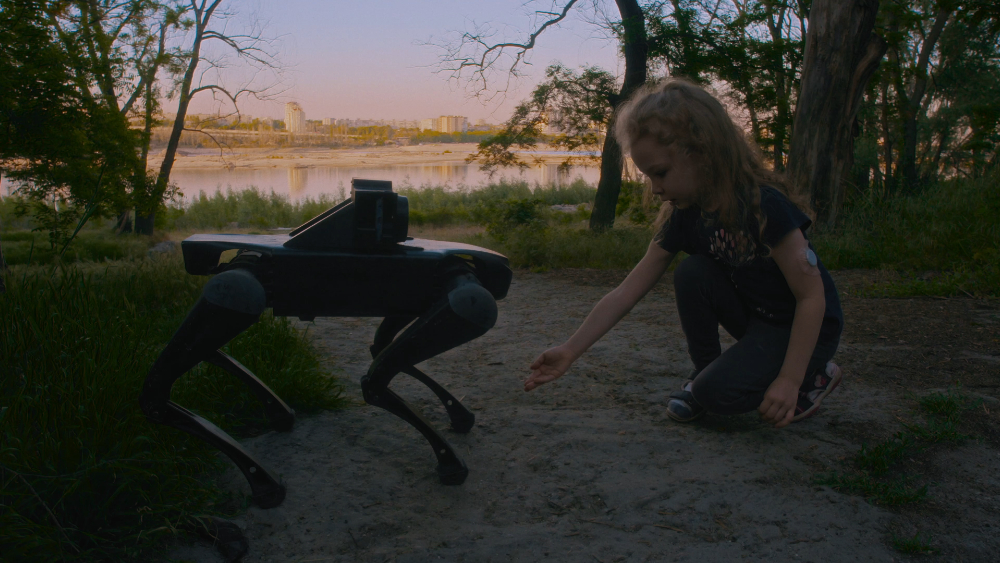
Roman Khimei and Yarema Malashchuk. Open World [Mundo abierto], 2025. Two-channel video installation, color, sound. Variable dimensions. Produced by TBA21–Thyssen-Bornemisza Art Contemporary for the 36th Ljubljana Biennale of Graphic Arts, 2025, with the support of the Pontevedra Art Biennial. Still: courtesy of the artists.
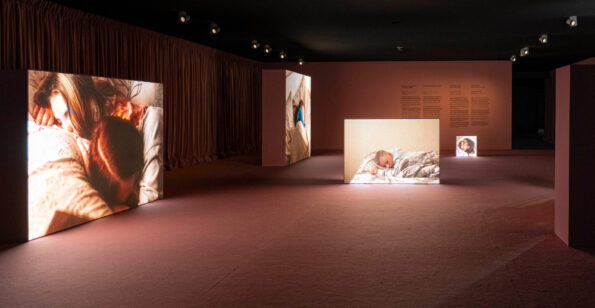
The third work, You Shouldn’t Have to See This (2024), pushes the question of representation into even more uncomfortable territory. The six-channel video installation shows Ukrainian boys and girls asleep. There is no shrillness, no dramatization —only vulnerable bodies deeply at rest. Yet we know —and this knowledge completely transforms the image— that these minors were forcibly displaced to Russian territory and later returned. The piece does not record the trauma; it records the aftermath, the space where horror is no longer visible but still somehow operative.
The exhibition culminates with We Didn’t Start This War (2026), an audiovisual triptych produced in the context of the still-ongoing conflict. The title, which echoes a chant heard across Ukrainian society since the invasion, does not function as a slogan but as a stubborn assertion of agency. Far from patriotic rhetoric or heroic imagery, the piece focuses on something seemingly minor: the persistence of everyday life. Minimal gestures, idle time, and barely perceptible routines take the place usually reserved for action.
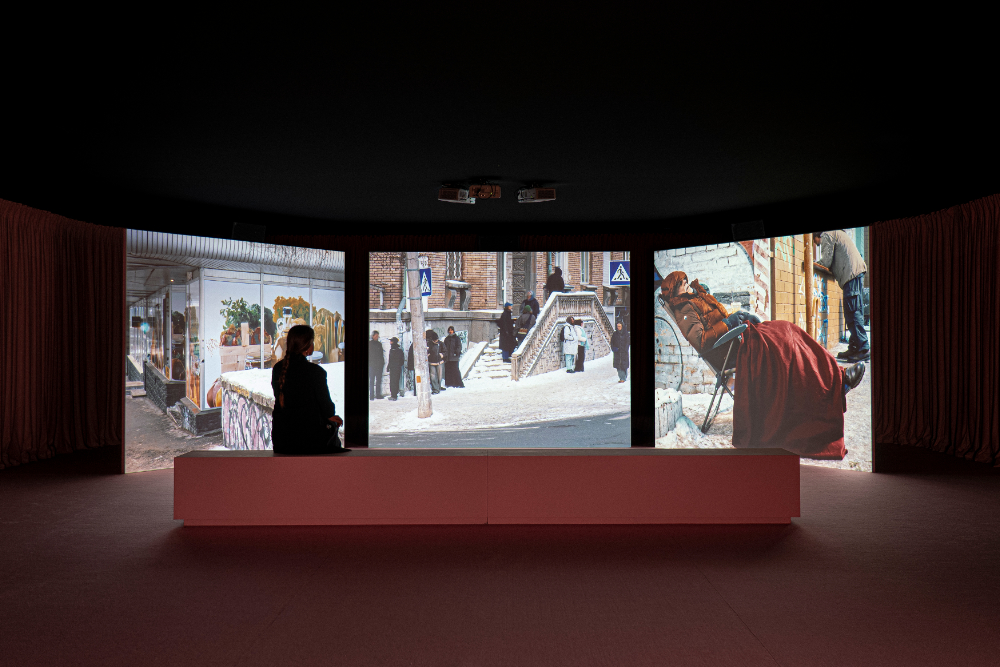
Installation view of We Didn’t Start This War [Nosotros no empezamos esta guerra], 2026. Museo Nacional Thyssen-Bornemisza, Madrid. March 2026. © TBA21–Thyssen-Bornemisza Art Contemporary. Photo: Maru Serrano.
In these insistent gestures lies a true pedagogy. War does not only destroy bodies and cities; it also colonizes the imagination, imposing a visual grammar in which everything must be urgent, extreme, final. Firmly anchored in the historical present amid escalating belligerence, the exhibition tests an ethics of attention capable of reconnecting us with one another. Instead of amplifying horror, it skirts around it. Instead of probing the wound, it observes how what the war has not completely destroyed begins, unsteadily, to heal. If the pornography of pain turns looking into consumption —as Susan Sontag warned— here watching demands stillness. Not every image of war needs to scream. Some, in order to resist, only need to endure.
[Featured image: ‘Pedagogies of War’, an exhibition by Roman Khimei and Yarema Malashchuk, 2026. Presented by the Museo Nacional Thyssen-Bornemisza and TBA21 Thyssen-Bornemisza Art Contemporary. You Shouldn’t Have to See This, 2024. Installation view. Photo: Maru Serrano]
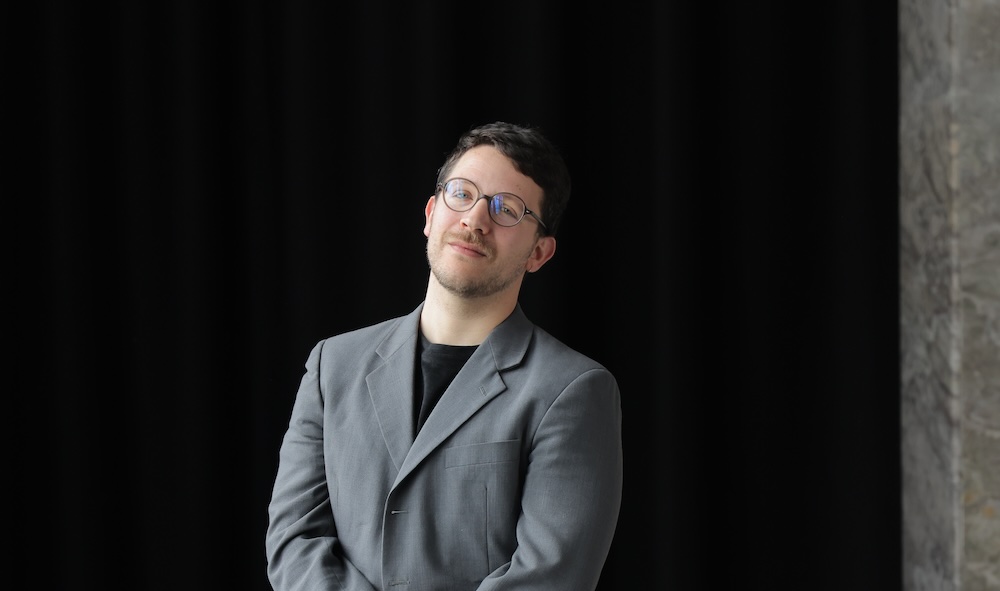
Alejandro Alcolea Marín (Palma, 1990) is a journalist and cultural critic. Throughout his career professional has been dedicated to communication, management and research in different institutions cultural institutions such as the Círculo de Bellas Artes, the Center for Contemporary Culture of Barcelona (CCCB) and Es Baluard Contemporary Art Museum of Palma. He has collaborated with media and publications such as A*Desk, elDiario.es, CTXT or lamarea. You are interested in what happens (and what doesn’t) in the intersection between them fields of culture, power and technologies.
Media Partners:




"A desk is a dangerous place from which to watch the world" (John Le Carré)