Search
To search for an exact match, type the word or phrase you want in quotation marks.
A*DESK has been offering since 2002 contents about criticism and contemporary art. A*DESK has become consolidated thanks to all those who have believed in the project, all those who have followed us, debating, participating and collaborating. Many people have collaborated with A*DESK, and continue to do so. Their efforts, knowledge and belief in the project are what make it grow internationally. At A*DESK we have also generated work for over one hundred professionals in culture, from small collaborations with reviews and classes, to more prolonged and intense collaborations.
At A*DESK we believe in the need for free and universal access to culture and knowledge. We want to carry on being independent, remaining open to more ideas and opinions. If you believe in A*DESK, we need your backing to be able to continue. You can now participate in the project by supporting it. You can choose how much you want to contribute to the project.
You can decide how much you want to bring to the project.
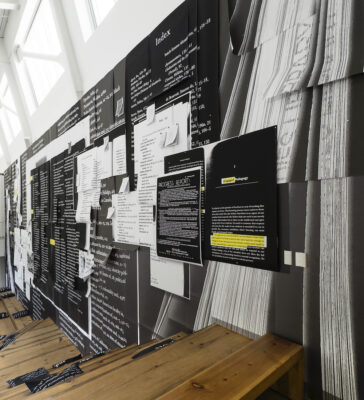
We don’t know what American education will look like in ten years. Here’s an art installation that takes a look at what’s at stake: Present Tense (Roll Call), Stephanie Syjuco’s oversized installation on the politics of education, at the University of California at Berkeley.
Stephanie Syjuco[1]Stephanie Syjuco (b. 1974) is a professor in the department of Art Practice at the University of California (UC) Berkeley since 2013 and an educator at Stanford University before that, Syjuco uses … Continue reading regularly creates monumental installations, but Present Tense (Roll Call), curated by Matthew Villar Miranda at the Berkeley Art Museum & Pacific Film Archive on display till June 28, 2026, is her largest work to date at 19 x 8 x 9 meters. Syjuco describes her work of art as “[a]n oversized love letter to teaching and learning during fraught times, and the constellations of knowledge we carry forward with us.”
Her description feels particularly poignant because the university city of Berkeley is just 13 miles east across the bay from San Francisco, major center in the development of artificial intelligence. As such, Present Tense (Roll Call) functions as a place for collective remembrance made from the accumulated vestiges of academia, asking us to reconsider knowledge production and diffusion at this unprecedented historical moment. Equally pressing is that many of the terms on the ArtWall are among the list of words banned by the federal government as compiled by Pen America.
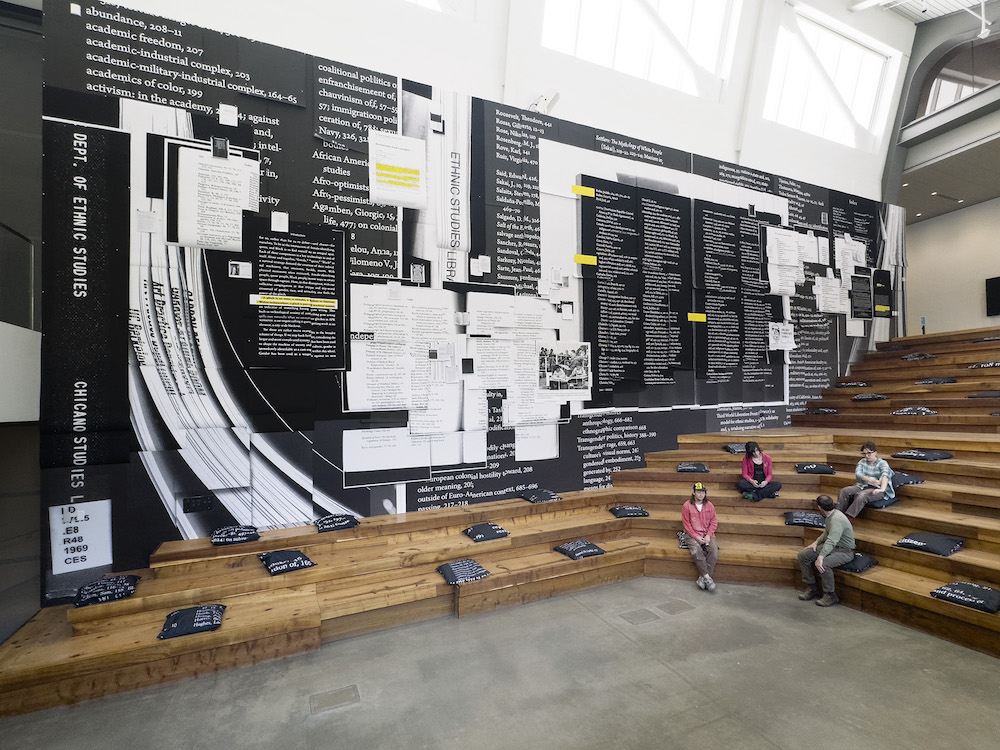
Stephanie Syjuco: Present Tense (Roll Call), 2025. Installation view. Digital paper prints, hardware, vinyl, custom printed textiles, 19x8x9m. Courtesy: the artist
By re-framing, enlarging, and juxtaposing images and historical documents in unexpected layers, her work prompts audiences to reflect on how archives perpetuate broadly accepted narratives. Whose histories are preserved and whose voices remain silent and forgotten, and why?
The title of Syjuco’s Present Tense (Roll Call) references the practice of confirming one’s presence in the classroom. A museum-commissioned work, it is impossible to miss upon entering the vestibule. You might naturally approach the work from its right side as you enter. It’s framed by the fore-edge of a book, photographed and enlarged, at the top of the steps leading down to the center of the Crane forum. If you step back to view the work in its entirety, you’ll notice that the left side of the wall is also framed by a book’s fore-edge which reads in part “Art Practice Department.” This is supported by a textured black book-spine – “Department of Ethnic Studies … Chicano Studies L” in white letters. The last word remains hidden. The fore-edges cascade down, and the words stamped on them are not easily legible. You might instinctively turn your head to the side to try to read them. They curve like soft-bound paper does when placed on a shelf. There is deliberation in the imprecision of it and Syjuco captures not just the sheaf of papers, but also an element of time which has weighed the books down, perhaps distorting or obscuring them.
Standing in front of Present Tense (Roll Call), the everyday names and pages of academia become larger than life and you are forced to contemplate them in a way you normally wouldn’t. The process may be deliberate here – literary theory applied to visual art. Coined by Russian Formalist Victor Shlovsky, defamiliarization is the isolation of literary forms and properties in order to overcome and challenge habitual perception. The process – ostranenie – leads to a renewed consideration of a text by prolonging the time one takes to take in an aesthetic object. Syjuco has also inverted black and white in the work.
Because the wall is dense with layered texts, it is not immediately possible to grasp its content in its entirety, yet you can spot elements that stand out and serve as a guide. Towards the top center of the wall is another prominent fore-edge with “ETHNIC STUDIES LIBRA…” trailing off in capital letters, and from there, your eye might be guided by the yellow highlights that stand out against the black and white blocks of color.
To the right, is some highlighted text from the first chapter of bell hooks’ Teaching to Transgress: “Throughout my years as a student and professor, I have been most inspired by those teachers who have had the courage to transgress those boundaries that would confine each pupil to a rote, assembly-line approach to learning.” Known for her work on gender, race and capitalism, her words cast meaning into the index fragment on the uppermost left-hand corner which reads “… academic freedom 207/ academic-industrial complex 203, academic-military-industrial complex 164-65…” As your eye continues to scan for color, you might follow the transfer tape across the wall to highlighted sections from the 2012 academic paper “Decolonization is Not a Metaphor.”
Words slip into near incoherence, as they seem to “glitch” in the way they might if they were on a flickering screen, cut off in places for the viewer to figure out. Some texts are sharply legible, while others blur or fade as they are re-photographed —an intentional decision that reflects the selective visibility of history and technology. Highlighted text from Glitch Feminism on the far left of the work seems to echo this: “A glitch is an error, a mistake, a failure to function. Within techno culture, a glitch is part of machinic anxiety…”
As part of producing this work, Syjuco photocopied books from Berkeley’s Ethnic Studies Library. Pages flap and curl at the edges, white at the spine edges recall the bright flashing light under the glass of photocopy machines. The layers of paper imperfectly pasted and fanned one on top of the other like an archeological record of knowledge mimic the effort that goes into researching and deciphering the abundance of the index. The work is deliberately sculptural and tactile.
Beneath the mural, the forum seating features black cushions with white lettering. The viewing space is transformed into a participatory classroom where the public is invited to sit and contemplate constellations of knowledge – how they are constructed, controlled and collide.
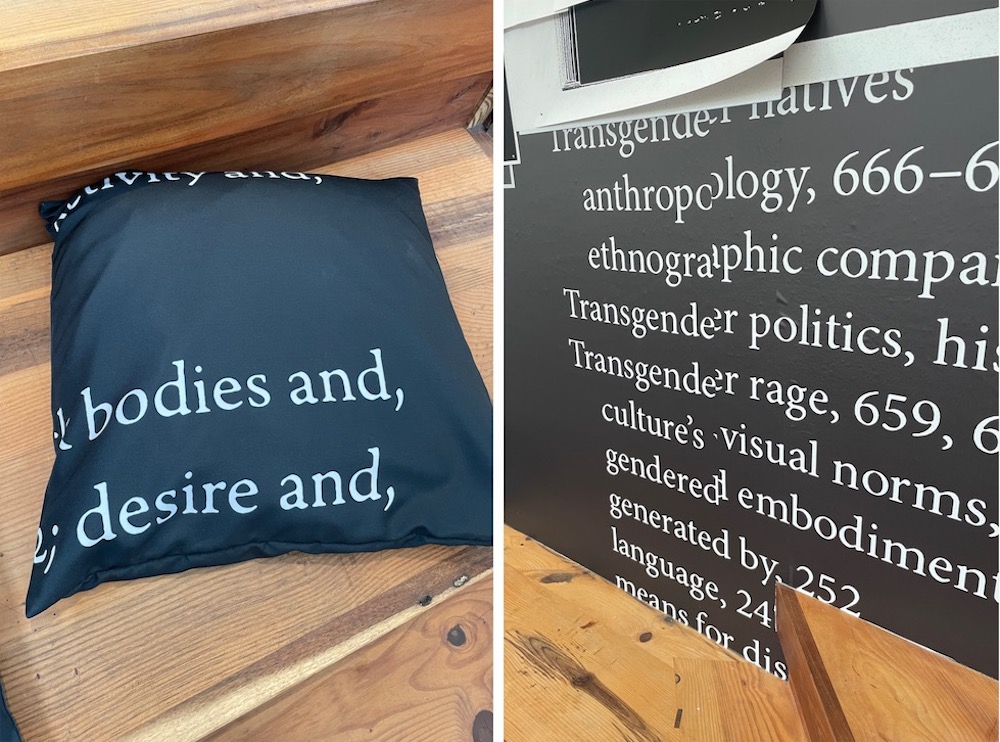
Stephanie Syjuco: Present Tense (Roll Call), 2025, installation details. Foto: Maria Victoria Yujuico
(Featured image: Stephanie Syjuco: Present Tense (Roll Call), 2025, installation view. Courtesy: the artist)
| ↑1 | Stephanie Syjuco (b. 1974) is a professor in the department of Art Practice at the University of California (UC) Berkeley since 2013 and an educator at Stanford University before that, Syjuco uses photography and collage as critical tools to question archives and the hierarchical universes they construct. Her work can be found at The Museum of Modern Art, the Metropolitan Museum in New York, The Getty Museum, and the San Francisco Museum of Modern Art, among others. |
|---|
Maria Victoria Yujuico writes about the intersections between art, literature and modern life. She holds a masters in Spanish and Latin American literature and is a student of contemporary art at IL3-Universidad de Barcelona. She lives in California, between the Monterey Bay and the San Francisco Bay Area.
Media Partners:




"A desk is a dangerous place from which to watch the world" (John Le Carré)