Search
To search for an exact match, type the word or phrase you want in quotation marks.
A*DESK has been offering since 2002 contents about criticism and contemporary art. A*DESK has become consolidated thanks to all those who have believed in the project, all those who have followed us, debating, participating and collaborating. Many people have collaborated with A*DESK, and continue to do so. Their efforts, knowledge and belief in the project are what make it grow internationally. At A*DESK we have also generated work for over one hundred professionals in culture, from small collaborations with reviews and classes, to more prolonged and intense collaborations.
At A*DESK we believe in the need for free and universal access to culture and knowledge. We want to carry on being independent, remaining open to more ideas and opinions. If you believe in A*DESK, we need your backing to be able to continue. You can now participate in the project by supporting it. You can choose how much you want to contribute to the project.
You can decide how much you want to bring to the project.
Articles pour in about gallery closures, merges, and art market instability, as series emerge on institutional crises,[1]https://news.artnet.com/art-world/museums-in-crisis-takeaways-2717463 and as colleagues publish articles on everything being rotten.[2]https://kunstkritikk.com/consolation-prize/ The global scale of contraction is felt over the entire artistic sector. This is not coincidence, but planned obsolescence, a curated curtailing of possibility in a sector that boomed under the premise of utopian-free-capitalism-for-all, and which has now become the weakest link in the new wave of militarist political ideology. In the new algorithmic values of fluid capital, art is too material (can be easily destroyed by weaponry), artists too fleshy (life is bought and sold on the weapons market), and archives are too heavy (require investment rental space rather than cloud). Therefore, a political contraction is taking place in which old forms of power and privilege are re-emerging under the guise of common struggle – and this starts from the positionality of the largest state institutions themselves.
Speaking from my own city of Amsterdam, it is easy to see this politics taking shape in the ongoing fiscal crisis and staff cuts of the Eye Filmmuseum,[3]https://metropolism.com/nl/feature/eye-filmmuseum-maakt-herstructureringsplan-bekend-30-fte-minder/ and in the criticism towards the institutionalisation of the Prix de Rome.[4]https://www.nrc.nl/nieuws/2025/12/01/de-prix-de-rome-de-belangrijkste-prijs-voor-jonge-kunstenaars-wil-het-dit-jaar-helemaal-anders-doen-a4913983 Both are cases of institutions institutionalising – whether by sacrificing staff after risky moves catered to blockbuster Hollywood exhibitions, or whether open calls crumble into “expert gazes” that make null the original premise of a prize for underrepresented young artists. Either way, the idea of an open, plural, experimental institution that was touted a decade ago, gives way to the fortified gates of the fearful museum, careful not to tread on the toes of its unwilling funders or its retreating political support, cautious of journalists who might dare to express an opinion not verified by the museum’s internal marketing team.[5]The new policy implemented by the Stedelijk is that press must request access to the museum at least two days in advance and then wait for approval by the press office. Information gleaned from a … Continue reading
Yet, series such as that on Artnet that focus solely on museum infrastructures fail to see the wider network of artistic relations, and how the museums themselves have been the first to cut off their sensors towards the outside world and contemporary production in the place of culture.[6]Homi Bhabha, The Location of Culture. Art is not made in museums, rather, that is where it goes to be buried in dignity,[7]Alain Resnais et Chris Marker, Les Statues Meurent Aussi (1953) https://www.imdb.com/title/tt0046365/ and the closing of the institutional gaze into an inward-looking investigation is nothing more than a mirror of the political devaluation of the living.
In Amsterdam it is ridiculous to speak about institutional cuts with any emotion, because the small and medium sized platforms have already been eliminated.[8]https://kunstverein.nl/Far from a single instance, the absurdity is felt in the straggling struggles of decades-old programming institutions such as P/////AKT who have been forced to institutionalise, jump through bureaucratic hoops, and exhaust energy to a final degree where the contradictions of dry bureaucracy (finding them a space, giving positive advice, but then not awarding any funding) emphasize the cold machinic quality of urbanism championed by false progressive policy. Ever-more dizzying sets of protocols become unmanageable and grotesque for small teams who represent the living, breathing, human passion for art which is the base of all cultural production and solidarity. Justified behind drives to “decenter” art and to promote “entrepreneurship” lies the basic lack of ability to properly place a finger on where the value of art lies.[9]Roel Pots, Cultuur, koningen en democraten (2000) https://hdl.handle.net/11245/1.173157 outlines how the Dutch consideration of art as an “educational tool” stems from the Nazi occupation of the … Continue reading
The inefficiency of public investment here is undeniable: small spaces create much more in relation to their small budgets in comparison to the behemoth Stedelijk. Yet it is precisely these spaces that face existential funding threats, forced to navigate increasingly labyrinthine bureaucratic processes for diminishing resources. It is ironic for a museum with the name “Stedelijk” which in Dutch, translates to “from the city” to see a bizarre disconnected programming and a catering to touristic audiences. Even more outlandish than the programming, is the political choice to form a museum alliance with the Van Gogh Museum [10]https://www.vangoghmuseum.nl/nl/over/nieuws-en-pers/nieuws/20250305-grote-tentoonstelling-over-anselm-kiefer-opent-in-het-van-gogh-museum-en-stedelijk-museum-amsterdam rather than with Moker, the association of contemporary art spaces working for better conditions in Amsterdam’s art sector. The partnership between two large museums, one next to the other, is a strategic decision connected to the wave of entrepreneurship that values tourist footfall above artistic discourse.
This year, Stedelijk Museum opened a large-scale Anselm Kiefer exhibition spread across the contemporary museum as well as the Van Gogh museum a few meters away. A popular art blockbuster strategy not dissimilar to Eye’s Tilda Swinton debacle. Clearly an attempt to drive up numbers of German tourists, the Kiefer exhibition also served as an alignment mechanism with the Netherland’s eastern neighbour in a time when the artistic community has attempted to cut all ties.[11]https://hyperallergic.com/artists-pledge-to-boycott-german-institutions-over-stifling-of-pro-palestine-speech/ As opposed to Germany, Dutch artists and institutions associated with Moker have put political concerns for the ongoing genocide in Gaza at the forefront of their programmes and statements. [12]The statement of the association as well as its members can be found on the Moker website: https://moker.amsterdam/ This article does not mean to question Kiefer’s art historical significance, but to contextualise the choice of programming within a contemporary political climate, and to ask for accountability from a museum who should take timing into consideration for relevance, or naturally be considered a politically conservative provocation. Stedelijk repeatedly hides its ostrich head under cold machinic excuses of institutionality. This is not merely a strategic decision; it is a statement about priorities, about who the museum considers its constituency, and what it understands its public mandate to be.
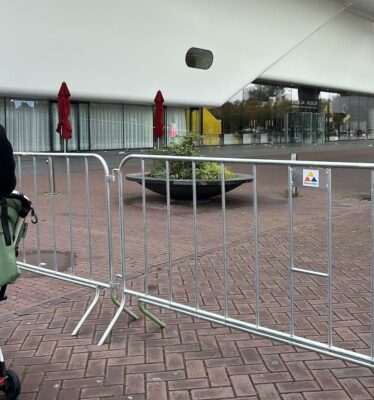
The bizarre choice of Kiefer in 2025 is not dissimilar to the robotic quality that became painfully visible in the case of Ahmet Ögüt’s “Bakunin’s Barricade.” When student protestors against the genocide in Gaza requested to borrow the work, a sculpture explicitly designed to repurpose art as defense for protestors, the museum refused.[13]https://www.mistermotley.nl/how-stedelijk-museum-amsterdam-refused-to-let-bakunins-barricade-be-a-symbol-against-the-ongoing-genocide/ Then, on October 5th, when thousands gathered at Museumplein as part of the “Wij trekken een Rode Lijn” protest, the Stedelijk erected metallic barricade fences around the building. The precaution was understandable as a measure to protect the museum’s glass entrance. Yet, anyone versed in visual analysis, anyone operating with the kind of cultural literacy a contemporary art museum should embody, should have recognized the bitter irony: one artwork meant to use art as defense for protestors, refused; one bureaucratic measure used to protect the gift shop inside the museum’s entrance from peaceful protestors seeking to end monstrous, senseless killing: deployed without apparent reflection.
The incident crystallizes everything wrong with how scale operates in cultural institutions. A large museum can pretend to house radical work, can acquire pieces that challenge institutional power, but when confronted with the reality that the work addresses, bureaucratic self-preservation overrides any genuine engagement with the art’s meaning or the community’s concerns. The question of priorities, falsehoods, and unearnest politics continues to follow the Stedelijk’s director Rein Wolfs after the fiasco of an interview conducted by Raul Balai in which Rein Wolfs argued that museums should not make political statements, going so far as to suggest that previous institutional positions on Ukraine and Black Lives Matter were mistakes.[14]https://www.nporadio1.nl/fragmenten/de-nieuws-bv/9c710672-bfd7-43dd-ae8d-c84853e79a3f/2024-07-04-kunstenaars-willen-dat-het-stedelijk-museum-een-kunstwerk-uitleent-voor-een-protest This statement is clearly not reflective of Amsterdam’s artistic community at large and goes directly against the numerous calls for real political alignment rather than empty gesturing as a protective measure for the selfish reflex of self-preservation.
Administrations face the challenge of how to quantify cultural value, and solutions for this have not been effectively developed. Visitor numbers and economic impact metrics favor large institutions by design, but they measure the wrong things. The value of experimental and professional spaces cannot be captured in tourist data because their contribution is not to tourism but to the cultural vitality of the city itself. It is clear that the value of culture will never be understood by those who only see profit margins and numerical sets as measures of success, yet no better option has been developed for the algorithmic rhythms and political pressures of buckling rapid-transaction investors other than baroque gluttony and frivolous personal preference.[15]https://hartwigartfoundation.nl/
The solution is not simply redistribution, but a more sensible way of accounting for the value of art, and an increase of local production budgets. Amsterdam’s cultural budget needs to grow to adequately support the small and medium-sized contemporary institutions that have defined the city’s international reputation for decades. The recent debacle around H’ART Museum crystallizes the problem: Amsterdam gave 3.2 million euros to this single institution [16]https://www.parool.nl/kunst-media/h-art-museum-krijgt-3-2-miljoen-van-amsterdam-andere-instellingen-verbaasd~b8464661/ at precisely the moment when the Amsterdam Fonds voor de Kunst (AFK) was forced to close two of its funding schemes due to lack of resources. A city that claims to be at the forefront of contemporary culture can no longer afford to support the innovation and artistic production that sustains that claim, while it finds millions for institutions that contribute little (by importing ready-made modernist exhibitions from elsewhere) to the creative ecosystem that makes Amsterdam internationally significant.
Rather than supporting an existing scene and creating art historical context for it, detached cool seems to be a survival strategy for fascist times. These pursuits are not only futile, but damaging to the social fabric that creates it should ethically serve. The spaces that need increased funding are those that have made Amsterdam matter on an international scale: the network of small and medium exhibition platforms, project spaces, and artist-run initiatives that for decades have incubated ideas, supported emerging practices, and maintained the city’s position as a site of genuine artistic discourse rather than “cultural tourism.” How can the large-scale institutions learn from, invite, and support these smaller players rather than shutting them out and competing for resources? This is the task we must take on as an artistic community if we want experimentation and wildness to survive within public systems, or abandon it altogether.
(Featured image: Sara Giannini, Wij trekken een rode lijn, Fences at Stedelijk Museum, Amsterdam, October 5, 2025)
This article was written based on anonymous conversations that took place over four days within the context of the exhibition “The Hard Edge of the Labour of Time” at PAKT Foundation, Amsterdam. (November 2025).
Media Partners:




"A desk is a dangerous place from which to watch the world" (John Le Carré)