Search
To search for an exact match, type the word or phrase you want in quotation marks.
A*DESK has been offering since 2002 contents about criticism and contemporary art. A*DESK has become consolidated thanks to all those who have believed in the project, all those who have followed us, debating, participating and collaborating. Many people have collaborated with A*DESK, and continue to do so. Their efforts, knowledge and belief in the project are what make it grow internationally. At A*DESK we have also generated work for over one hundred professionals in culture, from small collaborations with reviews and classes, to more prolonged and intense collaborations.
At A*DESK we believe in the need for free and universal access to culture and knowledge. We want to carry on being independent, remaining open to more ideas and opinions. If you believe in A*DESK, we need your backing to be able to continue. You can now participate in the project by supporting it. You can choose how much you want to contribute to the project.
You can decide how much you want to bring to the project.

Natalia Piñuel: Recently, a retrospective of your work was inaugurated at the Palau de la Virreina, curated by Mabel Tapia, as well as your exhibition, curated by Playtime Audiovisuales, at the DA2 in Salamanca. With the size of the Virreina exhibition and the fact that it encompasses your entire career, how did you feel putting it together and how are you feeling now?
Paloma Polo: It was quite a challenge, even beyond the production of new work. The Virreina asked me to carry out a fifteen-year retrospective culminating in a new piece. I had already begun the research but I couldn’t finish it until I was given a Fulbright scholarship and was able to go to Syracuse. I didn’t have much time to think about the entire exhibition and so my energy was focused on building relationships in the region and bringing the project to fruition. I’m very happy with the results. I’ve never had such a large exhibition with so much media. I feel that the present show is consistent with everything I’ve done since 2009. The connections are evident within a trajectory that, throughout these years, addresses coloniality and which has opened up dialogues of political thought with other people and projects. On a production level, it’s been a privilege to work alongside Valentín Roma (director) and Mabel Tapia (curator). Emotionally, however, I arrived at the installation completely exhausted. My biggest concern was living up to the trust placed in me and doing justice to these histories and erasures. This last year has been very difficult and it’s a miracle that I managed to accomplish everything.
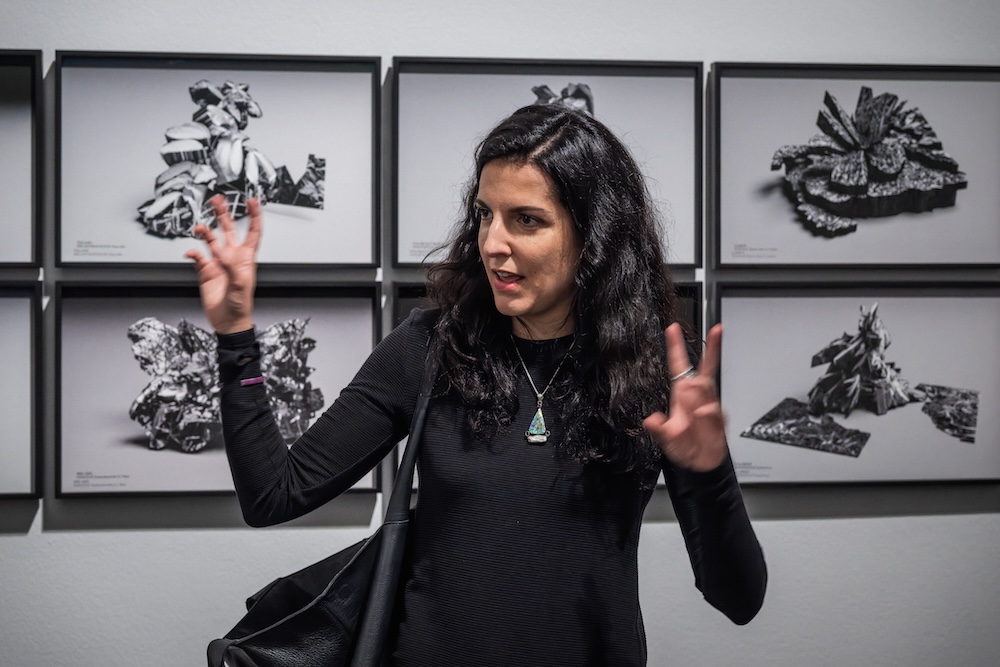
Paloma Polo at La Virreina. Photo © Pep Herrero
NP: Wrinkled Minds is the name of the new work. In it, you construct a speculative, fictional narrative about white supremacy, giving visibility to the Native American community, specifically the Haudenosaunee women. How did you begin your research and how did you approach them? What role did the writer and activist Michelle D. Schenandoah play in this process?
PP: One dimension of my work involves thinking about political issues and then materializing them artistically. To answer your question I should talk about my previous project in the Philippines, and one of the reasons I went there is that I realized I couldn’t continue addressing issues of coloniality from the comfort of my home. From a guerrilla context, I began to learn about Filipino political thought. There are practices that stretch back four hundred years, almost four centuries of systematic insurrections against colonial powers (Spain, Japan, the United States). Although this struggle can be formulated, as a Marxist, I believe that on a discursive level it is appropriated by Eurocentrism, but when you look “inward,” at the daily organization, what you find is Indigenous political thought. I maintained a conversation over time with José María Sison, also known as Joma, a founding member of the Communist Party of the Philippines, who passed away in 2022. Joma had the foresight to link the student movement with the Indigenous movement in order to reorganize and revitalize the struggle, creating the New People’s Army. That helped me understand that there was a problem with genealogies. I saw how they were putting feminism into practice without explicitly speaking about it, but that within the guerrilla movement there was a very guarded openness to any kind of gender identity and to being queer. It was an inspiration and an approach to feminism that didn’t come from books, it came from something much deeper and more rooted in their origins. This subject stayed with me for a long time, and in that obsession I saw how it is now more than proven that Enlightenment thought owes a great debt to Indigenous critique. All paths led me to the Haudenosaunee people and culture when I started studying the genealogies of political thought. I see the connections between the origins of Marxism and Indigenous communities, but feminism also owes a great debt to Indigenous women. Then I thought, how is it possible that information about this non-patriarchal society didn’t resonate with Western intellectuals who were beginning to think about contemporary feminist ideology? However, when I read books on the origins of feminism and contacted women who had previously researched this topic, their response was that they hadn’t noticed these connections. How is it possible that no one thought of this? So that led to a very interesting research project. From there, I began reading Sally Roesch Wagner, an American scholar who passed away in 2024 and who spent forty years investigating how 19th-century Anglo-Saxon feminism emerged in dialogue with the influence of Haudenosaunee women. There are no archives about them because the archives were controlled by white men. There is a gender problem and a class problem in historical memory. The hegemonic genealogy of feminism is an invention that white feminism itself constructs. I am very fortunate to have decolonial philosopher friends who support me, such as Michelle D. Schenandoah, and she reminded me that her anti-patriarchal struggle doesn’t require theorizing or self-defining as feminist because her practice is already an ancestral challenge to the hierarchy of oppression.
NP: It is impossible to avoid mentioning the US today, which has a government that denies climate change and is deeply racist. The Haudenosaunee way of life is based on the complete opposite, that is, on care, on the age-old principle that all decisions must take into account their impact on seven future generations. You’ve had some close contact with them, what is it like under the current administration?
PP: That’s exactly where the film begins, with how these colonialist discourses reverberate in the present and what other iterations they have had in different historical moments that have not been examined. One example is the Clinton-Sullivan campaign of 1779, in which the army committed genocide against the Haudenosaunee nations, a bloody campaign that barely appears in history books. This gave me the key to structuring the film’s present-day narrative. The Jesuits’ attacks on women and the attacks on the land are for me deeply connected in terms of coloniality. I decided to assemble three interconnected time segments into a single narrative. The violence we see in the United States today can be understood in light of that past as a continuum.
NP: Having lived in Trump’s America, I can understand your desire to bring the two protagonists to life, that pair of white men who exemplify supremacist values. How did you come to create them? How does casting such people work?
PP: The United States is the eighth country I’ve lived in and the place where I’ve experienced the greatest culture shock. The polarization of society is very strong. The overall mood is very depressive, paranoid, almost schizophrenic. For example, I had never felt like a person of color, since I speak English quite fluently. But as soon as they noticed an accent, I stopped being European and white and became a Latina immigrant, and the treatment became different, hyper-violent. The casting was complex. In the film, they aren’t constructed as characters with specific identities. For me, they’re more like devices or vectors. Adrian Thömmes is an experimental theater performer and Bill Sage is a film actor. I like Bill a lot because he was the lead actor in almost all of Hal Hartley’s films. I wanted a Hollywood actor who was also familiar with more indie cinema, and he appeared. I didn’t want to pander to the audience by simply putting two white supremacists on screen, I didn’t want a caricature of Trumpism so the average progressive viewer could feel satisfied after seeing the film. In terms of the acting, I needed to create a point of tension where the audience could identify with the characters, I needed a certain degree of hermeticism. The film isn’t scary, but I wanted to emphasize its sinister and terrifying aspects. The ambiguity of the characters, including their sexuality, had to be evident.
NP: The title Wrinkled Mind comes directly from a Haudenosaunee concept used to define the Western way of thinking. All of this was implicit in your 2019 work, Barro de la revolución (The Mud of Revolution). Did you enter the guerrilla community as a member, with military discipline? How did you approach the work methodology?
PP: It was wonderful. I went to the Philippines when I was 29 years old and had no idea what armed struggle was like there. The project began when a Dutch institution proposed that I do a project on ecology and land use. I got them to pay for a preliminary research trip and came across members of the Communist Party who worked at the university. They asked me: “Do you want to learn? We propose that you become a visiting research fellow. We won’t pay you, but we’ll get you a visa.” And I said: “When do I start?” My duty was to learn and train. It was hard to earn the respect of my comrades, but after three years, almost part of their collective, I proposed to the party that we make “a film to educate outsiders,” in the sense of opening up a field of understanding, and they agreed. In terms of my methodology, it adapts to the circumstances. The base I always start from is listening and sharing, thinking with the people. My methodology coincides with Devon Abbott Mihesuah’s assertion: In any interaction, one should not write, publish, or speak about communities, especially Indigenous communities, if this exercise is not of interest and use to them, and if it does not serve their future generations.
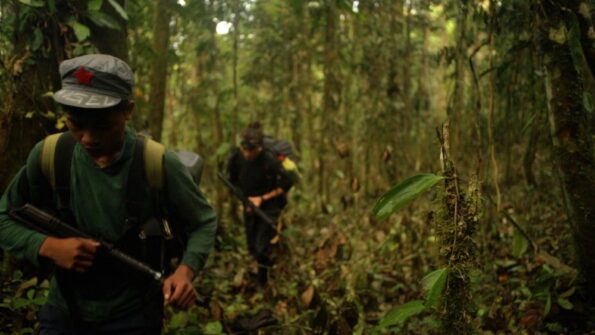
Frame from El barro de la revolución [The Mud of Revolution]
PP: The armed struggle is usually understood as military combat, but that’s only 5%. In the Philippines, the armed struggle rests on three pillars: the agrarian revolution; base building, which involves organizing, raising awareness, and working with the people; and, lastly, military combat. The armed struggle also consists of teaching people to read and write; political education; and caregiving. I wanted to portray the entire structure that sustains the armed struggle, which isn’t so much about shooting an enemy, a very traumatic experience that shouldn’t be idealized, because life is very hard. There were parts of the film I had to negotiate in terms of what could be shown and what couldn’t. There also came a point when they told me I had to leave. Before that, I had suggested the possibility of becoming a full-time guerrilla fighter, and obviously they said no. They did tell me, though: “We’re going to take advantage of the privilege you have as a white woman in the art world to have you speak about this in Europe. That’s going to be your mission.”
NP: Your films don’t fall within the genre of non-fiction cinema, but I’ve read that you also “feel like an outsider” within the artworld. Does the political aspect of your work make it difficult for museums? Does distribution fit better into activist contexts?
PP: I have no formal training as a filmmaker but I think in images and my language is audiovisual. I really enjoy filming. When presenting the works, I don’t think about the display. At La Virreina, since I had an architect working on the installation, we focused more on how to present them. I make films because it’s the most accessible way for my work to circulate and reach people. I’m not so keen on making pieces tied to exhibition spaces. The films I make have an educational purpose and a clear political agenda. Part of my goal is to make them visible, although sometimes I feel like I’m in a no-man’s-land. At festivals they tell me my work is risky and doesn’t fit into their program. In political circuits they work well, but certain more subtle aspects of the script and editing are criticized. The number of educational talks and presentations that Barro de la revolución has had around the world is impressive. The work has been understood better in activist contexts than in the art world. I feel it’s very violent when in the world of film and art I hear comments like, “No, Paloma, armed struggle is violent.” I find that hard to believe. After five centuries of colonization, how can you judge the dignity of people who do admirable work, who could have died when corporations arrive with mercenaries to destroy everything, and whose Indigenous lives are worthless? Think about what you’re saying: Which armed struggle do you consider violent? There’s nothing more colonial and violent than making that judgment. Who is responsible for interrupting or ending the cycle of violence?
Paloma Polo ’s films demand an attentive and engaged viewing from the audience. The work doesn’t shy away from exploring the role of dissent from the margins and from otherness, or of denouncing structural sexism and always promoting the feminist struggle.
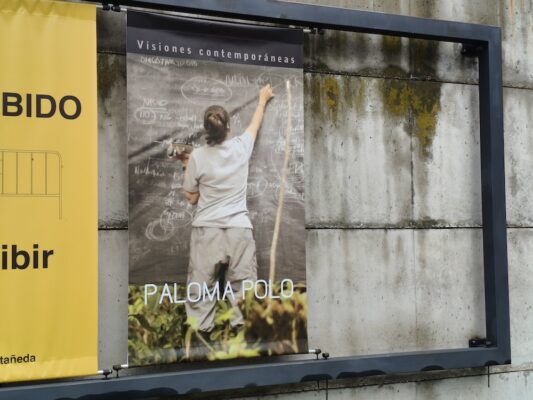
Banner of the exhibition at DA2
*Interview conducted in Madrid, December 2025
Paloma Polo’s exhibitions can be visited at Domus Artium de Salamanca (DA2), part of the Contemporary Visions series, until February 22nd, 2026 and the exhibition The Return of the Gaze: The Political Task of Narrating at La Virreina, Centre de la Imatge in Barcelona, until March 1, 2026.
[Featured Image: Installation view of video piece Wrinkled Minds at La Virreina, Centre de la Imatge]
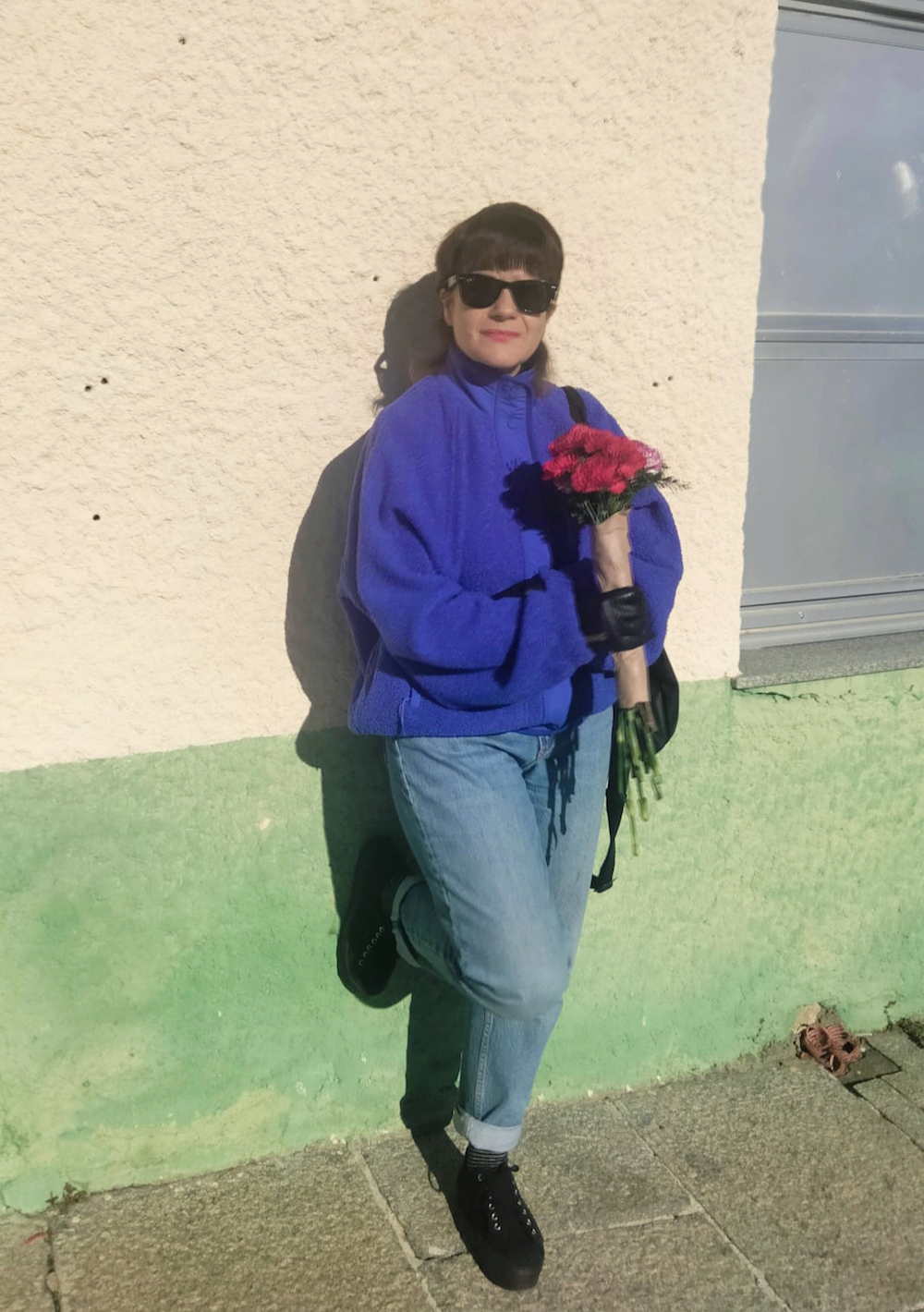
Natalia Piñuel Martín is an art historian, cultural researcher and curator. Co-founder of the Playtime Audiovisuales platform based in Madrid since 2007 from where they develop projects for museums and cultural spaces such as MUSAC (León), DA2 (Salamanca), Espacio Fundación Telefónica and Museo Centro de Arte 2 de Mayo (Madrid), AECID or the Cervantes Institute. She has been programming music & activities for the She Makes Noise Festival at La Casa Encendida since 2015. She writes regularly in the media and gives classes and talks on contemporary artistic practices and gender issues. She has curated exhibitions for the MEIAC (Badajoz) and audiovisual and performance cycles for the Women’s Institute and the Her Festival. She currently directs and hosts the Derivas podcast. She is in her second year as a doctoral student at USAL. Photo: Enrique Piñuel.
Media Partners:






"A desk is a dangerous place from which to watch the world" (John Le Carré)