Search
To search for an exact match, type the word or phrase you want in quotation marks.
A*DESK has been offering since 2002 contents about criticism and contemporary art. A*DESK has become consolidated thanks to all those who have believed in the project, all those who have followed us, debating, participating and collaborating. Many people have collaborated with A*DESK, and continue to do so. Their efforts, knowledge and belief in the project are what make it grow internationally. At A*DESK we have also generated work for over one hundred professionals in culture, from small collaborations with reviews and classes, to more prolonged and intense collaborations.
At A*DESK we believe in the need for free and universal access to culture and knowledge. We want to carry on being independent, remaining open to more ideas and opinions. If you believe in A*DESK, we need your backing to be able to continue. You can now participate in the project by supporting it. You can choose how much you want to contribute to the project.
You can decide how much you want to bring to the project.
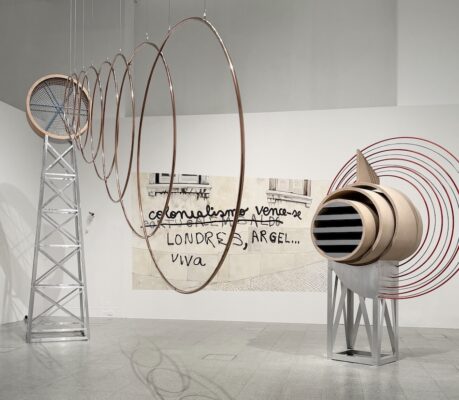
History is often written by those who have the power to archive it. Ângela Ferreira has spent decades challenging precisely that authority, the one that determines which versions of the past ultimately prevail as the official narrative. Here I Stand, her exhibition at MAC/CCB in Lisbon (on view until 28 February 2027), spans more than thirty years of artistic practice, using sculpture, sound (radio in particular), film and installation to revisit the legacies of colonialism and their contradictions. Through 25 works and installations created between 1991 and 2026, the Mozambican artist, a pivotal figure in the deconstruction of Portugal’s colonial past, confronts historical whitewashing and forcefully dismantles the Portuguese imperial legacy.
Ferreira is interested in exposing how history is constructed through narratives, images and power structures that can and must be reconsidered. She does so through an aesthetic that combines the Russian Constructivism of her formative years with domestic objects transformed into sculptures that speak to the symbolic violence of everyday life. For years, the artist has been dismantling the official narratives of modernity and examining the traces colonialism has left in Africa. The exhibition’s title comes from a 1958 book by Paul Robeson, who argued that artists cannot remain neutral. Ferreira wholeheartedly endorses this position: “I have a political mission.”
Born in Maputo in 1958, when Mozambique was still a Portuguese colony, Ferreira lived through apartheid in South Africa, where she studied Fine Arts at the University of Cape Town. Her biography is inseparable from her work, which focuses on the relationships between architecture, ways of living and power structures.
The photographic project Sites and Services (1991–1992) opens the exhibition. It documents a peripheral settlement in Cape Town (Khayelitsha), where South African authorities provided plots with basic infrastructure, including toilet blocks, before homes were built. The programme also allowed the authorities to control the settlement’s spatial distribution, as it was designed to channel the urbanisation of the Black population into new residential areas. What is particularly striking is that Ferreira stole four of these blocks and, in an act of literal appropriation of apartheid material turned into artistic matter, incorporated them into one of the installation’s minimalist sculptures.
In A Tendency to Forget (2015), Ferreira reverses the anthropological gaze, turning researchers Jorge and Margot Dias into the subjects of her own investigation. Drawing on Margot’s field diaries, Jorge’s reports and footage shot in Mozambique, which encapsulate the tensions between field experience and the account that could be made public within that political context, she reconstructs the contradictions of research conducted under the Salazar dictatorship and in the service of colonial institutions. The projection calls into question the supposed neutrality of a scientific gaze shaped by colonial power.
Radio, whose significance in liberation movements also features in Ferreira’s research, emerges as a tool for emancipation and the circulation of voices. In Rádio Voz da Liberdade (2022), she revisits broadcasts by the Algerian radio station that, during the war of independence, gave voice to the anti-colonial struggle and also provided a platform for Portuguese exiles opposed to Salazar’s dictatorship.
Her latest installation, Stone Free (Zama Zama) (2026), returns to South African mining, filming informal miners who clandestinely enter abandoned mines to survive (the zama zama), caught between the promise of wealth and the reality of an extractive colonialism that never ended. A suspended mining tower, two projections and an audiovisual piece by musician Scúru Fitchádu compose this landscape of exploitation and survival.
Curated by Nuria Enguita, Here I Stand invites us to look at the colonial past through its material and symbolic traces, but also through the ways in which it continues to shape the present. To do so, Ferreira opens archives, revisits images and dismantles power structures that still determine who has the right to tell history.
Ver esta publicación en Instagram
Paco Arteaga is a 360º journalist: he takes photos and videos, writes, translates, edits in CMS (WordPress, Storyblok) and Photoshop, optimizes SEO, proofreads and manages two blogs: Berlinamateurs.com and Withinflorence.com.m. He is attracted to art in all its manifestations. Portfolio: www.paconeumann.com
Media Partners:






"A desk is a dangerous place from which to watch the world" (John Le Carré)