Search
To search for an exact match, type the word or phrase you want in quotation marks.
A*DESK has been offering since 2002 contents about criticism and contemporary art. A*DESK has become consolidated thanks to all those who have believed in the project, all those who have followed us, debating, participating and collaborating. Many people have collaborated with A*DESK, and continue to do so. Their efforts, knowledge and belief in the project are what make it grow internationally. At A*DESK we have also generated work for over one hundred professionals in culture, from small collaborations with reviews and classes, to more prolonged and intense collaborations.
At A*DESK we believe in the need for free and universal access to culture and knowledge. We want to carry on being independent, remaining open to more ideas and opinions. If you believe in A*DESK, we need your backing to be able to continue. You can now participate in the project by supporting it. You can choose how much you want to contribute to the project.
You can decide how much you want to bring to the project.
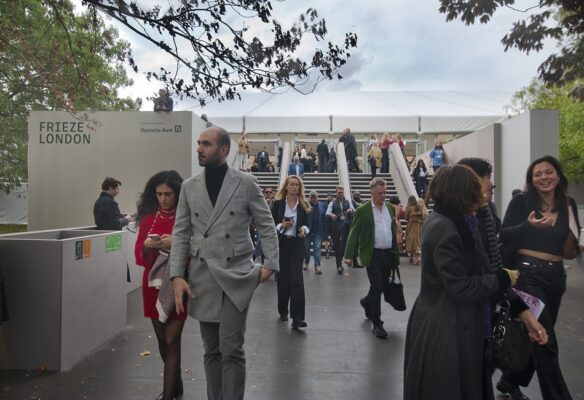
In late September, during my morning walks through Regent’s Park, I watch an army of workers in fluorescent vests racing against the clock to set up the infrastructure for Frieze. Everything must be ready by October 14th. For that week, London becomes the epicenter of the art market, drawing in collectors, artists, and the public from across the globe. The “Frieze Week effect” extends well beyond the tents, permeating the entire city: museums launch major exhibitions, auction houses hold high-value sales, and a proliferation of satellite and independent spaces emerges—a testament to a vibrant and diverse local scene. But to what extent can a temporary infrastructure support a city’s artistic ecosystem throughout the rest of the year?
Although Brexit—along with the consolidation of Art Basel Paris, which takes place the following week—has led to some major business shifting to the French capital, Frieze retains an undeniable symbolic weight: being at Frieze is a must. As art advisor Arianne Piper explained to ARTnews, the end of import exemptions and the introduction of customs hurdles have pushed the fair to evolve from a transactional hub into a more curated, talent-focused platform. In the same article, gallerist Thaddaeus Ropac notes that London’s appeal lies in the fact that it is a city where artists actually create work: “Frieze London showcases what is happening in studios and within the emerging scene.” This shift is also reflected in the fair’s layout: as of 2024, “Focus”—a section dedicated to young galleries (35 of them this year, hailing from all over the world)—greets visitors right at the entrance.
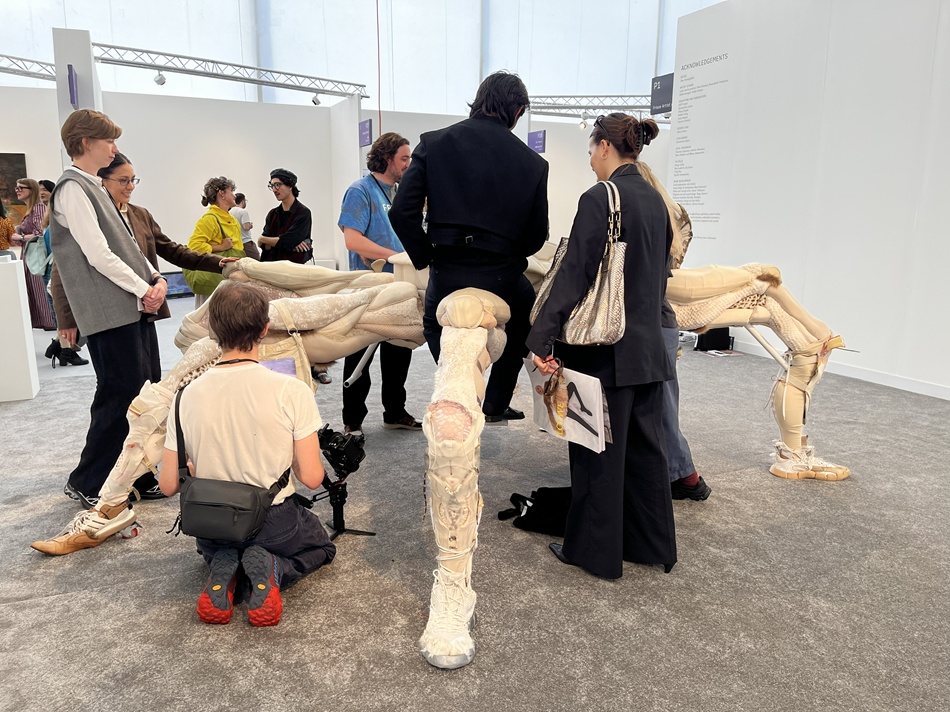
Theo Triantafyllidis, Feral Metaverse (Spider), 2026. Commissioned after winning Frieze Artist Award this year. Photography by Cecilia Martín
“In a way, we now build our entire year around the fair,” says Freddie Powell, founder of Ginny on Frederick, a London-based gallery specializing in emerging art. For Powell, London is experiencing an exciting moment: a whole new generation of young galleries—such as his own, Brunette Coleman, Public, or Nicoletti—is taking off. “There is undoubtedly an exciting energy surrounding this part of the market. In weeks like this, when we win an acquisition prize and there’s so much to celebrate, everything feels much more positive,” he says.
This refers to the acquisition of Fame is a Gun—a painting by Okiki Akinfe, accompanied by a light box and a preparatory drawing—through the Dasha Shenkman Focus Fund. This new £30,000 fund is financed by philanthropist Dasha Shenkman and managed by the Contemporary Art Society to acquire works by young artists featured in the “Focus” section of the fair. In this inaugural instance, the pieces will go to Abbot Hall in Kendal. “This is Okiki’s first acquisition by a British museum—the first permanent home where her work can be seen in this country. That is an incredible milestone for any artist,” emphasizes Powell. For a young gallery, the fair serves not only as a commercial showcase but also as a platform for institutional validation.
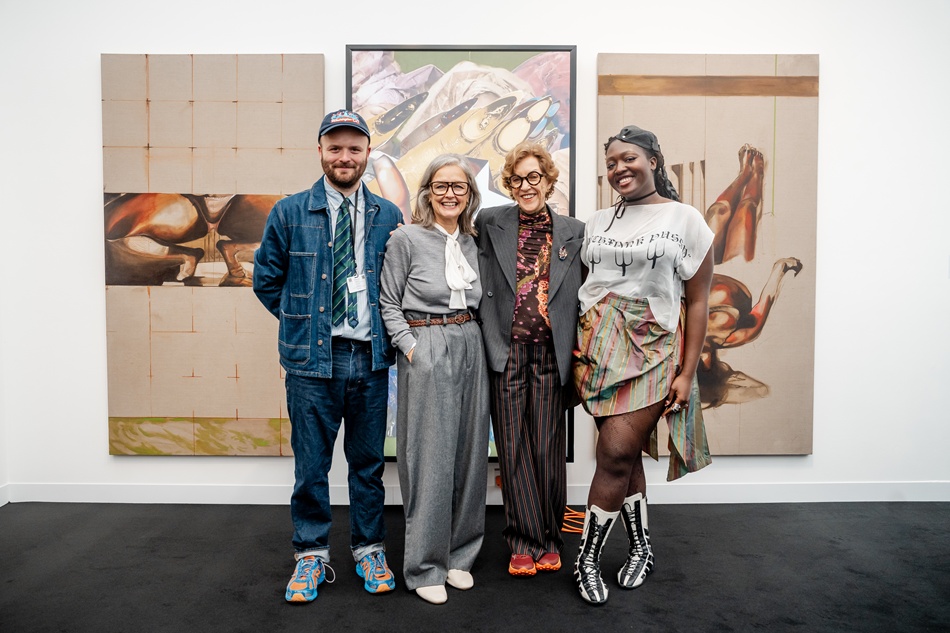
Freddie Powell, Caroline Douglas, Dasha Shenkman and Okiki Akinfe at Ginny on Frederick. Courtesy of the Contemporary Art Society. Photography by Joe Short.
Such acquisitions carry even greater weight given the ongoing decline in public funding. Caroline Douglas, director of the Contemporary Art Society, is direct in her assessment: “Public collections have not only seen their acquisition budgets slashed—or even eliminated—by successive governments, but years of staff cuts have also left many curators struggling to find the time for research.”
Frieze has cultivated a network of partnerships with institutions and foundations, turning the fair into a gateway for emerging art to enter public collections. This year, the Contemporary Art Society marks the tenth anniversary of its Collections Fund at Frieze, through which it has acquired 37 works for nine regional museums. In this edition, three works will go to The Whitworth in Manchester: a video by Karimah Ashadu, a textile piece by Claudia Alarcón and the Wichí weaving collective Silät, and a drawing by Gala Porras-Kim. For all the artists whose work was acquired this year, this marks their first inclusion in a British museum collection.
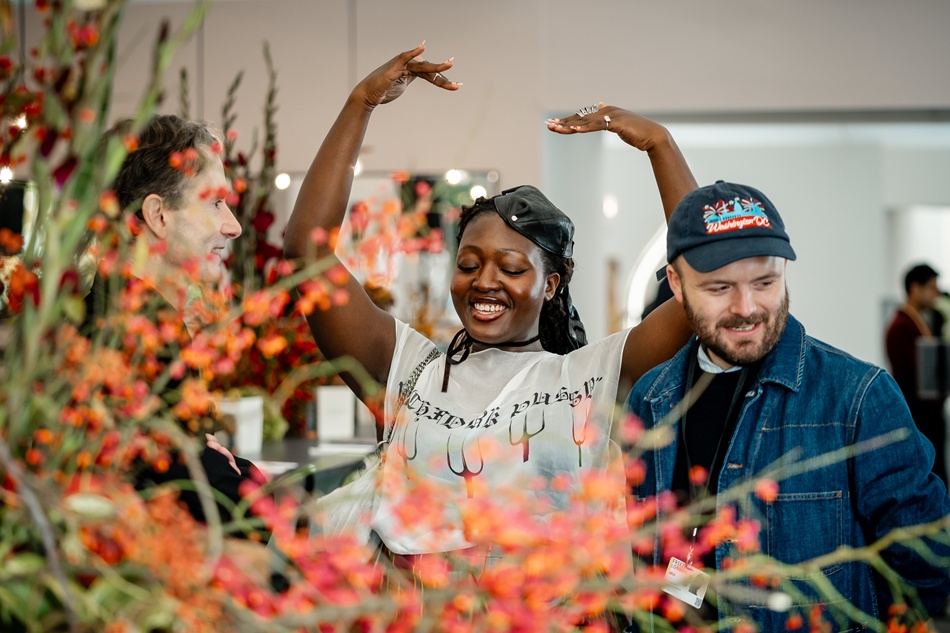
Peter Davies, Okiki Akinfe and Freddie Powell. Courtesy of the Contemporary Art Society. Photography by Joe Short.
Other partnerships focus on exhibition rather than acquisition. Since 2018, the Camden Art Centre Emerging Artist Prize has selected one artist from the “Focus” section. According to its director, Martin Clark, the prize serves two purposes: it focuses attention on the artist and their gallery during Frieze Week and, crucially, offers the artist a solo exhibition at the center within the following 18 months. This is an increasingly rare opportunity; as Clark notes, “The capacity for a publicly funded institution to take a risk on a young artist has been shrinking over the last decade.” This year’s winner is Ella Fleck, whose work incorporates sculpture, sound, and scent. Jack O’Brien, the 2023 winner, went on to exhibit at institutions in Germany and Poland, as well as in the British Art Show. The prize also supports a new generation of galleries and collectors; many of its “Award Patrons” are under the age of 50.
According to Douglas, private philanthropy now funds a significant portion of new acquisitions—even for the Arts Council Collection, which was once entirely state-funded. “For years, we have been moving toward an American model of private patronage, though this is much harder to cultivate outside of London,” he adds.
The Frieze brand also plays a role. Although the Dasha Shenkman Focus Fund is not strictly framed as a prize, Douglas acknowledges that this year “it felt like one,” generating a buzz that proved beneficial for both the artist and Abbot Hall: “It turns an acquisition into an event.” The same applies on a city-wide scale: “Frieze Week” functions as a shared identity, helping museums, galleries, and independent spaces gain visibility and reach audiences they might otherwise miss.
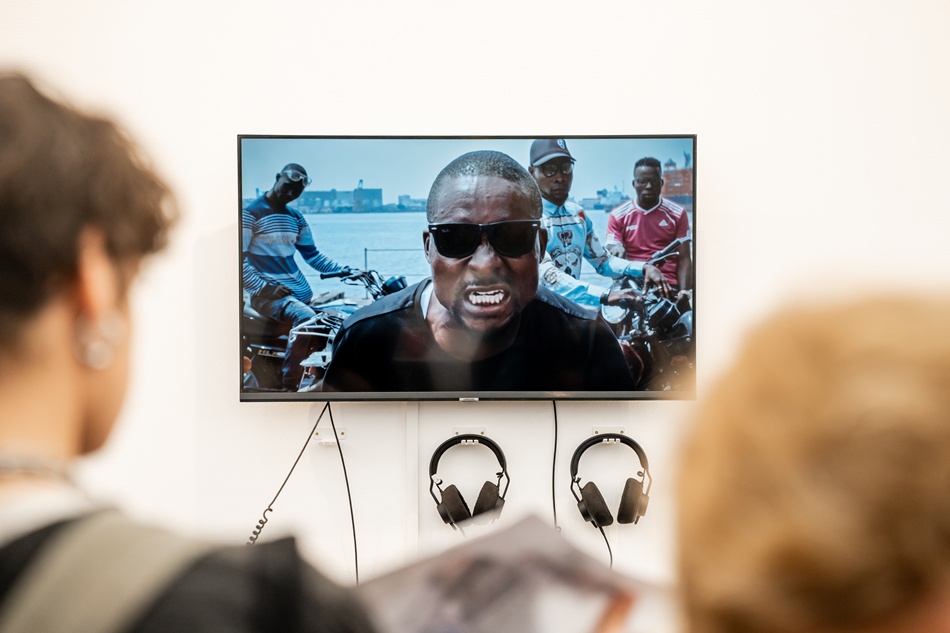
Karimah Ashadu, Machine Boys, 2024, installation view. Frieze London 2026. Photography by Joe Short
Yet, it is important to remain mindful of the inherent contradictions. As The Guardian critic Jonathan Jones writes: “Frieze is said to define what is new and to discover the stars of tomorrow. But it is clear that, in reality, it serves the needs of sellers and the tastes of a specific, ultra-wealthy type of consumer.” With tickets priced at around £92, Frieze remains, first and foremost, a commercial space. And if part of the institutional recognition of emerging artists depends on it, one must ask what happens to those who remain outside its circuits.
A fair, on its own, cannot sustain a city’s art ecosystem. Douglas notes that Frieze London has made an effort to provide a platform for younger galleries—a reflection of the dynamism of the London scene—while institutions and patrons transform that fleeting visibility into permanent collections. The Contemporary Art Society, she explains, acts as a connector: “We help turn the energy of the commercial art world into a lasting public benefit,” because “a healthy art ecosystem depends on sustained, collaborative support for new talent across the entire sector.” Such support, however, increasingly relies on private patrons and partnerships. The question, perhaps, is not whether Frieze benefits the London ecosystem, but rather what it says about that ecosystem that a commercial fair has become so pivotal to the funding, visibility, and legitimation of emerging art.
[Featured image: Frieze London 2026. Image by Lyndon Douglas. Courtesy of Frieze]

Cecilia Martín is the arts and culture brand strategist. Cecilia is based in London and has founded the Cultural Connection (CC) network-agency that helps museums, art galleries, biennials, orchestras, auditoriums and universities around the world to break the mold and find new ways to connect with their public. Cecilia is a professor of Communication and Branding in Art for the Master of Contemporary Art of the IL3 at the University of Barcelona.
Media Partners:





"A desk is a dangerous place from which to watch the world" (John Le Carré)