Search
To search for an exact match, type the word or phrase you want in quotation marks.
A*DESK has been offering since 2002 contents about criticism and contemporary art. A*DESK has become consolidated thanks to all those who have believed in the project, all those who have followed us, debating, participating and collaborating. Many people have collaborated with A*DESK, and continue to do so. Their efforts, knowledge and belief in the project are what make it grow internationally. At A*DESK we have also generated work for over one hundred professionals in culture, from small collaborations with reviews and classes, to more prolonged and intense collaborations.
At A*DESK we believe in the need for free and universal access to culture and knowledge. We want to carry on being independent, remaining open to more ideas and opinions. If you believe in A*DESK, we need your backing to be able to continue. You can now participate in the project by supporting it. You can choose how much you want to contribute to the project.
You can decide how much you want to bring to the project.
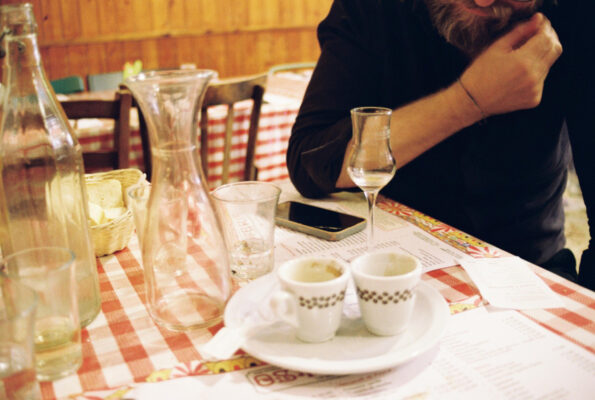
In this second part of the conversation, we turn from the wider structures of English as a literary gatekeeper to something more personal: the daily reality of writing, reading, and translating between languages. We talk about the strange authority of translators working into English, how small publishing houses really make decisions, and the unexpected political lives of minority languages – why defending Catalan feels different from defending Veneto. We end, perhaps oddly, on Latin: a language that belongs to no one, and therefore maybe to everyone.
Holten: So we’ve covered translation and the wider implications of English as a sort of ‘industry standard’ for literary production. But what about you personally as a writer? I felt Perfection got so many of the all-important details right, and some of that was played through the use of the German language. I was reading the English translation, but in general, what is your relationship to English day-to-day? Do you want to speak a little bit about that?
Latronico: I still do a large part of my reading in English, unfortunately, in a way, because I would like it to be different. Often, these are books directly written in English, but more often they are books whose Italian translations either don’t exist or are less precise. I say this as a translator myself. Translators are poorly paid in every country I know, but compared to the Italian market, translations into English are much better paid. Because they have more time – not because they’re intrinsically smarter – they tend to produce better work; they can devote more energy to it.
But I don’t think it’s just the money. There is also a difference in the “philosophy of translation.” There’s a Hungarian academic, Ágnes Orzóy, who did a clever piece of research interviewing translators working between English and Hungarian. She tracked how they saw their craft and their position within the cultural ecosystem – specifically whether they saw their work as a “menial task” or as something more.
Holten: Is that a menial task, or as you know, artists making art?
Latronico: Exactly. And those working towards English had a much higher idea of their position than their Hungarian counterparts. Of course, this is because translators into English are also the conduit to a big market. Normally, you know that if you are translating a Hungarian writer, you are doing something very significant for them – it’s going to be a big thing for their career. Whereas the opposite often doesn’t hold. I mean, frequently when I was translating American writers, I would send them emails with very detailed questions about their work, and they would just say, “Oh, whatever. Do whatever you want. I don’t really care.” Because, you know, Italy is a small market. Why would they spend time on that? This would never happen the other way around.
So, I think that is part of the equation. But it’s not just that. I also think that for many reasons – maybe the dominance of English is one – the “code of conduct” of translation gives more authority to the translator within the English language than abroad. I mean, look at the Han Kang example; the famous case of Deborah Smith’s translation of The Vegetarian. It was wildly successful, but then it was criticized for taking too many liberties with the original text.
The way that Sophie Hughes translated Perfection is not a way that would have been acceptable in the case of a translation towards Italian. But I think she was right in doing this, because a language is not just about precise word or sentence equivalence. It’s about recreating a “vibe,” if you will, and a style. But you can only really claim the authority to do that if you operate within a context of dominance.
I mean, if you read the German Romantic theory of translation – and at the time, not coincidentally, German was the dominant language in literature and culture in Europe – the German Romantics thought that translations were actually better than the original. They believed the translator could kind of “purify” the imperfections – the accidental imperfections of, say, this great universal idea happening to you, an Irishman – and in translation, I could purge it of those accidentals and restore it to its universal purity. Of course, this is not exactly what Sophie Hughes has done, but I think you can only formulate the theory that translations can slightly diverge from the original from within a dominant language. But then, sometimes that’s good.
Holten: Yeah, that’s fascinating. A while back there was the idea put around – even by some in the Swedish Academy – that the Americans and British (and Irish I should add) weren’t reading enough world literature. You know, it actually being the dominant language can also make you a bit weaker, right?
Latronico: Definitely. But I think it’s also very easy to analyze this in a purely materialistic sense. Every Italian editor speaks perfect English, so they have no problem there. Imagine an Italian editor has my book and your book on their desk. My book is a manuscript – it’s a Word file. Your book is about to come out in the UK or in the US.
This editor, who has read both, has to defend their decision to publish either one in front of their bosses. In my case, the editor can only say, “Well, I think this book is good.” In your case, they can say, “Well, I think this book is good, and Penguin also thinks this book is good, and they’re going to spend this much in marketing,” and so on. Or even better: Penguin has already published the book and it got these reviews.
So, paradoxically enough, for an Italian editor it’s much easier to publish translated fiction – especially if it’s been out in English – than it is to publish Italian fiction. Because – and I realize it’s a bit reductionist to analyze world literature in these practical terms of how corporations work, but I think it is enlightening – in the US and the UK, you most often don’t need to speak another language to be an editor. Translated literature in their case becomes a burden because they cannot really evaluate it well enough themselves; they need to spend money on the translation. Whereas the fact that a book is translated in Italy is a “pro.” It makes an editor’s life easier.
Holten: This will be translated, as you know, into Catalan and Spanish.
Latronico: Right, and there’s another interesting thing that maybe can be added or not, which is about what we were saying regarding nationalism. I find it fascinating – especially in the case of Catalan – because the defense of Catalan traditionally comes from the left. It’s seen as having been opposed by the Franco regime, and so the defense of Catalan is generally associated with the leftist cause.
But it’s interesting that in Italy, dialects were also very strongly opposed by the Fascist regime. However, the defense of local languages today is associated with the far-right. The defense of the Veneto dialect, for instance, is championed by the party of Matteo Salvini. It is a far-right cause, even though there are contemporary poets – one of the greatest Italian poets of the last few decades, Andrea Zanzotto, also writes in the Veneto dialect, and he definitely was not voting for Salvini. But that cause in Italy is coded right-wing. Even the defense of linguistic autonomy in South Tyrol is very right-wing coded; they were even “Nazi-coded” at some point. I don’t know –I have no conclusion to draw from it, but I find it fascinating.
Holten: I think that’s great that we end on that point. I want us to include that exact thought because it is a paradox. I used to joke – it was a joke in bad taste – but I used to say that I was a “self-hating English speaker” because I want to speak the languages I’m surrounded by. I should hear as much Italian or German as I do English – living with an Italian in Berlin, as I do.
It’s strange that it then becomes this nationalist thing to defend against or hate on the English language. We need a universal discourse space – if we want universal ideals to be able to operate in this world of xenophobia and division, then it helps to have a lingua franca, maybe.
Latronico: Yeah, of course.
Holten: But then, it should be nobody’s language.
Latronico: I think that Latin was good because nobody was born with Latin, and so everyone was on an equal footing!
This is the second part of the conversation between Vincenzo Latronico and John Holten. You can read Part 1: The Weight of the Center, here.
(Featured Image: © Juliet Barbieri)

Vincenzo Latronico is a writer and translator. His latest novel, Perfection, has been translated in 43 languages; it has been shortlisted for the International Booker Prize, longlisted for the National Book Award and the Strega Prize, and awarded the first Tom Wolfe Air Mail Prize. He lives in Milan.
Portrait © Marcus Lieder

John Holten is an Irish born, Berlin-based novelist and publisher, whose most recent novel is The Trains of Europe (2024). www.johnholten.eu
Portrait © Juliet Barbieri
Media Partners:








"A desk is a dangerous place from which to watch the world" (John Le Carré)