Search
To search for an exact match, type the word or phrase you want in quotation marks.
A*DESK has been offering since 2002 contents about criticism and contemporary art. A*DESK has become consolidated thanks to all those who have believed in the project, all those who have followed us, debating, participating and collaborating. Many people have collaborated with A*DESK, and continue to do so. Their efforts, knowledge and belief in the project are what make it grow internationally. At A*DESK we have also generated work for over one hundred professionals in culture, from small collaborations with reviews and classes, to more prolonged and intense collaborations.
At A*DESK we believe in the need for free and universal access to culture and knowledge. We want to carry on being independent, remaining open to more ideas and opinions. If you believe in A*DESK, we need your backing to be able to continue. You can now participate in the project by supporting it. You can choose how much you want to contribute to the project.
You can decide how much you want to bring to the project.
1.
In the heady late eighties and early nineties – the end of history, to some – as the Berlin Wall fell, the Soviet Union dissolved, and the Thatcher–Reagan axis wreaked havoc on either side of the Atlantic, something queer and roguish was being born. The film scholar and critic B. Ruby Rich labelled this burgeoning thing New Queer Cinema, naming a constellation of largely but not exclusively North American and British films that orbited non-normative desire and its attendant sensibilities.[1]B. Ruby Rich, “New Queer Cinema,” Sight & Sound, vol. 2, no. 5, September 1992, pp. 30–34; reprinted in New Queer Cinema: The Director’s Cut (Duke University Press, 2013).
2.
In Vienna, Ursula Pürrer, A. Hans Scheirl and Dietmar Schipek, a renegade trio of filmmakers, were imagining a future. In their feature-length film Rote Ohren fetzen durch Asche (released in English as Flaming Ears) (1991/1992), we are thrown into the chaos of the year 2700 in the city of Asche, a burnt-out dystopian metropolis. Constructed over two years and populated by a motley cast of friends, former lovers and fellow travellers, the imagined city and its denizens fused into a strange yet seductive chimera.[2]Remake. Frankfurter Frauen Film Tage, “Rote Ohren fetzen durch Asche / Flaming Ears,” restoration programme, 2019.
3.
As the story goes, Pürrer met Scheirl in Vienna in the mid-1980s and a ménage à trois between the two and a Super 8 camera ensued. The pair refer to their short films of this period, most of them staged in Pürrer’s apartment, as “lesbian punk home movies”.[3]“Flaming Ears (1992),” 366 Weird Movies; see also Sixpackfilm, Ursula Pürrer filmography. It’s easy to see how these early homespun experiments lay the groundwork for the queer configurations at the heart of Flaming Ears, which offers a distorted snapshot of Vienna’s lesbian scene: an underground coterie of artists, musicians and assorted misfits.
4.
With the film’s English title, Flaming Ears, the trio chose a tauter, punchier appellation than the literal German-to-English translation, Red Ears Rip Through Ashes, would have afforded. Not to mention its added allure of summoning Jack Smith’s low-budget, genre-defying Downtown cult classic Flaming Creatures (1963). And like the older film its title echoes, Flaming Ears has a taste for the antic and the perverse, one that could rankle audiences, including those who stormed out of screenings or called the film “disgusting”.[4]Holly Willis, “Reckless, Greedy and Dangerous: Angela Scheirl Talks About Flaming Ears,” Filmmaker Magazine, Winter 1993.
5.
In my many ill-fated attempts to write on this unruly piece of cinematic history, I kept returning to the circus as an archetype or form and to this bunch of co-conspirators as something like a travelling band of social outcasts and weirdos. It’s a curious but apt analogue: a troupe that carries its world with it, costumes, props and sets alongside the bodies required to animate them. Flaming Ears was made in this spirit, and by these means, with Pürrer, Scheirl and Schipek sharing production duties, passing the camera among themselves, writing the script, and largely making the costumes, music, sets and special effects themselves.[5]Ibid. When Vienna – a nineteenth-century city in appearance and social mores – offered too little of the world our cineastes craved, they ran off to shoot in Hamburg and New York with costumes and props in tow.
6.
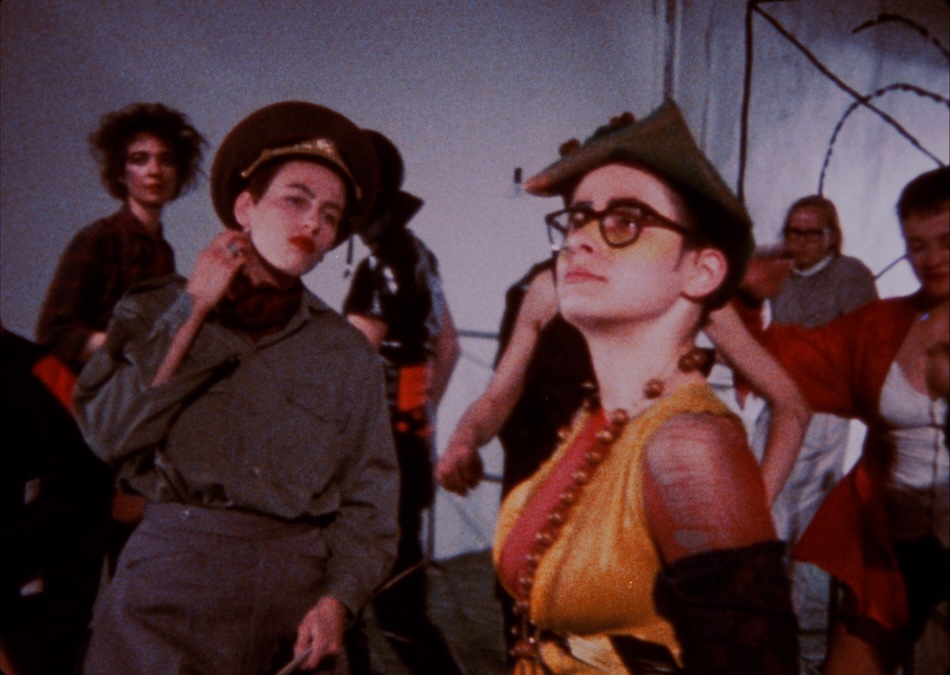
On the third or fourth watch, I found myself frustrated by the near impossibility of following the plot, if Flaming Ears can be said to have anything of the sort. As one writer put it, Flaming Ears is “less of a narrative film and more of a burlesque wandering through a lesbian wasteland.”[6]BL Panther, “Flaming Ears Is a Queer Dystopian Romp Through an Uncertain Future,” INTO, 5 June 2023. If I were pressed to give a synopsis, this here would be as good as any: Spy is a comic-book artist whose printing press has been burned down by Volley, a pyromaniac performance artist, and sets out to exact revenge. Her pursuit leads her to the club where Volley performs, but Spy is beaten before she can get very far. Nun, Volley’s extraterrestrial lover in blazing red leather, comes across the injured Spy and becomes enamoured of her. What follows is an increasingly unstable triangle of desire, jealousy, betrayal and violence.[7]Sixpackfilm, “Flaming Ears / Rote Ohren fetzen durch Asche,” film catalogue.
7.
In her eponymous 1992 Sight & Sound essay “New Queer Cinema”, B. Ruby Rich distilled something of the film’s unruly theatricality when she described it as possessing “an atmosphere of cabaret, rubble, and revenge”.[8]B. Ruby Rich, “New Queer Cinema,” Sight & Sound, vol. 2, no. 5, September 1992, pp. 30–34. The rough-and-ready sensuality of each scene takes precedence over any kind of plot or narrative. This is a cinema of scabrous textures and – perhaps most ingeniously – exaggerated sound, the two enlisted to emphasise the mise-en-scène’s material qualities.
8.
When Scheirl describes their and Pürrer’s earlier Super 8 films as performances for camera, they highlight “the performance, the gesture, the posing.” Flaming Ears expands this intimate arrangement for two into something for the multitude, a riotous chorus of bodies drawn from the filmmakers’ lesbian compatriots, nowhere more vividly than in the nightclub scenes, where revellers grind, dance, pose, fuck …
9.
The imprint of Pürrer’s, Scheirl’s and Schipek’s influences can be gleaned throughout the film – the DIY abrasiveness of punk and post-punk; VALIE EXPORT’s confronting bodily provocations, Kenneth Anger’s occult pageantry, the camp delirium of Jack Smith, Fassbinder’s cruel melodrama and the baroque artifice of Ulrike Ottinger; and perhaps less predictably the choreographic prowess of Tsui Hark’s and King Hu’s martial arts cinema.
10.
Place all this against a backdrop of conservative Viennese society, signalled in part by the Catholic symbols strewn across the film’s eighty-four minutes. Witness the church tossed around and played with like an old prop. As the film’s introduction announces, Asche is a place where – like an inversion of Sodom and Gomorrah – it is “highly unlikely for a pure soul to survive.” Call it a queer eschatology, if you will. Or the lesbian carnivalesque. The order of things is upended in this topsy-turvy world of strange and lurid happenings.
11.
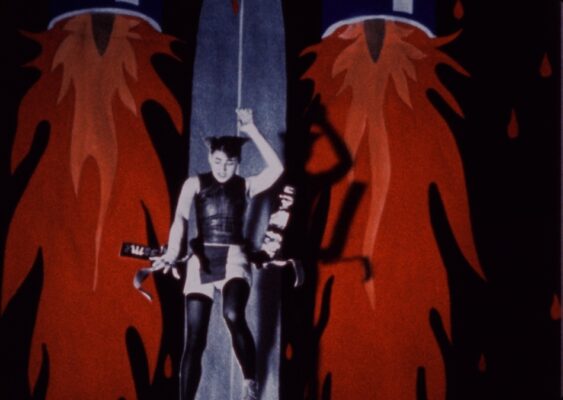
When a character falls against a backdrop of flames in an animated sequence somewhere in the film’s first few minutes, is this a descent from prelapsarian grace into the fallen world? And if all has been flipped on its head, what sort of kinky pleasures await them?
12.
From the Latin cadere, “to fall, sink, settle down, decline, perish” is where we derive the word cadaver.[9]Oxford English Dictionary, s.v. “cadaver.” But death here is hardly a serious affair: after all, the characters in Flaming Ears die more times than I can count before returning to life just as often.
13.
By my fourth or fifth viewing of Flaming Ears, I’m frustrated and more than a bit dispirited by my failure to make something of that opening flurry of nonsensical gestures, actions and wordy non-sequiturs. Then, a little further on, we are introduced to the city of Asche cast in miniature as a large maquette, like a beaming totality sent to relieve me of the barrage of fragmented sensations, forms and images. For a moment, the promise of relating parts to a greater whole is teased before we are dragged back into the chaos again.
14.
The imagined metropolis of Asche is cast in miniature: an elaborate maquette or, as I’ve come to think of it, a toy city whose inhabitants are dressed, posed, coupled, mutilated, killed, revived and rearranged capriciously as if by the invisible hand of some mischievous god-baby (or three). For the British paediatrician and psychoanalyst D. W. Winnicott, transitional objects such as dolls, blankets and teddy bears are “affectionately cuddled” and “excitedly loved and mutilated”.[10]D. W. Winnicott, “Transitional Objects and Transitional Phenomena,” International Journal of Psycho-Analysis, vol. 34, 1953, pp. 89–97; reprinted in Playing and Reality (London: Tavistock, … Continue reading Through them, the child discovers the external world’s capacity to withstand its affection and aggression, one punch, scratch and bite at a time – a game of “fuck them up and find out”, to riff on a now-familiar idiom.
15.
Is the aggression in Flaming Ears – playful, ersatz, and cartoonish, as it is – meant to impart on its viewers some kind of lesson? I strongly doubt it. If anything, this is a film that bristles at being stuffed into a parable, or the too-tidy cubbyhole of feminist filmmaking.
16.
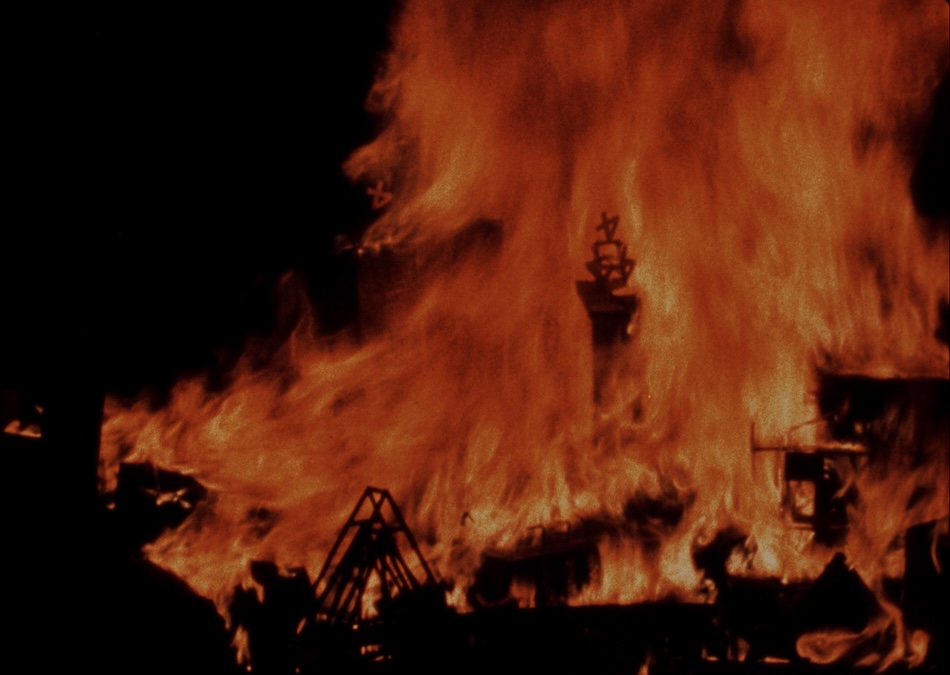
Flaming Ears is an oddball, sci-fi production in which play, artifice and self-fashioning are cris de coeur against conformity. If the city outside cannot deliver the worlds you desire, it says, grab some friends and build your own. Just don’t forget the matches.
(All images: Pürrer, U., Scheirl, A. H. y Schipek, D. (Directors). Film Stills from Rote Ohren fetzen durch Asche (released in English as Flaming Ears), Austria, 1991/1992. Sixpackfilm. http://www.sixpackfilm.com/en/catalogue/2160/)
| ↑1 | B. Ruby Rich, “New Queer Cinema,” Sight & Sound, vol. 2, no. 5, September 1992, pp. 30–34; reprinted in New Queer Cinema: The Director’s Cut (Duke University Press, 2013). |
|---|---|
| ↑2 | Remake. Frankfurter Frauen Film Tage, “Rote Ohren fetzen durch Asche / Flaming Ears,” restoration programme, 2019. |
| ↑3 | “Flaming Ears (1992),” 366 Weird Movies; see also Sixpackfilm, Ursula Pürrer filmography. |
| ↑4 | Holly Willis, “Reckless, Greedy and Dangerous: Angela Scheirl Talks About Flaming Ears,” Filmmaker Magazine, Winter 1993. |
| ↑5 | Ibid. |
| ↑6 | BL Panther, “Flaming Ears Is a Queer Dystopian Romp Through an Uncertain Future,” INTO, 5 June 2023. |
| ↑7 | Sixpackfilm, “Flaming Ears / Rote Ohren fetzen durch Asche,” film catalogue. |
| ↑8 | B. Ruby Rich, “New Queer Cinema,” Sight & Sound, vol. 2, no. 5, September 1992, pp. 30–34. |
| ↑9 | Oxford English Dictionary, s.v. “cadaver.” |
| ↑10 | D. W. Winnicott, “Transitional Objects and Transitional Phenomena,” International Journal of Psycho-Analysis, vol. 34, 1953, pp. 89–97; reprinted in Playing and Reality (London: Tavistock, 1971). |
Tendai Mutambu is a curator, writer and film producer based in Aotearoa (New Zealand), where he is Director of Enjoy Contemporary Art Space. His work focuses on contemporary artists’ moving image, with particular attention to Black, Indigenous and diasporic theory and practice. He has held programming and editorial roles at institutions including the European Media Arts Festival, Fridericianum, LUX Moving Image and Berwick Film and Media Arts Festival, and has curated exhibitions and film programmes by artists including Marwa Arsanios, Danielle Brathwaite-Shirley and Tanoa Sasraku. He was associate producer of Aura Satz’s debut feature length documentary Preemptive Listening. His writing has appeared in Frieze, ArtReview, Elephant, Art Monthly UK, MoMA Magazine and Ocula Magazine, where he was a contributing editor.
Portrait: Ajamu X.
Media Partners:







"A desk is a dangerous place from which to watch the world" (John Le Carré)