Search
To search for an exact match, type the word or phrase you want in quotation marks.
A*DESK has been offering since 2002 contents about criticism and contemporary art. A*DESK has become consolidated thanks to all those who have believed in the project, all those who have followed us, debating, participating and collaborating. Many people have collaborated with A*DESK, and continue to do so. Their efforts, knowledge and belief in the project are what make it grow internationally. At A*DESK we have also generated work for over one hundred professionals in culture, from small collaborations with reviews and classes, to more prolonged and intense collaborations.
At A*DESK we believe in the need for free and universal access to culture and knowledge. We want to carry on being independent, remaining open to more ideas and opinions. If you believe in A*DESK, we need your backing to be able to continue. You can now participate in the project by supporting it. You can choose how much you want to contribute to the project.
You can decide how much you want to bring to the project.
For a long time, I thought my curatorial practice had begun in museums. After many years, I realized it had started much earlier in the markets of western El Salvador/Kuskatan, a territory that, after the Spanish invasion, would be reorganized by means of so-called “Indian villages.” My mother, my grandmothers, my aunts, and many of the women in my family worked in these markets. That was the school where I learned that a conversation is worth as much as an archive, that breakfast sometimes opens more doors than an official letter, and that relationships need time, reciprocity, and care to endure. There, I learned that for many of us, art doesn’t begin in museums, but rather in the textiles, adornments, carvings, jade, and ceramics that shape our daily lives.
The infrastructures that make much of the artistic work possible in Kuskatan and Guatemala rarely appear in exhibition credits or cultural project reports. When I speak of these infrastructures, I’m not referring to institutions or budgets but to kinship networks, markets, paths traveled, recommendations from godmothers, shared meals, those who introduce you to other artists, and the trust that is slowly built over the years.
My relationship with markets didn’t begin as a researcher or curator. It began as the son and grandson of women who earned their living there. My grandmother worked her entire life in the markets of Guaymango and Sonsonate. My mother worked throughout her childhood and adolescence selling food and other things in the Sonsonate market. It was there that I learned the different ways of trading, observing, dressing, negotiating, and caring. Those spaces that my mother showed me and shared with me were my first aesthetic education. They were also my first lesson in collective organization, the circulation of knowledge, and shared responsibility.
Over time, I came to understand that markets produce much more than just merchandise. It is in these spaces that trust, memory, and other forms of knowledge are produced, forms rarely recognized as such by most cultural institutions. It was also in this way that I learned that trade is a form of relationship. Objects travel, but they never do so alone, they always travel accompanied by people, conversations, recommendations, kinship, and responsibilities. Following these journeys, I understood that political borders say very little about how our peoples have continued to meet, trade, and learn from one another.
This is why, when I return to Guatemala time and again, I never feel that I am crossing a border into another place. I continue to traverse a territory that my family has crossed since long before I could name it as a method or as a curatorial practice. As a child, I traveled with my parents in the family pickup truck to Esquipulas, Antigua, el Lago de los Cisnes, Guatemala City, Quetzaltenango, and Chichicastenango. These were ways of learning about the territory. My mother took advantage of every trip to explore markets and to buy textiles, carved wood, ceramics, clothing, jewelry, and objects for our home. Many times we returned with the car full of things she had carefully selected, each one carrying its own story. The house was constantly transformed by these objects and I learned that each one arrived accompanied by relationships, conversations, and journeys.
The road itself was my school. I learned by watching my mother negotiate with the vendors, listening to the conversations between merchants, distinguishing the colors of textiles from different communities, feeling the smoothness of carved wood, the hardness of jade, and the motifs of the ceramics. That’s how I understood that each place produced particular ways of making and seeing the world. My education in art and aesthetics began there, uncontaminated by the colonial understanding of art that universities and museums have taught without questioning it.
Eventually, I understood that those trips didn’t just cross an international border. They traveled along an ancestral corridor between western El Salvador/Kuskatan and Guatemala, a route connected by pilgrimages, markets, kinship ties, trade, and shared ways of doing things. My curatorial practice was born within this continuity and has largely consisted of continuing to cultivate the relationships that my family already understood as part of daily life. In these markets, grandmothers preserve and share knowledge about their garments and the stories of their communities. Each conversation at a stall can become the story of a necklace kept for decades, of a family that still preserves a certain weaving technique, of a neighbor who wants to sell an inherited piece, or of someone who works in another community. Knowledge never remains still, it comes and goes between communities, between women, between generations.
In recent years, I have come to understand that the work of Mayan Quiché artists José Luis Fernando Morales (Luisfer), who works in the Antigua Guatemala market, and Silvia Canil Xirúm, who works in the Chichicastenango market, cannot be described solely as that of jewelry designers or ornamental artists. Each piece materializes a curatorial and public history practice sustained over months or years. Luisfer and Silvia, whose native language is Quiché, spend much of their time touring markets, talking with grandmothers, visiting weavers, carvers and silversmiths, learning new techniques, listening to stories, and building relationships that continue long after a piece is finished. The grandmothers with whom they work in the market return to their communities, talk with other women, and enquire about who has old necklaces or chachales, who still master certain fabrics, and who could collaborate on a new project. Days, weeks and sometimes even months later they return with new materials and new stories. The visible result is a necklace, bracelet, or earring carved from jade, but the real work is the network of relationships that made those pieces possible.
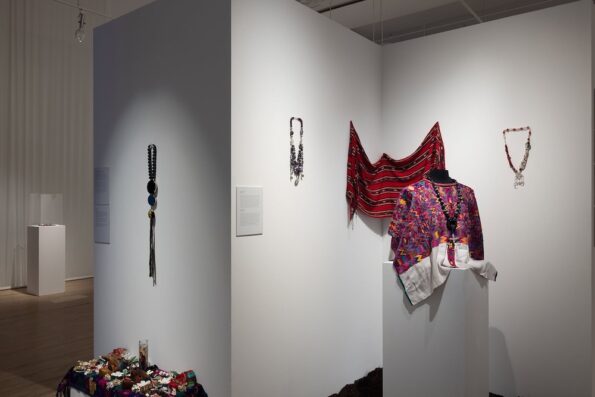
View of the exhibition Market as Archive: Economy, Women’s Knowledge, and Survival, showed in the context of 8.ª Bienal de Arte Contemporáneo Indígena (BACA) at EXPRESSION, Centre d’exposition de Saint-Hyacinthe, Quebec, Canadá. Installation by Luisfer (left) and installation by Silvia (right).
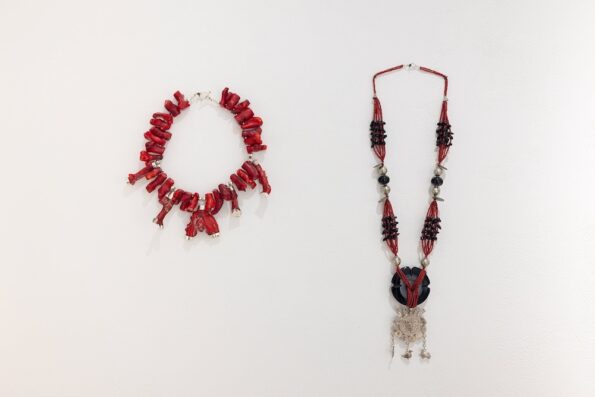
View of two works showed at the exhibition Color Is Not Neutral, as part of the 8.ª Bienal de Arte Contemporáneo Indígena (BACA), Galerie Art Mûr, Montreal, Quebec, Canadá. Left, work by Luisfer with red colar and sterling silver; right, work by Silvia made with obsidian, coral beads and chachal
When I accompany Luisfer to visit workshops of carvers, silversmiths or weavers, I understand that their practice consists less of producing objects than of bringing people together around a shared responsibility. Each artist has specific knowledge and each material has its own story. Each piece synthesizes years of trust accumulated between people who often belong to different communities. Quiché, Kaqchikel, Tzutujil, and Mam techniques and knowledge all come together in a single piece. The work does not erase the differences between peoples but rather recognizes how these relationships allow different knowledge to enter into dialogue without losing its specificity. Luisfer and Silvia’s curatorial practice does not consist of selecting works for an exhibition, it consists of making it possible for history, knowledge, materials, people and responsibilities to find new ways of meeting each other.
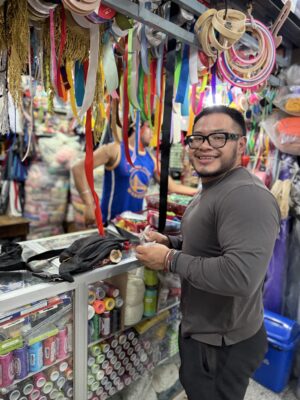
Antigua: José Luis Fernando Morales (Luisfer) looking for materials at the market, Antigua Guatemala, 2025. Photo: Armando Perla.
That is why I am less and less interested in asking where a curatorial practice occurs. The question that really interests me is what conditions make it possible for this practice to exist and continue. Over the years I have come to understand that the answer is rarely found in cultural institutions. Instead, it is found in people like Luisfer and Silvia, in grandmothers who tour the markets, in those who introduce one artist to another, in those who refer a collector to an artist, in those who maintain ties for decades without that work ever appearing in the credits of an exhibition or in financial reports.
It is precisely through indigenous ornamentation that techniques, memories, responsibilities and forms of relationship have circulated for generations, surviving processes of colonization, dispossession and genocides in both Nahua and Mayan territories. At the same time, many of the practices that sustain these relationships continue to occupy an ambiguous place within the art world. Ornament tends to continue to be read as craftsmanship rather than as a contemporary artistic and intellectual practice capable of producing theory, articulating territory and generating knowledge. For example, although in recent years Luisfer and Silvia have been part of multiple exhibitions in galleries and museums in Canada and New Zealand Aotearoa, they have never been invited to exhibit their work in cultural institutions in Guatemala or the rest of Central America.
There is also another paradox, namely, that much of this work occurs with very little institutional support. Visits to workshops, tours of markets, conversations, collaborative projects and research that allow these networks to be built usually depend on the daily work of artists, curators and communities that finance, organize and sustain these relationships with their own resources. If institutions arrive, they often do so at the end of the process, when the relational infrastructure has already been built by others.
Recognizing this infrastructure implies expanding our understanding of curatorial practice and artistic production. It means recognizing that a conversation in a market, a recommendation between friends, a shared trip through the territory, or a necklace made between several communities constitute the work itself. It is there where the conditions are produced for knowledge to continue circulating, where art continues to be built as a practice of relationship and where the territory remains alive through those who travel through it and sustain it.
Perhaps the challenge is not to incorporate these practices into existing categories of contemporary art but to ask ourselves how these practices transform what we understand as curatoring, artwork and institutions.
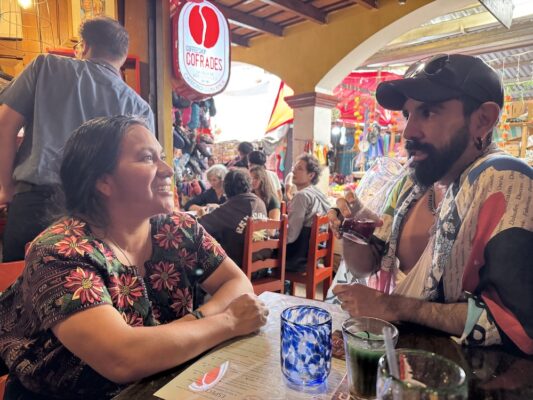
[Featured Image: Chichicastenango: Armando Perla in conversartion with the conversa con la maester weaver kaqchikel Oralia Chopén at the market Chichicastenango, Guatemala, 2024. Photo: Diego Ventura Puac-Coyoy.]
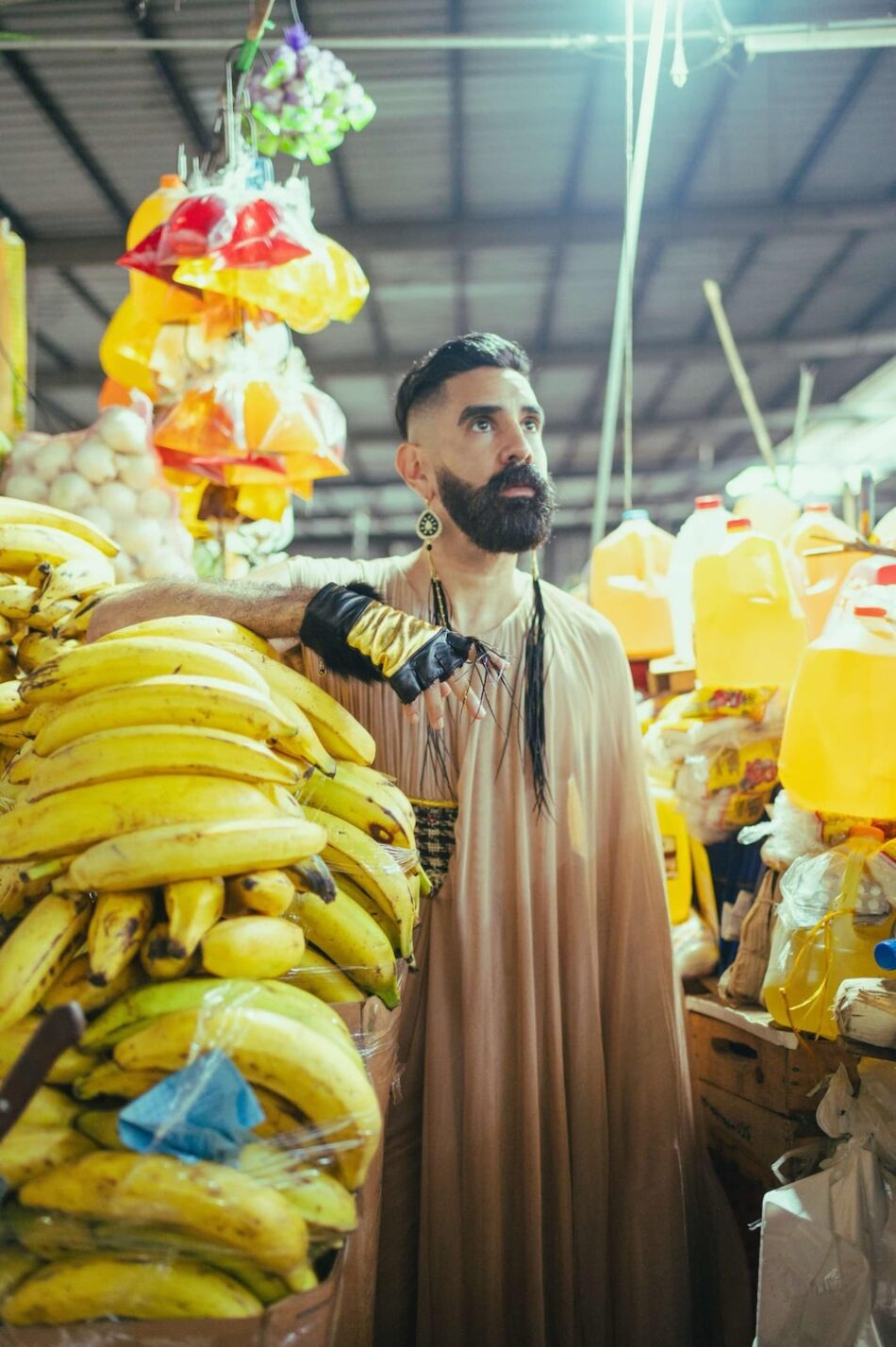
Armando Perla (they/them) is a non-binary curator, academic, artist and collector of Afro-Indigenous descent (Nahua, Maya, Senegambian and Spanish), originally from El Salvador. They arrived in Canada as a refugee and have built their career in museums, universities and collaborations led by Indigenous peoples. Their practice encompasses installation, performance, fashion and personal adornment, and includes a transnational collection of Indigenous fashion and visual arts. They currently co-direct the curatorial team for the 8th Biennial of Contemporary Indigenous Art (BACA). They have been awarded the Coronation Medal of King Charles III (2025) and the Joseph-Armand Bombardier Doctoral Fellowship (2021). They hold a PhD in Art History and Museology from the University of Montreal.
Portrait: Armando Perla, Santa Tecla market, 2024. Photo by Salvadoran artist Paula Rivera.
Media Partners:








"A desk is a dangerous place from which to watch the world" (John Le Carré)