Search
To search for an exact match, type the word or phrase you want in quotation marks.
A*DESK has been offering since 2002 contents about criticism and contemporary art. A*DESK has become consolidated thanks to all those who have believed in the project, all those who have followed us, debating, participating and collaborating. Many people have collaborated with A*DESK, and continue to do so. Their efforts, knowledge and belief in the project are what make it grow internationally. At A*DESK we have also generated work for over one hundred professionals in culture, from small collaborations with reviews and classes, to more prolonged and intense collaborations.
At A*DESK we believe in the need for free and universal access to culture and knowledge. We want to carry on being independent, remaining open to more ideas and opinions. If you believe in A*DESK, we need your backing to be able to continue. You can now participate in the project by supporting it. You can choose how much you want to contribute to the project.
You can decide how much you want to bring to the project.
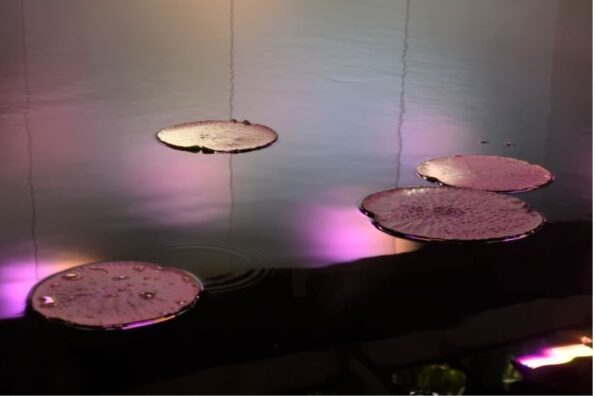
The happiest of water lilies are growing in the Canadian Pavilion of the Venice Biennale this year. Entre chien et loup (Between dog and wolf) by Abbas Akhavan (b. 1977, Tehran) transforms the pavilion into a greenhouse where Victoria water lilies (Victoria cruziana) bloom under ideal conditions of warmth and humidity. In their new garden, they resist imperial appropriation and start to shed the weight of their political reference to Queen Victoria (1819–1901). For wherever their seeds may go, if provided with the right ecology, they thrive.
From the display of water lilies in the Great Exhibition of 1851 in London’s Hyde Park, Akhavan takes them to today’s world’s fair of art. Yet unlike in 1851, Entre chien et loup begins to demythologise the water lily by giving the viewer space to bear witness the plant’s agency and the bareness of its material life. Audiences can partake in the joyful simplicity of watching these lilies flourish throughout the summer. Although their colonial legacy lingers in the background, Akhavan creates an ecology for the lilies to start breathing. The blossoming water lily reminds us of the possibility of outliving enforced imaginaries and political significations.
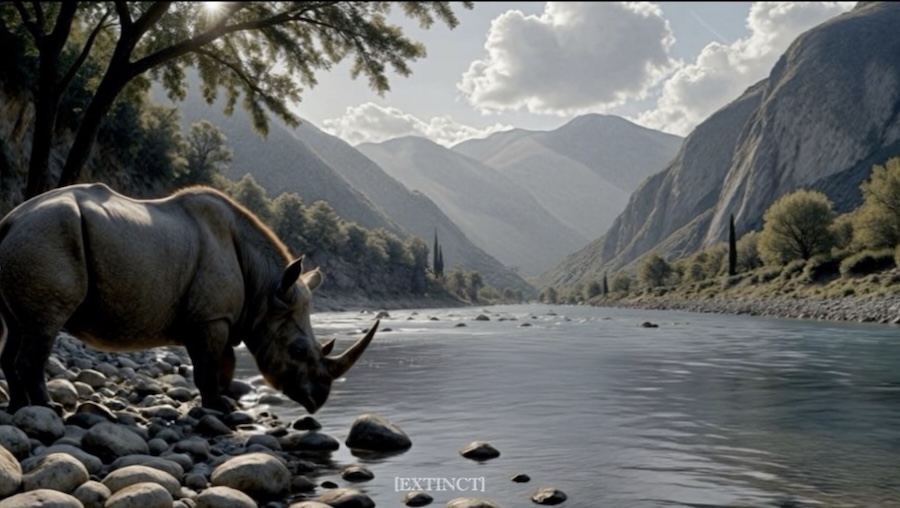
Sofia Dona, In Tempe or the dales of Arcady (2026), Thessaloniki Biennial, 2026. Photo: @sofia_dona_
On the other hand, some artists make us work by loading their materials with so much mythology that we begin to lose the plot. In February 2023, a disastrous train crash in Tempe Valley, Greece, killed 57 people who boarded in Athens on their way to Thessaloniki. In the aftermath, Greek society held vigils to honour the deceased, protests calling for accountability, riots against corruption, and railway union strikes. The Greek artist and activist Sofia Dona (b. 1981, Athens) responded to these tragic events by making In Tempe or the dales of Arcady, a fifteen-minute video of filmed footage and AI-generated animation.
For Dona, the whole ecology of the Tempe Valley, past and present, served as her material archive. She used AI to reanimate the extinct biodiverse climate that once occupied the site. While this is a powerful gesture to pay respect to the lives lost more recently, the work overflows with mythologies that come across as abstruse. Dona mixes references to Ovid’s Metamorphoses with the poetry of John Keats and the whispers of two of her friends who almost boarded the derailed train. There must be a less convoluted way to mythologise this ecology. Where Dona does succeed is that she does not re-externalise the violence of the land, rather she reimagines that which has gone extinct. Her video work stands as an ephemeral monument to the lives lost.
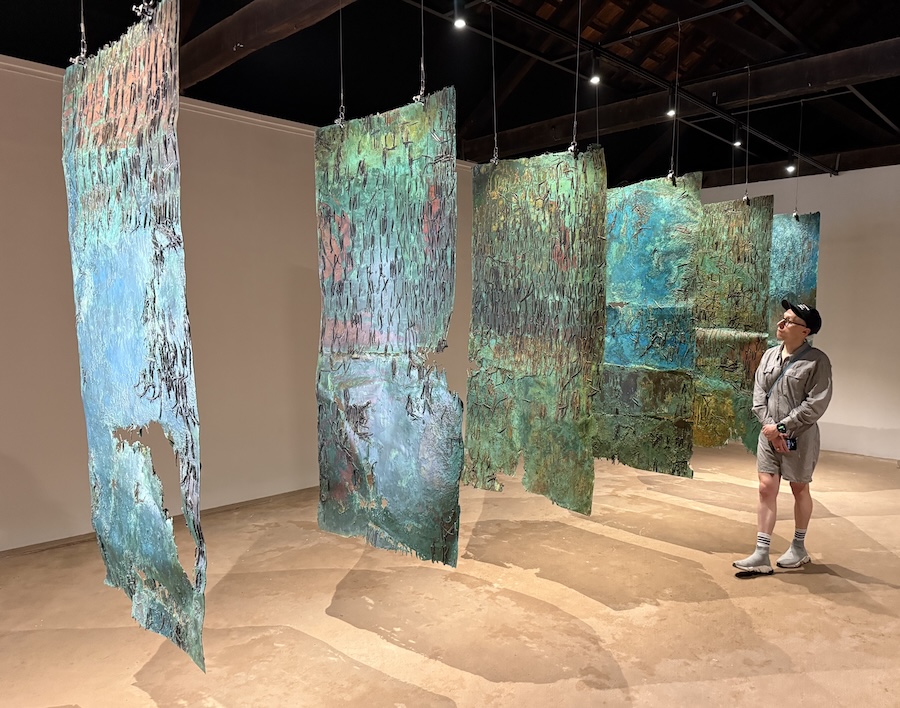
Kirtika Kain, Chronicles (2025), Aspinwall, Kochi Biennale, 2025. Photo: Vivek Gupta
In addition to material mythologies that respond to an ecological history such as those conveyed by Akhavan and Dona, there are others that are profoundly personal. These mythologies call upon viewers to put together the pieces to understand what exact materials an artist used to create their works and why those materials matter. And, spoiler alert, the materials are not often readily apparent and they frequently demand that one squints to read the fine print of an exhibition text.
Two artists Kirtika Kain (b. 1990, New Delhi) and Adebunmi Gbadebo (b. 1992, Livingston), whose works were on view in Kochi and Venice respectively, have created abstract objects that reflect on their own personal biographies. Kain’s project Chronicles (2025) includes cotton lamp wicks, dipped in tar, that are embedded in suspended sea-green copper plates. Through heating, casting, and oxidation, she allows the textures of copper to emerge. This labour-intensive process results in abstractions that accentuates the material’s mutability. However, the connection of Chronicles to Kain’s Dalit diaspora identity does not immediately come through. Dalit communities are indeed distinguished for their metalworking traditions, but it is left for the audience to wonder if this is why Kain devoted her attention to such a material.
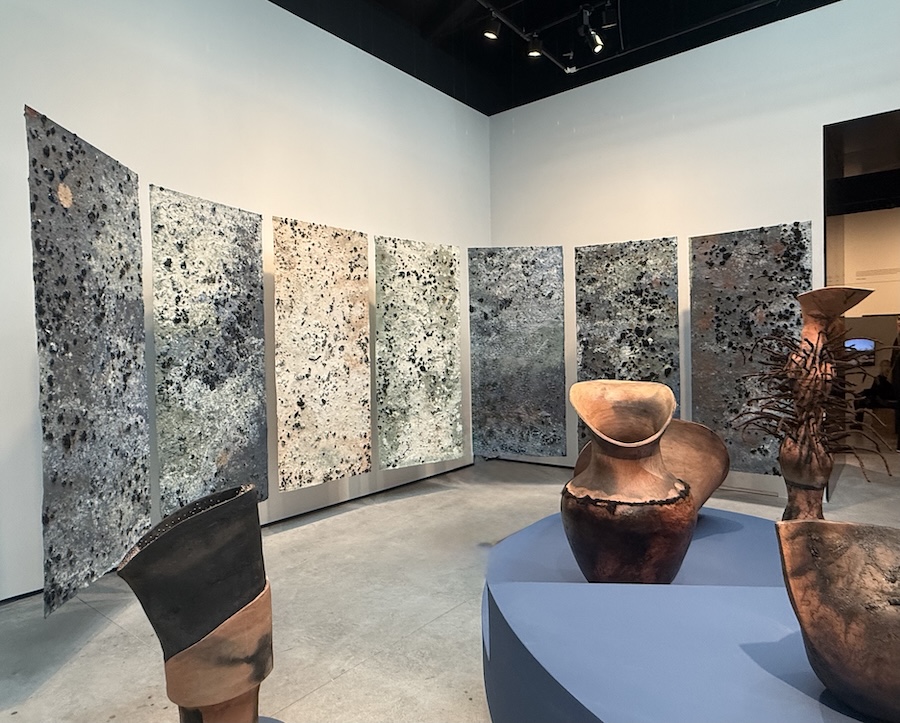
Adebunmi Gbadebo, installation of several works (2023–26). At the back, James Island (2025–26), Giardini, Venice Biennale, 2026. Photo: Vivek Gupta
Gbadebo’s abstractions similarly provoke the viewers to grapple with a layered material presence. Of course, her use of fragments of African-American hair summons a long arc of material history as best summed up by the practice of Lorna Simpson (b. 1960, Brooklyn). But this material mythology is much more specific to Gbadebo’s identity. For example, the fine print of seven suspended paper works, James Island (2023–26), the name of a town just south of Charleston, South Carolina, includes a long list of its materials. It is made ‘from True Blue Plantation Cemetery soil, SC, mined Kaolin Clay from Aiken, SC, Stoney Bluff Plantation soil, SC, human hair collected from Harlem barbershops, indigo, mica, periwinkle, phthalates blue pigment, Persian blue pigment, Cheryl R. Riley’s hair, True Blue Plantation cotton husk and seed, Moody family okra seed, Catawba Freedman okra seed, Ezelle Family fisheye pea seed, Sea Island rise pea, Bobby pins, [and] stainless steel bar’. This is an astonishing archive, much of which we are told has to do with the communities in South Carolina (SC) where Gbadebo’s ancestors lived and were forced to labour.
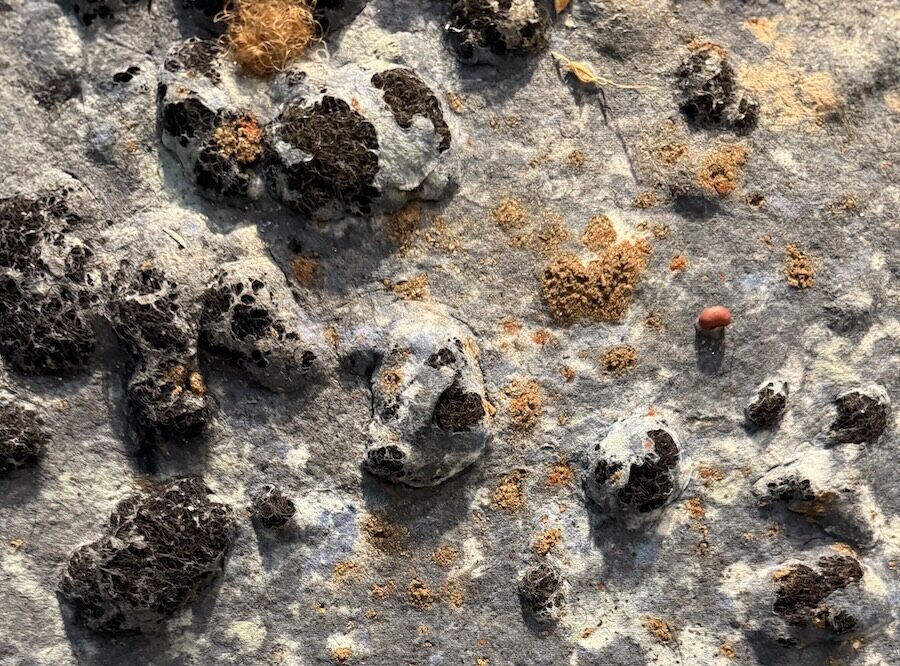
James Island (2025–26), detail. Giardini, Venice Biennale, 2026. Photo: Vivek Gupta
And despite their specificities to Dalit diaspora or African-American identities, when viewing Gbadebo’s James Island and Kain’s Chronicles together, we see several formal similarities. They appear as sheets of congealed personal mythologies both of which use abstraction to speak to the embodied power relations of labour. Yet, how broadly do these materialisations of struggle and memory reach outside a personal mythology? And, to what extent does their affective charge lie in knowing the complex stories of their materials? These are tricky questions because both of these artists excel in laying bare textured materials and the conditions of making.
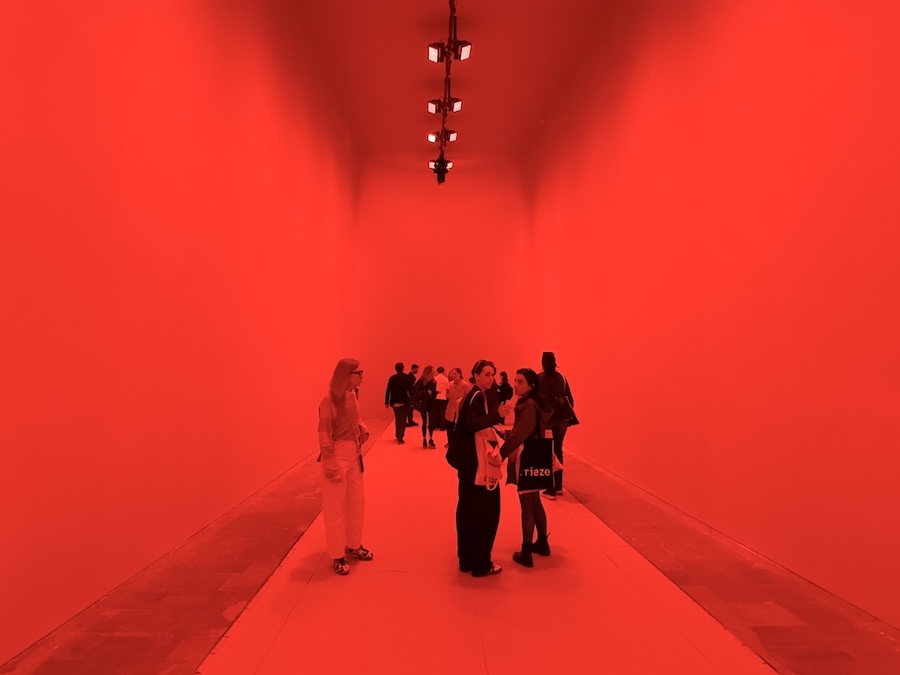
Alfredo Jaar, The End of the World (2023–24), Arsenale, Venice Biennale, 2026. Photo: Denis Maksimov
We conclude with a work that functions as a foil to Akhavan’s pavilion. If Akhavan’s Entre chien et loup signals the persistence of material life, The End of the World by Alfredo Jaar (b. 1956, Santiago) calls attention to its destruction. Intensified by an anxiety-inducing red light, Jaar builds a cathedral of human greed where he features ten rare metals: copper, rare earths, tin, nickel, lithium, manganese, coltan, germanium, and platinum. These metals are essential for technologies of warfare and are the very materials that are responsible for the gravest human tragedies today. Pressed into a small cube placed in a case at the end of a red hall, these metals coalesce to stand for a new global religion of resource extraction. Here, choosing between the path of life, as in Akhavan’s water lilies, and self-destruction, as in Jaar’s The End of the World, remains a constant challenge. The preservation of our very humanity obliges us to cultivate what Nadja Argyropoulou calls ‘radical intelligence’ — the act of creation beyond the manipulative desires to accumulate, tame, and subdue. This is about the material mythologies we choose to live by and how we remake their futures.
[Front image: Abbas Akhavan (b. 1977, Tehran), Entre chien et loup, Canada Pavilion, Venice Biennale, 2026, Photo: Courtesy La Biennale di Venecia]
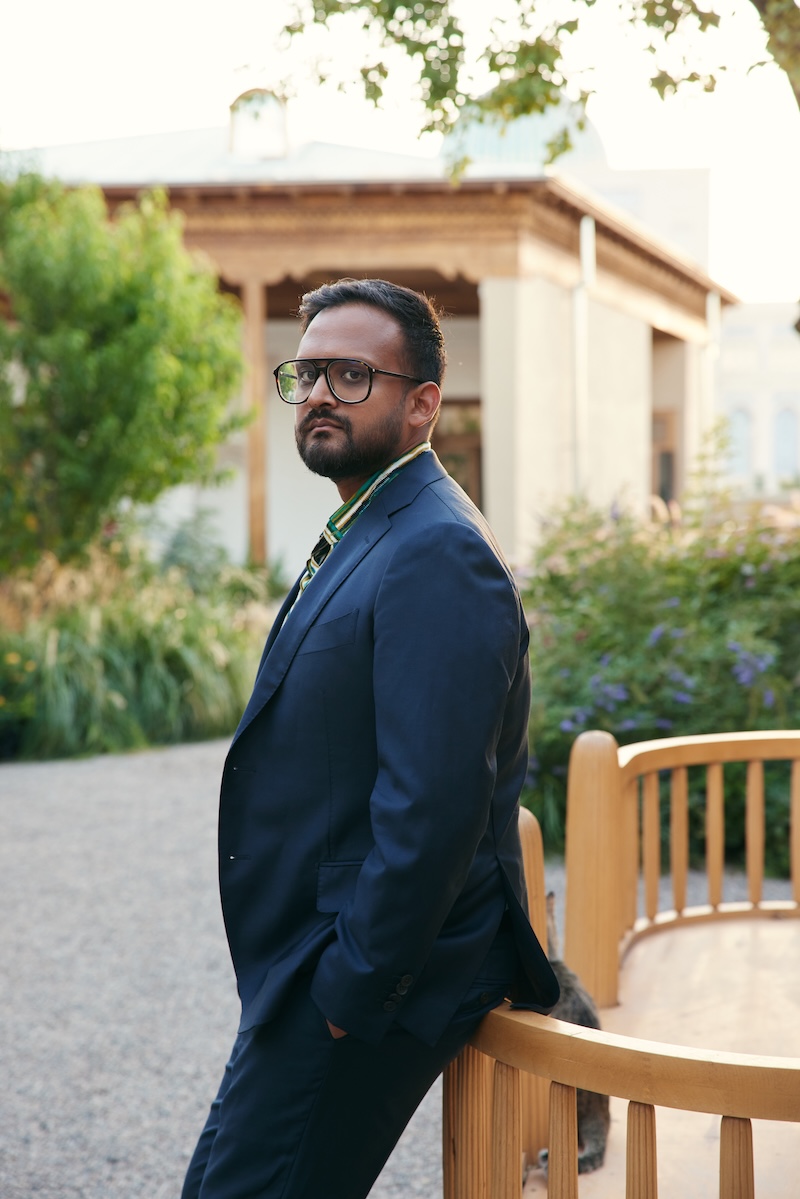
Dr Vivek Gupta is an art historian and curator of the Islamic, South Asian, and Indian Ocean worlds. He specialises in the art of the book, painting, calligraphy, and connections between portable objects and architecture. In recent publications, he has written about transregional circulation, cultural exchange, intersections between art and science, and transmediality. He is the author of Wonders of Hindustan: Artists and books in the early modern world (UCL Press) and curator of A Mughal Songbook: Art, Music, and Empire at the Fitzwilliam Museum, Cambridge (2026–27). He is currently a British Academy Postdoctoral Fellow in History of Art at University College London (2023–26) and previously was a Postdoctoral Research Associate at the University of Cambridge (2020–23).

Denis Maksimov is a historian of art and knowledge. His work focuses on aesthetics of epistemology, the relationship between heritage and future-making, and lecture performance. He is a guest curator at NYU Abu Dhabi Art Gallery and has curated exhibitions and programmes for institutions globally, including Helsinki Art Museum, Glyptoteket in Copenhagen, Pushkin House in London. His research and curatorial work have been presented in the Venice Biennales of Art and Architecture (2015, 2016, 2017, 2019 & 2022), Documenta 14 (2017), Ural Industrial Biennial (2017), São Paulo Biennale (2016), Art Basel, London Art Fair, Cosmoscow, etc. He is a lecturer at Backstein’s Institute of Contemporary Art, Salzburg International Summer Academy of Fine Arts, and was a visiting lecturer at the University of Applied Arts in Vienna. His writing has been published by MIT Press, Edward Elgar Publishing, MoMA, Ocula, Conceptual Fine Arts, Moscow Art Magazine, Obieg, Arts of the Working Class, among others.
Media Partners:






"A desk is a dangerous place from which to watch the world" (John Le Carré)