Search
To search for an exact match, type the word or phrase you want in quotation marks.
A*DESK has been offering since 2002 contents about criticism and contemporary art. A*DESK has become consolidated thanks to all those who have believed in the project, all those who have followed us, debating, participating and collaborating. Many people have collaborated with A*DESK, and continue to do so. Their efforts, knowledge and belief in the project are what make it grow internationally. At A*DESK we have also generated work for over one hundred professionals in culture, from small collaborations with reviews and classes, to more prolonged and intense collaborations.
At A*DESK we believe in the need for free and universal access to culture and knowledge. We want to carry on being independent, remaining open to more ideas and opinions. If you believe in A*DESK, we need your backing to be able to continue. You can now participate in the project by supporting it. You can choose how much you want to contribute to the project.
You can decide how much you want to bring to the project.
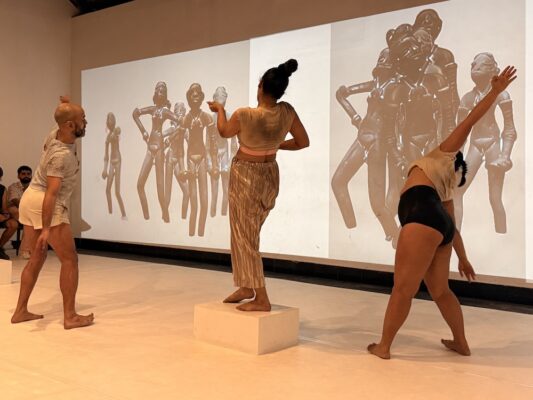
Objects are never stable. Even if modernity tries to fix them in place, in a frame or grid, they continue to misbehave. At a time when the lives of objects are under intensified pressure, with repatriation demands and political iconoclasm on the rise, artists of all three biennials under discussion draw our attention to the incessant mutability of things. This essay considers how artists have responded to everything including fragments of cultural heritage, everyday things, esoteric crystals and devotional icons.
Dystopic, haunting, and unruly, Mandeep Raikhy’s Hallucinations of an Artifact, a centrepiece of this edition of the Kochi Biennale, builds on Raikhy’s decades of experience cultivating an embodied intelligence. Stemming from his work on the tribhanga (triple-bend pose), Raikhy, along with his collaborators Akanksha Kumari and Manju Sharma, take the dislocated Indus Valley figurine off her plinth and onto the stage. Through reverberating movements, the trio speculates on the histories of the so-called bronze ‘Dancing Girl’ excavated in 1926 in Mohenjo Daro, modern-day Pakistan, and currently housed in the National Museum, New Delhi.
Like the mutability of the ‘Dancing Girl’, which Gupta has previously written about, performances change with their context. In development since 2019, Raikhy has toured Hallucinations around India and Europe, but its showcase in Kochi, at a biennale curated by the performance-based artist Nikhil Chopra (b. 1974, Kolkata) emphasises its provisional nature. The very mutability of the ‘Dancing Girl’ breaks down the binary between form and process. The figurine traverses historical epochs, she dances in the club, she weathers Delhi’s suffocating pollution, she lives, then dies, then is born again. Form is always in process and relies on its performance.
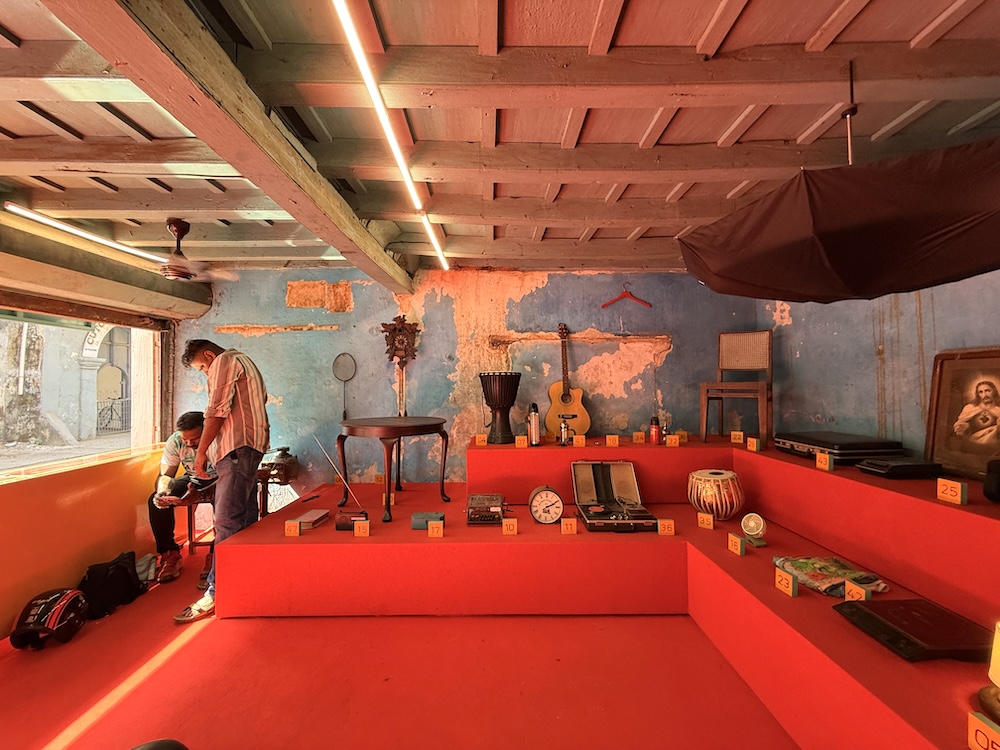
Cinthia Marcelle, History, Kochi Biennale 2025–6, Mattancherry. Photo: Vivek Gupta and Denis Maksimov
Across the street from the site of Raikhy’s Hallucinations, one finds a particularly strong dialogue concerning the mutability of objects in the work History by Cinthia Marcelle (b. 1974, Belo Horizonte). The things of Marcelle’s shopfront installation were not highly-politicised museum artifacts like ‘Dancing Girl’ or the Benin bronzes in Pio Abad’s contribution to this edition of Venice discussed last week. They were everyday objects that visitors brought to Marcelle’s ‘House of Repair’ so that they could be used again. Marcelle also established a relationship between the person who mended the object and its owner by acknowledging the worker’s name. All of this amounts to the performance of social bonds that go against capitalist logic. An object need not be in the public spotlight for it to warrant conservation and the care of communities.
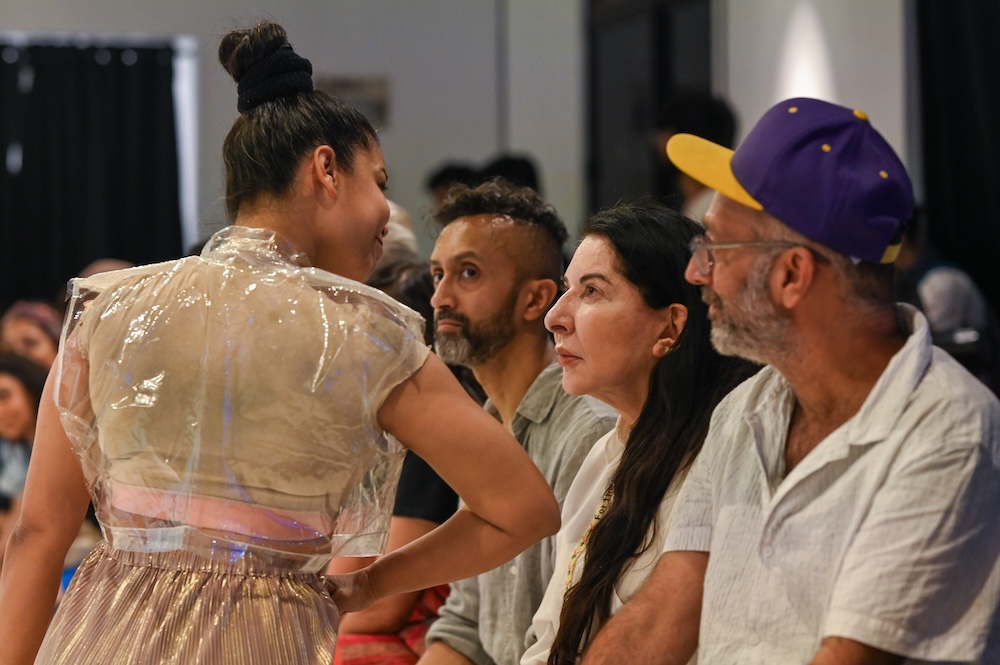
Manju Sharma in Hallucinations of an Artifact by Mandeep Raikhy, Kochi Biennale 2025–6. Photo courtesy of the Kochi Biennale Foundation
Returning to Raikhy’s Hallucinations, the image of the dancer Manju Sharma staring directly at an audience member, Marina Abramović (b. 1946, Belgrade), signals how the gaze of performance art operates today and the urgent need to maintain the ecosystem of the Kochi Biennale. While Chopra must be commended for showcasing Abramović’s practice in Kochi, particularly with an arresting display of her Waterfall (2002–3), the stare of the new generation practitioner into the eyes of the matron of performance art feels both critical and somewhat gratuitous. Abramović’s most recent exhibition Transforming Energy at Gallerie dell’Accademia in Venice, running in parallel with the biennale this year, exemplifies how vital praxis turns into a sort of esoteric entertainment. The show leans into an obsession with crystals, awkwardly juxtaposed with her seminal work Balkan Baroque (1997). Unlike in Waterfall, where Abramović harnessed the collective chant of Tibetan monks, in Venice she created entertainment stations meant for individual, and most certainly, market consumption. To be clear, we have nothing against crystals or the market, but what are the politics of this work? It’s too surface-level to believe. Sharma’s gaze and her effort to let the ‘Dancing Girl’ survive speak volumes in contrast.
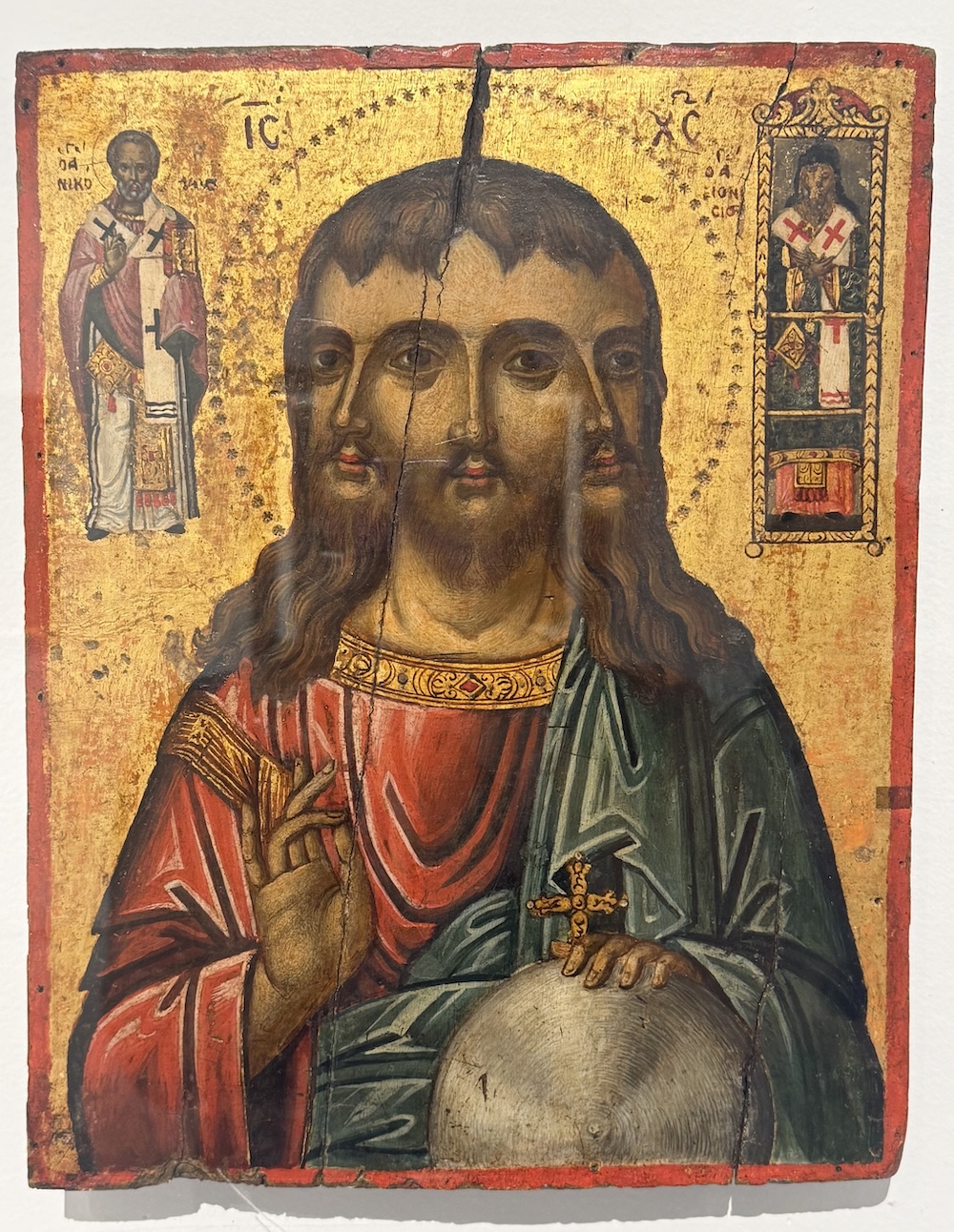
Three-Faced Christ, 18th century, installed in MOMus, Thessaloniki, on loan from the Loverdos Collection (L 434/CL 429), Byzantine and Christian Museum, Athens. Photo: Denis Maksimov
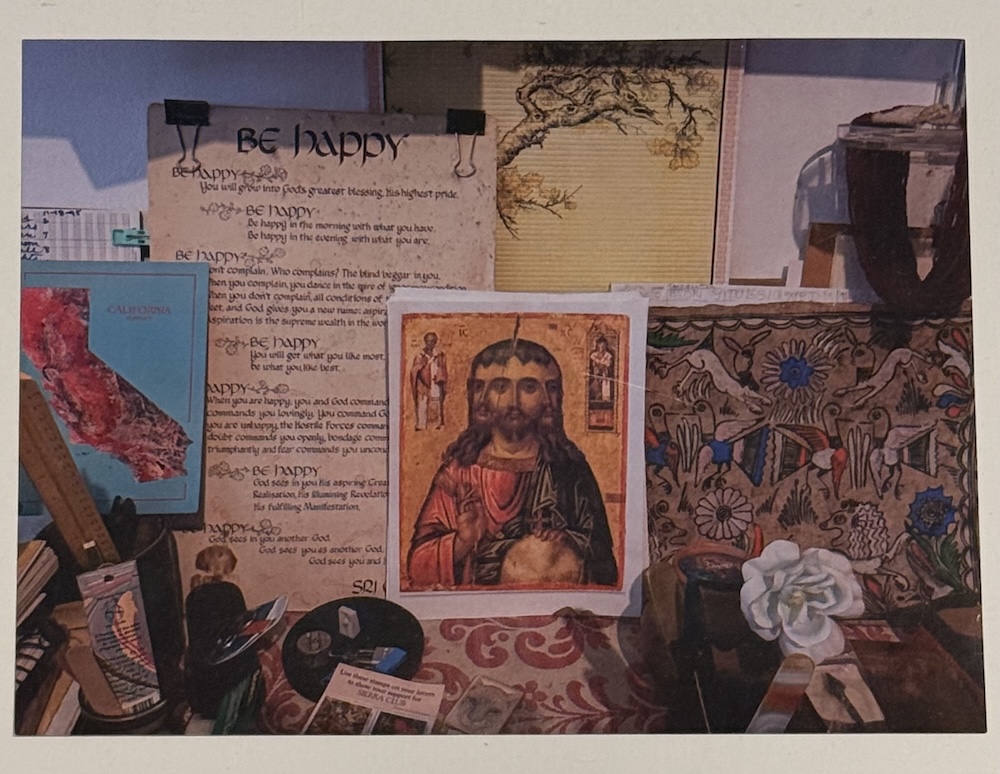
Nanos Valaoritis, Greek Mythology, 1963–74. Photo: Denis Maksimov
As with the relational triad of performers that Raikhy deployed for Hallucinations, trios manifest throughout the Thessaloniki Biennale to draw attention to an object’s instability. There is always a third bearing witness the struggle between the other two. Shown in Thessaloniki’s MOMus, the biennale juxtaposed an eighteenth-century orthodox icon of the Three-Faced Christ, on loan from Athens’ Byzantine and Christian Museum alongside the works of surrealists such as the Greek-American poet and critic Nicolas Calas (1907–1988) as well as a trinity of Afro-Cuban culture in L’Ombre (1953) by Wilfredo Lam (1902–1982). In Confound the Wise (1942), Calas writes ‘For several years I have been haunted by a Holy Trinity in the Museum Loverdo in Athens. It is a three-faced figure with four eyes, three noses and three mouths. On whatever part of the picture the gaze first falls, be it on the central one or either of the side ones, the image is complete and yet it is manifestly only part of a larger whole. The real meaning of such a painting is very difficult to grasp’. Nanos Valaoritis (1921–2019) appeared to have been equally confounded by this image as he and his wife collected a postcard with its image which is also currently shown at MOMus. For, the Three-Faced Christ was a short-lived way of presenting the holy trinity until it was pronounced heretical by Pope Urban VIII in 1628 and generally non-canonical in the Orthodox church. Over time, it has exercised a queering agency that can be an open field for radical change. The Three-Faced Christ remains a mutable object that invites reactivation and critical performance.
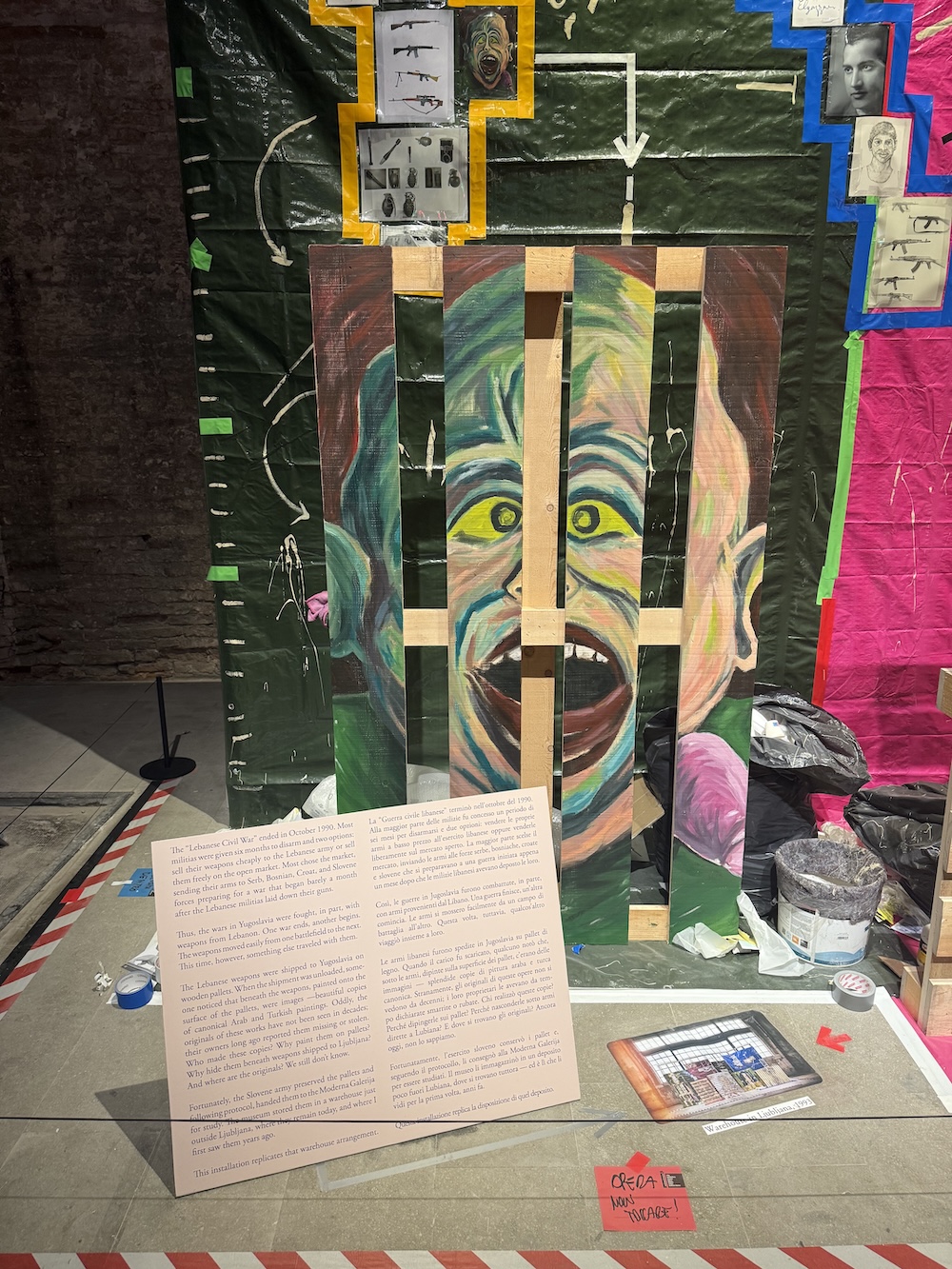
Walid Raad, Postscript to the Arabic Edition, 1938–2025, Arsenale, Venice Biennale 2026. Photo: Vivek Gupta
We close this chapter with the work of Walid Raad (b. 1967, Chbanieh), an artist who has meditated on the mutability of objects for decades. Many of Raad’s previous works such as Scratching on things I could disavow: Les Louvres have questioned what happens when museum objects are translocated and how their new sites of reception transform them. In Venice, Raad’s installation in Arsenale, Postscript to the Arabic Edition, 1938–2025, shows images painted on the wooden pallets used for selling weapons that he tells us are the lost paintings of Arab and Turkish artists. A text panel explains that after the ‘Lebanese Civil War’ ended in October 1990, Lebanese weapons were sold and shipped to Yugoslavia on such wooden pallets. ‘When the shipment was unloaded, someone noticed that beneath the weapons, painted onto the surface of the pallets, were images–beautiful copies of canonical Arab and Turkish paintings’. Here, Raad urges us to grapple with the last and lost traces, the memories and the destruction of objects. His critical fabulation continues, ‘Who made these copies? Why paint them on pallets? Why hide beneath weapons shipped to Ljubljana? And where are the originals? We still don’t know.’ As Dan Hicks reminds us, ‘every monument will fall’, but don’t things continue to change after their death?
Next week, we continue this discussion by crossing from objecthood to materiality and the many mythologies ascribed to objects that provoke an intellectual performance of meaning making.
[Front image: Mandeep Raikhy, Hallucinations of an Artifact, Kochi Biennale 2025–6, Photo: Denis Maksimov]
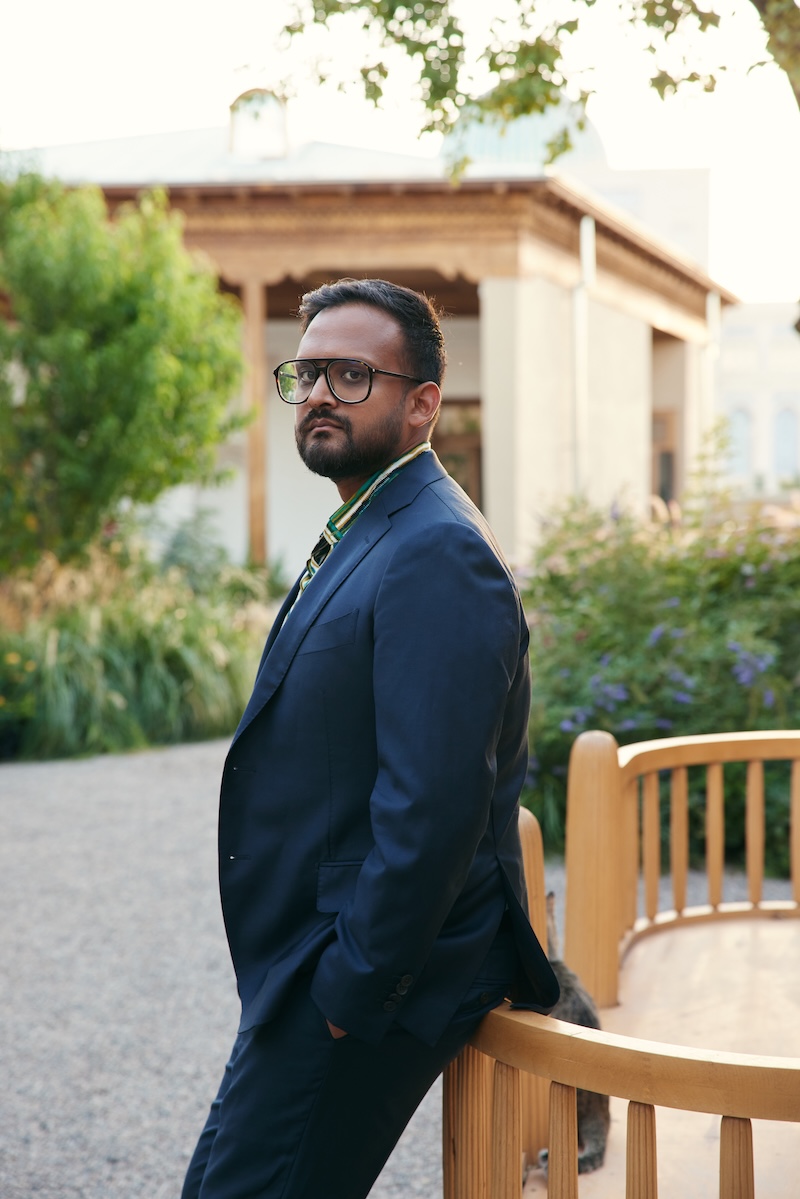
Dr Vivek Gupta is an art historian and curator of the Islamic, South Asian, and Indian Ocean worlds. He specialises in the art of the book, painting, calligraphy, and connections between portable objects and architecture. In recent publications, he has written about transregional circulation, cultural exchange, intersections between art and science, and transmediality. He is the author of Wonders of Hindustan: Artists and books in the early modern world (UCL Press) and curator of A Mughal Songbook: Art, Music, and Empire at the Fitzwilliam Museum, Cambridge (2026–27). He is currently a British Academy Postdoctoral Fellow in History of Art at University College London (2023–26) and previously was a Postdoctoral Research Associate at the University of Cambridge (2020–23).

Denis Maksimov is a historian of art and knowledge. His work focuses on aesthetics of epistemology, the relationship between heritage and future-making, and lecture performance. He is a guest curator at NYU Abu Dhabi Art Gallery and has curated exhibitions and programmes for institutions globally, including Helsinki Art Museum, Glyptoteket in Copenhagen, Pushkin House in London. His research and curatorial work have been presented in the Venice Biennales of Art and Architecture (2015, 2016, 2017, 2019 & 2022), Documenta 14 (2017), Ural Industrial Biennial (2017), São Paulo Biennale (2016), Art Basel, London Art Fair, Cosmoscow, etc. He is a lecturer at Backstein’s Institute of Contemporary Art, Salzburg International Summer Academy of Fine Arts, and was a visiting lecturer at the University of Applied Arts in Vienna. His writing has been published by MIT Press, Edward Elgar Publishing, MoMA, Ocula, Conceptual Fine Arts, Moscow Art Magazine, Obieg, Arts of the Working Class, among others.
Media Partners:







"A desk is a dangerous place from which to watch the world" (John Le Carré)