Search
To search for an exact match, type the word or phrase you want in quotation marks.
A*DESK has been offering since 2002 contents about criticism and contemporary art. A*DESK has become consolidated thanks to all those who have believed in the project, all those who have followed us, debating, participating and collaborating. Many people have collaborated with A*DESK, and continue to do so. Their efforts, knowledge and belief in the project are what make it grow internationally. At A*DESK we have also generated work for over one hundred professionals in culture, from small collaborations with reviews and classes, to more prolonged and intense collaborations.
At A*DESK we believe in the need for free and universal access to culture and knowledge. We want to carry on being independent, remaining open to more ideas and opinions. If you believe in A*DESK, we need your backing to be able to continue. You can now participate in the project by supporting it. You can choose how much you want to contribute to the project.
You can decide how much you want to bring to the project.
It’s August in Barcelona and the extreme heat overwhelms my senses. I’m in the Vapor Vell library in Sants, where I appreciate the presence of air conditioning in public spaces. I’m facing a window that gives me a direct line-of-sight to the Tibidabo Amusement Park, built on the foothills of the Collserola mountain range, the highest point in the city. Behind me lies Montjuïc, another of Barcelona’s hills, where an amusement park once stood whose name also coincided with the mountain it sits on but which has since been transformed into parks and gardens.
I am in the in-between space of these two points in the city, places that once were, or still are, organized by structures and machines in motion and bodies in altered, disoriented states.
In recent months, I have been investigating precisely these kinds of in-between spaces, where planes come together and create creases, intervals, voids. Brazilian artist Lygia Clark called that which emerges from such an intermediate space a Linha Orgânica, a structure that acts as a membrane, a line that instead of separating actually articulates spaces.
This research project, carried out with the support of the Juncal Ballestín Grant from the Artium Museum, seeks to analyze how Susana Solano, Ángeles Marco, and Lygia Clark address transitional states in their sculptural practices, utilizing ideas such as instability, contagion, vertigo, and deformation.
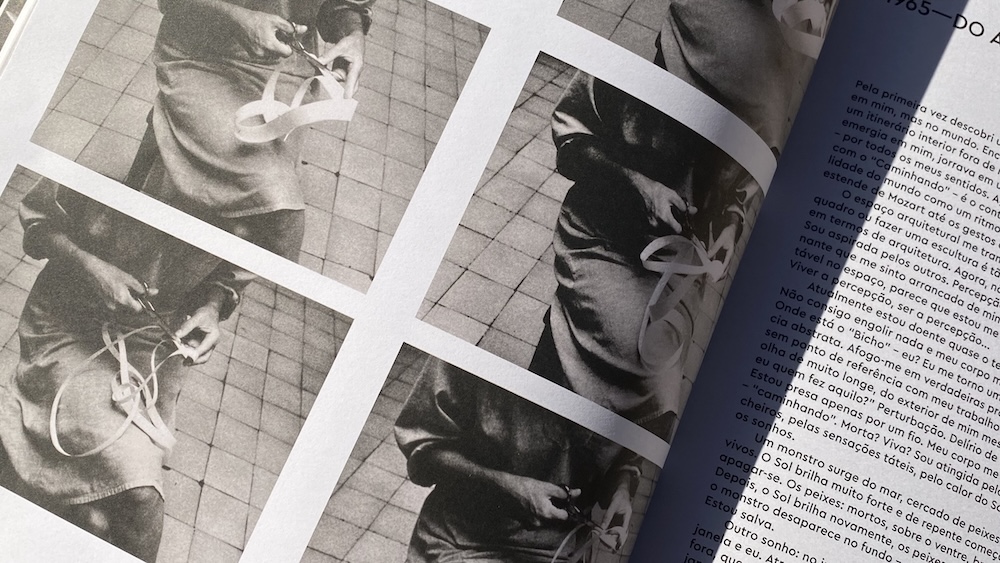
Lygia Clark, Caminhando, 1963
The research also seeks to understand how the materials present in their works, such as iron, rubber, and metal, can be interpreted in relation to the historical and political contexts of the democratic and anti-democratic moments they experienced in both Spain and Brazil.
I use Clark’s Linha Orgânica as a tool to develop this research, like a flashlight that allows me to reach greater distances in the dark or as a glove that protects me from sharp surfaces and abrasive toxins but which, thanks to the malleability of the material it is made of, still retains its sense of touch.
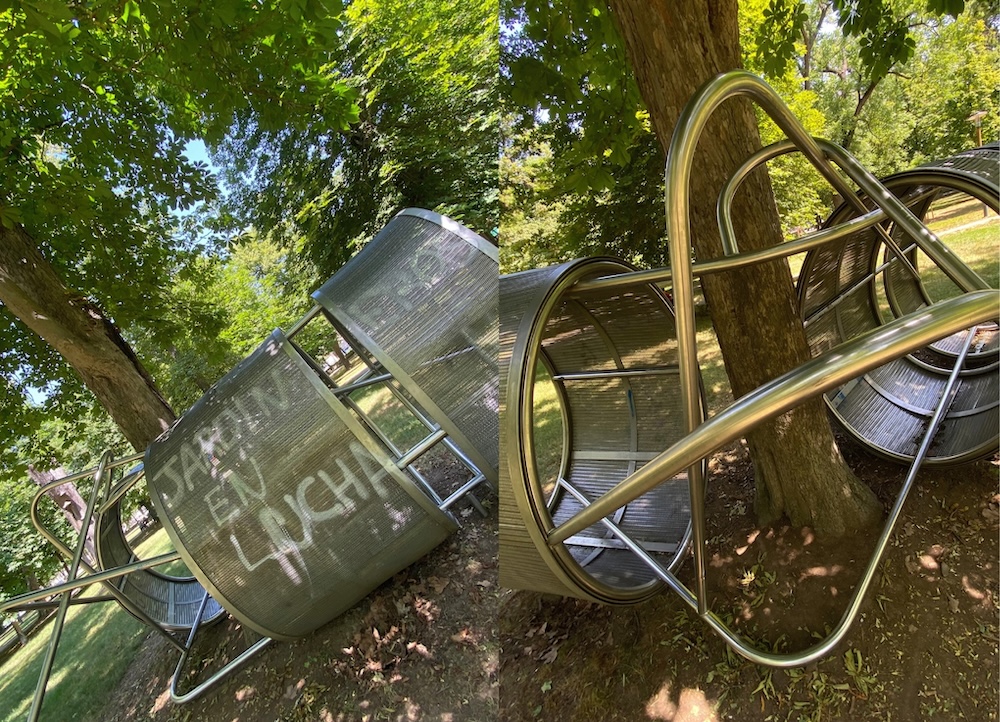
Susana Solano, La linterna I, 2002-2003. Collection: Parque del Prado. Vitoria-Gasteiz Town Hall
This work is an elastic structure that takes shape but then is deformed, subverting geometric logic and becoming topology, in which the border between inside and outside, self and other, is fluid.
Linha Orgânica also allows me to invert the usual meaning of art history, shifting my gaze from a trajectory that traditionally starts in Europe and moves to Latin America. I go back and forth, reading Solano and Marco from the perspective of Clark[1]This research draws on the ideas presented by Irene V. Small in her book The Organic Line: Toward a Topology of Modernism (Zone Books, 2024)..
This coming and going is part of a methodology that I have used within my practice and that is related to more than ten years of work I have developed together with Renan Araujo, in which we rethink curatorial formats, relationships with artists, archives and contexts.
This coming and going is not restricted to the horizontal axis, as it also moves vertically, rising up to the heights of the green mountains of Collserola and Montjuïc or roller coasters, underground foundations of museums, and luminous water fountains.
This coming and going is manifested in this article through the insertion of two texts that at times move closer and at times move away. They communicate to us and with each other through interupted conversations.
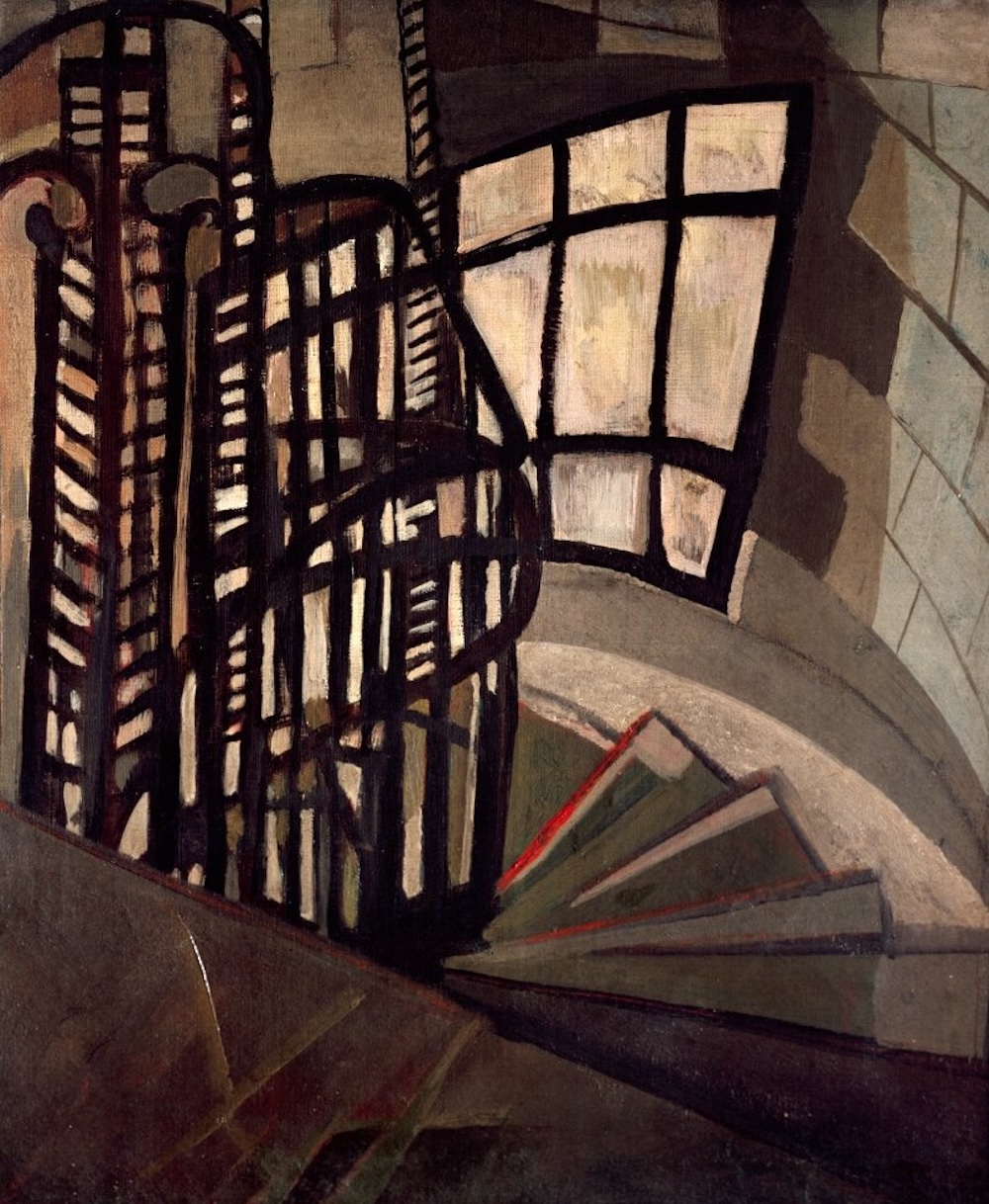
Lygia Clark, Escada, 1948
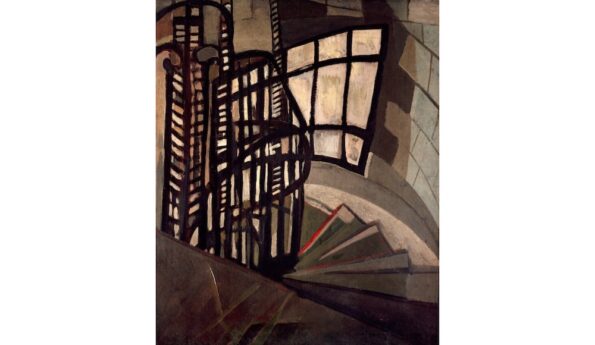
Back in the late 1940s, Lygia Clark began a series of paintings based on the image of staircases, which then progressively lost its figurative character and became a field of relationships between lines, planes and rhythms. “Escada”, from 1948, presents a spiral staircase that activates a centripetal movement in experience and a helical movement in geometry, that is, a spiral descent. It is a formal structure that contains a relational logic that, as Paulo Herkenhoff pointed out, “forms the genesis of the dualities that will concern the artist in the future: I am the inside and the outside, the front and back.” Or, as Lygia herself observed in 1986: “Inside the staircase, you could already see the leaves being eaten by a Bug. The Bug is already inside the staircase, right?”
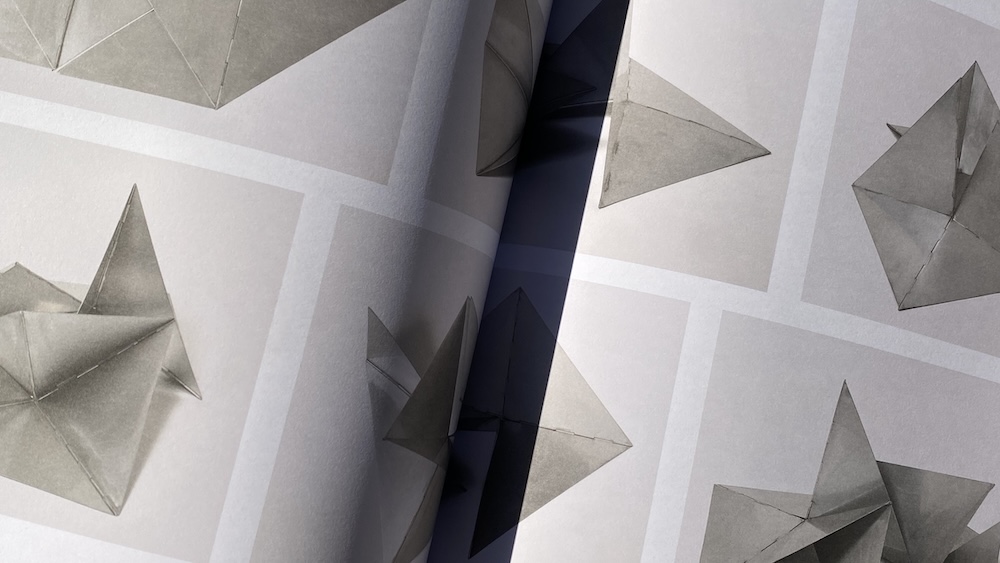
Lygia Clark, Bicho — Caranguejo Duplo, 1961
I think curatorial practice can be performative when its own research, selection and articulation produce forms of knowledge, generating not only spaces, but also situations. When it chooses to “present” instead of “represent,” and when it incorporates dynamics that extend beyond the exhibition space, it introduces ambivalence and blurs the limits between inside and outside.
Stairs, like elevators, ramps and slopes, serve as devices and events to investigate transitional states in the work of Lygia Clark, Susana Solano and Ángeles Marco, which is why my attention to stairs has become more conscious since I moved to the La Bordeta neighborhood.
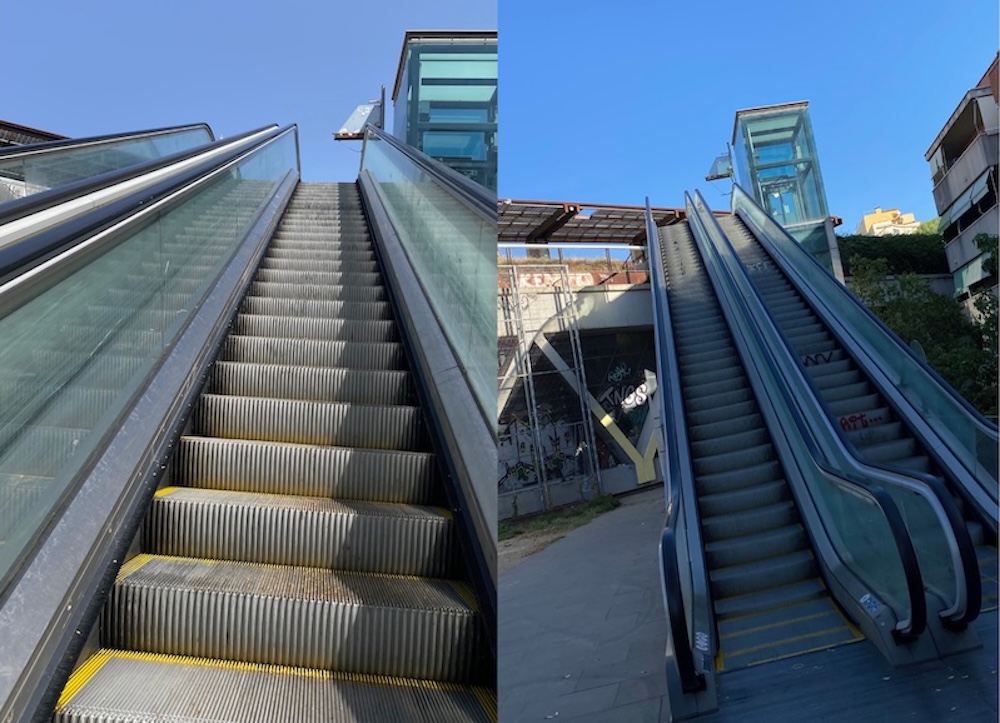
Stairs connecting the end of the Rambla de Badal, in the La Bordeta neighbourhood, Barcelona. Photo: Julia Coelho
I live a few meters from Rambla de Badal, which I like to think of as a space between Barcelona and L’Hospitalet. It is a place whose structure is marked by overlapping infrastructures, such as avenues, tunnels, railway lines and a promenade built on the roof of a railway corridor.
Constructed in the 2000s, this urban project covered avenues, connecting the environment through ramps, elevators and escalators, reducing the fracture produced by the railway infrastructure and returning to the neighborhood a continuous public space for neighborhood coexistence.
I also believe that being a curator is precisely inhabiting in-between spaces, those which exist between artist, public and institution, in their multiple combinations and paths of meaning. I believe that curatorial work is, to a large extent, a work of mediation between people, objects and places, and I understand this mediation as necessarily involved in a context, linked to a history, a community and a political project that produces ways of feeling and collective memory. Curatorial work is always collaborative work.
I am also just a few meters from the border between La Bordeta and Sants. To cross this border along Rambla de Badal, above the train line, I must go up and down two escalators installed outdoors. Remaining still while my body moves, surrounded by buildings, windows and trees, feeling that the scale is constantly resized and that my perspective is altered in this ordinary and everyday experience, is to remember that experience which we seek to activate within the artistic field, namely, something that happens and that transforms you without you realizing it simply because you are part of the action.
I position myself as a curator in between historical research, archival work and exhibitions, ways of moving between time and space that, guided by art, allow me to shift perspectives. I understand its performativity as a practice that moves and that produces knowledge in the movement itself.
In this way, I am interested in detours as turning points, because it is there where we can position ourselves again and ask ourselves the question: How we can yearn for a context that is already familiar to us? How can we look at it again in order to inhabit it in another way? I return to Clark’s topological ideas and think about how detours, both in their formal dimension and in their agential dimension, by interrupting a trajectory, open up non-linear and unprogrammed possibilities of relationship and orientation.
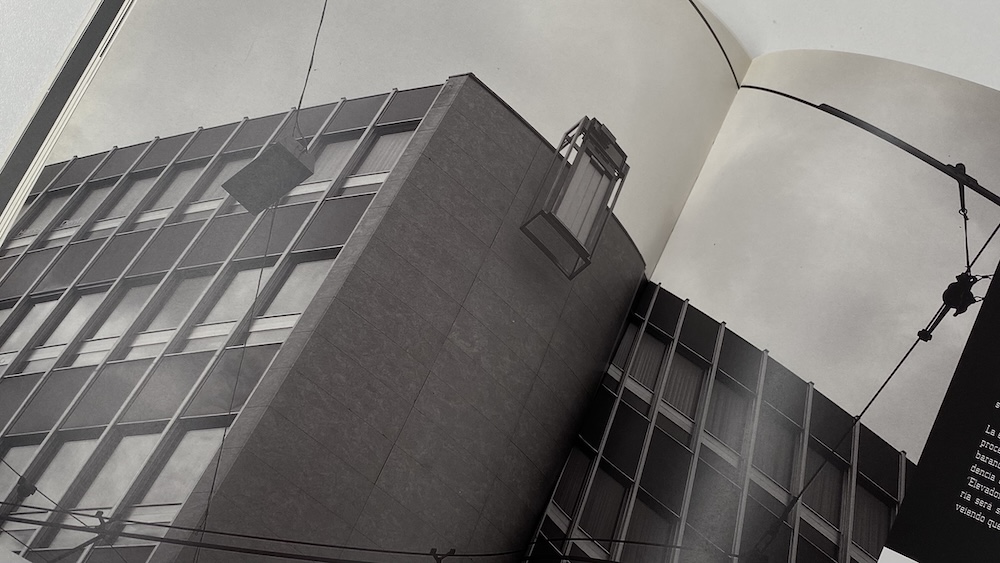
Ángeles Marco, Elevador (from the Salto al Vacío series), 1991. “Tabula Rasa. 26 Artists in Bienne/Biel Urban Space, Switzerland”
In 1991, Ángeles Marco exhibited “Elevador (from the Salto al Vacío series)” on the façade of a building in Biel, Switzerland. The steel sculpture reproduced the structure of an elevator without fulfilling the machine’s function of going up and down and transporting people. The roles are reversed when the elevator stops moving bodies and is instead moved by them. Stripped of its purpose, the elevator produces noise within the landscape and resonates with the architecture that surrounds it. It is a sculpture installed between the private space of a building and the public space of a street activated by a relationship that can only occur in the distance.
It is important to mention that inhabiting in-between spaces is also related to immigration, such as being between Brazil and Spain, of being and not being, and of oscillating between different forms of belonging. This condition reminds us that the line is one of the fundamental devices of coloniality since it marks territories, produces exclusion, establishes borders and organizes the world through limits and binarisms. The border between two nation-states is a territorial act that establishes a spatial discontinuity in an otherwise continuous geographical space.
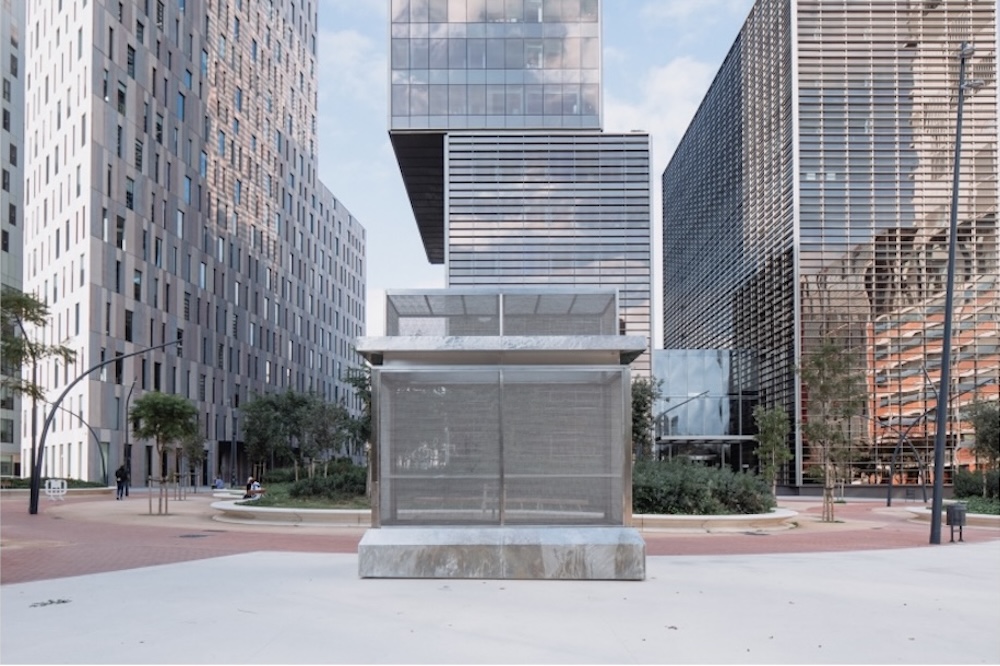
Susana Solano, Himne, mite i paradís, 2019-2021. Plaça de Ca l’Aranyo, Barcelona. Collection: Barcelona Town Hall
In Marco’s work, vertigo is not reduced to the physical sensation of falling but rather takes on an existential and political dimension. The body is related to industrial materiality and to the ideologies inscribed in the forms and devices that organize space. In “Elevador”, the artist makes a reference to suicide and suggests that monuments in urban centers should also respond to contemporary issues of exhaustion. In this sense, death appears as another form of transit.
This work is about creating potential situations through sculpture that refer to real objects, generating a discontinuity between their form and function and provoking what the deviation from the usual trajectory had already announced, that is, looking at it again in order to inhabit it in a different way.
The in-between space that Lygia Clark called Linha Orgânica is understood by the artist as a living, active space. Its disjunction is precisely what allows it to remain unstable, open to transformation and relationships. Perhaps it is precisely this condition in which curating finds its power, as what happens in the interval produces displacements, approximations and detours. It is a collaborative and performative practice that, when moving between bodies, works, archives, places and temporalities, works like a membrane. It exists precisely where a line stops separating and begins to articulate, and where other forms of relationship can emerge.
| ↑1 | This research draws on the ideas presented by Irene V. Small in her book The Organic Line: Toward a Topology of Modernism (Zone Books, 2024). |
|---|
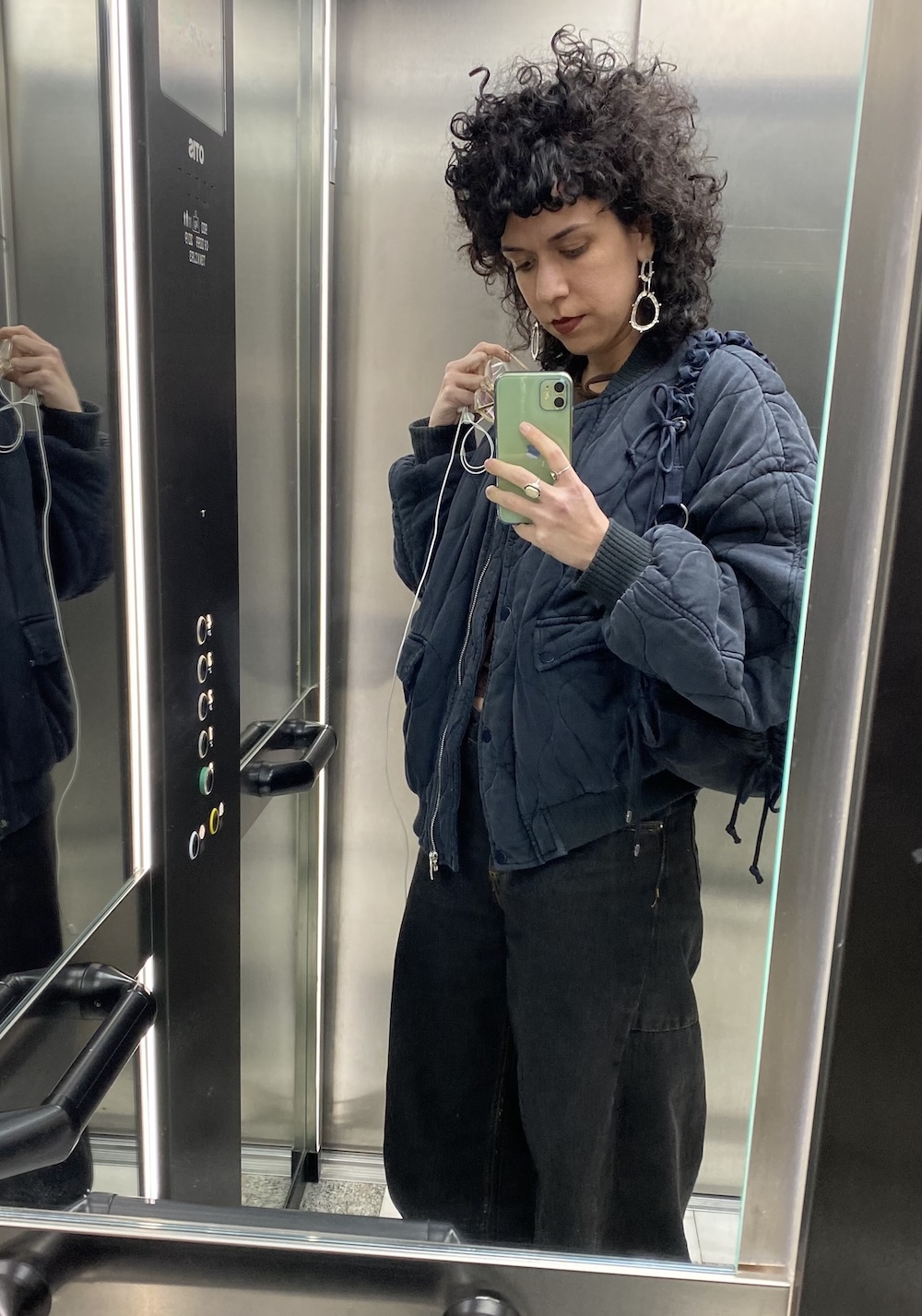
Julia Coelho is a curator and writer. She holds a degree in Fine Arts from the University of São Paulo (Brazil) and a Master’s degree in History of Science from the Autonomous University of Barcelona and the University of Barcelona.
Her practice is rooted in a sensitive awareness of context, through which she explores the relationships between spatiality, perception and movement. In her projects, she investigates the politics and poetics of distortion through architecture, micro-histories, material language and altered states of consciousness. She is currently conducting research entitled ‘The organic line between Lygia Clark, Susana Solano and Ángeles Marco’, as part of the Juncal Ballestín International Fellowship at the Artium Museoa. In recent years, he has curated projects at the CIAJG (Guimarães), La Casa Encendida (Madrid), the Centre d’Art Maristany (Sant Cugat), Galeries Municipais de Lisboa and Mercedes (Barcelona).
Media Partners:






"A desk is a dangerous place from which to watch the world" (John Le Carré)