Search
To search for an exact match, type the word or phrase you want in quotation marks.
A*DESK has been offering since 2002 contents about criticism and contemporary art. A*DESK has become consolidated thanks to all those who have believed in the project, all those who have followed us, debating, participating and collaborating. Many people have collaborated with A*DESK, and continue to do so. Their efforts, knowledge and belief in the project are what make it grow internationally. At A*DESK we have also generated work for over one hundred professionals in culture, from small collaborations with reviews and classes, to more prolonged and intense collaborations.
At A*DESK we believe in the need for free and universal access to culture and knowledge. We want to carry on being independent, remaining open to more ideas and opinions. If you believe in A*DESK, we need your backing to be able to continue. You can now participate in the project by supporting it. You can choose how much you want to contribute to the project.
You can decide how much you want to bring to the project.
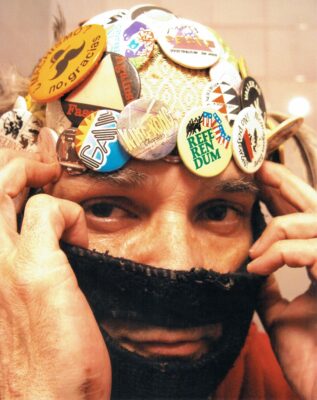
At the beginning of the exhibition season in Madrid, there is something strange and unsettling about the fact that the work of a deceased artist is one of the few that directly confronts one of the great catastrophes of our time. While galleries and institutions are once again launching their new exhibitions, a series of works from more than thirty years ago bursts forth from the past to bring Palestine back into focus. This voice, so absent and yet so present, is that of the performance artist (as he liked to call himself), poet, and activist Miguel Benlloch (1954–2018) in Todavía (Still), his first solo exhibition at The Ryder Projects.
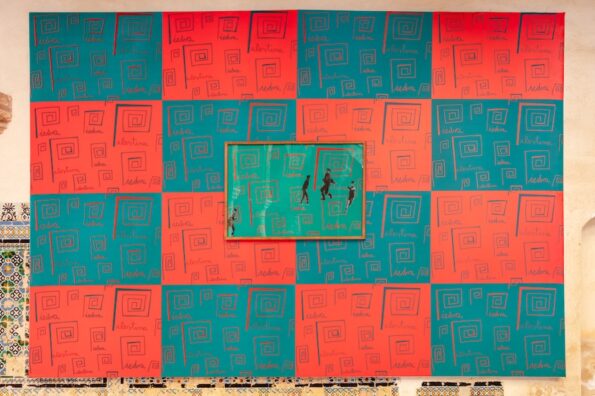
Miguel Benlloch, Piedra Palestina, 1993. Centro Andaluz de Arte Contemporaáneo, Sevilla. Courtesy of The Ryder Projects
The contrast between his past acts of rebellion and the current maelstrom of accelerated life raises once again the age-old question of art’s capacity to situate itself in the world around it and achieve something that neither the market nor current events seem to know how to do anymore, namely, to endure. “The relationship between what we see and what we know is never resolved,” John Berger wrote in his book Ways of Seeing (1972). Perhaps it is precisely here that Benlloch’s work finds a new urgency today. Three decades later, his works do not return as closed documents from another time but instead as images still capable of engaging with our own era.
In this context, the exhibition arrives after a recent process of institutional recovery that has brought back to the center of the conversation a figure whose historical importance had remained on the margins for far too long. Following the retrospective Bajar la voz (Lower Your Voice) at the Andalusian Center for Contemporary Art (CAAC), the Madrid exhibition extends this exercise and gives voice once again to a practice in which art, activism, poetry, and political life were never separate. In fact, the word “still” functions here as a declaration of principles, as the artist continues to speak, and some of the struggles that permeated his work continue to demand forms of representing conflict within a conservative and risk-averse context.
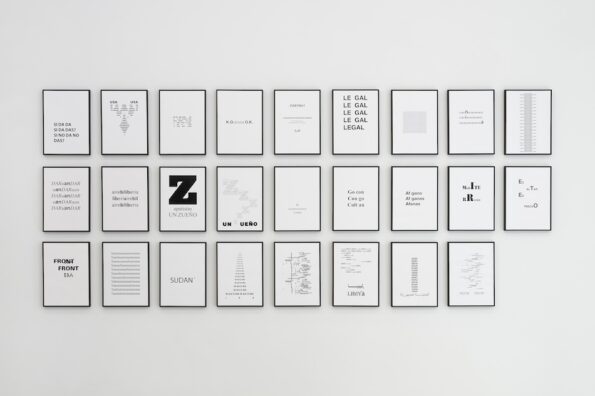
Miguel Benlloch, Epigramas contra la guerra, 1990-2018. Courtesy of The Ryder Projects
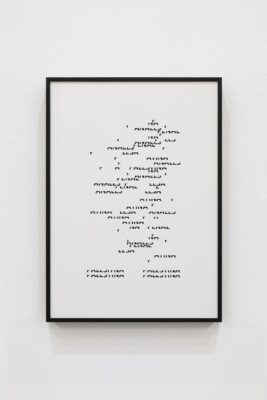
Miguel Benlloch, Epigramas contra la guerra. Palestina, 2018. Courtesy of The Ryder Projects
The first floor focuses on Benlloch’s outward-looking perspective, with the works Piedra Palestina (Palestinian Stone, 1993), Canario (Canary, 1993), and Epigramas contra la guerra (Epigrams Against War, 1990–2018), in which language becomes a tool for political intervention. Piedra Palestina is perhaps the inevitable point of entry. Created in 1993 after the First Intifada, the piece belongs to a body of work in which solidarity with the Palestinian struggle is explicitly expressed. In 2026, it arrives in Madrid imbued with a force that needs no explanation, as history has already done that. The artistic gesture hasn’t changed but the conditions from which we view it have. In turn, the artist’s own archive places Palestine alongside Iraq, Bosnia, Algeria, Chechnya, Rwanda, Congo, Western Sahara, Syria, and Afghanistan within the territories traversed by his Epigramas contra la guerra. Palestine, therefore, does not appear as a retrospective reading imposed by the present since it was already there, and still is. The Crusades might be over but not their causes or their wounds.
The placement of Canario (1993) at the entrance to the room seems very fitting, suggesting a different approach. The recited poem (“Arabs, enter. We are tired of Visigoths”) from an old Walkman shifts between political discourse, historical memory, and absurdity, until it is interrupted by the song of a bird. As with Piedra Palestina, in addition to taking a stand against the occupation of the territory, the work acquires a provocative and unpredictable reading in light of the recent arrivals of migrants to Ceuta and at a time when borders are once again at the center of public debate.
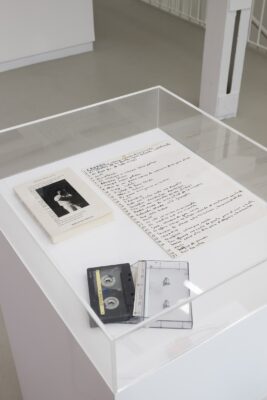
Miguel Benlloch, Canario, 1993. Installation view. Courtesy of The Ryder Projects
Beyond the specific works, we can still hear a phrase that resonates throughout his thought and practice, namely, that the personal is political, as the second-wave feminists have said. Perhaps, though, we can now reverse this and say that the political is also corporeal, intimate, and affective. His homosexual activism, his political militancy, his opposition to NATO, his defense of dissident bodies, and his community-based artistic action were all part of the same project of questioning the categories that order social life.
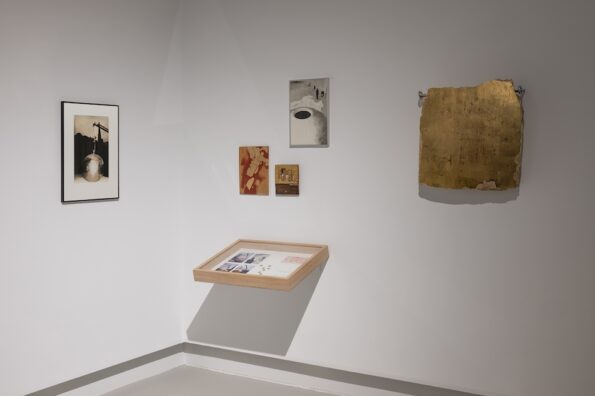
Miguel Benlloch, O donde habite el olvido, 1992-2002. Installation view. Courtesy of The Ryder Projects
hus, his political actions are connected with the highly poetic dimension of work linked to ritual, popular religions, memory and emotions. This can be seen best in O donde habite el olvido (Where Does Forgetting Live?, 2001), in which the story of James Lee Byars’ construction and destruction of a golden sphere is mixed with his poem Granada (1992), or the 12 Esferas de la intimidad (12 Spheres of Intimacy, 1994), born from the historic Plus Ultra project within the framework of the Andalusian Pavilion at Expo’92. As small forms of portraiture, offering and emotional transmission, some of these pieces still remind us that the political is never very far from the poetic, as both operate as forms of memory and relationship.
Which is why it is significant that Benlloch appears again now. Not because political criticism has completely disappeared from contemporary art (practices such as those of La Chola Poblete, Iman Issa and Pedro G. Romero continue to interrogate colonialism, violence against bodies and memory), but because the difference is perhaps in its directness in the face of a world that is collapsing. It is not about who speaks and who remains silent, but about how one speaks and under what conditions. Benlloch, who died in 2018, cannot produce a new work about Gaza, but what he has left us is an archive capable of intervening again in the present. That is where the strength of Todavía lies, in its ability to look, name, intervene and remain. The artist can no longer respond, but his work can still.
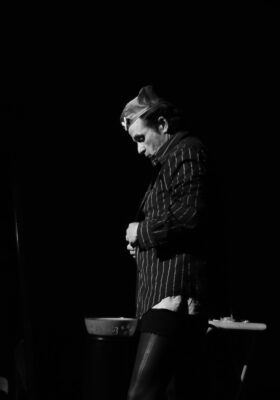
Miguel Benlloch portrait. Courtesy of The Ryder Projects
Miguel Benlloch. Todavía at The Ryder Projects, Madrid until the 31st of October 2026
[Featured image: Portrait of La braga activista, 2004 © Gonzalo Saenz de Santa Maria Poullet. Courtesy of The Ryder Projects]
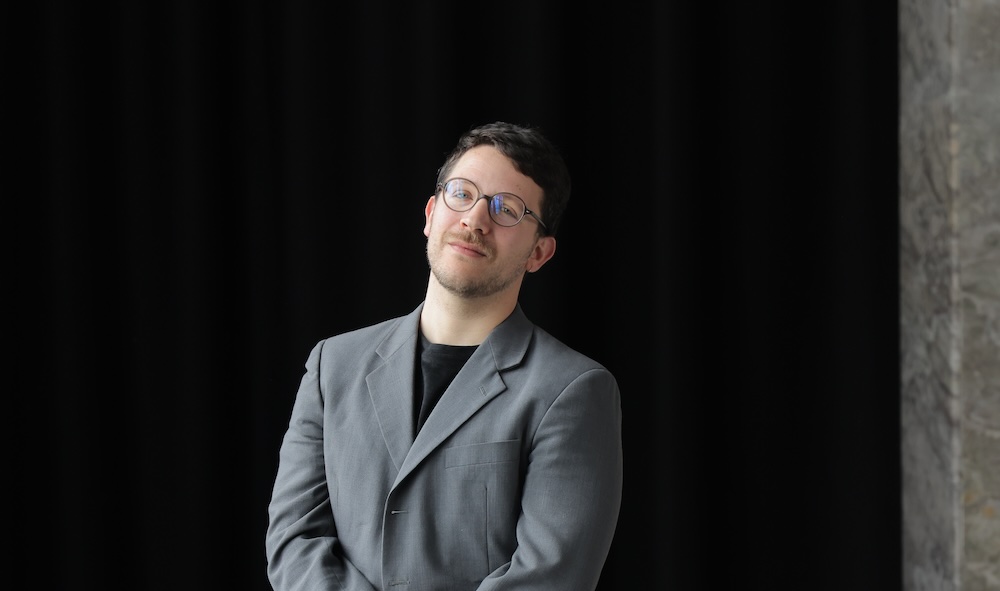
Alejandro Alcolea Marín (Palma, 1990) is a journalist and cultural critic. Throughout his career professional has been dedicated to communication, management and research in different institutions cultural institutions such as the Círculo de Bellas Artes, the Center for Contemporary Culture of Barcelona (CCCB) and Es Baluard Contemporary Art Museum of Palma. He has collaborated with media and publications such as A*Desk, elDiario.es, CTXT or lamarea. He is interested in what happens (and what doesn’t) in the intersection between them fields of culture, power and technologies.
Media Partners:






"A desk is a dangerous place from which to watch the world" (John Le Carré)