Search
To search for an exact match, type the word or phrase you want in quotation marks.
A*DESK has been offering since 2002 contents about criticism and contemporary art. A*DESK has become consolidated thanks to all those who have believed in the project, all those who have followed us, debating, participating and collaborating. Many people have collaborated with A*DESK, and continue to do so. Their efforts, knowledge and belief in the project are what make it grow internationally. At A*DESK we have also generated work for over one hundred professionals in culture, from small collaborations with reviews and classes, to more prolonged and intense collaborations.
At A*DESK we believe in the need for free and universal access to culture and knowledge. We want to carry on being independent, remaining open to more ideas and opinions. If you believe in A*DESK, we need your backing to be able to continue. You can now participate in the project by supporting it. You can choose how much you want to contribute to the project.
You can decide how much you want to bring to the project.
Arts Catalyst was founded in 1994 in London by curator and writer Nicola Triscott. Over the past three decades, this small-scale organisation has lived many lives and taken many shapes, though always seeking to reimagine what role art can play in society and which spaces artists can occupy and affect. In this short text, I am going to delve into Arts Catalyst’s most recent history and the way it has articulated its social and ‘more-than-social’ practice, its relation to place, and the impact of this work in the context of their programming and micropolitics.
I joined the organisation nearly ten years ago, at a time of growing uncertainty and dramatic changes in the UK: on the one hand the impact of the harsh austerity measures that followed the financial crisis of 2007-2008 in most of Europe kept exercising a form of slow violence on the social fabric, with cuts to welfare, public services, and cultural and social spaces – a process that, to an extent, never ceased to happen. On the other hand, in the aftermath of the Brexit referendum in 2016, the anti-immigration narratives that had led the country to leave the EU continued proliferating.
In this context, arts institutions and organisations (particularly small-scale ones, usually more responsive and prone to change and self-reflexivity) began to reconsider their civic and political role in response to an increasingly fragmented and under-resourced social fabric, growing inequalities, and multiple intersecting crises.
In 2020, Arts Catalyst moved from London to Sheffield, South Yorkshire. Until then, Arts Catalyst had been based in London, and centred its programme of work on a critical engagement with science and technology. Throughout this time the organisation had developed ambitious London based exhibitions and programmes, as well as UK and international wide touring exhibitions and research programmes. In 2013 the organisation began experimenting and testing out new formats of curation which were more place based and rooted in community enquiries and in planetary ecology and wellbeing across the country. The geographical move was driven by a desire and urgency to shift towards a more rooted, hyperlocal approach to place and belonging that would allow us to dedicate our work to a specific region (South Yorkshire), while maintaining a national and international horizon.
In this transition, collaboration became an integral part of our work: rather than an occurrence or an instrumental element of the artistic programme, collaboration, partnership building, and co-creation turned into the engine of the strategy for Arts Catalyst. Community organisations, services for mental health and wellbeing, youth centres, migrant justice organisations, hospitals etc are among our main interlocutors, alongside artists with their vision, practice, and lived experience.
One of the projects that more clearly exemplifies this way of working is Co-hostings by designer Bahbak Hashemi-Nezhad, developed with City of Sanctuary Sheffield [1]City of Sanctuary is a British charitable organisation and grassroots movement whose purpose is to build a movement of welcome across the UK, predominantly for asylum seekers and refugees, by … Continue reading, an independent charity working in solidarity with people seeking sanctuary. Their vision is for Sheffield to be a place of safety and welcome for people seeking sanctuary.
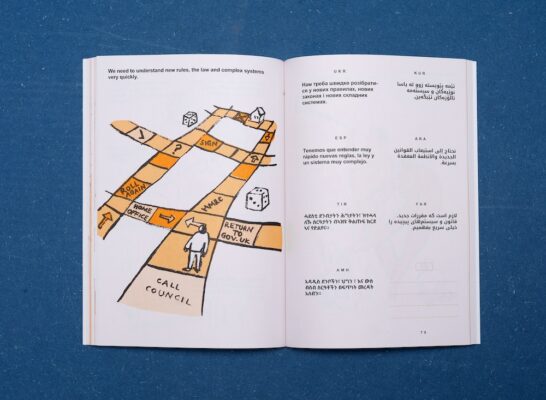
Bahbak Hashemi-Nezhad, Don’t Judge a Book By Its Cover, 2026. Illustration by Danielle Rhoda. Photography Bahbak Hashemi-Nezhad
Arts Catalyst’s long term collaboration with Hashemi-Nezhad began in February 2020, when he was invited to utilise Arts Catalyst’s relocation from London to Sheffield as a point of intervention to test out new ways of working in the city and relationships with communities and organisations that inhabit it.
The project began with a phase of what Bahbak describes as ‘sense-making’: a series of meetings, internal workshops and conversations between himself, Arts Catalyst, staff at City of Sanctuary, and members of their Experts by Experience (a group of people who have lived experience of seeking sanctuary and migration, and whose voices are central to the City of Sanctuary Sheffield’s work). Starting with a provocation: What does it mean to re-imagine Sheffield through the lens of the non-hostile environment [2]The non-hostile approach is a direct reference to the “hostile environment”, a set of UK government policies introduced in 2012 by then-Home Secretary Theresa May consisting of … Continue reading?, during this first phase of work we mobilised questions of belonging, safety, joy, comfort, and lack of it in the city. At the same time, we discussed prioritising non-extractive methods and people’s desires, the project pace, and the ethics of the process, with the team at City of Sanctuary largely guiding the conversation and setting the parameters of the work with us.
It became apparent that the project could only progress at the pace of trust, and that a slow and long-term approach was a priority for our partners and the community they serve. Under these premises, Bahbak undertook a two-year engagement process at City of Sanctuary, following the lead of those taking part, and making space for listening, learning and, when necessary, reconsidering and adjusting. Bahbak started to join the weekly English classes – a well-attended space where he could meet people and connect around the ideas underlying the project. On a Thursday, Bahbak would cook Ash Reshteh, a one pot Persian noodle soup filled with fresh herbs, leafy greens, legumes, and noodles in the large kitchen in the newly renovated space at City of Sanctuary Sheffield.
At the end of the English class, Bahbak would engage the attendees in conversations, exploring questions of rootedness in Sheffield, and the role that English language and its translations hold: the power that English holds, the non-neutrality of the language and of the ways in which it is taught and learnt, the avenues that English language enables, and ultimately, the impossibilities of translation and interpretation itself. In this process, it felt important to introduce the notion of a non-neutral way of sharing language, centred in the lived experience of those who are learning it for the first time rather than in a fixed set of rules and categories to familiarise with.
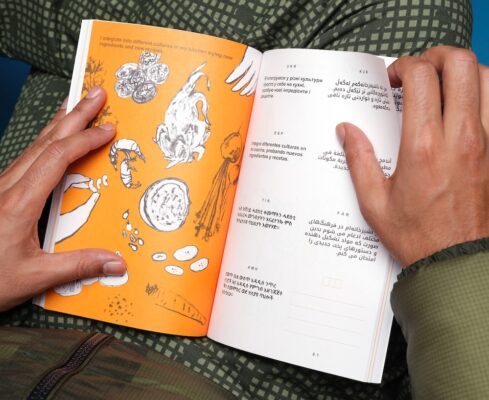
Don’t Judge a Book by its Cover. An English exercise book emerged from this process. Commissioned by Arts Catalyst as part of Co-hostings, the book presents itself as an English exercise book translated into Arabic, Kurdish, Tigriniya, Amharic, Spanish, Ukrainian, and Farsi (the main languages Bahbak encountered during the engagement phase of the project).
The book collates the knowledge and insights gathered during this process that were then edited with Experts by Experience. The phrase book is simultaneously an English language tool, and a journey into participants’ aspirations, ideas, and challenges. Short sentences and statements offer insights into places, habits, encounters, and experiences within and despite the hostile environment.
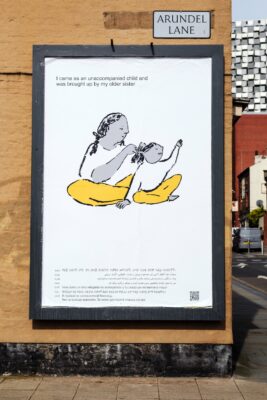
Bahbak Hashemi-Nezhad, Don’t Judge a Book By Its Cover, 2026. Illustration by Danielle Rhoda. Photography Bahbak Hashemi-Nezhad
Each page is accompanied by illustrations made by artist Danielle Rhoda, who carefully translated words into images to offer a nuanced visual journey into the stories and experiences that participants at City of Sanctuary shared.
The learning that emerged from Co-hostings has now informed many other co-creation projects: Mind Garden, a garden centred programme with artist Harun Morrison at the mental health and wellbeing charity Sheffield Mind; Housewarming, a project around making as a form of gathering and belonging with artists Sahra Hersi and Sofia Niazi and the advice bureau Andalus Community Centre; and our current commission focused on sound and soothing with artist Aliaskar Abarkas at Sheffield Children’s Hospital.
These partnerships extend beyond the specific temporality of each project and artist commission, and become an inherent part of Arts Catalyst’s extended infrastructure – an immaterial space where we can practice solidarity, exchange knowledge and information, and collectively advocate for more just and equitable futures – a resource increasingly necessary in times of growing anti-immigration right-wing sentiments.
From this perspective, our work takes the form of ‘radical place-making’, where place is not determined by a set of administrative boundaries, but it is instead constantly produced and re-imagined through the process of creating and mobilising relationships.
| ↑1 | City of Sanctuary is a British charitable organisation and grassroots movement whose purpose is to build a movement of welcome across the UK, predominantly for asylum seekers and refugees, by coordinating and supporting networks of community groups across the UK and Ireland. Sheffield became the first City of Sanctuary in the UK in 2007 |
|---|---|
| ↑2 | The non-hostile approach is a direct reference to the “hostile environment”, a set of UK government policies introduced in 2012 by then-Home Secretary Theresa May consisting of legislative and administrative measures specifically created to make life in Britain as difficult as possible for migrants so they would leave voluntarily. |
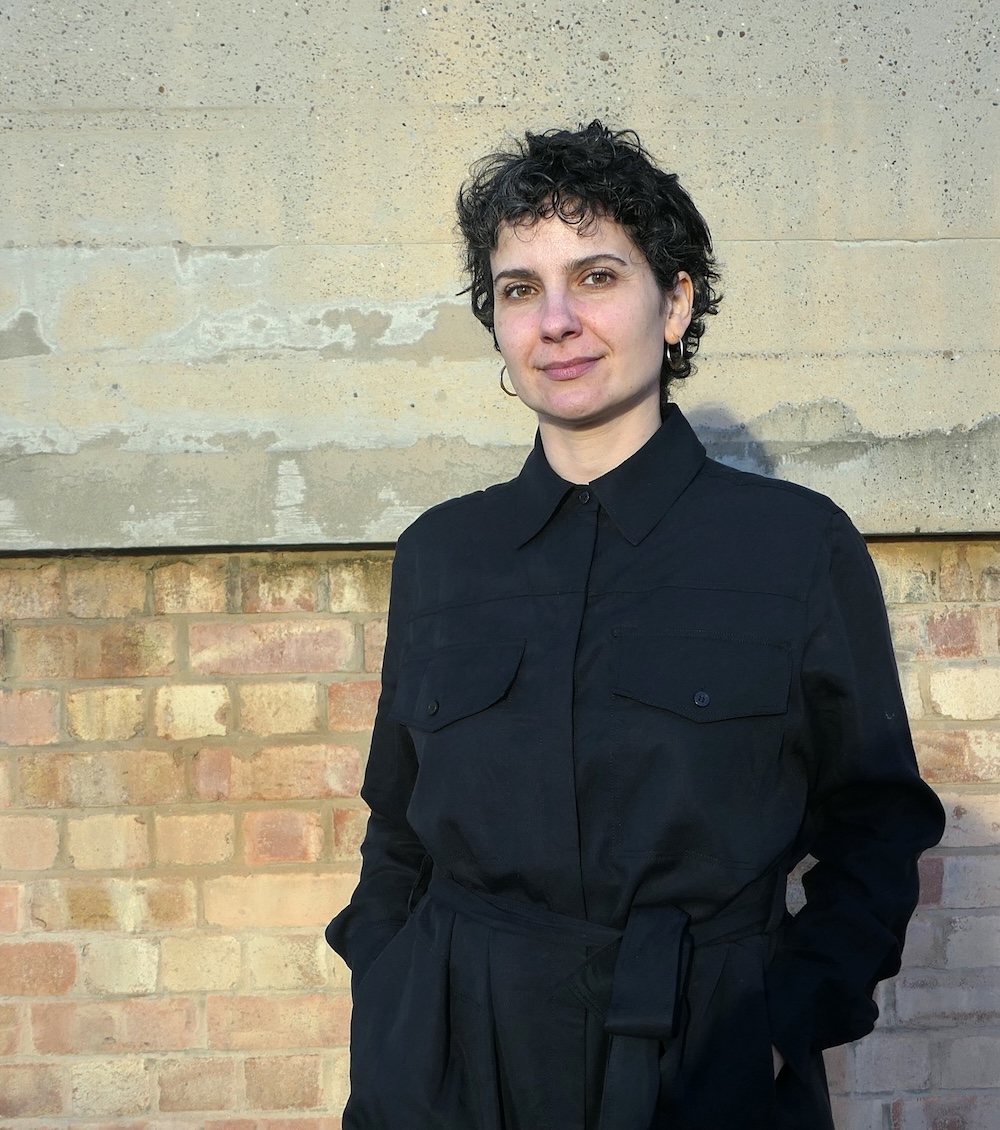
Anna Santomauro is a curator and researcher in micropolitics and socially just art practices. She works as Head of Programme at Arts Catalyst (Sheffield, UK), where she leads on the curatorial development and delivery for the organisation, with a focus on co-producing artistic programmes with community and third sector organisations as well as other cultural partners.
Anna is co-founder of Vessel in Puglia (Southern Italy), a nomadic curatorial agency invested in supporting artistic practices that are situated and research-led, primarily from a Southern and Mediterranean perspective. In 2022-2025 she was Senior Research Fellow at the Culture and Creativity Research Institute at Sheffield Hallam University.
Media Partners:




"A desk is a dangerous place from which to watch the world" (John Le Carré)