Search
To search for an exact match, type the word or phrase you want in quotation marks.
A*DESK has been offering since 2002 contents about criticism and contemporary art. A*DESK has become consolidated thanks to all those who have believed in the project, all those who have followed us, debating, participating and collaborating. Many people have collaborated with A*DESK, and continue to do so. Their efforts, knowledge and belief in the project are what make it grow internationally. At A*DESK we have also generated work for over one hundred professionals in culture, from small collaborations with reviews and classes, to more prolonged and intense collaborations.
At A*DESK we believe in the need for free and universal access to culture and knowledge. We want to carry on being independent, remaining open to more ideas and opinions. If you believe in A*DESK, we need your backing to be able to continue. You can now participate in the project by supporting it. You can choose how much you want to contribute to the project.
You can decide how much you want to bring to the project.
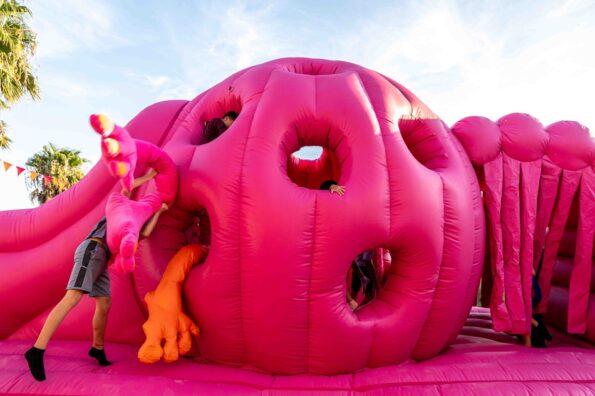
When we asked people in Parke Alcosa what makes a park a park, the first words that came up were people, friends, play, and care (slides and swings came later, almost as a technical detail). In post-catastrophe moments, like those experienced in this neighborhood after the 2024 DANA floods, the community spent a lot of time making demands and taking stock of what was lost. In that urgency, there was very little space for a community to look at itself and recognize all that it has already done. Surviving, supporting each other during the first weeks, organizing aid, or reopening businesses are achievements that are rarely celebrated, as reconstruction quickly transforms into the starting point for the next challenge. This neighborhood, however, showed that what sustains a place is a network of relationships built around play, and that desire needs time for mourning and for paying tribute.
Envisioning a Future for Parke Alcosa. Photo: Tamara Sánchez
We need to recognize ourselves collectively, to speak aloud about what we have been able to sustain. This is what paying tribute is, a commitment to transforming recent memory into a solid ground from which to imagine. To act together, we need our struggle to become a joyful militancy, like the one proposed by Carla Bergman and Nick Montgomery (2023), who describe the increase in power when people act from a collective and embodied perspective. Political power is about reclaiming tenderness and vulnerability without relinquishing the responsibility and tenacity that these struggles demand. In this sense, paying tribute to a community is a form of affirmation that emerges from pain managed together.
In Estructuras de afecto (Emotional Structures), the project we are supporting at Massa Salvatge with Concomitentes, we began to think of play as an infrastructure of desire. Playgrounds are a fragile yet persistent structure capable of producing shared futures and caring for those who inhabit them while those futures do not yet exist. Sara Ahmed (2019) reminds us that happiness can become a mandate, and this warning accompanies us when we speak of playing in a context of struggle. Play can become an obligation to feel good, and it can open a space where joy coexists with exhaustion and anger. The difference depends on who sets the pace, and that is why we believe it is important that play originates within the group and respects its pauses.
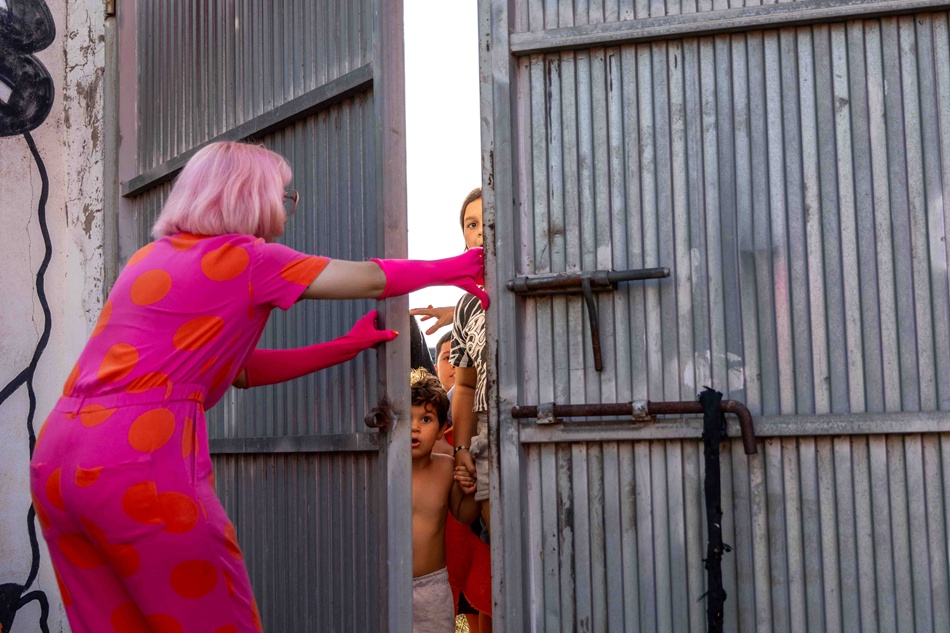
Inauguration Un Parque para Parke. Photo: Tamara Sánchez
Dream together
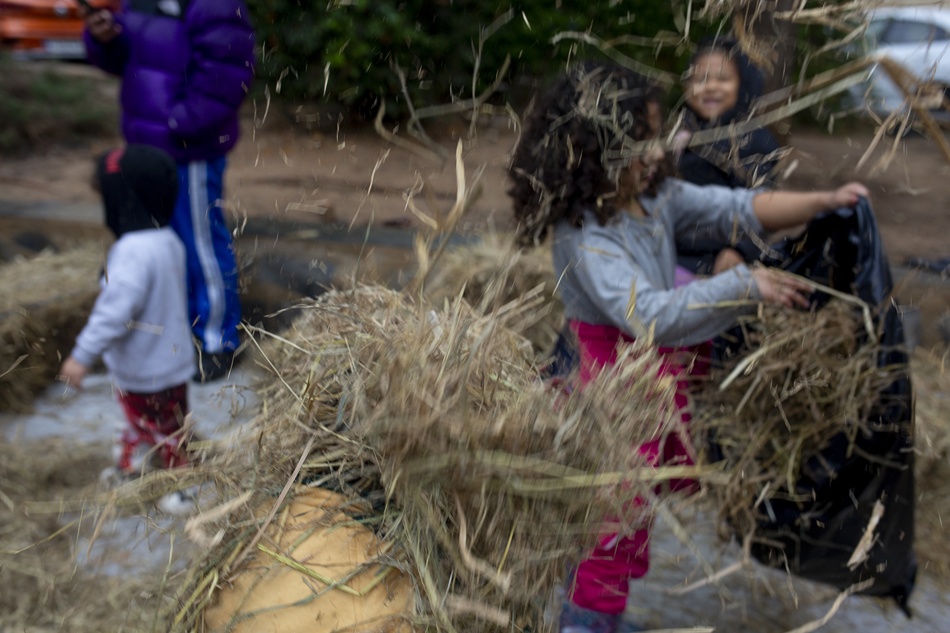
During one of the actions of the process, while we were building cabins with bales of straw, it started to rain. The adults ended up holding clothes above the children’s heads while the game and laughter continued underneath. The scene summarizes something that Donald W. Winnicott (1971/2012) formulated within psychoanalysis, namely, tht the game happens in an intermediate space that depends on trust, and that trust needs an environment that sustains it. That afternoon the atmosphere was full of wet clothes and tired arms, but it was enough to make protecting and playing become the same action.
We like to think of play as infrastructure precisely for this reason, because to exist it needs care, which those who participate produce at the same time. When we talk about struggle or social resistance, we think of adults carrying out actions, organizing, mobilizing, but in this context resistance is taking care of oneself, sustaining oneself. Today, we might call this soft resistance, acts that dismantle the idea that adults provide care while children play.
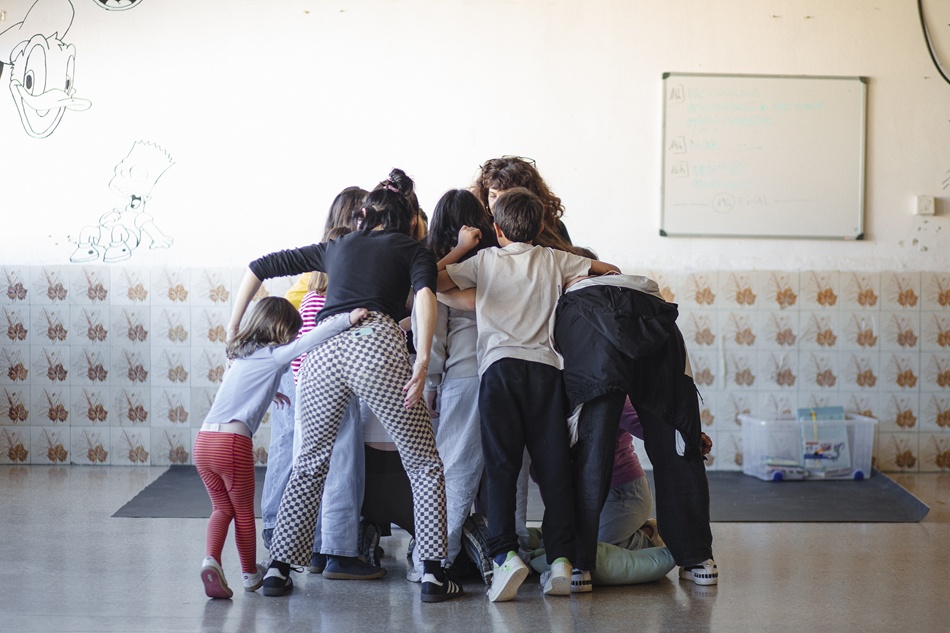
Tribute. Public Workshop on Structures of Affection. Photo: Tamara Sánchez
The assignment we gave to the artist Reyes Pe had a condition that has been with us since then, that the work must be a structure capable of being played with, touched and stored. We think a lot about that verb, to store. We usually associate infrastructure with what remains, such as bridges, pipelines or roads that are measured by their ability to withstand the passage of time. Lauren Berlant (2016) conceived of another possibility when she proposed thinking of the common as an infrastructure for turbulent times, something that is made while we are alive and that allows us to imagine a provisional life that can be lived. In Parke, that provisionality took the form of a dinner in the square, a sign, a curtain upon which the neighborhood wrote their wishes, a game that is repeated every afternoon. They are infrastructures that are taken out when needed and stored when the neighborhood needs to rest, and perhaps that is why they respond to the rhythms of a tired community. Reyes Pe works with textiles and discarded materials, and has spent years redefining failure from a feminist perspective. Her practice fits into a softness that welcomes bodies of all sizes and ages without imposing a single form of use on them.
Thinking about play as an infrastructure of desire challenges the cultural policies that accompany reconstruction processes, because enjoyment requires a long time, mediation and a budget. We can imagine it as a soft structure that is carried, shared, taken out to the square when necessary and carefully stored until the next meeting.
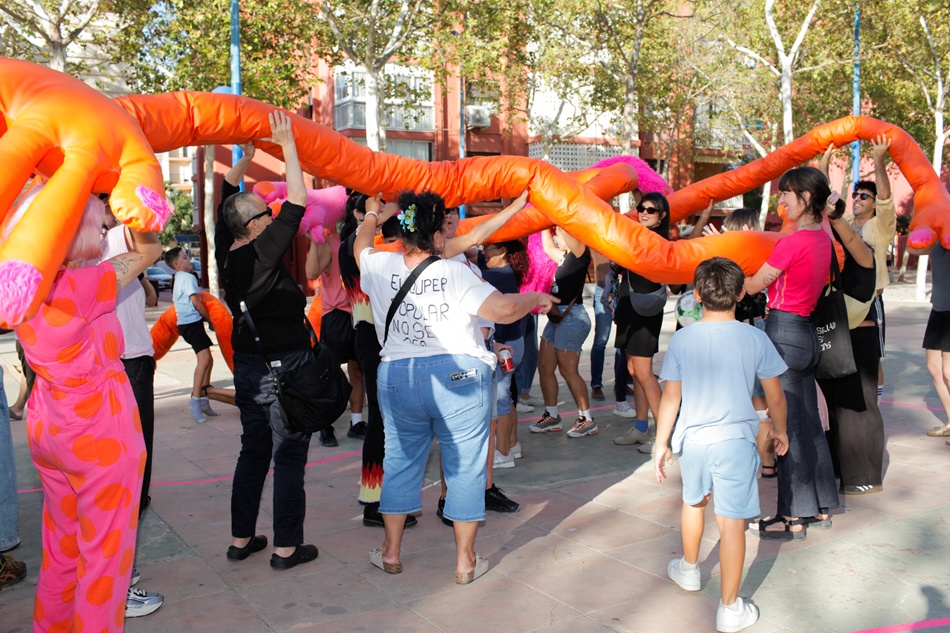
Inauguration Un Parque para Parke. Photo: Laura Leal
Desire is produced, and the game is one of the places where it is produced most easily, because it temporarily suspends the demand to obtain results and allows the rules to be changed without ruining the experience. Gaston Bachelard (1960/1982) wrote that childhood dreams are dreams of expansion, capable of enlarging the world. His gaze, however, contemplates childhood from the memory of the adult as a lost territory to which one returns with nostalgia. In Parke, daydreams happen in the present and out loud, that is, children imagine the neighborhood while they play in it. We are interested in that shared dream, which emerges from nostalgia and placed in the square, because that is where the imagination becomes political.
At Massa Salvatge, we call this union between art and play a simulation, a situation in which the participating people act as if certain ideas were no longer inevitable. For a few hours, a neighborhood can function with a park that is yet to be made. The simulacrum has something of both things, a communal delirium and a promise that is rehearsed with the body, a way of provisionally living what we still do not know how to sustain as a community.
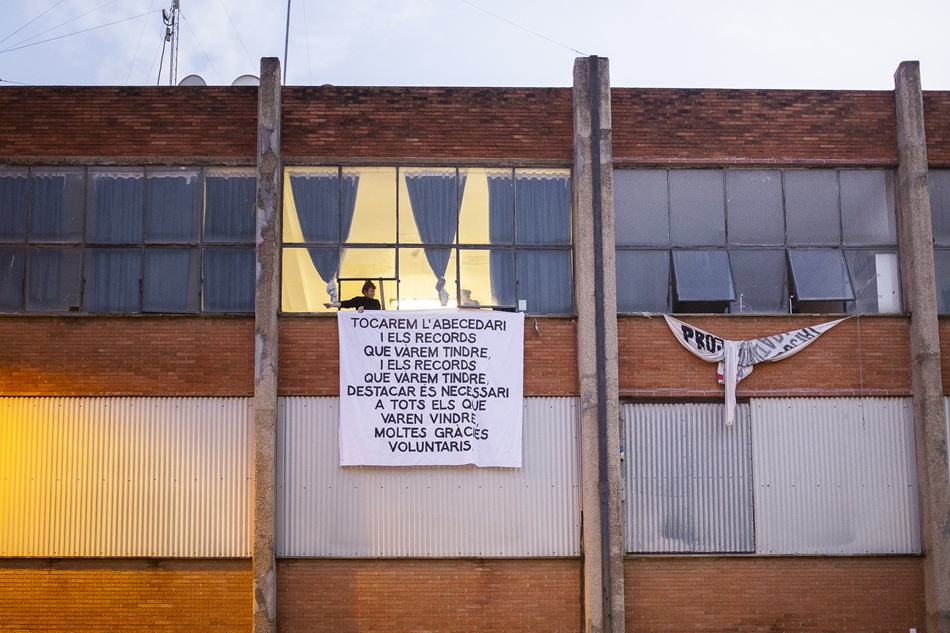
Tribute. Public Workshop on Structures of Affection. Photo: Tamara Sánchez
References
Ahmed, S. (2019). La promesa de la felicidad. Una crítica cultural al imperativo de la alegría (H. Salas, Trad.). Caja Negra.
Bachelard, G. (1982). La poética de la ensoñación (I. Vitale, Trad.). Fondo de Cultura Económica. (Treball original publicat el 1960)
Bergman, C., y Montgomery, N. (2023). Militancia alegre. Tejer resistencias, florecer en tiempos tóxicos. Traficantes de Sueños.
Berlant, L. (2016). The commons: Infrastructures for troubling times. Environment and Planning D: Society and Space, 34(3), 393–419. https://doi.org/10.1177/0263775816645989
Winnicott, D. W. (2012). Realidad y juego (F. Mazía, Trad.). Gedisa. (Treball original publicat el 1971)
[Featured image: Inauguration of Un Parque para Parke. Photo: Tamara Sánchez]
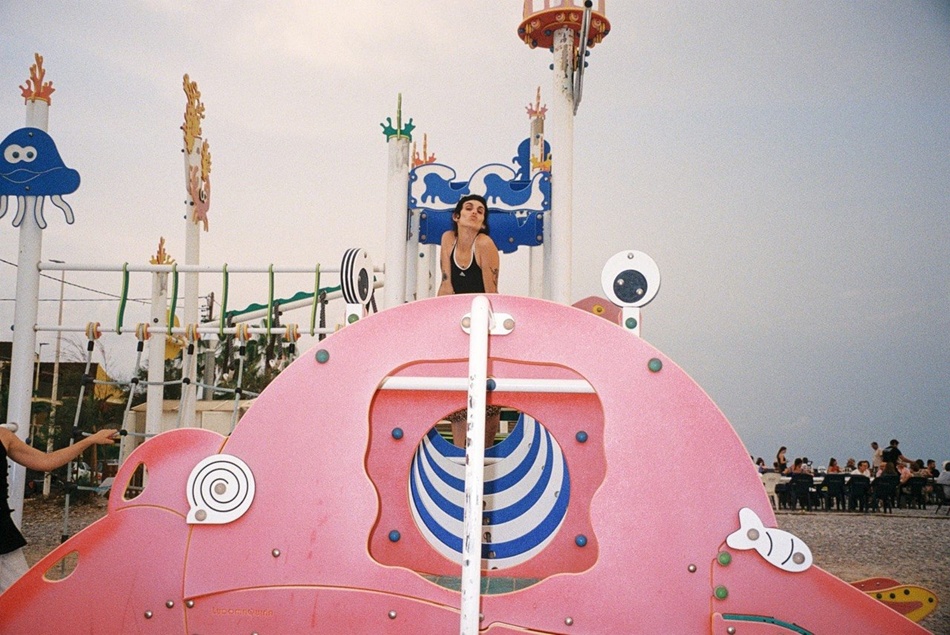
Alba Oller is the founder of the Massa Salvatge cooperative, where she develops projects that promote critical perspectives centered on an anti-adultist approach to education, art, and culture through mediation, and combines her practice with participatory research, cultural management, and training. A teacher by training, she holds a Ph.D. in educational research and is a professor of Art Education Pedagogy. She has carried out various projects focused on the relationship between visual culture, teacher training, the history of education, and mediation. She works at the intersections and margins between cultural institutions (IVAM, MACBA, MNCARS, CA2M, CCCC…), training centers (UV, UA, UCM, UJI) (Regional Ministry of Education, Cefire, Ministry of Culture…), and grassroots and community spaces and collectives (La Figuera, Parke Alcosa, La Surera, Fira Anarquista). She serves as a mediator for Concomitentes within the Estructuras de Afecto project.
Media Partners:








"A desk is a dangerous place from which to watch the world" (John Le Carré)