Search
To search for an exact match, type the word or phrase you want in quotation marks.
A*DESK has been offering since 2002 contents about criticism and contemporary art. A*DESK has become consolidated thanks to all those who have believed in the project, all those who have followed us, debating, participating and collaborating. Many people have collaborated with A*DESK, and continue to do so. Their efforts, knowledge and belief in the project are what make it grow internationally. At A*DESK we have also generated work for over one hundred professionals in culture, from small collaborations with reviews and classes, to more prolonged and intense collaborations.
At A*DESK we believe in the need for free and universal access to culture and knowledge. We want to carry on being independent, remaining open to more ideas and opinions. If you believe in A*DESK, we need your backing to be able to continue. You can now participate in the project by supporting it. You can choose how much you want to contribute to the project.
You can decide how much you want to bring to the project.
It all began with a copy. With the idea that the original was nothing more than a vehicle that transports ideas and that ideas cannot be limited to the uniqueness of an object. This impulse, and above all its invasion into the logic of art, began to take over as access to machines of reproduction became commonplace.
In Mexico, this impulse found fertile, though often forgotten, territory, connecting as it did with a tradition of mail art, experimental poetry, and activism. This text explores this territory between the 1990s and 2010, a period of digital enthusiasm, transnational solidarity, and the exploration of non-human languages. What follows is a collection of fragments of situated history, woven from the bellybutton of the moon. [1] According to tradition, the word Mexico comes from three words in the Nahuatl language: metztli, which means moon; xictli, navel or center; co, place. In both a literal and metaphorical sense, the … Continue reading
The arrival of the Internet radically changed the way we communicate and, with it, the ways in which we interact and create, especially affecting the arts. Since the early beginnings of the leap to shared digitality we have seen a creative surge that has led to the confrontation with or rupture of various paradigms. However, the ways in which we approach production from and for the Internet have a long tradition in explorations such as mail art, textile work, poetry, and performance.
In Mexico, this tradition is rooted in concrete poetry, mail art, and the first experiments with personal computers in the 1980s. It is precisely from these ideas that artists such as Lilia Pérez-Romero, Minerva Cuevas, Fernando Llanos, and Tlaolli Argüello redirected their gaze to the screen and, more specifically, to the Internet as a site for collective exploration.
A fundamental space for understanding this development is S@lón, a project based in San Miguel de Allende which, between 1994 and 2003, was dedicated to observing, disseminating, and experimenting with net art practices in Mexico. One of the most significant milestones in its history was Documenta X in 1997, an edition that marked the first official inclusion of net art in the exhibition program and which also hosted the First Cyberfeminist International, organized by the Old Boys Network collective. In addition to this event, S@lón presented projects from institutions such as the Dia Art Foundation and Gallery 9 at the Walker Art Center, which were shown at the Estación Internet cybercafé in San Miguel de Allende.
The sociopolitical context of the 1990s, marked by enthusiasm for the democratic and community potential of the early Internet, was decisive for the emergence of initiatives that explored new forms of production, communication, and community within the art world. Amid this climate of digital experimentation and online activism, projects also began to take shape that understood virtual space as a territory for political and symbolic action.
A paradigmatic example of this shift was the creation of FloodNet (1998) by the collective Electronic Disturbance Theater 1.0 [2]Electronic Disturbance Theater 1.0 (EDT) is an art and activism collective founded in 1997 by Ricardo Domínguez, Carmin Karasic, Brett Stalbaum and Stevan Wray. A pioneer of hacktivism and … Continue reading, an act of tactical poetics that used a website to carry out coordinated blockages of various institutional sites, including that of Mexican President Ernesto Zedillo, national banks, the Pentagon, and the Frankfurt Stock Exchange, as a form of digital protest. Supporters of the Zapatista Army of National Liberation (EZLN), the collective conceived their work as a response to the Acteal massacre, with the aim of articulating a transnational political message and making visible, beyond geography, solidarity with the struggles of indigenous peoples in Mexico.
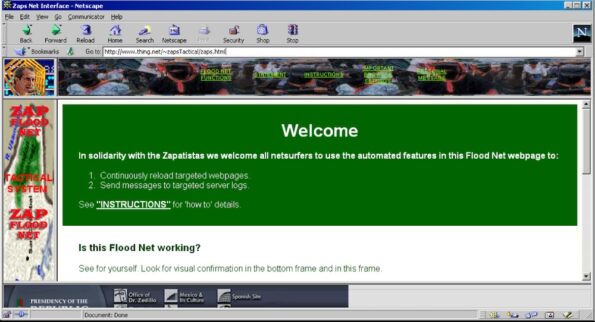
Electronic Disturbance Theater 1.0, Floodnet, 1998. Courtesy of EDT.
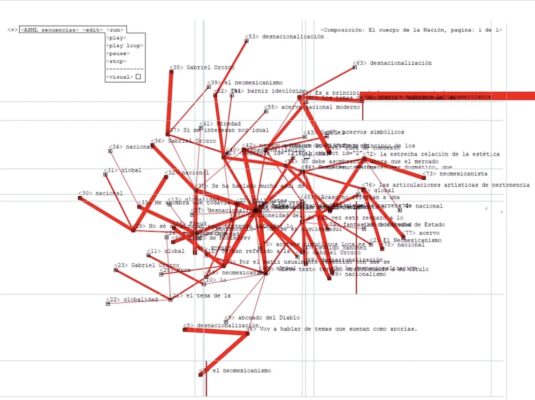
In addition to this work, there are pieces such as ASML (Art Statement Markup Language, 2003) by Iván Abreu [3] Iván Abreu is a Cuban-Mexican artist and designer. His work combines art, science and technology, focusing on the visualization of data and socio-political systems. , in which the artist explores the language of curatorial discourse, starting from references such as Príamo Lozada, Osvaldo Sánchez and Olivier Debroise, with a computerized analysis that facilitates its reading. This piece starts by labeling fragments of texts and diagramming them, and generating new grammars and also new logics of exchange between work and text, author and critic. In this transcoding of discourses there is also a reflection that connects it with work linked to electronic literature, an area of creation that diagonally intersects with art on the Internet, especially at the beginning of the 2000s.
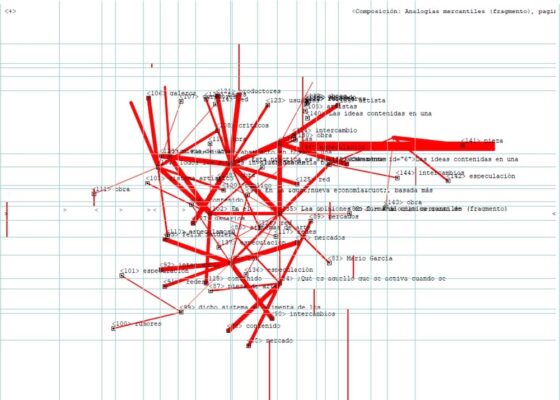
Iván Abreu, ASML –Art Statement Markup Language–, 2003. Courtesy of the artist.
The relationship between technology and language has been present since the definition of language itself. Thus, it is not surprising that since the incorporation of typewriters there has been much reflection on its expansion. This is clearly seen in the body of work of computer poetry pioneer Laura Elenes, along with Noemí Atamoros, creators of the Atelén [4]Laura Elenes was a Mexican painter, sculptor, and printmaker whose work integrated industrial design and research into pre-Hispanic literature in order to examine the relationship between tradition … Continue reading project (circa 1980). Atelén, according to Elenes, “is the aesthetic possibility of transferring literature as the written word simultaneously to visual poetry, painting, graphics, sculpture and pentaphonic music.” [5]Laura Elenes, quoted in Leticia Ocharán’s El pigmento y la luz. Prácticas específicas, in the catalogue of the II International Biennial of Visual and Alternative Poetry in Mexico, Mexico City, … Continue reading This expansive work shows a series of reflections in a coming and going of shapes, colors and formats. In her text The Pigment and the Light (1987), Leticia Ocharán states how artists:
“(…) found in the chromatic luminosity of their personal computer an abstract language of vibrant colors. And this was only one of the many resources that stimulated other pictoluminous works. The continuous work, the confrontation with the ephemeral moments of the created image, in constant and sometimes uncontrollable change, was another of the exciting qualities of using the computer.” [6] Ibid., p. 22.
Fragments of these reflections materialized throughout the 1990s, when access to personal computers became more affordable and digital practices began to be incorporated into events and publications linked to alternative poetry. Shortly after, research by authors such as Mónica Nepote [7] Mónica Nepote is a Mexican writer, editor, and cultural manager. Her work combines poetry, essays, and sound experimentation that explore and expand the boundaries of literary genres. deepened these explorations, opening the way to think about machine language, non-human languages and the expansion of communication through the screen, ideas that were later consolidated in spaces such as the E-Literature repository of the Centro de Cultura Digital.
One of the first institutional projects in Mexico that recognized the creative potential of the Internet was the Cyberlounge in the Tamayo Museum, active between 2002 and 2009. This space was initially dedicated to the exhibition of on-screen works linked to net art, video, software art, video games and other hybrid practices, incorporating over time sound art as part of its programming. Directed and curated by Arcángelo Constantini, the project presented exhibitions, talks, residencies and live presentations that fostered dialogue between different technological and artistic languages.
The Cyberlounge activities included in-person net art navigations, video exhibitions accessible from the museum patio, meetings between artists, curators and specialists, as well as short residencies in which sound artists experimented with the public space of the Tamayo. Among the participants were Brian Mackern, Erandy Vergara and Bárbara Perea. However, as Constantini has pointed out, the museum did not keep an adequate record of the activities carried out, which has made its study difficult and left a void in the institutional memory about a crucial stage in the history of art + technology in Mexico.
This process of institutionalization and professionalization found its correlation in the educational field. Around 2006, El Tecnológico de Monterrey launched a Bachelor’s Degree in Animation and Digital Art, a program with a focus oriented towards the creative industry. More critical and experimental initiatives followed, such as the Bachelor’s Degree in Digital Art at the Faculty of Arts of the UAEMéx (2011) and the Bachelor’s Degree in Digital Art and Communication at the UAM Lerma (2013). The consolidation of these programs, along with the creation of the Digital Culture Center (2012), transformed the panorama from a territory of exploration on the margins to artistic practices with digital technologies that began to be institutionalized in Mexico as a field of study and creation.
By 2010, practices linked to Internet use were beginning to emerge in an interconnected wave. The enthusiasm of early net art gave way to criticism of platforms and the appropriation of social networks. Works and processes, such as those of Anni Garza Lau and the Astrovandalistas collective, echoed a genealogy that, from the margins and the screen, had been forming for years around the critical, poetic and political possibilities of digital technology.
This collective screenshot is, above all, a series of fragmented stories that seek to make sense of the journey of these practices in Mexico. The current panorama is exciting and there are many who continue surfing (myself included) on this strange surfboard that, sometimes in a subtle and sometimes in an intense way, sustains us in a sea of 0’s and 1’s.
References
Constantini, Arcángelo. Personal interview about the Tamayo Museum Cyberlounge. 2022.
Ocharán, Leticia. El pigmento y la luz. Prácticas específicas (Pigment and Light: Specific Practices). In the catalogue of the II International Biennial of Visual and Alternative Poetry in Mexico, Mexico City, 1987, pgs. 21-25.
Rabadan, Maria Eugenia. “Sobre el origen del net art en México” (On the origin of net art in Mexico). In El Ojo de Orfeo. Visiones contemporáneas de la relación Arte-Tecnología (The Eye of Orpheus. Contemporary Visions of Art-Technology). 2020, pgs. 158-179.
Ríos, Doreen y Ricardo Domínguez (eds.). Cuánto tiempo lleva todo esto derramándose sin desbordarse (How Long Has All This Been Spilling Without Overflowing?) Centro de Cultura Digital, 2021.
[Featured Image: Iván Abreu, ASML –Art Statement Markup Language–, 2003. Courtesy of the artist.]
| ↑1 | According to tradition, the word Mexico comes from three words in the Nahuatl language: metztli, which means moon; xictli, navel or center; co, place. In both a literal and metaphorical sense, the word means “in the bellybutton of the moon,” or, to put it another way, “in the center of the lake of the moon.” |
|---|---|
| ↑2 | Electronic Disturbance Theater 1.0 (EDT) is an art and activism collective founded in 1997 by Ricardo Domínguez, Carmin Karasic, Brett Stalbaum and Stevan Wray. A pioneer of hacktivism and electronic poetics of resistance. |
| ↑3 | Iván Abreu is a Cuban-Mexican artist and designer. His work combines art, science and technology, focusing on the visualization of data and socio-political systems. |
| ↑4 | Laura Elenes was a Mexican painter, sculptor, and printmaker whose work integrated industrial design and research into pre-Hispanic literature in order to examine the relationship between tradition and modernity. Noemí Atamoros was a Mexican journalist and writer who dedicated 53 years to the newspaper Excélsior and specialized in studies on Sor Juana Inés de la Cruz. |
| ↑5 | Laura Elenes, quoted in Leticia Ocharán’s El pigmento y la luz. Prácticas específicas, in the catalogue of the II International Biennial of Visual and Alternative Poetry in Mexico, Mexico City, 1987, p. 21. |
| ↑6 | Ibid., p. 22. |
| ↑7 | Mónica Nepote is a Mexican writer, editor, and cultural manager. Her work combines poetry, essays, and sound experimentation that explore and expand the boundaries of literary genres. |
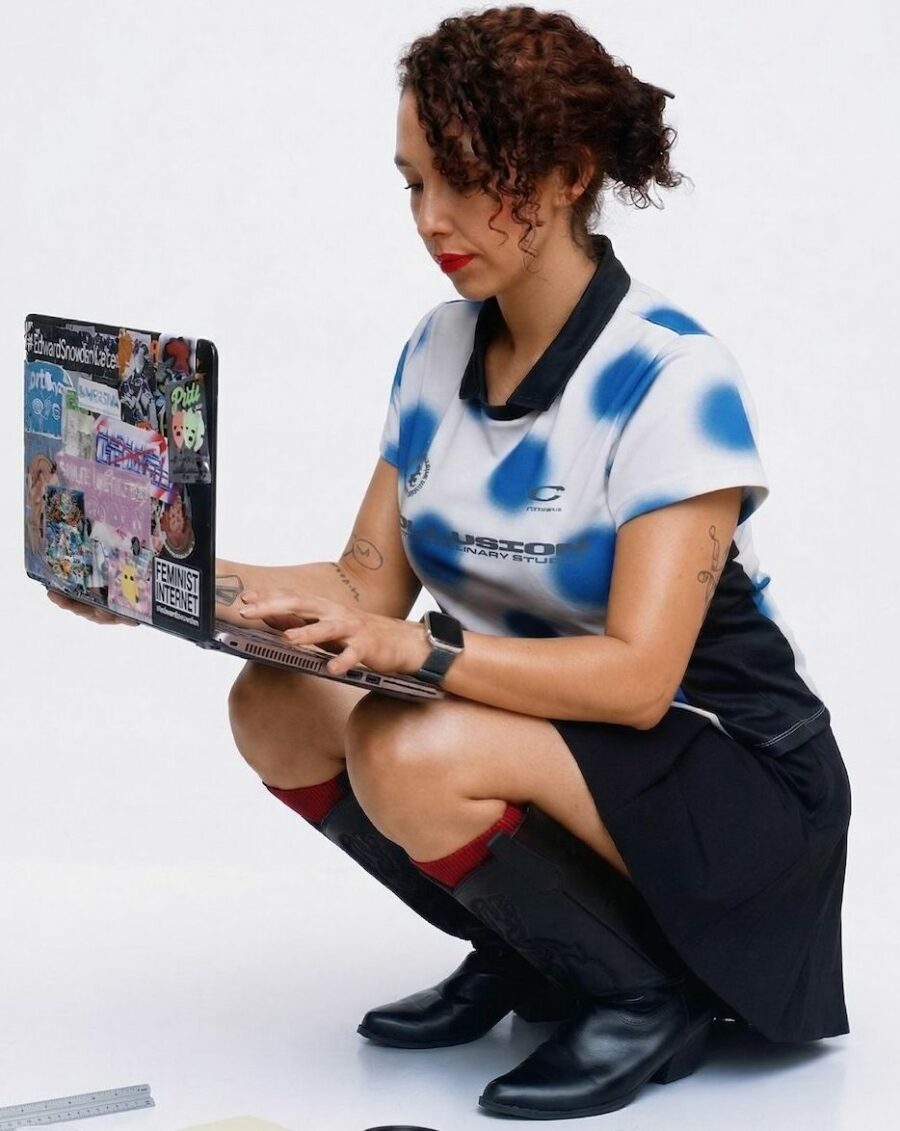
Doreen Ríos (Toluca, Mexico). Her work focuses on technological counterproduction within contemporary art, tactical media, and new materialities. She is the founder of ANTI]MATERIA, an online platform dedicated to researching and exhibiting the critical use of technology in Latin American art. She is the author of the book Medios inestables. De objetos técnicos y arte [Unstable Media: On Technical Objects and Art] (2025). She was chief curator of the Center for Digital Culture (Mexico City, Mexico) from 2019 to 2021.
She holds a Master’s degree in Contemporary Curating from the Winchester School of Arts, specializing in digital cultures, and a Bachelor’s degree in Architecture from Tecnológico de Monterrey. She is currently pursuing a PhD in Art History, Theory, and Criticism at the University of California, San Diego, and is a member of the international selection committee for the Lumen Art Prize and the Leonardo Peer Review Panel.
Media Partners:







"A desk is a dangerous place from which to watch the world" (John Le Carré)