Search
To search for an exact match, type the word or phrase you want in quotation marks.
A*DESK has been offering since 2002 contents about criticism and contemporary art. A*DESK has become consolidated thanks to all those who have believed in the project, all those who have followed us, debating, participating and collaborating. Many people have collaborated with A*DESK, and continue to do so. Their efforts, knowledge and belief in the project are what make it grow internationally. At A*DESK we have also generated work for over one hundred professionals in culture, from small collaborations with reviews and classes, to more prolonged and intense collaborations.
At A*DESK we believe in the need for free and universal access to culture and knowledge. We want to carry on being independent, remaining open to more ideas and opinions. If you believe in A*DESK, we need your backing to be able to continue. You can now participate in the project by supporting it. You can choose how much you want to contribute to the project.
You can decide how much you want to bring to the project.
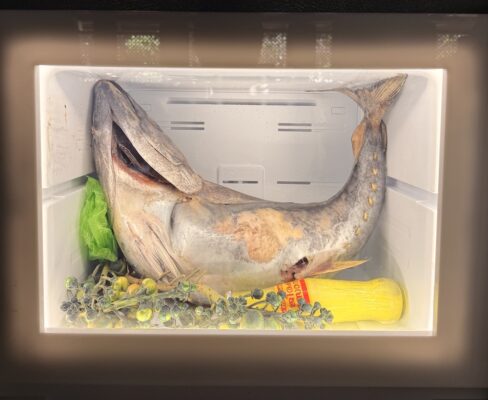
At the entry to Aspinwall, the Kochi Biennale’s largest site, a visitor this year would be welcomed with a group of refrigerators. Like seventeenth-century Dutch nature morte paintings that represented one’s bounty, Adrián Villar Rojas (b. 1980, Argentina) staged rotting assemblages of fruits, vegetables and fish inside of freezers lit like museum vitrines in his work Rinascimento (2015–ongoing). This installation captures the contradictions inherent in many modern technologies of capitalist accumulation. Is it really possible to preserve and consume abundance in perpetuity?
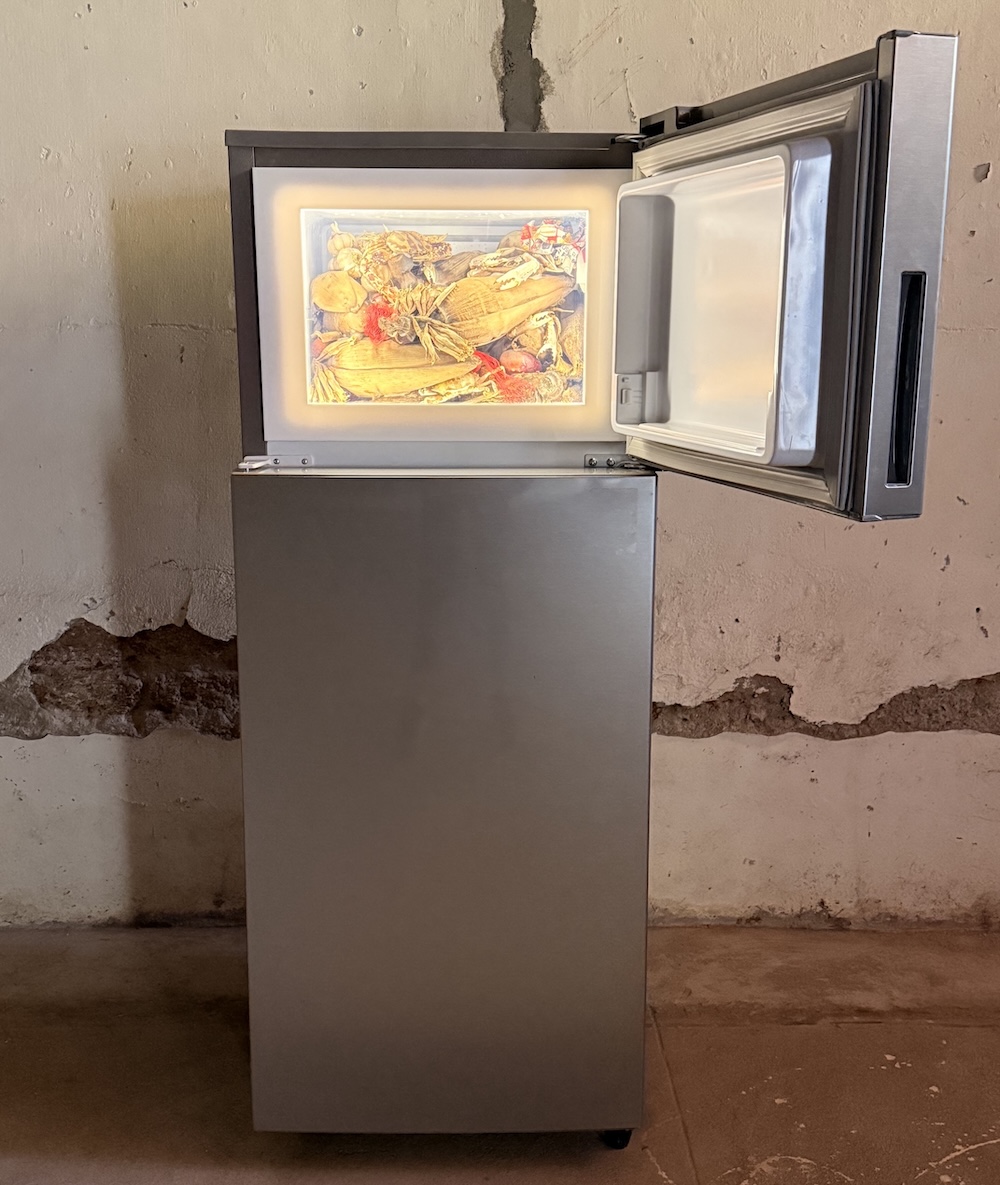
Adrián Villar Rojas, from the Series Rinascimento, 2015–ongoing, Aspinwall, Kochi Biennale, 2025. Photo: Denis Maksimov
Rinascimento, which means Renaissance, conveys many of the paradoxes that we have identified in three of 2026’s biennials of contemporary art: For the Time Being (Kochi) curated by Nikhil Chopra, In Minor Keys (Venice) posthumously curated by Koyo Kouoh, and everything must change. Radical intelligence. Saloniki 9 (Thessaloniki) curated by Nadja Argyropoulou. This editorial takes the pulse of contemporaneity through the contributions of these projects and proposes the three emerging themes of the mutable object, material mythologies, and the anti-modern that we treat in successive articles.
Yet before diving in, it is worth addressing some of the irritations that we seek to tune out in our experience of these projects. In a display that claims to provoke slowness, we have never witnessed audiences speeding through quicker. Amidst calls for radical care, art workers continue to work without adequate pay. In one of the last remaining spaces of cultural critique, we hear more about a curator’s social network while hearing almost nothing about their actual ideas or expertise. Exhibitions across the spectrum have turned into flower arrangements of trends cooked up by conversations with AI. As in the Dutch Venice Pavilion’s work this year, The Fortress (2026) by Dries Verhoeven (b. 1976, Oosterhout), do we just angrily scream mantras into the void of our own impotence? Here, we seek to cut through the fluff to tap into some discursive frames that could potentially lead to future paths of inquiry.
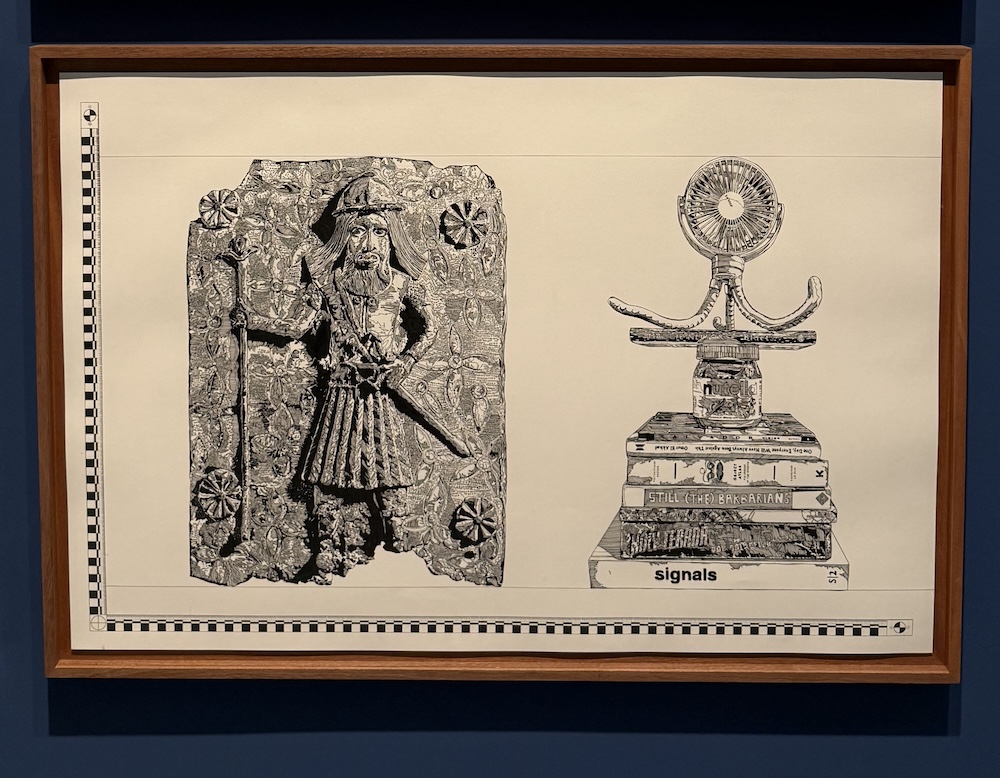
Pio Abad, 1897.76.36.18.6 (2023–26), Giardini, Venice Biennial, 2026. Photo: Vivek Gupta
Across all three projects we call a first emergent discourse ‘the mutable object’. By this, we call attention to the preoccupation with the transformative and impermanent nature of physical objects. Artists have pushed against the fixity of objects by emphasising their performance, temporal and processual layers, and often, their placelessness. This comes across in the works of the artist Pio Abad (b. 1983, Manila). In his series of ink drawings 1897.76.36.18.6 (2023–26) on view in Venice, he brings looted objects of cultural heritage, especially the Benin bronzes, into the space of domesticity by responding to their formal qualities. The form of a standing warrior in relief becomes a desk fan standing upon a Nutella jar and a stack of books. Executed in black and white line drawings with a graphic sensitivity to scale, the style of Abad’s work draws upon archaeological survey images. By juxtaposing a sacred object with domestic flotsam, Abad throws the process of transforming a Benin statue from cultural heritage to museological capital into high relief. Next week’s editorial takes up the mutable object as a core concern of today’s artists by dwelling on the practice of Cinthia Marcelle (b. 1974, Belo Horizonte), Mandeep Raikhy (b. 1980, New Delhi), Walid Raad (b. 1967, Chbanieh), and others.
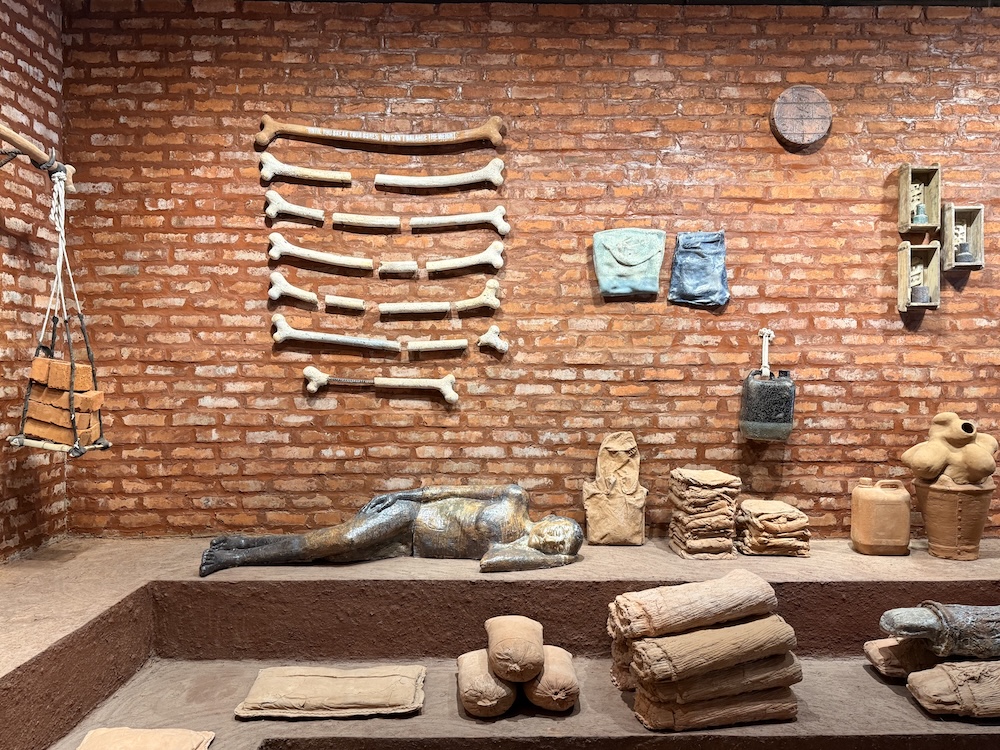
Birender Yadav, Only the Earth Knows Their Labour (2025), Aspinwall, Kochi Biennale. Photo: Denis Maksimov
A second discursive thread uniting these projects can be termed ‘material mythologies. Has the material turn in the history of art gone too far? Or, rather, has it gone in the wrong direction? Questions of how things are made, the labour that went into their making, and the materials harnessed for their manufacture can indeed lead to many fruitful lines of investigation. The installation Only the Earth Knows Their Labour (2025) by Birender Yadav (b. 1992, Ballia) in Kochi manifests the embodied pressures of seasonal migrant workers of brick kilns in Mirzapur, Uttar Pradesh. The tools, clothing, shoes, bags, and sleeping mats of labourers make visible the haunting material life of their work. Headless, disembodied fragments of sculpted flesh grafted with tools accentuate how the body has been reduced to a machine. A clay tablet mounted on a kiln in this display reads, ‘molds without a name is discarded as waste, then what of the laborers whose name was never inscribed?’ When artists explore material mythologies to critique social relations, as in the invisible labour of brickmakers, Yadav reminds us that there is always more to a work of art than the material out of which it is made. Moreover, those layers can exceed in importance both the intention of the artist and contextual references that could be read from its surface.
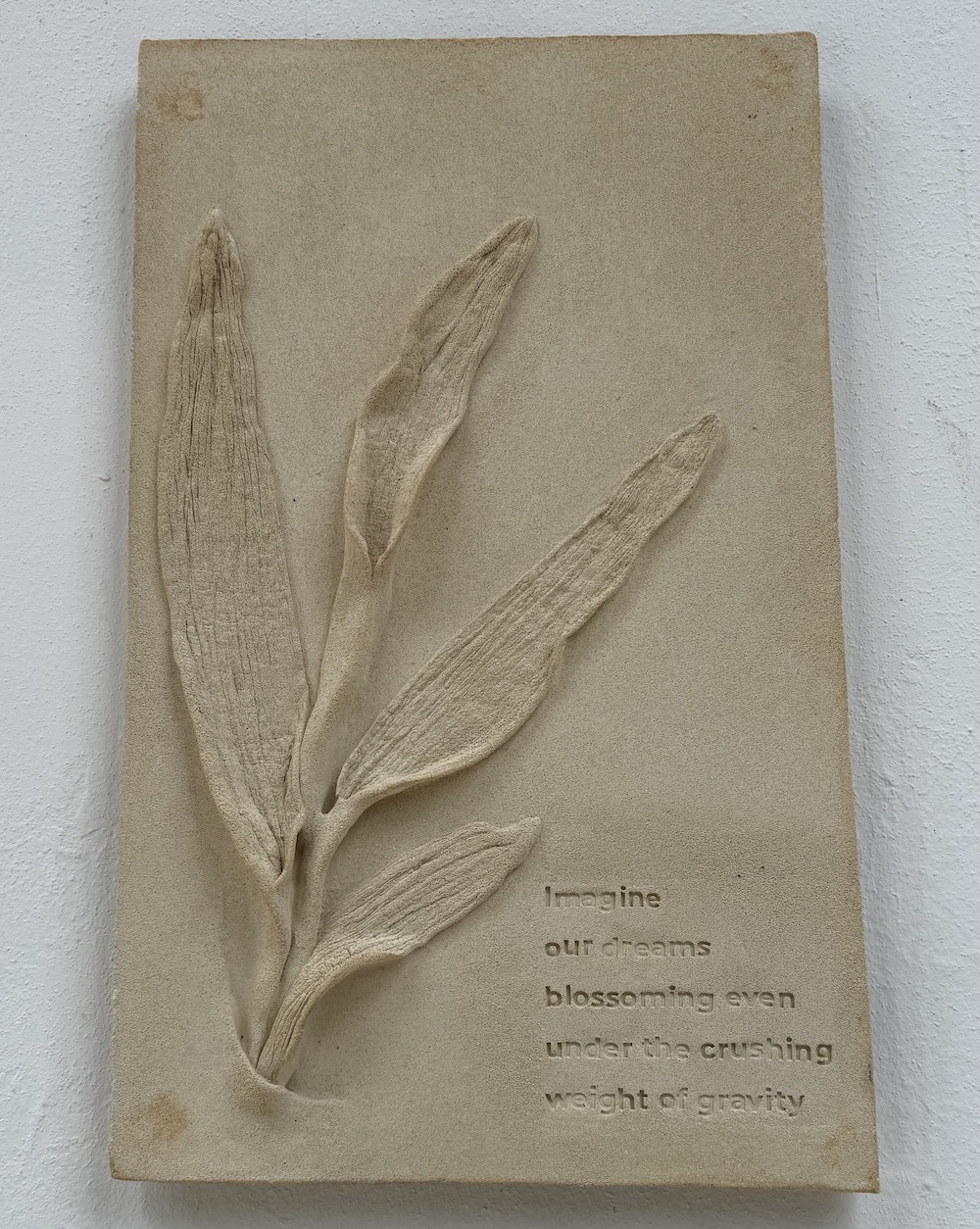
Otobong Nkanga, Soft Offerings to Silenced Voices and to All Who Have Turned to Dust, Giardini, Venice Biennial, 2026. Photo: Vivek Gupta
Yadav’s attention to embodiment and the labour of earthen materials in Kochi comes into dialogue with Soft Offerings to Silenced Voices and to All Who Have Turned to Dust by Otobong Nkanga (b. 1974, Kano) installed at the entrance to Giardini. Nkanga, whose work was also on view in Kochi, created an ever evolving ecosystem by dressing the iconic pillars of Giardini’s central pavilion with locally-made bricks, ceramic pots for climbing plants, and sculpted insect houses. Of the installation’s twelve high-temperature fired clay tablets, one reads ‘Imagine our dreams blossoming even under the crushing weight of gravity’, with plants emerging from the surface. Like Yadav, Nkanga homes in on the immense pressures that bodies and materials endure to survive. While some practitioners might imbue their materials with mythologies that range from the hyper scientific to historically dubious, the tactile, embodied, and social features of Yadav and Nkanga’s works lead to fruitful introspection on our relationships with the earth as well as each other. Our third editorial will further explore the potentials and pitfalls of material mythologies through key works by Alfredo Jaar (b. 1956, Santiago), Kirtika Kain (b. 1990, New Delhi), and Adebumni Gbadebo (b. 1992, Livingston).
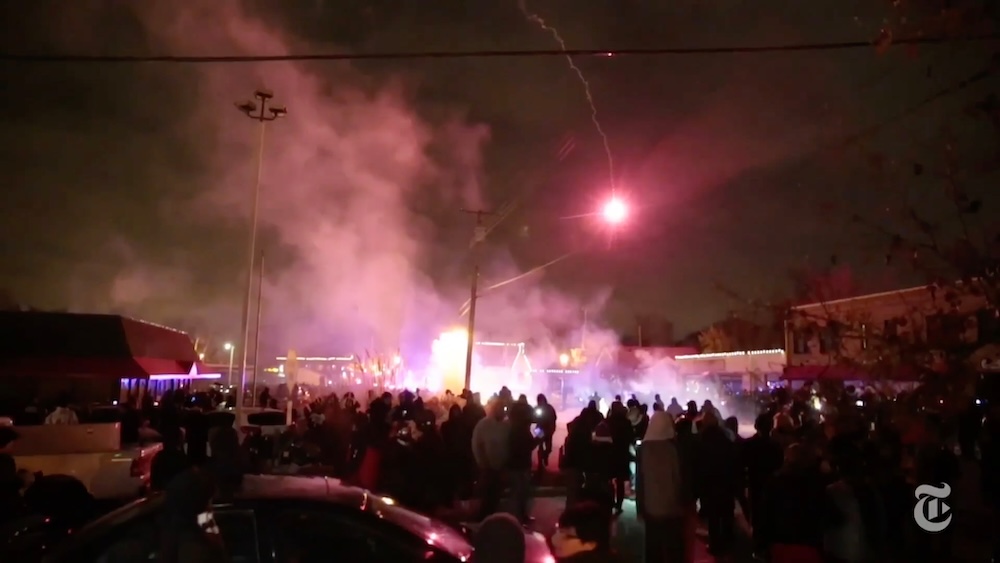
Arthur Jafa, Love Is The Message, The Message Is Death, 2016. Video (color, sound), 7’ 25’’. Courtesy of the Artist and Sadie Coles HQ, London
Driven by the interventions of the Thessaloniki Biennial, our final article for the month will deal explicitly with what we provisionally call the ‘anti-modern’. As we acknowledge the everchanging nature of objects, rather their fixity in a grid or determined meaning, and we accept their multivalent materials, many contemporary artists today seem untethered to the discourse of modernism. Indeed, today’s art world is congested with people and institutions devoted to modernism, but increasingly we are bearing witness to its failures. For instance, Arthur Jafa (b. 1960, Tupelo), an artist of the Thessaloniki Biennial – whose work is featured in what has been dubbed by one of the co-authors of this piece the unofficial American pavilion, Helter Skelter: Arthur Jafa and Richard Prince (Fondazione Prada, Venice) – sees what the tight framework of modernism ignores. He exposes the many elephants in the room – the internal contradictions of the modernist agenda. He sheds light on the cleavages in which modernism pushes society to fall such as the agony of interracial warfare of the United States and the performative manifestation of political visions that spill from the American context on the whole world. America’s omnipresence corrupts the ability for conflicts to be resolved that have existed in more developed societies for centuries. By our final editorial, we aim to fill out a framework of the anti-modern through projects by Jafa, Laurie Anderson (b. 1947, Chicago), Zarina Muhammad (b. 1982, Singapore), and several others.
As two curators and scholars of the premodern and contemporary spanning cultural traditions across Eurasia, these essays are not only our engagement with artists but also with each other. Based on the propositions of this year’s biennials in Kochi, Venice, Thessaloniki, the centres of contemporaneity and its discourses have shifted from where and when they were once imagined to be. In the face of an almost provincialised Europe, persistent presentism, and the narrow frameworks of art history and its institutions, the anti-modern is a form of liberation.
[Front image: Adrián Villar Rojas, from the Series Rinascimento, 2015–ongoing, Aspinwall, Kochi Biennale, 2025. Photo: Denis Maksimov]
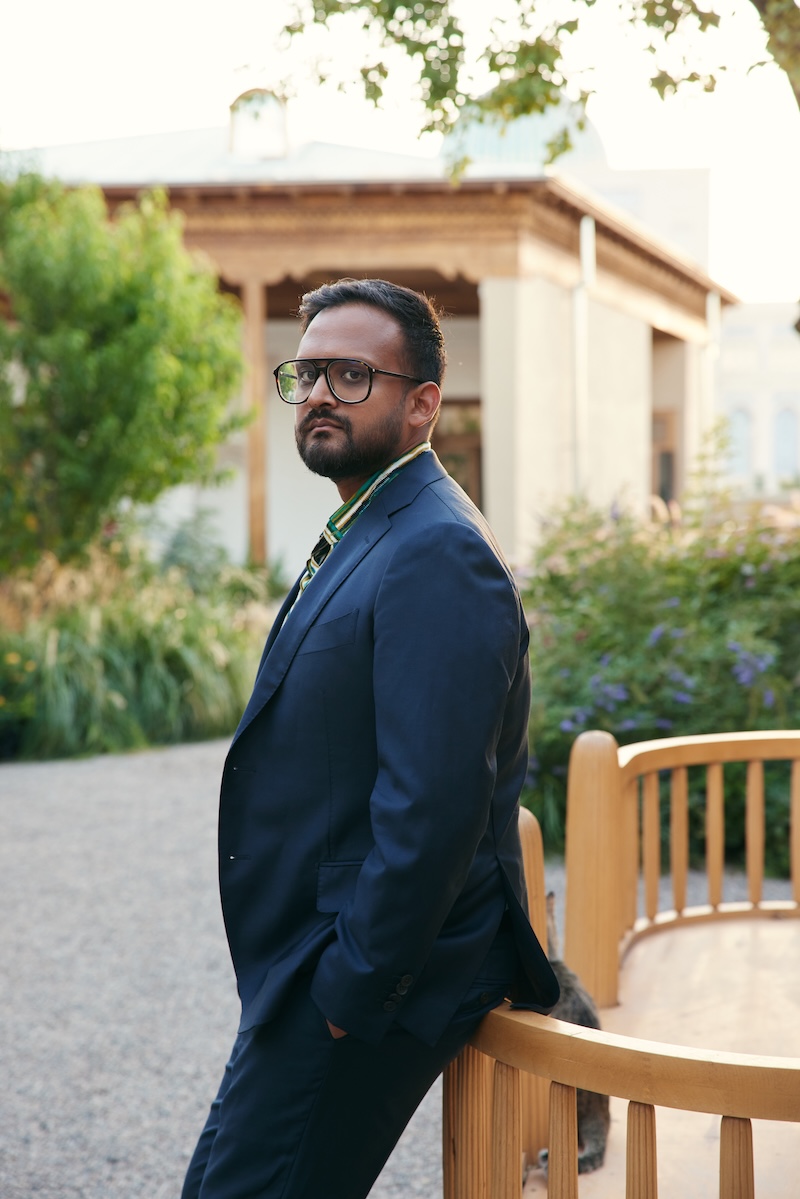
Dr Vivek Gupta is an art historian and curator of the Islamic, South Asian, and Indian Ocean worlds. He specialises in the art of the book, painting, calligraphy, and connections between portable objects and architecture. In recent publications, he has written about transregional circulation, cultural exchange, intersections between art and science, and transmediality. He is the author of Wonders of Hindustan: Artists and books in the early modern world (UCL Press) and curator of A Mughal Songbook: Art, Music, and Empire at the Fitzwilliam Museum, Cambridge (2026–27). He is currently a British Academy Postdoctoral Fellow in History of Art at University College London (2023–26) and previously was a Postdoctoral Research Associate at the University of Cambridge (2020–23).

Denis Maksimov is a historian of art and knowledge. His work focuses on aesthetics of epistemology, the relationship between heritage and future-making, and lecture performance. He is a guest curator at NYU Abu Dhabi Art Gallery and has curated exhibitions and programmes for institutions globally, including Helsinki Art Museum, Glyptoteket in Copenhagen, Pushkin House in London. His research and curatorial work have been presented in the Venice Biennales of Art and Architecture (2015, 2016, 2017, 2019 & 2022), Documenta 14 (2017), Ural Industrial Biennial (2017), São Paulo Biennale (2016), Art Basel, London Art Fair, Cosmoscow, etc. He is a lecturer at Backstein’s Institute of Contemporary Art, Salzburg International Summer Academy of Fine Arts, and was a visiting lecturer at the University of Applied Arts in Vienna. His writing has been published by MIT Press, Edward Elgar Publishing, MoMA, Ocula, Conceptual Fine Arts, Moscow Art Magazine, Obieg, Arts of the Working Class, among others.
Media Partners:






"A desk is a dangerous place from which to watch the world" (John Le Carré)