Search
To search for an exact match, type the word or phrase you want in quotation marks.
A*DESK has been offering since 2002 contents about criticism and contemporary art. A*DESK has become consolidated thanks to all those who have believed in the project, all those who have followed us, debating, participating and collaborating. Many people have collaborated with A*DESK, and continue to do so. Their efforts, knowledge and belief in the project are what make it grow internationally. At A*DESK we have also generated work for over one hundred professionals in culture, from small collaborations with reviews and classes, to more prolonged and intense collaborations.
At A*DESK we believe in the need for free and universal access to culture and knowledge. We want to carry on being independent, remaining open to more ideas and opinions. If you believe in A*DESK, we need your backing to be able to continue. You can now participate in the project by supporting it. You can choose how much you want to contribute to the project.
You can decide how much you want to bring to the project.
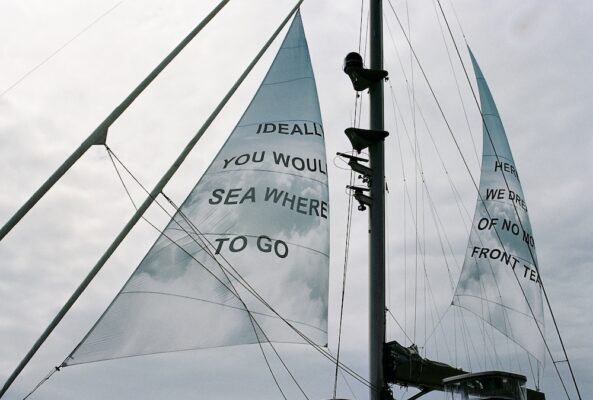
For nearly 300 years, starting from the late eight century, the British Isles suffered frequent raids and invasions by Scandinavian pirates. Eventually, some of those violent Norsemen ended up settling in England, peacefully amalgamating with the local population and gradually adding (at least) nine hundred Old Norse words, such as sky, law and thrall into the cauldron of the English language.
Fast-forward to 2026: English is now omnipresent in contemporary Icelandic society. The land of the Eddas and the Sagas is thoroughly saturated in English, even more so than in the 90s, when the author of these lines was growing up. It’s everywhere in daily life. In the gym locker room, I often overhear young Icelandic guys casually slipping into some seamless American English pastiche, uncannily devoid of Icelandic accent, to say something that’s easily sayable in their own mother tongue. It seems to be influencing orthography too, for example in the way familiar compound words increasingly tend to be split apart. The English presence and influence are such that ever more native Icelanders fear for their language. Some are merely conservative language purists, refusing to accept that it’s a living, evolving idiom. Others, though, worry that some more fundamental shift is taking place, as we speak. That a certain linguistic continuity that goes back a thousand years might be broken.
Scholars have warned that Icelandic nowadays has a problem of dominance, i.e. that it’s not fully sufficient in all domains of Icelandic society due to social, economic and technological changes or globalization. Unlike, say, the way French is fully sufficient on all levels in French society. Professor Emeritus Eiríkur Rögnvaldsson has also argued that Icelandic has an image problem: Young Icelanders associate Icelandic with school assignments, grades, corrections, respect and old people, whereas they associate English with fun, entertainment, travel and future opportunities.
According to a received notion here, all Icelanders speak English fluently, even as well as native English speakers. However, research from 2017 by Max Naylor of the University of Edinburgh shows that Icelanders in general tend to vastly overestimate their English skills and are far from being bilingual. Icelanders’ lack of a realistic perception of their own English skills not only prevents them from improving it but also harms Icelandic. Before the banking crisis of 2008, one Icelandic university was considering dropping teaching in Icelandic altogether, and some in the banking sector were considering switching to English as the workplace language.
Two major socio-economic factors must be explained. Firstly, for a very long time Iceland used to be quite linguistically and ethnically homogenous. But by now the immigrant population has gone from 2% (1996) to 21% (present day) – over 70,000 out of a total population of less than 400,000 inhabitants. Given the lack of adequate funding and infrastructure at present, Iceland is struggling to teach the local language to all those potential students. Secondly, there’s an ongoing tourism boom that has lasted for over a decade (around 2.25 million tourists visited in 2025). Advertisements in English only are a common sight in mid-town Reykjavík and other tourist hotspots. In this environment, English functions as a lingua franca. The socio-linguistic situation is evolving rapidly. A research professor at the Árni Magnússon Institute who published a book about the topic in 2017 has deemed it necessary to make a revised and updated edition now, less than ten years after initial publication.
Then there are cultural factors. In addition to the constant barrage of Anglophone online entertainment with no way of translating it all, there’s also the wide-spread fascination with all things American that goes back at least to WWII when the island was occupied, first by the British and then the U.S. army, initiating a cultural revolution with rock n’roll, Coca-Cola, chewing gum and so on. Anglophone pop culture often gets the blame but recently Professor Benedikt Hjartarson and others have shown that there was also a marked shift in translated literature after WWII, with literary translations in general becoming decidedly less international and an increased emphasis on Anglo-American literary works during the Cold War. One might say that a taste for Anglophone culture has been cultivated here for several decades. The Cold War leftists used to speak of cultural imperialism. One also wonders what Robert Philippson, author of Linguistic Imperialism –controversial as he may be among linguists– would have to say about the Icelandic scenario.
There’s a lack of public debate about the place of English in Icelandic society. Most Icelanders seem to take it for granted, without reflecting on the worldview or ideology that might be speaking through them when they use it. In his work, historian Einar Már Jónsson discusses the sociopolitical and economic baggage that comes with English. The language of Shakespeare, yes, but also of Adam Smith, John Locke and David Hume, of the survival of the fittest, the East India Company, the Highland Clearances, the Inclosure Acts and a very particular conceptualization of the human being, referred to as homo oeconomicus. The problem, according to Einar Már, is when this baggage that comes out of specific historical circumstances gets universalized as something that applies not only to all men of all epochs but to all of Nature as well, such as when the British vulgar biologist Richard Dawkins (rather popular in Iceland in the early 21st century) wrote a book called The Selfish Gene. Einar Már mentions how Karl Marx observed how remarkable it was that Charles Darwin seemed to find his own 19th century Victorian society in the natural world.
(As a curious sidenote, we might add that David Friedman, son of economist Milton Friedman, has fantasized about Commonwealth era Iceland as a stateless, free market anarcho-capitalist utopia.)
In 1990, Édouard Glissant warned of the levelling effect of Anglo-American and that it, in turn, risked turning into a “technical salesman’s Esperanto”, a kind of dull sabir for global commerce that, in its insistence on transparency and clarity, would always be apoetical. Against this Glissant proposes the right to opacity, the right to not be transparent, immediately understood and quantifiable. And the literary text is a producer of opacity, he says. That would certainly apply to a lot of modern Icelandic poetry, but even more to medieval skaldic poetry, which is in fact the most opaque literature I can think of.
As the saying goes: A language is a dialect with an army and a navy. Iceland is that rare thing: a country without an army, a navy or dialects. It does, however, have a nation-state to prop up the official idiom, for example with laws that state clearly that Icelandic is the official language here, and thus it stands a better chance than many other small languages. Icelandic is not on UNESCO’s list of endangered languages. Not yet anyway.
Furthermore, it is receiving reinforcements from abroad. The most significant development in Icelandic literature in recent years is the emergence of writers of foreign origin who have made Iceland their home, mastered Icelandic and chosen to use it (beautifully) as their vehicle of artistic expression. Those authors have started receiving grants and awards, meaning they have gained entry into the literary establishment and are in that sense as Icelandic as the native-born authors. There are few signs of the inverse, i.e. native Icelandic speakers producing literature in English, or at least it doesn’t seem to get published much here. Certainly, there are some Icelanders with literary aspirations who are truly bilingual, but still there is little space for their Anglophone work in the book market. Indeed, such publications might even be regarded as provocative.
In other words, Icelandic is still hegemonic in the literary field and that seems unlikely to change soon. But then the question remains of what to do with the other non-Icelandic speakers in the scene. The poet, researcher and artist angela snæfellsjökuls rawlings, originally from Canada, has been based in Iceland for many years and occupies a liminal space between artforms, languages and nationalities. By their very being, they challenge the nation-state’s categories of what constitutes Icelandic literature. Will they one day receive the full recognition they deserve by the local literary establishment? Will their work ever become canonical, as it deserves to be? The future is uncertain as always, and as in the words of T.S. Eliot: “For last year’s words belong to last year’s language, and next year’s words await another voice.”
(Featured image: © Juliet Barbieri)
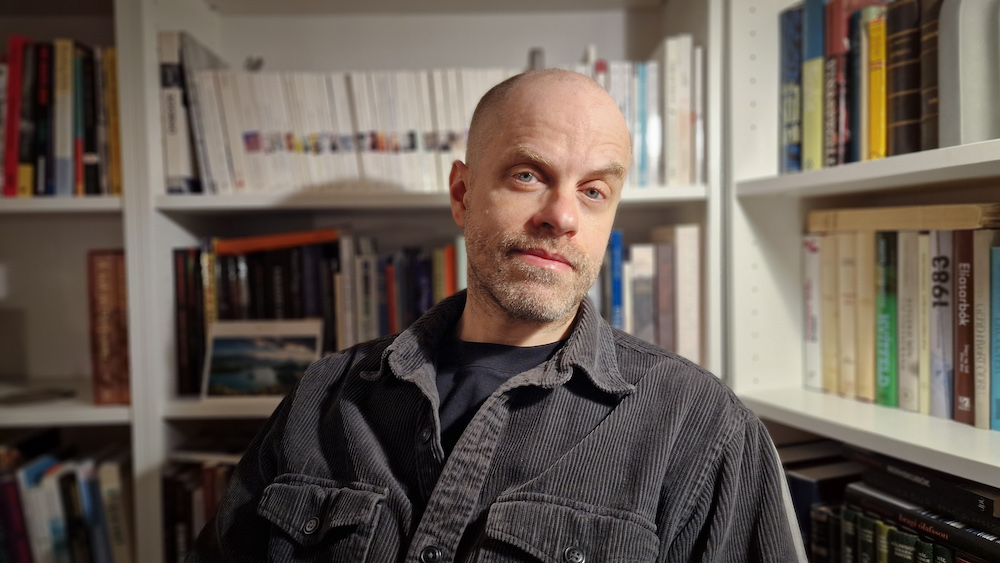
Kári Páll Óskarsson teaches Icelandic language and culture at the University of Iceland. He lives in Reykjavík.
Media Partners:






"A desk is a dangerous place from which to watch the world" (John Le Carré)