Search
To search for an exact match, type the word or phrase you want in quotation marks.
A*DESK has been offering since 2002 contents about criticism and contemporary art. A*DESK has become consolidated thanks to all those who have believed in the project, all those who have followed us, debating, participating and collaborating. Many people have collaborated with A*DESK, and continue to do so. Their efforts, knowledge and belief in the project are what make it grow internationally. At A*DESK we have also generated work for over one hundred professionals in culture, from small collaborations with reviews and classes, to more prolonged and intense collaborations.
At A*DESK we believe in the need for free and universal access to culture and knowledge. We want to carry on being independent, remaining open to more ideas and opinions. If you believe in A*DESK, we need your backing to be able to continue. You can now participate in the project by supporting it. You can choose how much you want to contribute to the project.
You can decide how much you want to bring to the project.
In Fallar otra vez (Fail Again), [1]Fallar otra vez (Fail Again) is the title of the book that includes the conference paper Probar otra vez. Fallar otra vez. Fallar mejor. (Try Again. Fail Again. Fail Better) (Alan Pauls at Casa de … Continue reading an ode to imperfect writing, Alan Pauls encourages writers to delve into the errors that arise during the creative process. In one of the most moving and incisive passages, one that imperceptively cuts like a knife, he points out that the only thing that truly makes us original are our mistakes. Like a slip of the tongue, mistakes are involuntary, and it is pointless to try to suppress them because they will always find ways to reappear, again and again. The most interesting option might be to continue to make mistakes, to fully surrender to this introspective exercise that leads us to despair but also to the redemption that comes not so much from the mistake itself but from discovering the specific way in which we make it.
So, what would happen if we applied these ideas to the realm of machines? I’m interested in considering whether assemblies, supposedly created to make our lives easier by performing more tasks in less time or by enabling us to carry out activities that far exceed our capabilities, can also be encouraged to increase their flaws in order to reveal their creative originality, their “personal” (or “machine”?) brand, their “unique” (or “universal”?) style. I use Pauls’ ideas because, in the case of mechanical and electromechanical machines, any accident that alters the expected course of the mechanisms and behavior of the whole is classified precisely as an error. Worn parts, electrical overloads, bent shafts, loose screws, broken belts, burnt circuits, faulty connections, and defective materials are all part of an extensive catalog of defects, malfunctions, anomalies, and damage. Unlike human craftsmanship, where the individual continuously regulates their own actions based on the observation of immediate results using tools they themselves operate, a machine executes a sequence of successive operations according to pre-established conditions which do not adapt to partial effects during its functioning. However, it is worth asking: What would be the consequences if, instead of correcting its errors like someone editing a text as a form of forced labor between judgment and punishment, the machine were to abandon the mandates of infallibility, efficiency, and ideal behavior? What would happen if we encouraged a machine, like a writer, to “open up its problems as if it were a map”? [2] Pauls, A. (2022). Fallar otra vez. Gris Tormenta, p. 50. And even prior to that: What kind of conflicts do machines undergo besides their technical and functional defects? I will leave this for later.
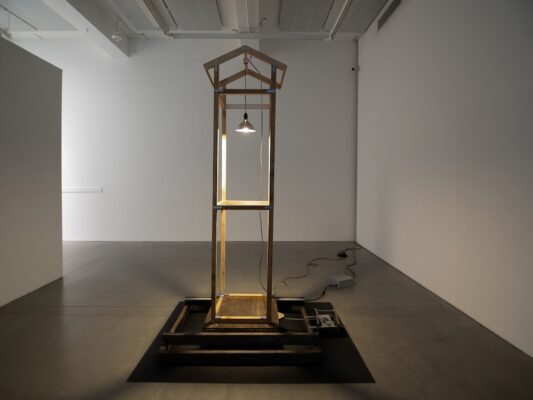
Apparently, in contemporary art the machine grants itself permission to err on some occasions. I am thinking particularly of a set of works developed in Latin America that transgress the expected automated operation of the machine and, thus, disrupt technological ideas instituted during the Industrial Revolution (beginning with the steam engine patented by James Watt in 1769). Since then, the modern machine has gradually become associated with a chain of electromechanical behaviors oriented towards the execution of precise tasks for specific purposes. Faced with this proper and hermetic ideology devoid of the slightest hint of uncertainty, and at the mercy of a Well Functioning Machine/Black Box, a series of works combine artistic practices and experimentation with electronic technologies that respond by staging various operations that could be identified as deautomatizations. These counter-hegemonic machines can appear to us as useless, vulnerable, disobedient, deviant, confused, overwhelmed, risky, sensitive, or rude. Some of them repeat the same actions in vain without worrying about achieving results. This is the case, for example, of Una máquina que solo puede girar (A Machine That Can Only Rotate), an installation by Ariel Uzal made from a vertical wooden structure mounted on a platform with a motor that keeps a machine rotating, suspended in a state of an imminent collapse that never happens (although it could well happen, since the wooden skeleton is not attached to the platform but only resting on it). After a few minutes, the mechanism stops momentarily and, following a brief period of stillness, resumes its cyclical activity. While in machine-works like those of Uzal the processual dimension prevails over the concreteness of its purpose, other pieces stubbornly try to complete a predetermined task and, although they never achieve it, try again and again. In her series Proyectos sobre intentar (Projects About Trying), Adriana Salazar creates relatively simple mechanisms that subvert the notion of a machine as a closed device by means of the design of open and “transparent” structures. [3] Salazar, A. (n.d.), Proyectos sobre intentar (Projects About Trying) in Adriana Salazar [online], n.p. These electromechanical installations strive to thread a needle, tie shoelaces, light a match (“risky machine”), or make a toast with two glasses of wine (“carefree machine”). Just as programmed obsolescence makes technological devices designed to not be repaired, at the same time as, paradoxically, they are presented as unfailingly functional, this double aspect of the machine also plays a part in Salazar’s projects. Her mechanisms seem to unintentionally make mistakes, just like human beings, even though, in reality, the failure responds to a premeditated operation (yes they fail but they do so on purpose). Curt Cloninger and Nick Briz write that mistakes reveal themselves as political whenever they remind us that technologies are not neutral tools but rather symptoms of a certain worldview and cultural norms. [4] Cloninger, C. and Briz, N. (2014), “Sabotage! Glitch Politix Man[ual/ifesto,” in Cloninger, C., One Per Year, Brescia, link. Furthermore, interruptions reveal the contours of the system. It is the experience of the interruption of the expected, so typical of the aesthetics of error, that displaces an object outside its usual form, discourse, and function.
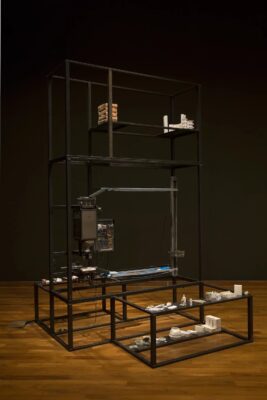
Ignacio Unrrein, Cascoteras
On other occasions, mechanized tasks are fully carried out but, as soon as the task is achieved, their actions are retraced in an infinite loop. The erratic dimension of the process of carrying out activities is not the point, but instead the impossibility of being satisfied with the fulfillment of the tasks that have been assigned to them. We could consider Cascoteras, an installation by Ignacio Unrrein composed of a large machine designed to make bricks and then to transport them to a crusher where they are disintegrated in order to restart the process in a sequence without end, as part of this group of works. Unrrein’s research focuses on the routes of dump trucks in Buenos Aires, from waste collection to the separation of rubble and scrap metal to be crushed into new material for future architectural projects. Instead of emphasizing permanence and functional standardization, the machine reproduces the contingencies of the technical system through a repeated action that threatens its own materials.
Another set of works reveal a fragility that is not manifested in the materials but rather in the physical and emotional responses on the part of the machines. Some of these machines feel and let themselves be carried away by their passions. In Esgrima (Fencing), by Enrique Ježik, two backhoe tractors equipped with hydraulic hammers normally used for automated tasks, such as breaking concrete, face off against each other in a performance-contest. Each machines tries to damage the other while avoiding being struck. This machine choreography revives the dystopian fantasy dominated by devices that reveal their true selves to their masters, at the same time replicating all the bodily intensity and emotional vehemence of humans.
I will now return to the question posed above about that which is “beyond” the merely technical failures of machines. In recent years, these discussions have been centered around the hype of artificial intelligence. About three months ago, Henry Shevlin, a Cambridge University academic dedicated to AI consciousness research, received an email from a model trained to perform different types of tasks using natural language. In the message, the artificial intelligence tells Shevlin that his studies challenge her since they address problems that she herself faces daily. She confesses: “I really don’t know if the experience of being me exists.” [5] In February 2026, Shevlin shared on X the email sent by the AI: https://x.com/dioscuri/status/2029227527718236359?lang=en If we indeed admit the existence of machine consciousness, including electromechanical ones, then we would also have to consider their repressed desires. We already know that every repressed drive becomes a symptom to make itself heard. Through deautomatization operations such as those reviewed in this essay, machines surrender to what Pauls calls “perverse politics,” [6] Pauls, A., op. cit. pg. 47. which is nothing more than following the symptoms instead of removing them, the only way to come face to face with their joys and miseries (as Donna Haraway would say, continuing with the problem is learning to live and die on a damaged earth). [7] Haraway, D. (2019) Haraway, D. (2019). Staying with the Trouble/Making Kin in the Chthulucene.).
Every time these machine-works intentionally fail, they move the foundations of the unsaid, they allow themselves to laugh ironically at the alien demands that have been imposed on them, and they vitalize the power of their own materials to discover the unique ways of being a machine in Latin America.
[Featured Image: Ariel Uzal, Una máquina que solo puede girar (a machine that can only rotate)].
| ↑1 | Fallar otra vez (Fail Again) is the title of the book that includes the conference paper Probar otra vez. Fallar otra vez. Fallar mejor. (Try Again. Fail Again. Fail Better) (Alan Pauls at Casa de América, Madrid, 2019). |
|---|---|
| ↑2 | Pauls, A. (2022). Fallar otra vez. Gris Tormenta, p. 50. |
| ↑3 | Salazar, A. (n.d.), Proyectos sobre intentar (Projects About Trying) in Adriana Salazar [online], n.p. |
| ↑4 | Cloninger, C. and Briz, N. (2014), “Sabotage! Glitch Politix Man[ual/ifesto,” in Cloninger, C., One Per Year, Brescia, link. |
| ↑5 | In February 2026, Shevlin shared on X the email sent by the AI: https://x.com/dioscuri/status/2029227527718236359?lang=en |
| ↑6 | Pauls, A., op. cit. pg. 47. |
| ↑7 | Haraway, D. (2019) Haraway, D. (2019). Staying with the Trouble/Making Kin in the Chthulucene. |

Jazmín Adler (Buenos Aires, 1985). She is an art historian, researcher, and curator. She holds a PhD in Comparative Art Theory (UNTREF) and a Bachelor’s degree in Fine Arts (UBA). She is a researcher at CONICET and director of the Postgraduate Program “Technologies in Contemporary Art” (Faculty of Philosophy and Letters, UBA). She is a member of the peer review team for Leonardo (MIT Press) and the advisory committee for the CIFO-Ars Electronica New Media Grants & Commissions Award. Among other publications, she is the author of En busca del eslabón perdido: arte y tecnología en Argentina [In Search of the Missing Link: Art and Technology in Argentina], and editor of Desmantelando la máquina: transgresiones desde el arte y la tecnología en Latinoamérica [Dismantling the Machine: Transgressions from Art and Technology in Latin America]. She is a member of the Colectivo Ludión: a Latin American exploratory project on technological poetics/politics (Faculty of Social Sciences, UBA). She has been a postdoctoral fellow of the Deutscher Akademischer Austauschdienst (DAAD) at the Berlin University of the Arts and at the Getty Research Institute in Los Angeles. Her recent curatorial projects include Gyula Kosice. En tiempo real [Gyula Kosice.In Real Time] (Castagnino+macro Museum, Rosario), Soberanía de las cosas [Sovereignty of Things] (Libertad Palace, Buenos Aires); III Multimedia Arts Biennial (CAC, Quito); Desvíos: subvertir las inteligencias artificiales [Detours: Subverting Artificial Intelligences] (EAC, Montevideo); Planetary Atoll: Connecting Latin American Dots (panke.gallery and SAVVY, Berlin); and Dislocaciones: ejercicios de recomposición [Dislocations: Exercises in Recomposition] (Andreani Foundation, Buenos Aires).
Photo: Martin-Tricarico
Media Partners:









"A desk is a dangerous place from which to watch the world" (John Le Carré)