Search
To search for an exact match, type the word or phrase you want in quotation marks.
A*DESK has been offering since 2002 contents about criticism and contemporary art. A*DESK has become consolidated thanks to all those who have believed in the project, all those who have followed us, debating, participating and collaborating. Many people have collaborated with A*DESK, and continue to do so. Their efforts, knowledge and belief in the project are what make it grow internationally. At A*DESK we have also generated work for over one hundred professionals in culture, from small collaborations with reviews and classes, to more prolonged and intense collaborations.
At A*DESK we believe in the need for free and universal access to culture and knowledge. We want to carry on being independent, remaining open to more ideas and opinions. If you believe in A*DESK, we need your backing to be able to continue. You can now participate in the project by supporting it. You can choose how much you want to contribute to the project.
You can decide how much you want to bring to the project.
In 1938, off the coast of South Africa, a coelacanth, a prehistoric fish believed to have been extinct for millions of years, reappeared alive, one of the greatest zoological discoveries of the 20th century. The shape of its fins placed it in a strategic position within the transition from aquatic to terrestrial environments. It was nicknamed a “living fossil.” I like to think of this reappearance as a poetic act, a deep past emerging in the present like a chronological error. The coelacanth not only survives, it disrupts the very idea of extinction.
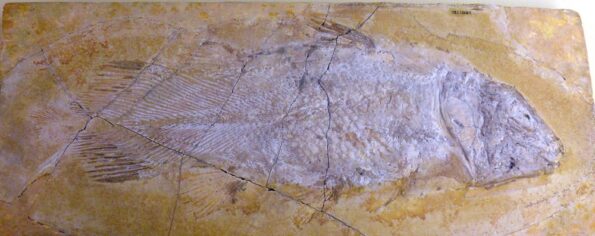
Coelacanth fossil. The oldest fossil record of this creature dates back approximately 360 million years and, since then, the coelacanth is considered to have retained many of its morphological characteristics.
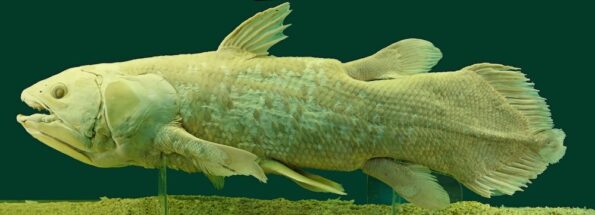
Preserved specimen of Latimeria chalumnae (Coelacanth) at the Natural History Museum in Vienna, Austria. The specimen was captured on October 18, 1974, near Salimani/Selimani, on Grande Comore, Comoros Islands.
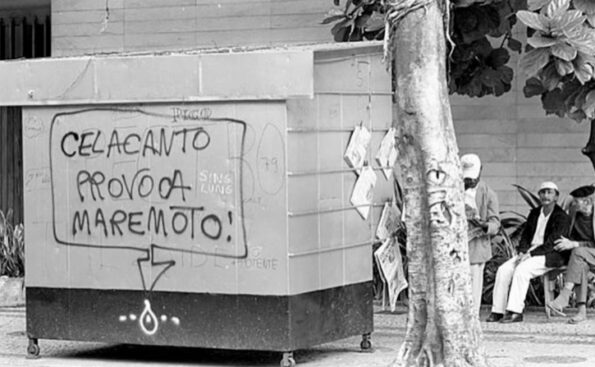
Decades later, towards the end of the 1970s, the phrase “Coelacanth Provokes Tsunami” appeared on walls in Rio de Janeiro, a collective enigma. There was much speculation about its origins (ranging from organized crime to extraterrestrial theories) until it was revealed to be an appropriation of the Japanese series National Kid, which appeared on the streets as a pre-internet meme.

The slogan “Coelacanth provokes tsunami,” which appeared on the walls of Rio de Janeiro in the late 1970s, is mentioned in local newspapers.
Between the living fossil and the urban enigma, the coelacanth makes me envision a curatorial approach that stems not from the promise of the future but from the disruption of time. If a certain idea of a modern-colonial future has collapsed or if it has become an integral part of its own catastrophes, perhaps the task of art is not to imagine new, redemptive futures but to reopen buried, spectral, unstable temporalities, thus provoking simultaneities in our experience.
The theoretical practice of curating interests me as a technology, as a set of procedures, mediations, and devices capable of producing thought through encounters and frictions. In contrast to art history that seeks to order meanings and values, curating [1]See: MARTINON, Jean-Paul (ed.). The Curatorial: A Philosophy of Curating. Bloomsbury, 2013. organizes objects and composes situations.
In terms of curating, I think of practices of sabotage, not as destruction but as a deprogramming operation that introduces flaws, discrepancies, and corrosion into the ways in which art elaborates space-time and reorganizes the world. I believe these are composed of three main actions:
Celacanto provoca maremoto (Celacanto Provokes Tsunami) emerged in this spirit, a speculative fiction in curatorial format presented at the Toda la Teoría del Universo festival in Concepción, Chile, in 2022. The project was based on the amazement caused by the return of the coelacanth and in the message which appeared throughout the city as noise, enigma, and disturbance. It was not an exhibition in the conventional sense but rather an experimental situation composed of two artistic actions, one focusing on celestial bodies and the other on minerals. On a small scale, the project used curatorship to create a sensitive hypothesis and to provide a provisional device for fabulation.
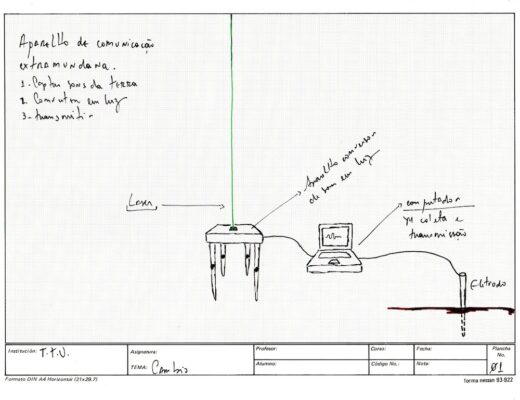
Diagram of the Cambio project by Denise Alves-Rodrigues.
In Cambio (Change, 2022), Denise Alves-Rodrigues carried out a telluric communication action aimed at potential viewers outside of Earth’s orbit which consisted of recording electrical signals from the Earth in different parts of the city. The artist believes these signals are a “memory of the Earth” which she transcodes into sound and then recodes into a beam of light sent into space using a laser. Mounted as a capsule in Monument 27F, the machine turned the technical gesture into a precarious ritual. The public gathered in darkness to listen to the Earth and observe the emission of pulses directed at an impossible recipient. The telluric signal fails as a message and, precisely for this reason, it creates a speculative form of communication.

Denise Alves-Rodrigues, Cambio (Change, 2022). A telluric communication action performed at the 27F Monument in Concepción, Chile, as part of Celacanto provoca maremoto (Celacanto Provokes Tsunami).
For her part, Luana Vitra, in La transformación es una esquiva (Transformation is Elusive, 2021–2022), displaces ruins from the field of loss to a zone of power and freedom. Thinking about the experience of black bodies, the artist establishes a relationship between galvanization (a process that prevents metal from “breathing” and oxidizing) and whitening as a technology for the containment of matter and transformation. Through interrupted electrolysis, it transfers rust from a corroded part of an object to a galvanized one. Its procedure introduces a deliberate collapse of matter, which then passes into a state of constant transformation. In Concepción (Conception), this process culminated in a performance in which Luana danced alongside musicians who made sounds from rusted metallic objects, activating a relationship between bodies and minerals and making corrosion a form of shared material memory.
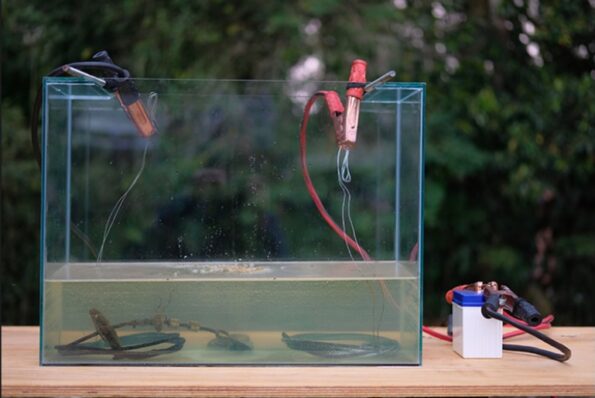
Luana Vitra, La transformación es una esquiva (Transformation Is Elusive, 2021–2022). Oxidation and material transfer process through interrupted electrolysis.
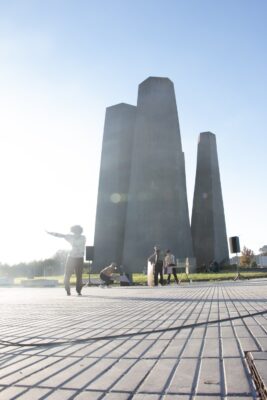
Luana Vitra, Transformation Is Elusive, 2021–2022. A performance given in Concepción, Chile, alongside musicians who made sounds from rusted metal objects.
These actions, on a reduced and situated scale, made me think about speculative curation as a methodology to formulate sensitive hypotheses about unforeseen or not yet legitimized relationships between life, matter, technique and memory. Fabulation operates critically by giving substance to these hypotheses, creating situations in which presences and temporalities not recognized by the dominant regime can emerge in another way. [2] On the concept of critical fabulation, see: HARTMAN, Saidiya. “Venus in Two Acts”. Small Axe: A Caribbean Journal of Criticism, Durham, v. 12, n. 2, p. 1-14, 2008. . The question, rather than how to expose technologies, is how to mount jamming devices.
Les Immatériaux, curated by Jean-François Lyotard and Thierry Chaput at the Center Pompidou in 1985, interrogated the emergence of a new material condition associated with telecommunications, information, language and technologies. The exhibition, or “manifestation” as its curators preferred to call it, proposed a labyrinthine, fragmented and disorienting device, in which art, science, design, philosophy and technology intermingled, putting stress on the traditional exhibition-form and the idea of art as a transparent transmission of messages. [3] HUI, Yuk; BROECKMANN, Andreas (eds.). 30 Years after Les Immatériaux: Art, Science and Theory. Meson press, 2015. https://meson.press/books/30-years-after-les-immateriaux/ .
Les Immatériaux, held in Europe in the 1980s, interrogated that which became “immaterial,” not as the absence of matter but as a constant reorganization through codes, messages, interfaces, networks and scientific models. However, the question I am interested in dealing with, from a Latin American perspective, is: What materials continue to sustain the fiction of technology? What extractive economies, bodies, and buried memories continue to operate behind the promise of innovation?
Latin American events such as Temblor, the 13th edition of the Santiago Media Arts Biennial held in 2017, shift the question to another terrain in which technologies no longer appear only as instruments of innovation, control, or mediation and instead begin to operate as devices for listening to the instabilities of a time of profound paradigm changes. According to its curatorial concept, inspired by Earth tremors, the exhibition, carried out by a large curatorial team and distributed in various spaces in Santiago, is made up of “constant frictions that not only act at a geological and tectonic level but also metaphorically as phenomena of tensions, dispersed energy, and technological, economic, artistic, political and social transformations.” [4] Curatorial text available in: https://13.bienaldeartesmediales.cl/ . The image of tremors interests me less as a metaphor for disaster than as a way of perceiving technologies located in unstable territories, where infrastructures, seismic memories, extractive economies, and social bodies are mutually implicated. [5] An interesting review about the exhibition can be read in: https://artishockrevista.com/2017/11/02/recorrido-bienal-artes-mediales-2017/. .
From Les Immatériaux to the tremors of the Santiago Media Arts Biennial, the problem is perhaps not only how to exhibit technology but how to make us aware of the world regimes that technology brings with it. Celacanto Provokes Tsunami, Denise Alves-Rodrigues’ machine and Luana Vitra’s minerals all use water, earth, and sky as scales of the same temporal fabulation. More than a symbol, the coelacanth fish functions as a curatorial operator, a way of bringing back what seemed extinct, of adding noise to narratives of progress, and of imagining technologies made of remnants, failed transmissions, ruins, rust, and attempts to contact extra-human life. A speculative curatorial approach, thus, perhaps begins in the production of small tsunamis within this world.
Text originally written in Portuguese, translated into Spanish with AI support and reviewed by the author and the editorial team.
[Featured Image: Slogan “Coelacanth provokes tsunami” on the streets of Rio de Janeiro. Photo credit: O Globo Archive].
| ↑1 | See: MARTINON, Jean-Paul (ed.). The Curatorial: A Philosophy of Curating. Bloomsbury, 2013. |
|---|---|
| ↑2 | On the concept of critical fabulation, see: HARTMAN, Saidiya. “Venus in Two Acts”. Small Axe: A Caribbean Journal of Criticism, Durham, v. 12, n. 2, p. 1-14, 2008. |
| ↑3 | HUI, Yuk; BROECKMANN, Andreas (eds.). 30 Years after Les Immatériaux: Art, Science and Theory. Meson press, 2015. https://meson.press/books/30-years-after-les-immateriaux/ |
| ↑4 | Curatorial text available in: https://13.bienaldeartesmediales.cl/ |
| ↑5 | An interesting review about the exhibition can be read in: https://artishockrevista.com/2017/11/02/recorrido-bienal-artes-mediales-2017/. |
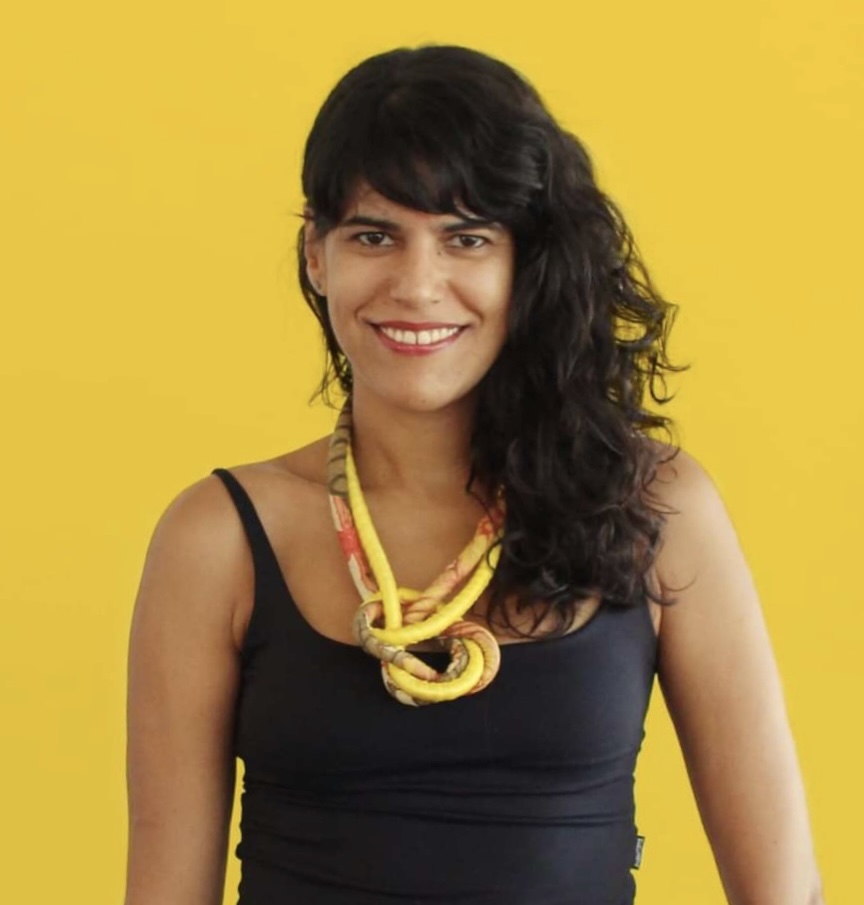
Juliana Gontijo is a contemporary art curator, researcher, and adjunct professor at the State University of Rio de Janeiro, Brazil. She works from a decolonial perspective, incorporating expanded knowledge of the arts and technologies, and is active in Latin America in curatorial collectives and through collaborative processes. She holds a PhD in Art History and Theory from the University of Buenos Aires, Argentina, and a degree in Film Studies from the Sorbonne Nouvelle University, Paris, France. https://juligontijo.wordpress.com
Media Partners:






"A desk is a dangerous place from which to watch the world" (John Le Carré)