Search
To search for an exact match, type the word or phrase you want in quotation marks.
A*DESK has been offering since 2002 contents about criticism and contemporary art. A*DESK has become consolidated thanks to all those who have believed in the project, all those who have followed us, debating, participating and collaborating. Many people have collaborated with A*DESK, and continue to do so. Their efforts, knowledge and belief in the project are what make it grow internationally. At A*DESK we have also generated work for over one hundred professionals in culture, from small collaborations with reviews and classes, to more prolonged and intense collaborations.
At A*DESK we believe in the need for free and universal access to culture and knowledge. We want to carry on being independent, remaining open to more ideas and opinions. If you believe in A*DESK, we need your backing to be able to continue. You can now participate in the project by supporting it. You can choose how much you want to contribute to the project.
You can decide how much you want to bring to the project.
From Monday to Friday I commute to work every morning, taking the 6:55 train from Kamnik to Ljubljana. The trains are often late, and the carriages are usually packed, but there is something valuable in those rides. Apart from having time to read, I get to sit next to and listen to people I would otherwise never meet, people far outside my social bubble. High school students, university students, adults going to work, adults with chores, pensioners enjoying free public transport, and the occasional addict travelling to the capital for a methadone dose. It is a lively space, not only in terms of age, class, gender, or political views, but also in terms of speech. Of languages.
The region where I live has become very attractive for people to move to, partly because it is close to Ljubljana, and partly because of jobs, flats, or – what many Slovenes value most – land. This means that during my commute I hear many different varieties of Slovene: regional dialects, Carinthian Slovene, Styrian Slovene, coastal dialects, and the Ljubljana variety (which we jokingly call something like “frog speech”). I also hear differences between generations: the speech of older people and that of the young.
Since I have lived in Slovenia for most of my life, I am fairly familiar with most dialect groups. I can usually understand them without too much trouble. They feel relatively stable, almost fixed in time, not changing too quickly. Of course, there are exceptions to my rule; northeastern dialects that mix with Hungarian or Croatian, or western ones influenced by Italian. Still, even when mixed, these dialects remain grounded in a recognizable system.
The speech that confuses me most is not regional, but generational. When I listen to the youngest passengers — Gen Alpha and younger Gen Z — I often feel completely lost. Their speech is heavily interwoven with contemporary internet English, or sometimes it is internet English. Even though I use social media (always too much) and consider myself quite comfortable in English, I quickly lose track of what they are saying.
The problem is not only vocabulary, but speed. Internet English, and its Slovenian variation, change extremely fast, much faster than my aging brain can comfortably follow. Its codes cannot be understood from a distance; they have to be lived. Inhabited. One has to use them daily, almost constantly, to keep up. Without that, meaning slips away.
Some adaptations are quite charming. For example, the Slovenian version of “bro” becomes “brt,” a shortened form of “brat,” and it is used across genders. It feels local and global at the same time. Other expressions, however, remain completely unclear to me. “Six seven”? Does anyone over thirty know what that means? I am still waiting for an explanation. Send help!
This gap, in itself, is not a problem. I do not feel the need to fully understand the speech of younger generations. I can remain curious, occasionally look things up, and accept that some meanings are simply not mine to grasp. The difficulty appears elsewhere: in literature.
What happens when internet English enters literary texts? And even more importantly: what happens when it needs to be translated into Slovene?
It would be naive to claim that literature has ever been fully accessible to everyone. In fact, for a long time, it was not even meant to be. Reading and writing were historically tied to education, and education was limited to higher social classes. Literature functioned as a kind of cultural capital, something that distinguished those who had access to it from those who did not. One could even think here of Pierre Bourdieu, who described how taste, language, and cultural knowledge help reproduce social differences. Literature was not just art; it was also a marker of belonging.
Before mass literacy, books circulated among elites: the clergy, the aristocracy, later the bourgeoisie. It took centuries for reading to become a (relatively) widespread practice, and even longer for people from different social backgrounds to not only read literature but also write it. The novel itself, as a form, is closely tied to this expansion: it gradually opened space for new voices, new experiences, and new readers.
Even then, accessibility remained relative. A Slovene reader might still struggle with the translation of Lost Illusions by Honoré de Balzac, or with certain original Slovene works, simply because of their vocabularies. Reading literature always involves encountering something unfamiliar, be it the characters, the time and place, or the language itself. There is always a certain distance to cross.
I remember reading the Slovene translation of Mrs Dalloway by Virginia Woolf – translated brilliantly by Rapa Šuklje – and often thinking: these are unusual words, not part of everyday speech. But I could still look them up in a dictionary (I always had lots of those) and understand them. The unfamiliarity was stable; it could be resolved with some effort.
This stability seems harder to maintain when language is shaped by the internet. I noticed this very clearly when reading Rejection by Tony Tulathimutte. The book is deeply coded in internet language, not only in vocabulary, but in rhythm, tone, and references.
While reading, I kept asking myself how such a text (a text I adore!) could be translated into Slovene. Not just literally translated, but translated in a way that would remain readable for someone who is not chronically online. Should the translator keep the English expressions? Replace them with Slovenian internet slang? But then, which version – the one used today, or the one that will already feel outdated tomorrow?
The problem is not only linguistic, but temporal. Internet language expires quickly. A translation, however, aims for durability. It enters a different time scale. This creates a tension: how do you translate something that is, by its nature, unstable?
There is also a deeper issue of access. If literature was once limited by class and education, it may now be limited by participation in digital culture. To fully understand certain texts, it is no longer enough to know the language; one must also inhabit a specific online environment. In that sense, a new kind of cultural capital emerges, not tied to formal education, but to constant presence on the internet.
This made me wonder whether the future of reading might start to resemble the current shape of our social world: fragmented, enclosed, organized into overlapping but not fully communicating bubbles. Just as online communities develop their own codes and references, literature might increasingly do the same. Not necessarily because writers want to exclude, but because the language they use is already formed within those spaces.
In that sense, the “imperial force” of English today is not only about dominance in numbers or global reach. It is also about speed, flexibility, and constant reinvention. Slovenian internet language does not simply borrow from English; it follows it, adapts it, reshapes it and sometimes loses stability in the process.
On that morning train, all these layers exist at once: stable dialects, generational shifts, and rapidly changing internet codes. For now, they still share the same space – quite literally the same carriage – and the same language in its many forms. The question is how long that shared space can remain understandable to most of us and whether literature, like everyday speech, will slowly split into worlds that no longer fully meet.
(Featured image: © Juliet Barbieri.)
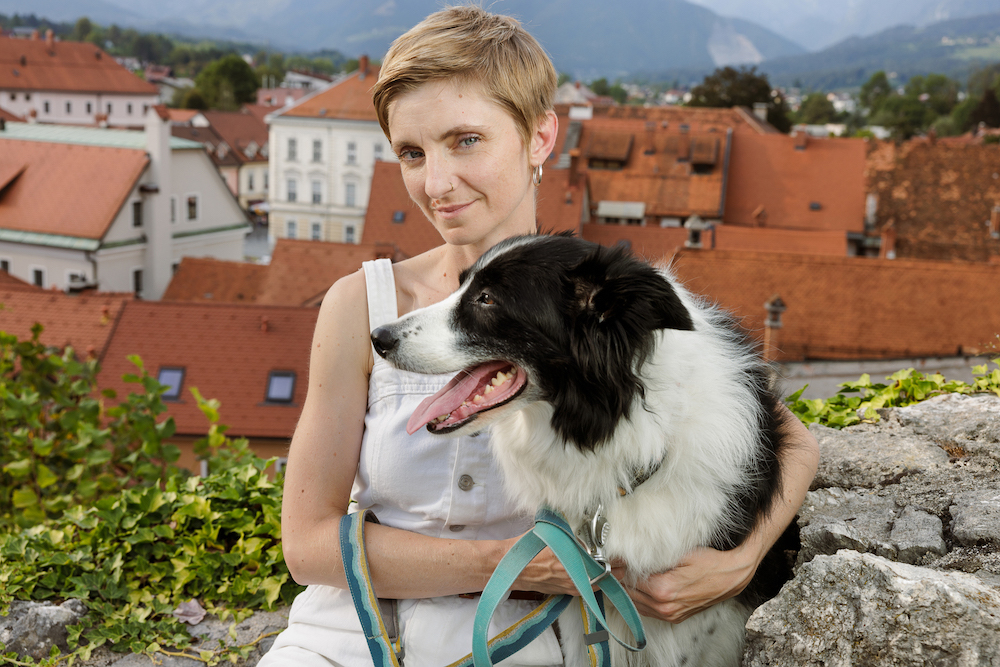
Ana Schnabl is an award-winning Slovenian writer and The Guardian contributor.
Portrait with Lucy by © Luka Dakskobler
Media Partners:


"A desk is a dangerous place from which to watch the world" (John Le Carré)