Search
To search for an exact match, type the word or phrase you want in quotation marks.
A*DESK has been offering since 2002 contents about criticism and contemporary art. A*DESK has become consolidated thanks to all those who have believed in the project, all those who have followed us, debating, participating and collaborating. Many people have collaborated with A*DESK, and continue to do so. Their efforts, knowledge and belief in the project are what make it grow internationally. At A*DESK we have also generated work for over one hundred professionals in culture, from small collaborations with reviews and classes, to more prolonged and intense collaborations.
At A*DESK we believe in the need for free and universal access to culture and knowledge. We want to carry on being independent, remaining open to more ideas and opinions. If you believe in A*DESK, we need your backing to be able to continue. You can now participate in the project by supporting it. You can choose how much you want to contribute to the project.
You can decide how much you want to bring to the project.
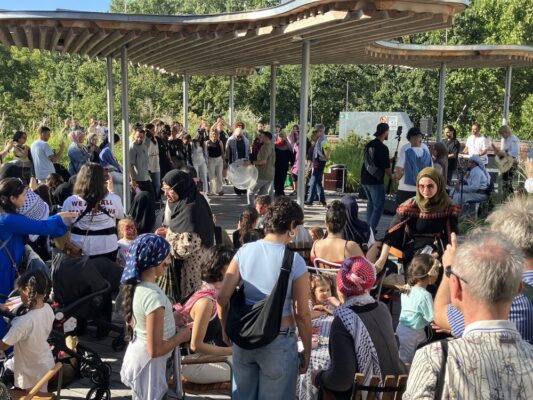
Veronica Valentini: Within the framework of Infrastructures of Relation, we shift attention from the institution as a fixed form to infrastructure as something that conditions and sustains ways of working together. What becomes perceptible when we approach cultural work through the material, temporal, and affective conditions that make relations possible?
Antonia Alampi: What becomes perceptible is the work that makes cultural work possible: the money, time, spaces, negotiations and forms of care that sustain a collaboration, often without appearing in its public account. An institution’s programme tells us only so much about how it operates. Looking at its infrastructure brings other questions into view: who can afford to participate, whose rhythms determine a process, who holds a relationship together, and who carries the uncertainty when resources or commitments run out.
My engagement with these questions precedes Spore. It developed through working in organisations such as Beirut in Cairo and SAVVY Contemporary, and through Future Climates, together with iLiana Fokianaki. These experiences made me attentive to how cultural organisations are sustained, including through labour and personal commitments that their budgets rarely acknowledge. At Spore, I intentionally built a team largely composed of people with experience in small-scale independent organising, often under precarious conditions. We were now working with a stable budget, a purpose-built space and the possibility of planning over longer periods. This shift made the question of what institutional stability is for particularly concrete.
Material conditions shape what people can ask of one another. Having the resources to pay for work, support local coordination or make a space available changes the possibilities of a collaboration. It also changes who can enter it and how much they have to sacrifice to remain involved. For us, this means asking what Spore’s resources can enable beyond its own programme: how money, space, visibility and institutional access can circulate; how we can support work where it is already rooted; and how smaller initiatives can use our infrastructure while retaining their own identity and direction.
Time is part of this distribution. A longer commitment can allow people to get to know one another, question an initial proposal or change direction as circumstances change. It gives a collaboration room to develop forms that could not have been specified at the beginning. But duration alone does not make a relationship meaningful. There is also the work of returning, listening, clarifying expectations and attending to misunderstandings. This is where the affective conditions become tangible: whether people feel able to disagree, express uncertainty or say that something is no longer working. Stable funding can support these conditions; trust still has to be built through how we behave.
This also asks something of the institution’s own expectations. Sometimes Spore’s most meaningful role is to facilitate, accompany or host—to help something become possible without needing to author it, own it or place ourselves at its centre. Distribution then concerns authority and attention as much as money: where decisions are made, where production happens, who the intended publics are, and what remains available to them after a programme ends. Berlin can be a meeting ground, a place of circulation or a host within these relationships.
Approaching cultural work through infrastructure makes the distance between our commitments and our everyday arrangements easier to see. We might speak of reciprocity while asking others to adapt continually to our deadlines, or value care while leaving the work of maintaining relationships unrecognised. Having stable resources makes us more responsible for attending to these distances. It asks us to understand the institution through the conditions it creates for others to work, participate and determine what happens next.
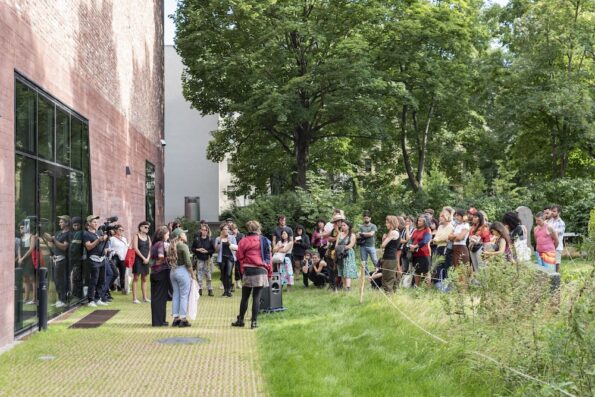 VV: This work unfolds through long-term collaborations, where continuity is often prioritised over visibility or output. How is an infrastructure composed and sustained when what matters is not the production of discrete events, but the ongoing maintenance of relations over time?
AA: Continuity is not created simply by extending a project over several years. It is made through recurring attention: returning, remembering what was said, recognising when conditions have changed and allowing a collaboration to develop at its own rhythm.
At Spore, we increasingly think of partnerships as trajectories. They may begin with an encounter or a period of mutual diagnosis, move through workshops or small pilot activities, and eventually generate a cultural tool, an exhibition, a learning process or a wider network. The form follows the relationship. This means leaving enough space for the purpose and outcome of a collaboration to emerge through the process.
It also affects how we understand highly visible moments such as exhibitions. An exhibition can concentrate attention, but infrastructure is what allows that attention to develop into relation. Without an afterlife, the intensity of the public moment can disappear as quickly as it was produced.
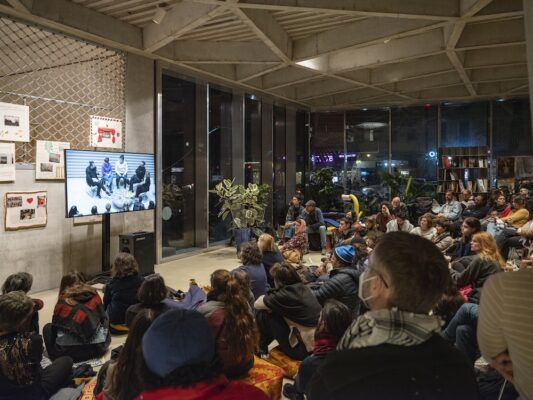 VV: Spore’s work moves across very different contexts, including collaborations in the Global Majority and a base within a European institutional setting. How are asymmetries of resources, location and knowledge production negotiated without reproducing extraction or symbolic use, but allowing for more reciprocal forms of exchange?
AA: Reciprocity, for me, does not mean symmetrical exchange. Partners bring situated knowledge, languages, political histories and community infrastructures that cannot be measured by a single institutional scale. Contributing funding does not entitle us to determine what should be produced or how someone else’s knowledge should circulate.
We work towards codesigned processes, with shared criteria, time frames and responsibilities, starting from what collaborators want the work to support. A central question is where its value remains: whether the tools and processes we support are useful where they emerge, who decides how they circulate, and what can continue beyond our involvement. Berlin can be a meeting ground within this exchange, without becoming the place where work acquires its legitimacy.
These arrangements do not remove asymmetries, but make them more open to negotiation. Reciprocity also requires us to change our priorities, timelines and use of resources in response to our partners. This is what being a learning institution means to me.
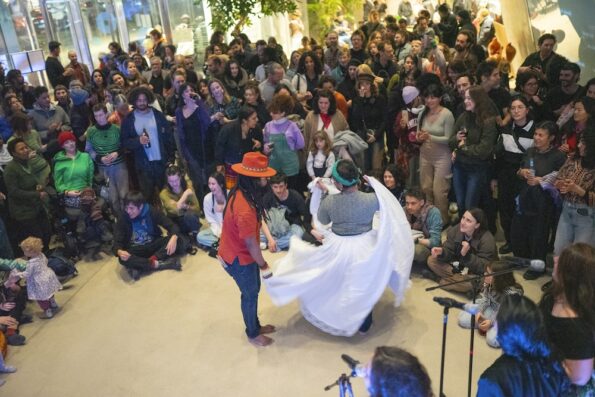 VV: A significant part of this work takes shape through co-produced cultural tools — publications, pedagogical materials and audiovisual formats. How can these be understood not as end products, but as living infrastructures that carry knowledge, enable translation and sustain relations across contexts?
AA: A cultural tool begins from the question of use: who needs it, what can it carry, and how might it continue to move once its first context has passed?
Publications, pedagogical materials, games, recordings and audiovisual works can hold forms of knowledge that do not fit comfortably within an exhibition or a single event. They can carry language, memory, oral history, ecological observation and practical methods between generations and places. Their life depends on whether people can translate, adapt, teach with, contest and reuse them.
VV: In this work, accessibility, reciprocity and dignity are not supplementary values, but conditions embedded in how work is organised. How are these principles operationalised in everyday practice, and what tensions emerge when they are treated as structuring rather than aspirational?
AA: These principles become meaningful through ordinary decisions. At Spore, public programmes are free. We consider translation, food, travel, childcare, physical access, schedules, language and different levels of familiarity with cultural institutions. We try to create several ways of entering a question: a highly theoretical conversation may coexist with a children’s game, a garden workshop, a meal or an informal gathering. Accessibility does not require simplifying the complexity of a subject. It means creating more than one threshold through which people can meet it.
Hosting is central to this.
It is a curatorial methodology and a redistribution of institutional capacity, right now led by my colleague Deputy Director Mohammed Abdallah. It means offering space, time, communication, technical support and trust, while not automatically claiming authorship over what happens. It also means accepting that others will use the building differently from us, bring in their own communities, alter its rhythms and aesthetics, and raise questions that may not have originated within our own programme.
Dignity concerns how people are received, whether they can recognise themselves as legitimate users of the institution, and whether they are able to refuse, disagree or change their minds. Reciprocity for me means asking continuously what a relationship makes possible for each participant and not only what it produces for Spore.
These commitments create tensions because resources and capacities are finite. Providing access and hosting takes labour, and that labour can itself become invisible or unevenly distributed within a team.
Holding these principles as structuring terms therefore demands choices. We sometimes have to reduce the number of activities, slow a process down, renegotiate its scale or say that something cannot be supported. Transparency is important here. Care without boundaries can become exhaustion; openness without structure can reproduce the very inequalities it seeks to address.
They are practices of continual adjustment. They require us to notice who is carrying the cost of a decision and to change course when our arrangements contradict our stated values.
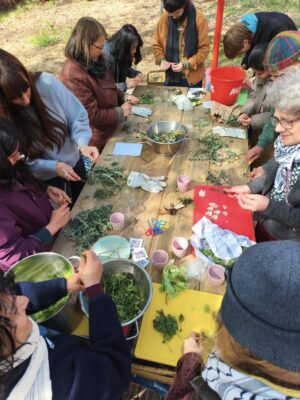 VV: Spore brings together a public programme, a library, a learning garden and multiple forms of mediation. How can we understand the relation between architecture, programming and relational practice as part of a single, evolving infrastructure rather than as separate domains?
AA: The Spore house, designed by AFF architects, in close conversation with founder Hans Schöpflin, was conceived as an ecology of interconnected spaces: a public programme, library, regenerative learning garden, kitchen, studio, exhibition areas, atrium and auditorium. Their relationship is more significant than any single function.
Before leaving Spore, co-founder Osvaldo Sánchez worked closely on the building’s interior and its furniture. The intention was to create the feeling of a home rather than a corporate cultural space. This can be felt in the differences between rooms, in the presence of artworks outside formal exhibitions and programmes, and in furniture that carries traces of use, repair and individual making.
Architecture establishes thresholds. It communicates who is expected, what kinds of behaviour are possible, whether one may stay without consuming, and whether a child, neighbour, gardener, artist or researcher can recognise a place for themselves. Hosting is therefore both an architectural and relational practice. A room may be physically open and still remain socially inaccessible; mediation and use are what turn space into relation.
The atrium is particularly important to me. I have thought of it as something resembling an Italian piazza: a common space where different generations can spend time together, sometimes doing different things and sometimes becoming part of a shared event. It can hold dance, music, performances, markets, collective meals, workshops and celebrations, but it is also simply a place to stay while Spore is open.
This is meaningful for families who struggle to find places where they can spend time with children (especially during Berlin’s winter) without being expected to consume something. Instead of a fountain at the centre of our piazza, we have a large couch, where people sit, talk and rest, and where children inevitably climb and jump.
The library has its own programme led by Mariela Nagle and life within this ecology. It has a strong focus on multilingual and multigenerational picture books, particularly books from small publishers around the world. Its collection includes books in Arabic, Farsi, Ukrainian, Polish, Portuguese, Spanish and many other languages, alongside publications concerned with ecological practices, community work, Indigenous knowledges, body-territory and alternative pedagogies. It grows through our programme and partnerships: each relationship may bring new languages, stories, publishing practices and ways of reading into the space.
The regenerative garden, farmed and nurtured by Mikhail Lylov and a whole planting community of neighbours, is also more than an illustration of an ecological programme. It is a changing plant community shaped by the seasons and by ecological succession. A feedback loop between soil and plant communities lies at its centre. Through gardening, composting, biodiversity work, seed exchange and food cultivation, it becomes a shared learning environment, while its changing needs teach the institution about maintenance, interdependence and forms of time that cannot be accelerated to match a programme calendar.
These proximities matter. Someone may enter through a children’s workshop led by Joao Albertini, and encounter an exhibition; a reading group may develop into a publication; a garden activity may open a discussion about land, health or migration; a gathering organised through Spore Hosts may produce relationships that continue elsewhere. The coherence does not come from making every activity address the same theme. It comes from shared ways of working: attention to land, material and cultural knowledge, histories of dispossession, eco-social justice, collective learning, and the conditions under which knowledge is produced and circulated.
The building also learns. Its use exposes what the original architecture failed to anticipate, and programmes reshape how spaces are inhabited. In this sense, Spore is not a finished institution housed inside a finished building. It is a learning institution: an evolving arrangement of spaces, people, plants, objects, resources and responsibilities, capable of being changed by the relations it holds.
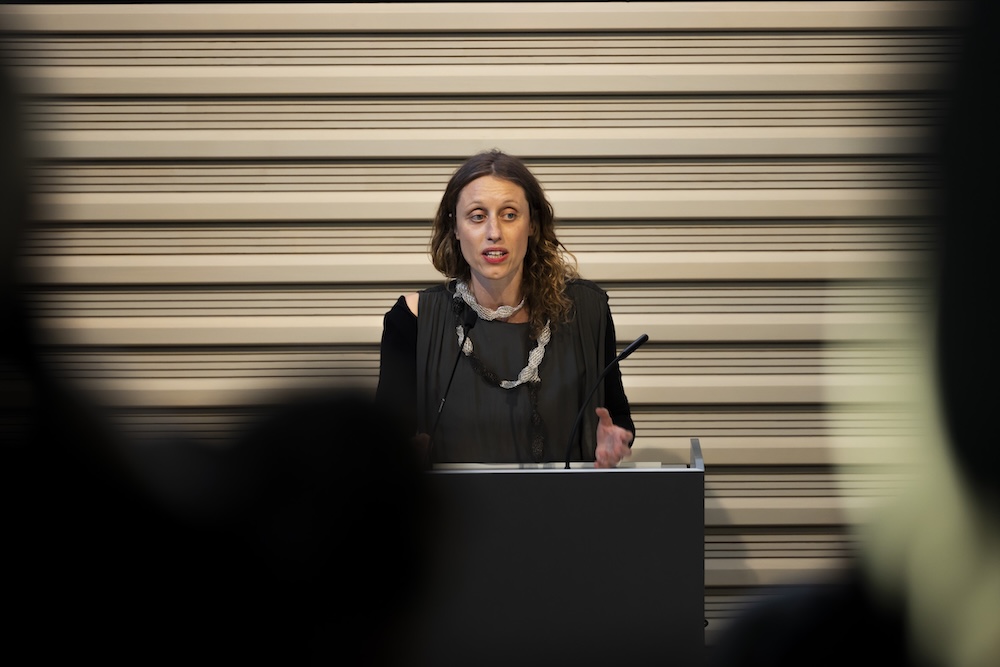
Antonia Alampi is the co-founding Artistic Director of Spore Initiative, a platform dedicated to artistic and cultural practices rooted in eco-social justice, community work, and the exchange of knowledge. As a cultural organizer, curator, and director, she has worked across disciplines and geographies, collaborating with socially engaged, politically conscious, and structurally precarious organizations.
She was Artistic Co-Director of SAVVY Contemporary in Berlin (2016–2020), part of the curatorial team of sonsbeek20➜24, curator at Extra City Kunsthal, Antwerp (2017–2019), and Beirut, Cairo (2012–2015). Beyond institutional positions, her work spans cultural projects, research, and publications focused on institution building, alternative education, intergenerational practices, and decolonial perspectives across various local contexts. She also teaches, writes, and speaks publicly. A mother of two daughters, she credits them, and the experience of parenthood, as having deeply shaped her professional path.
Photograph: Victoria Tomaschko
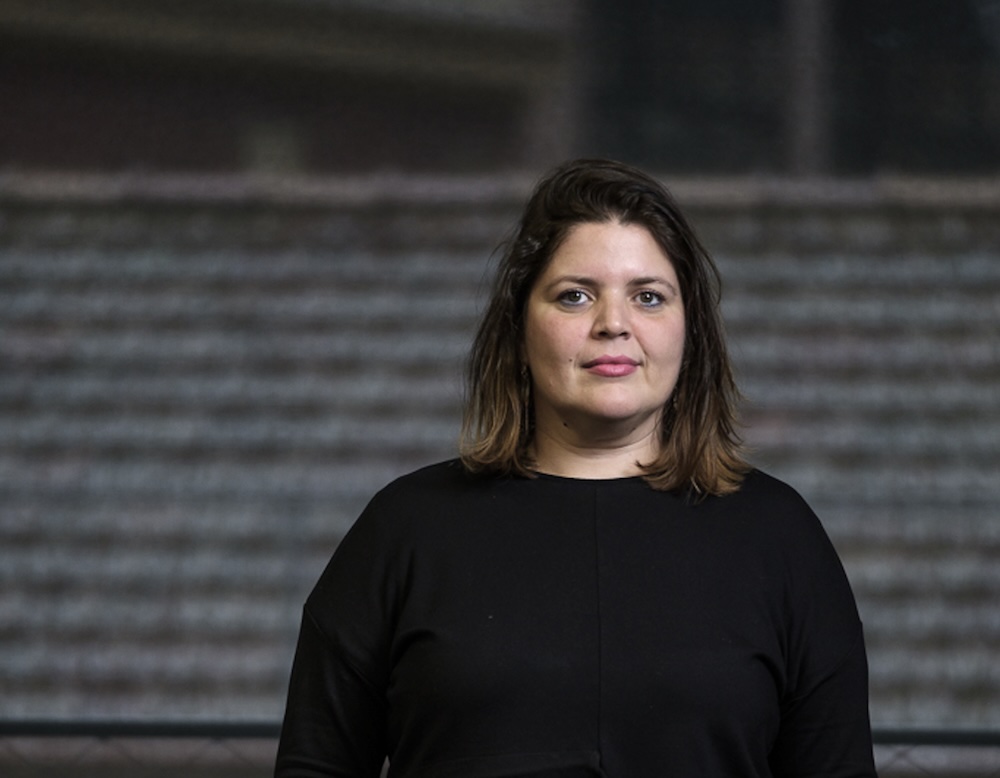
Veronica Valentini is a curator, educator, and researcher. She understands curatorial practice as a relational exercise that listens to contexts, choreographs affects, forms of knowledge, and diverse bodies, and cultivates connections toward new ways of being and acting together.
She is the founder and director of EMMA, and co-founder and co-director of BAR Project—a platform that currently develops the exhibition, public, and educational programming at HAUS–Espai d’art i pràctiques contemporànies. Since 2022, she has overseen international residency programs and research networks at Hangar, in Barcelona. As a founding member and mediator for Concomitentes in Spain since 2018, she has spearheaded initiatives such as Diversorium: Live Arts and Spaces for Coexistence—a project presented at music festivals and nightclubs in Barcelona, as well as in Paris, Stuttgart, and Stockholm, and within the framework of Manifesta. She is currently developing Parliament of the Sea, a project that bridges science and citizenship to prototype new forms of ecological governance within the marine and social territory of La Barceloneta.
In 2014, she served as one of the curators for the second CAFAM Biennial in Beijing, titled On Ambiguity and Other Forms to Play With. She has curated exhibitions and developed public, educational, and residency programs; she has also served on juries and led workshops and lectures at numerous art schools and institutions, both in Spain and internationally. Her publications include Dancing Diversity: Gestures and Affects for Encounters Between Diverse Bodies, Bartlebooth, 2024) and Reciprocity: Institutional and Artistic Practices as Metaphors for Mycelium, Ajuntament de Terrassa, 2026).
Media Partners:





"A desk is a dangerous place from which to watch the world" (John Le Carré)