Love is in the air? A themed route through Poblenou about air, dust and the right to breathe, by Olga Subirós
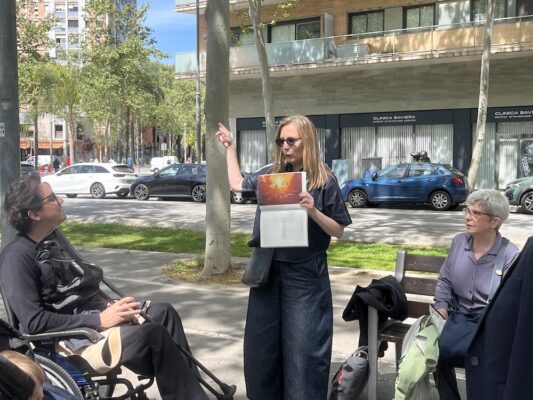
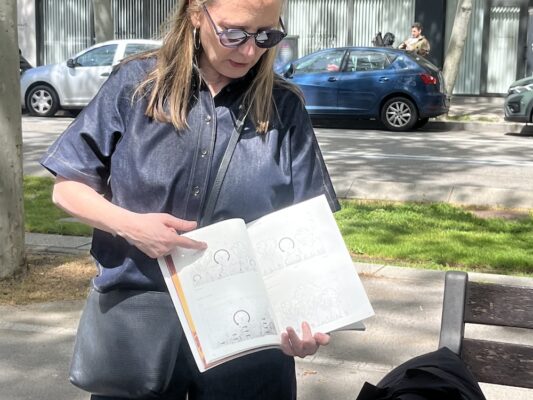
A*DESK and GRAF present themed routes that focus on critical thinking based on contents of the repository of A*DESK magazine, lead by the interpretation of a specialist (historian, artist, curator or critic) and relating it with the field. The routes, which are done in person, include both spaces belonging to the GRAF community and other types of places, both cultural and not, public and private, which also strengthens the discourse and artistic proposal, and makes the most out of this opportunity to learn about certain places that are normally closed or difficult to access.
Love is in the air? A route through Poblenou about air, dust and the right to breathe
is a route created and led by the architect and curator Olga Subirós
This route runs through Poblenou to read the air not as emptiness, but as political matter: a medium laden with dust, traffic, work, industrial memory and artistic practices that forces us to think about what we breathe, who can do it and how the city unequally distributes the universal right to breathe.
🗓️ April 18th at 11:00 am
📍 Meeting point: La Escocesa (C/ Pere IV, 345)
Route on foot, suitable for all ages.
This route begins at the intersection of GRAF’s spaces and A*DESK’s text repository, and is especially inspired by the articles published as part of “The Weight of Air”, the month I was guest editor.
From there, it proposes to read Poblenou through that which is normally unseen but permeates everything: air as a dense, historical, and political substance. In this neighborhood, the air has been laden with factory smoke, demolition dust, metropolitan traffic, urban transformation projects, and new economies that promise innovation while unequally redistributing space, land, and even the ability to breathe. Walking through Poblenou is, therefore, walking through a conflicted ecology where working-class memory, industrial heritage, touristification, urban design, and contemporary artistic practices intersect.
Poblenou was one of Barcelona’s great industrial landscapes. The concentration of textile, flour, metallurgical, and chemical factories led to the neighborhood being known as the “Catalan Manchester,” and this productive density not only transformed the land but also shaped an atmosphere, living conditions, and a social fabric made up of cooperatives, workers’ associations, and forms of neighborhood solidarity. Later, deindustrialization, the textile crisis, and large-scale urban development projects, especially since the 1992 Olympic Games and then with the 22@ urban redevelopment project, profoundly altered this ecosystem. This route stems from that continuity: from the atmosphere of the factory to the atmosphere of urban branding.
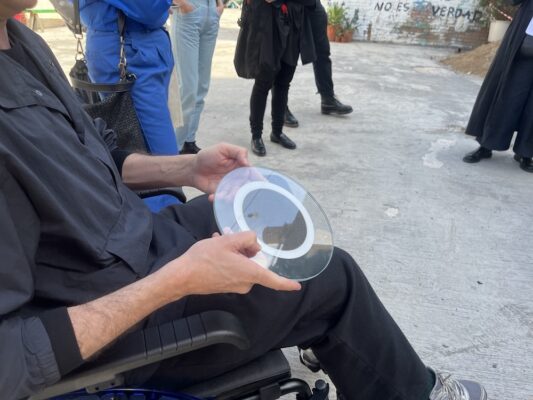
La Escocesa
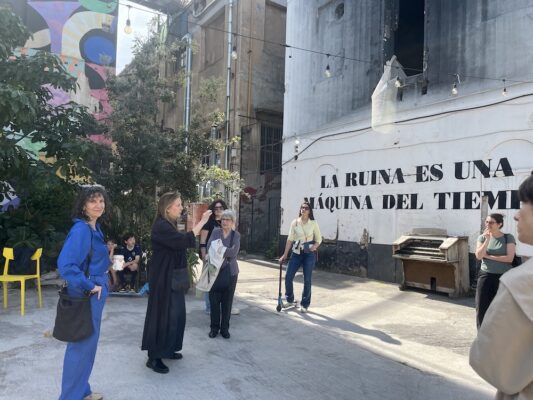
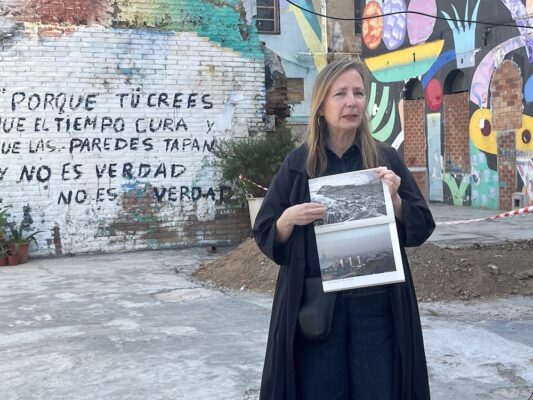
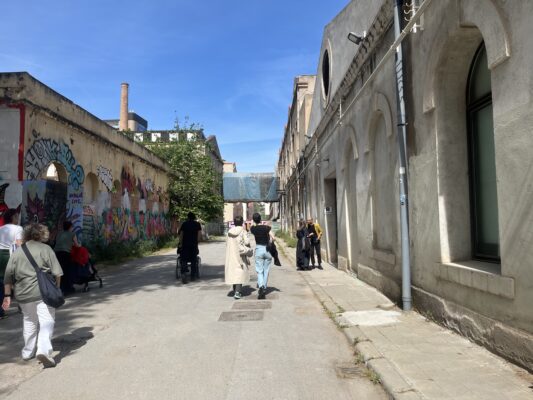
La Escocesa, as the starting point of the route, is especially fruitful because it encapsulates many of the layers the route will unfold: industrial memory, the neighborhood’s transformation, the factory’s enduring presence, and the cultural reappropriation of the space. La Escocesa is a repurposed former factory, and this fact alone is enough to highlight one of Poblenou’s central tensions: what happens when a production landscape becomes a cultural landscape while still being permeated by speculation, the loss of context, and the fragility of working-class memory? The factory doesn’t disappear entirely; it changes its regime, its narrative, and its users.
The case of Poblenou clearly demonstrates that many urban transformations showed little respect for industrial heritage and that, in numerous cases, only isolated chimneys or fragments remain, preserved as visual emblems.
Contemporary criticism of this process is clear: maintaining a vertical element can serve as a heritage pretext while the complexes, processes, and stories of work that gave them meaning disappear. Arriving at La Escocesa at the start of the route allows us to formulate the crucial question: can art and culture repair this loss of context, or do they merely aestheticize it? Can they cultivate a new sensitivity to the air, the dust, and the shared breath, or are they integrated into the very machinery that transforms the neighborhood into a brand?
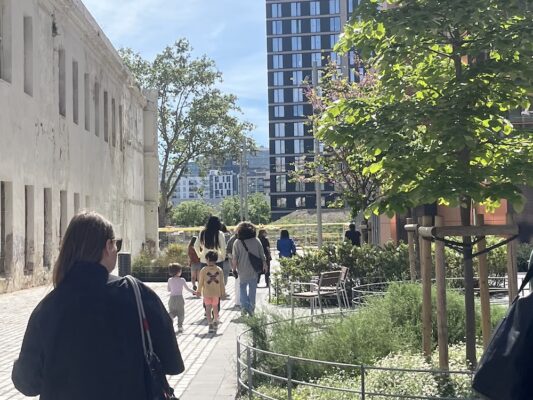
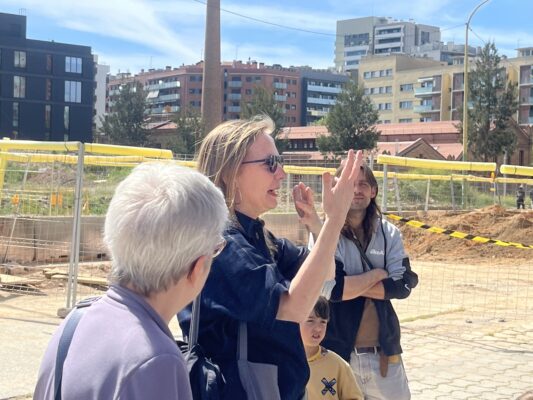
Transit and Green Axes: Pere IV / Cristóbal de Moura / Diagonal / Bilbao / Badajoz
This stop doesn’t focus on a building, but rather on a stretch of the city. And that’s important, because the theme of the route demands walking through the real atmosphere of the neighborhood, not just its cultural institutions. Pere IV, in particular, retains some of the contradictory density of Poblenou: it’s a diagonal street, over three kilometers long, that cuts across Cerdà’s grid, was a historical exit from Barcelona, and continues to function as a traffic corridor. Narrow sidewalks, busy roads, workshops, restaurants, tech companies, and remnants of a repurposed industrial landscape coexist along it. It’s a good place to understand that air isn’t abstract: it’s made of speed, friction, combustion, logistics, and unequal uses of space.
The recent transformations of Poblenou have turned these streets into a battleground between daily life, consumption, tourism, innovation, and social displacement. The literature on the neighborhood insists that improvements to public space can be accompanied by gentrification, privatization, and new forms of exclusion. In that sense, walking these streets is also about understanding how the city distributes mobility, noise, investment attraction, and visibility, while relegating the material conditions of everyday life to the background.
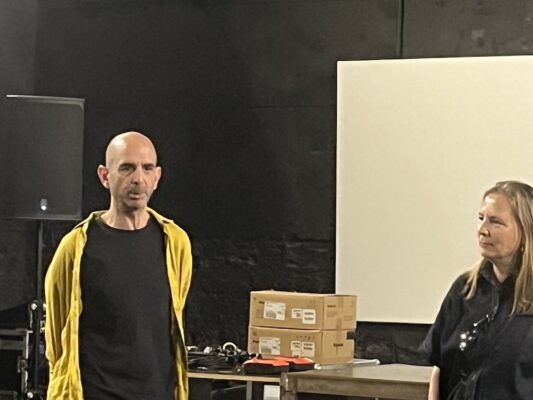
Hangar
The stop at Hangar introduces a shift in perspective. If the street confronts us with air as both infrastructure and conflict, an art production center allows us to question how to make perceptible what is normally unseen: particles, toxicities, atmospheres, vibrations, waste, or memories of work. In the route’s documentation, Hangar appears precisely as a place from which to consider contemporary practices capable of making these invisible materialities perceptible. Its interest lies not only in the cultural program but also in what it allows us to experiment with: other forms of attention, other techniques of listening, other ways of making public what usually remains in the background.
This stop can also be interpreted in continuity with the material history of Poblenou. The neighborhood has gone from being a territory of industrial production to a post-industrial landscape where creativity and knowledge often function as new engines of urban development. Therefore, Hangar should not be interpreted naively. The question is not simply to celebrate cultural transformation, but to ask what art can do in the face of this ambiguous legacy: whether it merely accompanies the new narrative of the neighborhood or whether it can interrupt it, thickening the memory of the bodies, the work, and the waste that preceded it and inhabit it now.
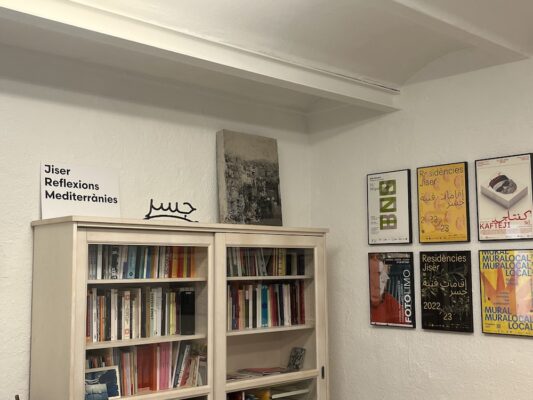
Jiser
Jiser allows us to scale down and, at the same time, radically broaden the question of the route. In a smaller, more intimate, and non-hegemonic space, air ceases to be read only as an urban or environmental issue and also appears as a universal right and as a political condition of livability. Closely linked to Mediterranean and Palestinian imaginaries, this point on the route proposes pausing to collectively read Achille Mbembe’s “The Universal Right to Breathe”. In this text, published in 2020, Mbembe reminds us that humanity was already threatened with asphyxiation before the pandemic and proposes understanding breathing beyond its biological dimension, as something we have in common and that cannot be appropriated.
Thinking about air, then, means shifting the focus from the neighborhood to a broader political ecology. Breathing ceases to be a metaphor or an exclusively health-related issue, revealing itself as a concrete measure of justice: who can breathe, under what conditions, and who continues to be exposed to forms of material, military, environmental, or social suffocation. If at other stops the air appears laden with traffic, dust, industry, and unequal urbanization, here it also appears as a fundamental right to existence, inseparable from the possibility of a shared and livable life for all.
Plaça de les Glòries / Museu del Disseny surroundings
Ending at Glòries allows us to immediately situate the metropolitan scale of the problem. Here, air is already perceived as the result of urban planning policy decisions, road infrastructure, and urban imaginaries. Glòries concentrates large flows of mobility, urban renewal projects, and an institutional will to transform a former traffic bottleneck into a more pleasant, greener, and more representative landscape. But this restorative image coexists with a less photogenic reality: persistent traffic, the pressure of major thoroughfares, and the continuity of an urban model that displaces conflicts without fully resolving them: the 1,300 deaths per year in Barcelona due to air pollution (Barcelona Public Health Agency, 2024).
Furthermore, Glòries is part of a sequence of transformations that have redefined contemporary Poblenou: the urbanization of the lower Meridiana section, the opening of Diagonal Avenue towards the sea, the renovation of the ring road, and the general reorganization of the surrounding area. Taken together, these projects show how the city has tried to suture its industrial past through grand gestures of redesign. The question that opens this first stop is uncomfortable but necessary: can urban planning produce more breathable air without simultaneously questioning traffic congestion, speculation, and the inequalities that generate it?
Museu del Disseny – DHUB
At DHUB, the air itself becomes an institutional narrative. The museum functions as a device from which to consider how design has participated both in the promise of better futures and in the normalization of certain forms of progress. Design has contributed to imagining comfort, hygiene, efficiency, mobility, and well-being; but it has also been part of the material systems that have made some worlds breathable at the cost of making others more toxic. Making a stop here means shifting the environmental question to the realm of material culture: what objects, infrastructures, and aesthetics have produced the air we inhabit today?
From this point, the museum also connects with the rest of the neighborhood as both a showcase and a symptom. Nearby, the tension between industrial memory and the post-industrial city becomes visible: preserved buildings, isolated chimneys, new offices, cultural facilities, and large-scale renovation projects. Design is not outside of this process; it is part of it. Therefore, this stop serves to delve deeper into the topic: it is not enough to simply make the ecological crisis visible: we must also question the languages that have made it acceptable, manageable, or even attractive.
As curator of Matter Matters at the Museu del Disseny-DHub Barcelona, I am interested in concluding this exploration by returning the question to the air we share. Marx and Engels wrote in their Communist Manifesto that “all that is solid melts into air,” but read literally from our current ecological perspective, that phrase takes on a different weight: the city does not disappear; it persists in its emissions, its waste, its infrastructure, and the particles it releases during its production, use, and disposal. Perhaps that is why asking again, “Love is in the air?” is not a lighthearted irony, but a way of gauging the extent to which we are capable of imagining a more just city, one more conscious of its materials and truly more breathable.
About Olga Subirós
Olga Subirós is a curator, architect, and exhibition designer. Her projects adopt an integrative perspective on 21st-century culture and the transformations of the digital age. www.olgasubiros.com
Olga Subirós was resident editor in A*DESK in July 2023 with the topic The Weight of Air.
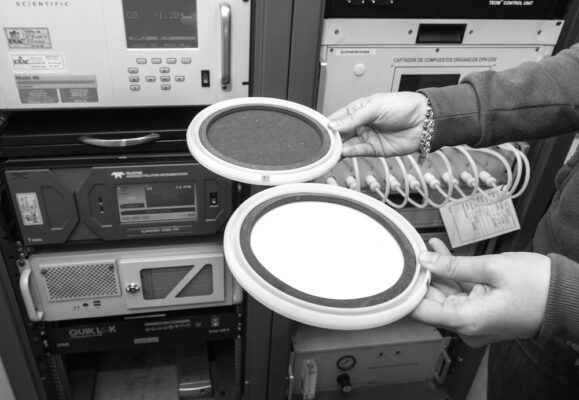
[Featured Image: Particulated Matter 10 micras The difference between them is 24 hours of air filtration in Barcelona. Photo: Gunnar Knechtel]