Search
To search for an exact match, type the word or phrase you want in quotation marks.
A*DESK has been offering since 2002 contents about criticism and contemporary art. A*DESK has become consolidated thanks to all those who have believed in the project, all those who have followed us, debating, participating and collaborating. Many people have collaborated with A*DESK, and continue to do so. Their efforts, knowledge and belief in the project are what make it grow internationally. At A*DESK we have also generated work for over one hundred professionals in culture, from small collaborations with reviews and classes, to more prolonged and intense collaborations.
At A*DESK we believe in the need for free and universal access to culture and knowledge. We want to carry on being independent, remaining open to more ideas and opinions. If you believe in A*DESK, we need your backing to be able to continue. You can now participate in the project by supporting it. You can choose how much you want to contribute to the project.
You can decide how much you want to bring to the project.
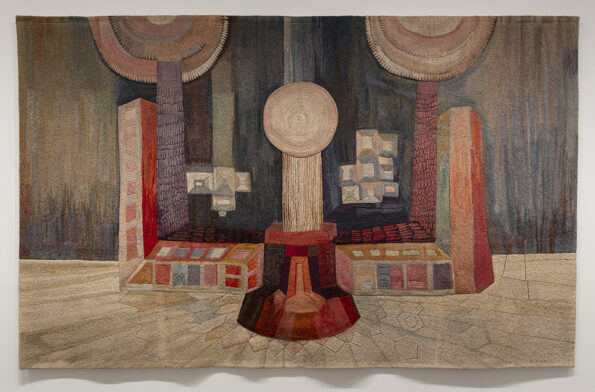
To mark the centenary of her birth (1926-2026), the Reina Sofía Museum is dedicating a retrospective to Aurèlia Muñoz, tracing her entire career. “Aurèlia Muñoz. Beings” will showcase everything from the two-dimensional format of her pictorial embroideries, through her colossal macramé structures and emblematic kite-birds, to her latest installations made with paper, as well as a selection of ink drawings and a vast collection of previously unseen maquettes created prior to her large-format works.
Although her name has historically been associated with textile art, Aurèlia Muñoz enjoyed a solid career based on her own personal vision. Despite his connection to the Escola Catalana del Tapís and the Nouvelle Tapisserie (he participated on several occasions in the International Tapestry Biennial in Switzerland), he adopted a different approach in the production of his work, creating three-dimensional pieces and working from the analysis and rigor of architectural methodologies.
Aurèlia Muñoz’s work gained international renown through her macramé sculptures, created between the late 1960s and early 1980s, during the emergence of a more sculptural approach to textile art. These works placed her in direct dialogue with her European and American contemporaries (Magdalena Abakanowicz, Sheila Hicks, Lenore Tawney). Using materials such as sisal and jute, she wove figures designed for three-dimensional placement—figures that unfold, hang, and transform the space—without the need for a loom. Sometimes these figures conceal metal skeletons, some with movable rail systems, which she wrapped in different textiles, varying the precise tension with which she tightened each knot. A specific type of knot allowed her to create “ribs” on the sisal weaving, giving the surface an organic undulation without the need for stitching.
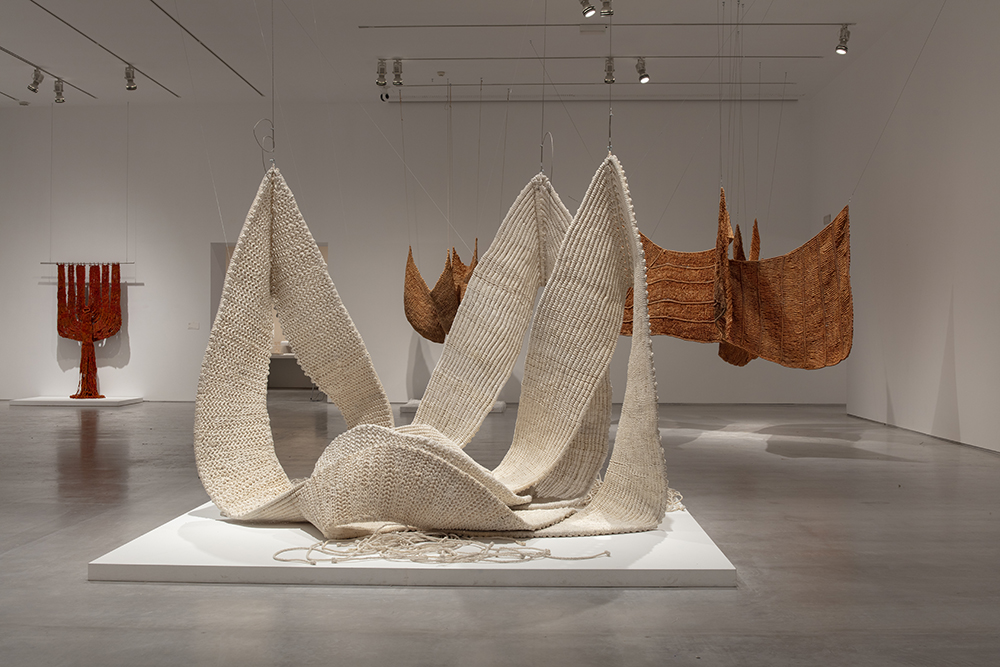
In the foreground: Aurèlia Muñoz, Ondulacions (Undulations), 1974. Macramé of nylon threads. Reina Sofía Museum, Madrid. Photo: Fátima Sanz
Her references are rooted in the local and Mediterranean visual imagination. Influenced by Catalan Romanesque art, the geometry, texture, and color present in the Catalan School became the raw materials for her two-dimensional work, creating tapestries with painterly dyes. Her curiosity about crafts and trades led her to learn from the fishermen of Barceloneta, studying ancient knotting techniques and the sails of their boats. This, in turn, led her to experiment with other textile techniques such as macramé, originating in the Arab period. She took note of the work of Antoni Gaudí, especially his method of constructing space with hanging elements, as well as his way of integrating plant life and organic forms into rigid materials.
Muñoz set up her workshop in the Eixample district of Barcelona, adapting several floors of her home to meet her production and artistic needs. From 1959 until 2011, the year of her death, she worked alongside Josefina Salazar. The industrial-sized workspace included an archive area, a treatment and dyeing area for textiles, and a hanging area for large-format pieces. A central, open space with high ceilings was equipped with beams, pulleys, and hooks from which the pieces were suspended as they were knotted vertically, allowing the artist and her assistants to walk around the sculptures and assess their three-dimensionality. The workshop functioned as a true sculpture studio, where metal structures, ship sails, sisal, jute, and heavy marine ropes were used. Muñoz is not a weaver exploring the medium, but a sculptor who uses the most logical material for her ambitions. Within this context, the artist’s drive for professionalization becomes clearer: her attention to public relations, her presence in the intellectual and critical circles of the time, and her collaborations with architects such as Jordi Bonet i Godo (Sagrada Familia) and Daniel Gilbert (Fundación Miró) to create magnificent, polished, and powerful pieces. This had a twofold merit: professionalizing her practice and, at the same time, legitimizing her voice as a female artist.
In 1973, she participated in the prestigious São Paulo Biennial. From 1979 onward, her flying sculptures appeared, and in the following decade, she worked with handmade paper: sculpture acquired a lighter quality in this final stage. Aurèlia Muñoz thus abandoned weaving, and perhaps the institution changed its perception of the artist: the two-dimensional tapestries and the materials that had been relegated to artisanal production were now better understood as part of an artistic practice.
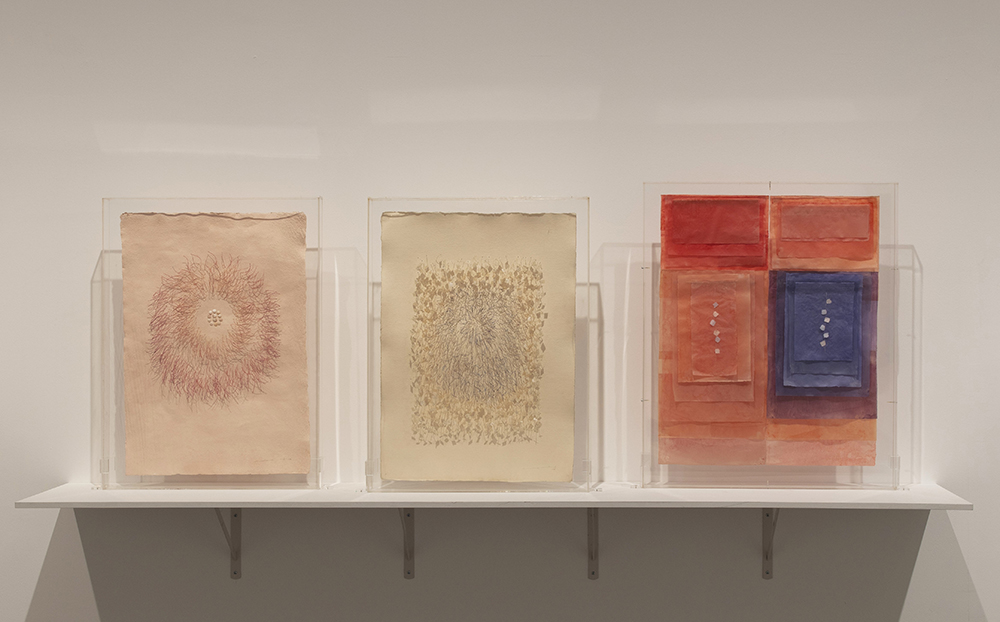
View of Room 6: The marine environment
After a period of institutional neglect, MoMA acquired three of her works in 2018 for the exhibition “Taking a Thread for a Walk.” Subsequently, the Madrid-based gallery José de la Mano began exhibiting her work in 2020. Although the artist’s rediscovery was triggered by the acquisition of works by MoMA’s design department, perpetuating her association with the decorative arts, this exhibition reverses that logic by showcasing the artist’s work outside the textile context.
Einaidea (Fundació Eina) has curated this monographic exhibition under the scientific direction of Manuel Cirauqui and in collaboration with curator Rosa Lleó and Silvia Ventosa Muñoz, the artist’s daughter. The curators consider Muñoz’s work to anticipate current concerns: the relationship with the environment, non-human beings, and the dialogue between the ancestral and the contemporary. The attention to the environment in Aurèlia’s work reflects a position historically associated with women: a conscious attitude that is evident in the choice of natural and readily available materials, as well as in a perspective that is sometimes non-anthropocentric.
There is a certain idealization of the artist (as Joaquín Jesús Sánchez has pointed out) in the curatorial approach, which refers to her as “one of the most singular creators of her time” or to “the radical contemporaneity of the artist.” The retrospective is presented as the most ambitious; however, a smaller selection of works might have strengthened the exhibition. The central spaces, featuring large-format pieces produced between the 1960s and 1970s, are very well designed: open yet with a sense of movement, they allow each piece to unfold and foster a dialogue between them. In the perimeter galleries, however, this feeling is weakened. A good example of this is the Kite-Birds, fabric structures stretched with small lead counterweights, which were conceived to be installed at a great height and interact with natural light: the gallery lighting and their proximity to other pieces do not complement their impact. Small pieces and models struggle to engage with hanging sculptures, displays of sketches, and models on central tables, which blend various periods of the artist’s work. These galleries connect the flow of the space but don’t quite connect with the artwork itself.
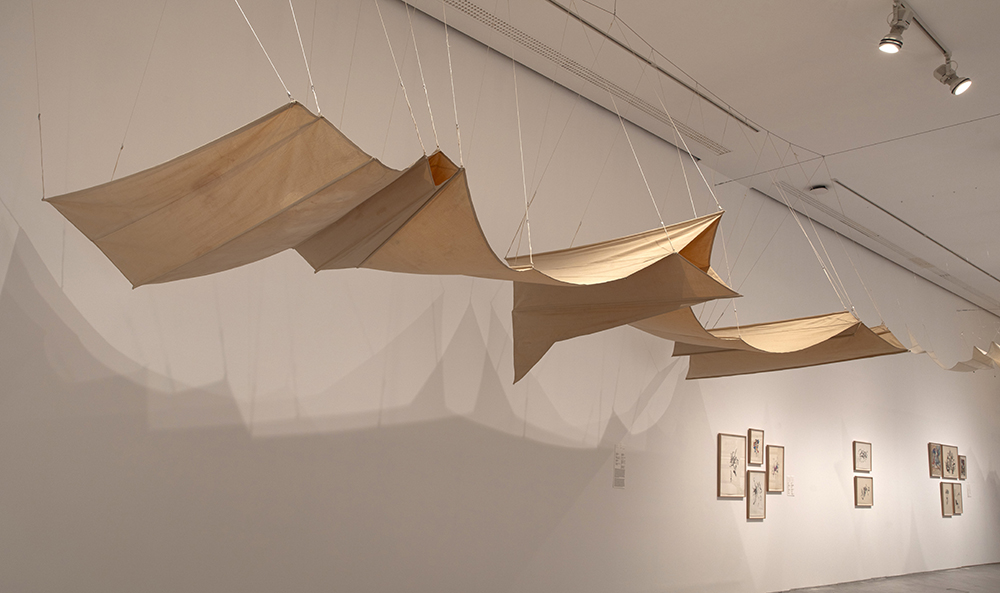
Aurèlia Muñoz, Ocell estel B1 (Comet Bird B1), 1981-1982. Cotton fabric and cords, rods and metal rings. Collection of Contemporary Textile Art and Tapestry, Sant Cugat City Council, Barcelona. Photo: Fátima Sanz
The direction of the MNCARS is making a concerted effort to include women artists in its programming, aiming to “transform the way we understand the history of recent art.” This exhibition undoubtedly reinforces Aurèlia Muñoz’s place within the art world, extending beyond the usual association of her work with textiles and crafts, and sets a precedent for the future re-examination and rediscovery of her work.
[Featured image: Aurèlia Muñoz, Homage to Jerónimo Bosco, 1971. Wool and cotton embroidery on jute burlap (300 x 475 cm). Collection Provinciehuis Noord-Brabant, ‘s-Hertogenbosch. Photograph: Fátima Sanz]
Marta Pérez González is a graphic designer and cultural mediator based in Madrid, Spain. She combines her experience in visual design and communication strategies with a reflective approach to contemporary art. She was a member of the Torta Collective, specializing in mediation and critical thinking in museums and other institutions, along with Tom Cano.

Gema Domene holds a PhD in Fine Arts from the Complutense University of Madrid, where she also earned her Bachelor’s degree in Fine Arts and a Master’s degree in Art Research and Creation. She completed a Master’s degree in Editorial Design and Digital Publishing at the Barcelona School of Design (ESDESIGN) in collaboration with the International University of Valencia. Her research has focused on the parallels between the development of hybrid visual representations and artistic practices linked to both new media and image technologies. She is currently a substitute lecturer in the Department of Painting and Conservation-Restoration at the Faculty of Fine Arts, Complutense University of Madrid.
Media Partners:









"A desk is a dangerous place from which to watch the world" (John Le Carré)