Search
To search for an exact match, type the word or phrase you want in quotation marks.
A*DESK has been offering since 2002 contents about criticism and contemporary art. A*DESK has become consolidated thanks to all those who have believed in the project, all those who have followed us, debating, participating and collaborating. Many people have collaborated with A*DESK, and continue to do so. Their efforts, knowledge and belief in the project are what make it grow internationally. At A*DESK we have also generated work for over one hundred professionals in culture, from small collaborations with reviews and classes, to more prolonged and intense collaborations.
At A*DESK we believe in the need for free and universal access to culture and knowledge. We want to carry on being independent, remaining open to more ideas and opinions. If you believe in A*DESK, we need your backing to be able to continue. You can now participate in the project by supporting it. You can choose how much you want to contribute to the project.
You can decide how much you want to bring to the project.
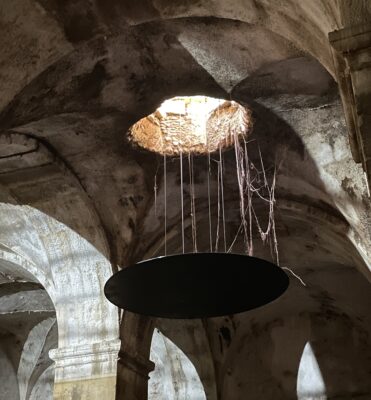
The Anozero Biennial does not function as a conventional biennial. Far from the neutrality of the white cube and the logic of cultural spectacularization turned into urban branding, the sixth edition of the Coimbra Contemporary Art Biennial, titled To Hold, To Give, To Receive, insists on thinking the exhibition as a form of dwelling: a spatial, political, and affective device in which art, architecture, and memory mutually contaminate one another. In this conversation with Carlos Antunes, director of Anozero Biennial, held at the Biblioteca Joanina of the University of Coimbra, we reflect on the Monastery of Santa Clara-a-Nova as the living body of the exhibition; on resistance to the extractive model of a possible luxury hotel; and on the capacity of contemporary art to transform “strangeness” into a form of collective belonging.
Maria Muñoz: You are an architect, and at Anozero there has always been a particular attention to spatiality. This year, sound also appears in a very present way, something deeply architectural. In a conversation with Hans Ibelings, one of the curators, tensions emerged between sound, architecture, memory, and politics that run through part of this edition. How do you think about this relationship between exhibition, space, and architecture?
Carlos Antunes: I would not say that the importance of spatiality in exhibitions has to do with being an architect. I think it is something natural. And since we are in a library, it is important to understand that an exhibition is not a book; it is the experience of a body moving through space. I therefore do not see how an exhibition can be conceived without acknowledging that it is, above all, a spatial experience. An exhibition does not teach you; it opens doors to curiosity. Books complement that experience, which is why catalogues exist. Since I also design many exhibitions from an architectural perspective, I am interested in working with curators who understand the exhibition as a spatial idea.
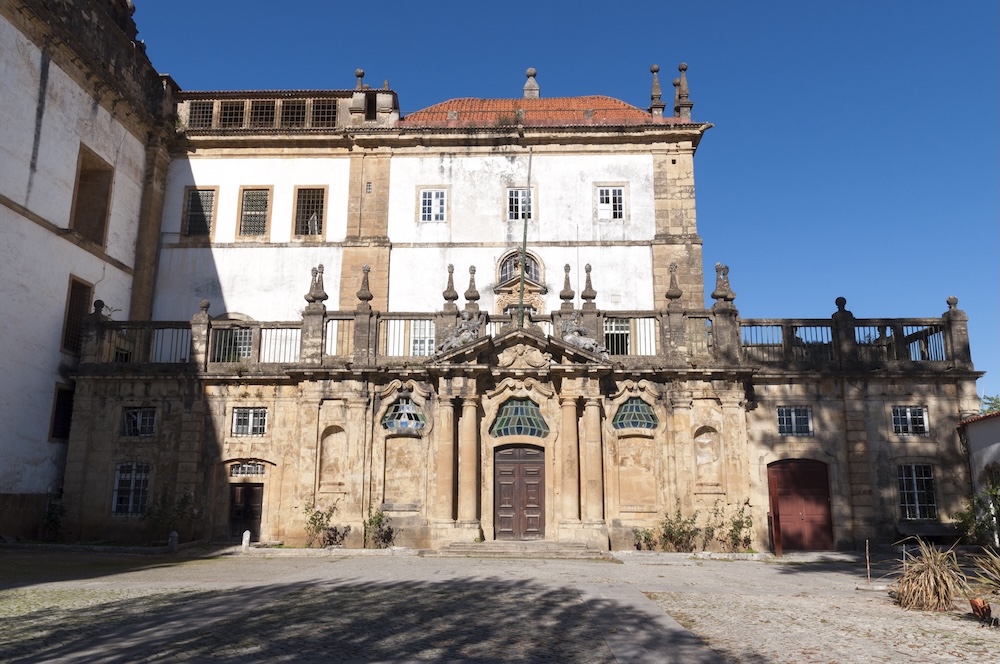
Mosteiro de Santa Clara-a-Nova
MM: And in Coimbra this is even more evident.
CA: Of course. When you work in a city with such an extraordinary heritage dimension as Coimbra—and with a space such as the Monastery of Santa Clara-a-Nova—it is impossible not to take into account the quality of the space. We say that the greatest content of our exhibitions is the space itself. It is exactly the opposite of the white cube logic. Here everything is in dialogue with history, with the marks of the building, with its layers of time. The best exhibitions we have made are those that engage with the space from the very beginning. That is why we believe the biennial should remain in the monastery. All the artists who come here say they have never seen a space like this—not only in Portugal, but anywhere in the world. Yesterday I was speaking with two highly internationally recognised Chilean architects, and they told me they would love to do multiple exhibitions here because the place is unique.
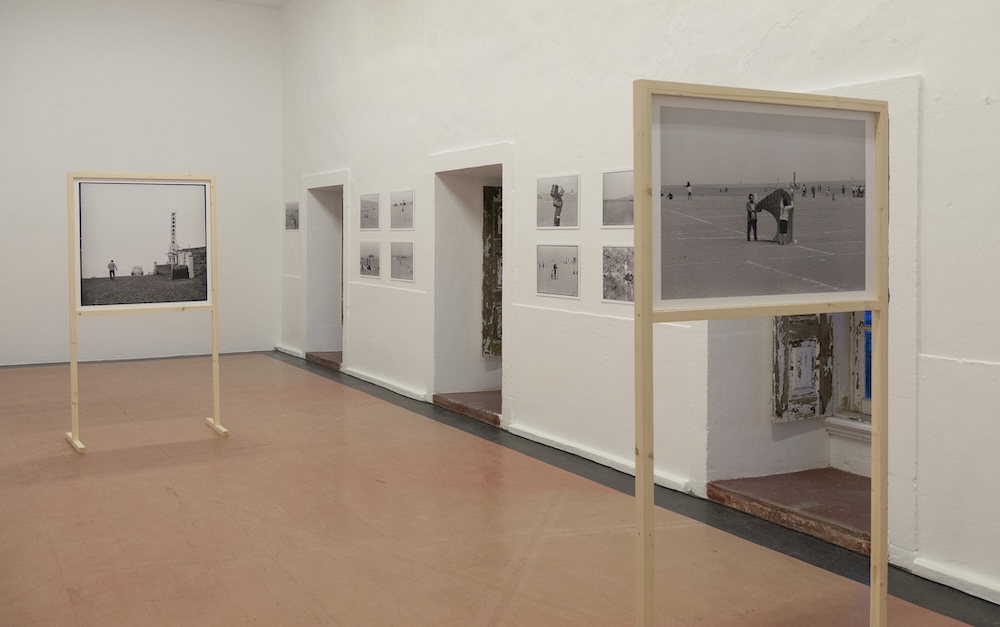
Carlos Ferrand Zavala, Villa El Salvador, Lima (Peru), 1971/1974 en Mosteiro de Santa Clara-a-Nova.
The monastery is not abandoned
MM: However, the future of the monastery remains uncertain. Is the project to convert it into a hotel still ongoing?
CA: Yes, and that is the problem. I understand the general principle of reusing “abandoned” heritage and transforming it into something useful rather than letting it decay. But Santa Clara is neither abandoned nor in ruins. It is the headquarters of one of the most important biennials in the Iberian Peninsula. The most important element of this biennial is the building itself. It is the distinctive feature. Why destroy this to build a hotel that could exist anywhere else? We would be killing the goose that lays the golden eggs. What gives us value is the building and the history we have been building here for almost ten years. The world would not understand how a small city, peripheral in global terms, decides to replace something so singular with a luxury hotel. And there is also a social question. What we do is deeply inclusive; we open the monastery to everyone. A five-star hotel is for a few. If you can have something for everyone, why turn it into something for a few?
Hospitality and art
MM: And what is interesting is that you do not reject the idea of inhabiting the monastery, as seen in the Three Rooms project.
CA: Exactly. We have never said that one cannot sleep there. In fact, that is one of the historical functions of the monastery: hosting travellers. What we want is to recover that dimension of hospitality through art, not through the logic of luxury. That is why we are so interested in the Three Rooms project. You can stay there, sleep there, but in coexistence with the artworks. You become part of the exhibition. The idea of habitat, content, and exhibition becomes indistinguishable. They are rooms for guests of art.
MM: As in Le Corbusier’s La Tourette, it is not about turning the monastery into a spa, but about experiencing the place as it is.
CA: Exactly. It must be an experience of place, not a generic banality.
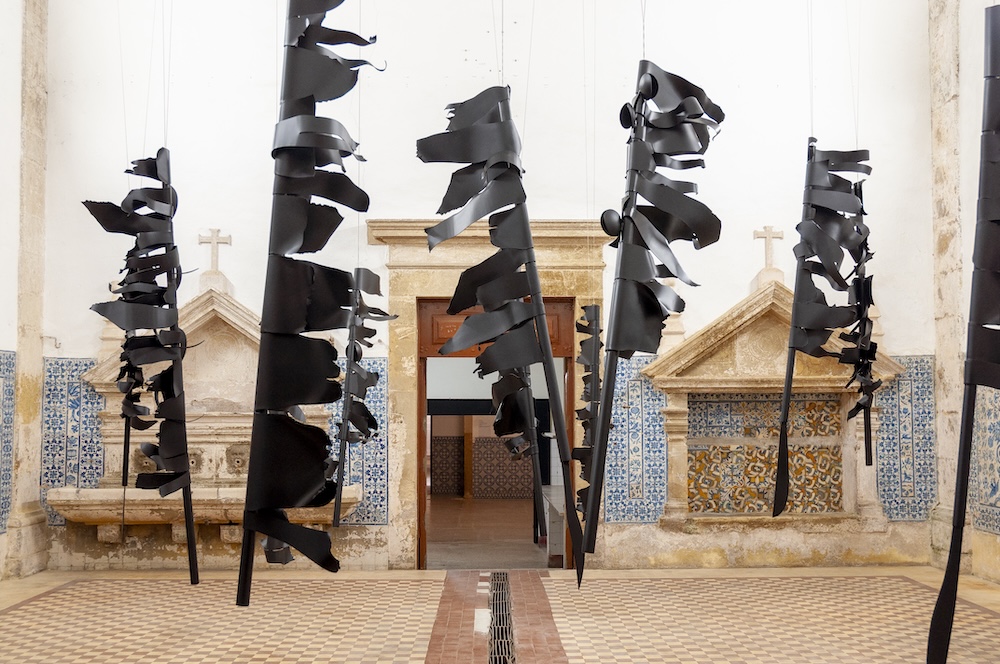
Rui Chafes, Acredito em tudo, 2025 en Mosteiro de Santa Clara-a-Nova.
A biennial that transforms the city
MM: There is also something important in how the biennial changes the city’s relationship with itself.
CA: That is fundamental. A person from Coimbra, who travels a lot for work, told me something very beautiful: “Before, I saw Coimbra as a peripheral, lost city. But with the biennial I began to see things here that I had seen in Madrid, Paris, Berlin, or New York.” That generates a sense of belonging to the world. When the list of artists includes names such as Nan Goldin or Forensic Architecture, Coimbra enters a global conversation. And it is not only about including major names; it is about engaging with political positions and worldviews. When Nan Goldin speaks here through her work, it is also Coimbra that is speaking. That brings back hope and belonging.
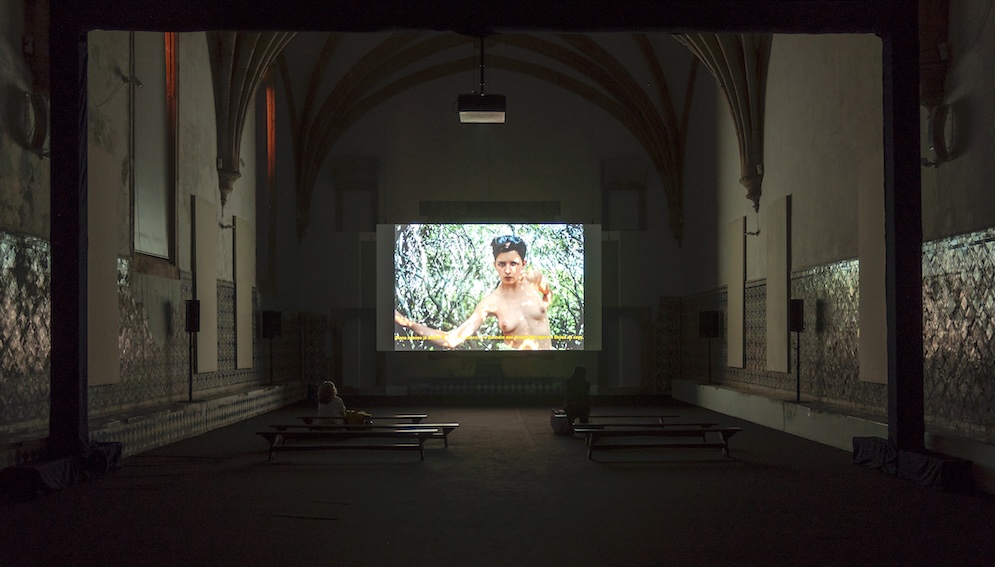
Nan Goldin, Stendhal Syndrome, 2024 en Sala de Cidade.
The walls speak
MM: Many of the works engage precisely with that relationship between memory and space. I am thinking, for instance, of Taryn Simon’s laments passing through the corridor of the former dormitories.
CA: Of course. When you hear those laments, what exactly do you hear? Only contemporary voices, or also an echo of the people who lived in the monastery centuries ago? That is the building. The walls speak through art. That is why I always say that the building resignifies the work, and the work resignifies the building. In a white cube, it would be completely different.
Familiar strangeness
MM: I also wanted to ask how the public’s relationship with contemporary art has changed through the five editions of the biennial.
CA: Contemporary art is always a place of strangeness, and it is good that it is so. Its function is to take you out of the expected. But when people are not familiar with that language, this strangeness can become rejection. What we try to do is transform “strange strangeness” into “familiar strangeness.” Familiar strangeness is when you do not fully understand something, but you still decide to approach it, to listen, to try to understand. I like this term because familiar strangeness transforms people by making them available to listen. And I think that is precisely what is happening in Coimbra. At first, the biennial was seen as elitist. Now people feel curiosity; they feel it is also for them.
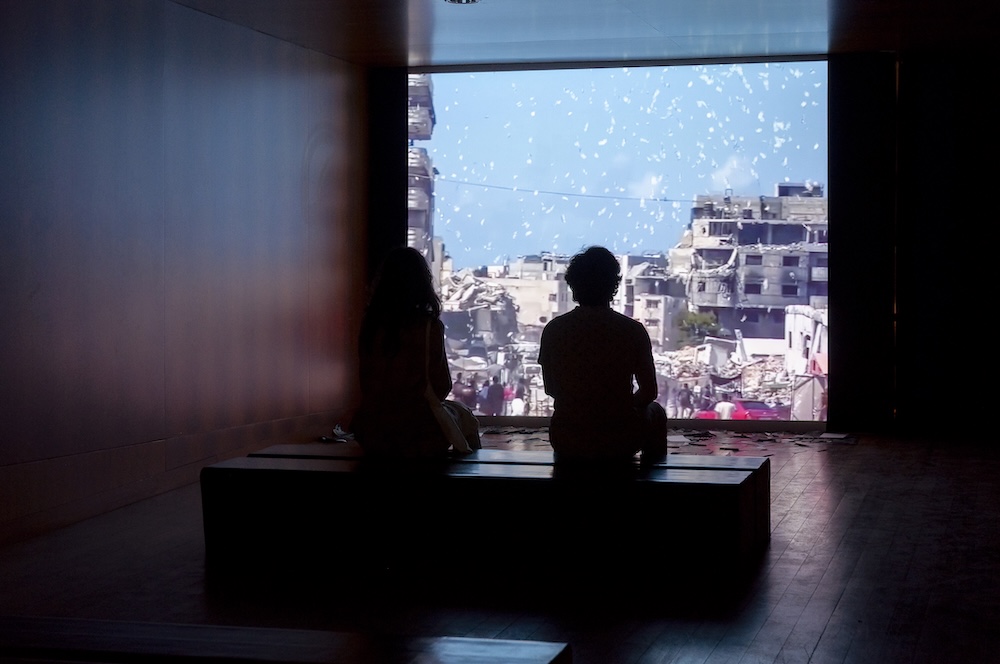
Forensic Architecture, Displacement by design, video instalación Death by a thousand cuts, 2025 en Círculo Sereia.
Manifesta and a new biennial model
MM: Finally, in two years the next edition will be developed in collaboration with Manifesta.
CA: Yes. Manifesta has been following us and inviting us to international meetings for some time, because they understand that Anozero can be a different model of biennial: a biennial of contained scale, where artists truly have space—not only symbolic but real. Here, an artist can have 200 or 600 square meters for a single work. That almost no longer exists.
What is interesting is that Manifesta also understood that we remain. They arrive and leave, as is the nature of a travelling biennial. We stay. That is why I like to speak of “Manifesta Anozero.” It is not Manifesta in Coimbra, but a joint, horizontal edition without hierarchies. If we speak of collaboration and horizontality, that must also exist in the structure of the project. Otherwise it would be fiction. And it is also significant that the first Manifesta in Portugal will take place here, in Coimbra.
MM: It makes perfect sense. Coimbra may not be the most obvious place for Manifesta—so much history, heritage, tourism—but precisely that is why the pairing with Anozero makes sense. Thank you very much, Carlos.
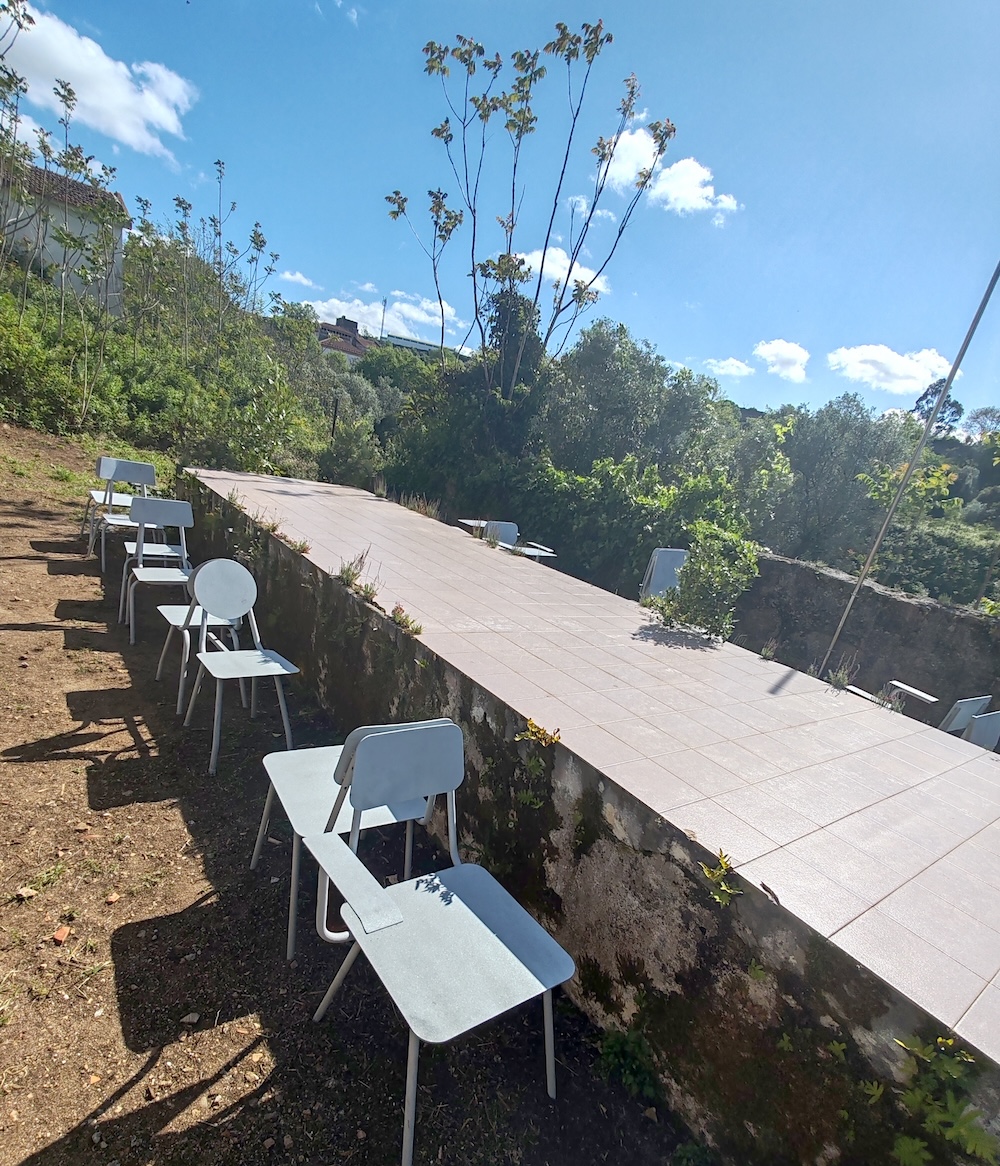
Inside Outside, A Shared Table, 2026, Site specific en jardines del Mosteiro de Santa Clara-a-Nova. Foto: Maria Muñoz
Note: The interview with Carlos Antunes was conducted in Spanish.
(Front image: Centrala, Imagined, 2026 en Cisterna del Mosteiro de Santa Clara-a-Nova. Foto: Centrala)
All images courtesy Anozero 2026. Photos: © Jorge das Neves
Anozero 2026, To Hold, To Give, To Receive, Coimbra Contemporary Art Biennial, runs until July 5.
All information here.

María Muñoz-Martínez is a cultural worker and educator trained in Art History and Telecommunications Engineering, this hybridity is part of her nature. She has taught “Art History of the first half of the 20th century” at ESDI and currently teaches the subject “Art in the global context” in the Master of Cultural Management IL3 at the University of Barcelona. In addition, while living between Berlin and Barcelona, she is a regular contributor to different media, writing about art and culture and emphasising the confluence between art, society/politics and technology. She is passionate about the moving image, electronically generated music and digital media.
Portrait: Sebastian Busse
Media Partners:








"A desk is a dangerous place from which to watch the world" (John Le Carré)