Search
To search for an exact match, type the word or phrase you want in quotation marks.
A*DESK has been offering since 2002 contents about criticism and contemporary art. A*DESK has become consolidated thanks to all those who have believed in the project, all those who have followed us, debating, participating and collaborating. Many people have collaborated with A*DESK, and continue to do so. Their efforts, knowledge and belief in the project are what make it grow internationally. At A*DESK we have also generated work for over one hundred professionals in culture, from small collaborations with reviews and classes, to more prolonged and intense collaborations.
At A*DESK we believe in the need for free and universal access to culture and knowledge. We want to carry on being independent, remaining open to more ideas and opinions. If you believe in A*DESK, we need your backing to be able to continue. You can now participate in the project by supporting it. You can choose how much you want to contribute to the project.
You can decide how much you want to bring to the project.
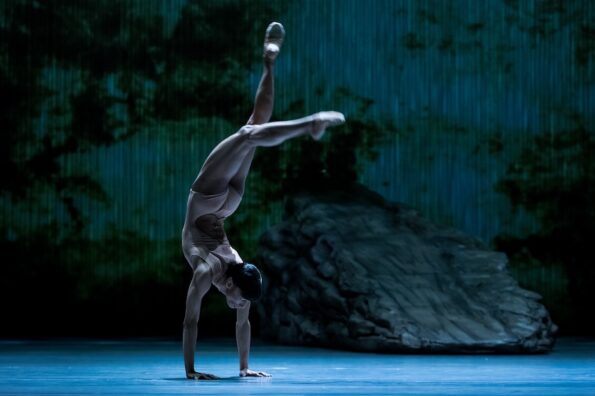
There are dreams dreamt with open eyes. Edward Clug’s Ein Sommernachtstraum / A Midsummer Night’s Dream for the Staatsballett Berlin is a ballet that flirtations with the chaos of the forest without getting its hands too dirty. Clug, originally from Romania, knows the rules of the narrative game and respects them with a correctness that, at times, borders on timidity.
A Midsummer Night’s Dream is based on William Shakespeare’s play of the same name, which delves into the depths of human nature, the power of love, the confusions of desire, and the magic of imagination. For this reason, Clug shifts his gaze toward what usually remains on the margins. The forest is not a backdrop; it is a physical presence. The animals—the praying mantis crossing the stage, the lurking insects—are creatures inhabiting the dream with a logic of their own: unclassifiable and strangely beautiful.
A Midsummer Night’s Dream is pure sensuality in its ensemble scenes. In the first act, thirty dancers lie on the floor in purple tights, and what emerges is not a landscape: it is a living creature, a carnivorous plant of bodies breathing as one. And then comes the certainty that Puck—with his ambiguity and childlike cruelty—is the only one who dares to disobey the choreographic order.
Milko Lazar’s score replaces Mendelssohn without apology. Moving between the ethereal and the minimalist, it features a moment of sonic suction that compels the body to move. Marko Japelj’s scenography opts for concrete abstraction and a door that, upon opening, reveals a forest that never quite becomes one. The result is an entertaining, visually elegant Shakespeare.
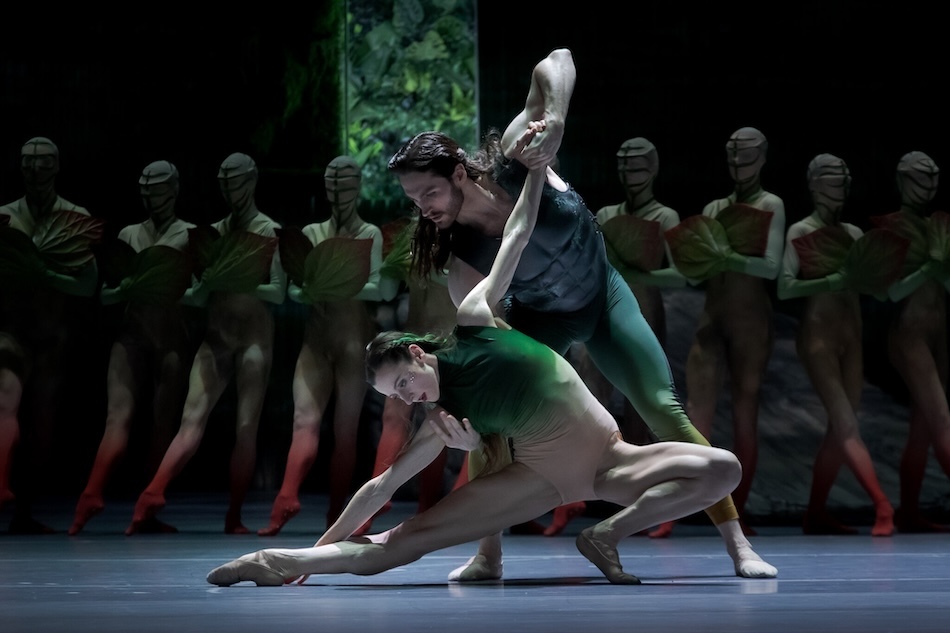
Weronika Frodyma, Cohen Aitchison-Dugas and ensemble. Photo: © Yan Revazov
The sharpest aspect of the production lies not in the lovers Hermia and Lysander, but in Leroy Mokgatle as Puck, the mischievous sprite and court jester who unleashes romantic chaos with his spells. Puck possesses a flamboyant, luminous, and unpredictable presence injecting a note of camp that the rest of the show welcomes. The same can be said for Michelle Willems as Helena, who dares to embrace absurdity, rage, and the kind of vulnerability that reminds audiences why they keep going to the theater.
Mokgatle is a South African non-binary dancer who joined the Staatsballett Berlin for the 2023/24 season and was promoted to demi-soloist in 2024. Before arriving in Berlin, Mokgatle had already won the Youth America Grand Prix and the Genée International Ballet Competition, and had danced with the Béjart Ballet and Ballett Zürich. Furthermore, Mokgatle was awarded the Daphne-Preis 2026 this year. Therefore, Mokgatle’s presence in Ein Sommernachtstraum is not a symbolic gesture; it is the magnetic center of the piece.
Clug does not deconstruct the original’s sexism—Oberon spellbinding Titania with impunity remains present, staged with professional craftsmanship. But what he does do is open up space for Mokgatle to be the anchor of the night. And in those minutes, the dream ceases to be domesticated and becomes subtly dangerous, evocative, with animals looking like they stepped out of an old engraving, and a Puck who asks no permission to exist.
This final performance of Clug’s Ein Sommernachtstraum closes the theater ahead of the summer holidays. It leaves a good taste in the mouth: it does not seek to provoke, deconstruct, or set the canon ablaze. It is not the most uncomfortable Shakespeare, but it is a Shakespeare that breathes—and sometimes, that is enough.
Featured image: Leroy Mokgatle as Puck at Ein Sommernachtstraum by Edward Club on the stage of the Deutsche Oper Berlin. Photo: © Yan Revazov
María Muñoz-Martínez is a cultural worker and educator trained in Art History and Telecommunications Engineering, this hybridity is part of her nature. She has taught “Art History of the first half of the 20th century” at ESDI and currently teaches the subject “Art in the global context” in the Master of Cultural Management IL3 at the University of Barcelona. In addition, while living between Berlin and Barcelona, she is a regular contributor to different media, writing about art and culture and emphasising the confluence between art, society/politics and technology. She is passionate about the moving image, electronically generated music and digital media.
Portrait: Sebastian Busse
Media Partners:








"A desk is a dangerous place from which to watch the world" (John Le Carré)