


Search
To search for an exact match, type the word or phrase you want in quotation marks.
A*DESK has been offering since 2002 contents about criticism and contemporary art. A*DESK has become consolidated thanks to all those who have believed in the project, all those who have followed us, debating, participating and collaborating. Many people have collaborated with A*DESK, and continue to do so. Their efforts, knowledge and belief in the project are what make it grow internationally. At A*DESK we have also generated work for over one hundred professionals in culture, from small collaborations with reviews and classes, to more prolonged and intense collaborations.
At A*DESK we believe in the need for free and universal access to culture and knowledge. We want to carry on being independent, remaining open to more ideas and opinions. If you believe in A*DESK, we need your backing to be able to continue. You can now participate in the project by supporting it. You can choose how much you want to contribute to the project.
You can decide how much you want to bring to the project.
I hadn’t noticed the number and size of the signs indicating public funding for Badajoz (Extremadura Regional Government, Spanish Government, Badajoz Provincial Council, European Union Next Generation Funds, etc.) until we started the Non plus ultra project [1]Los Caños was created as part of the Concomitentes Non plus ultra project, with the support of the Daniel and Nina Carasso Foundation, mediation by Jose Iglesias García-Arenal from Plataforma … Continue reading. I had accepted the enormous, cracked surfaces as a natural part of the landscape. In this spectral institutional presence, the power of the local estates persists, the latifundist structures that have marked the history of Extremadura. Signs to constantly remind us of our dependence on large and small centers of power. The periphery is internalized through gestures as simple as the scale of a sign.
These cracked planes were one of the elements we observed during Non plus ultra, a process driven by Concomitentes in which a group of young people from various towns in Badajoz sought to imagine more inspiring futures from which to discuss the drought—climatic and cultural—of the territory, and which I accompanied in a curatorial mediation role. In 2023, we formed a study group to learn to look at this symbolic landscape of imperial nostalgia from a place of estrangement, what Victorio Chamorro, in a book with the resounding title Extremadura. Afán de miseria (Extremadura. Yearning for Misery), calls “suffocating mythologies.”
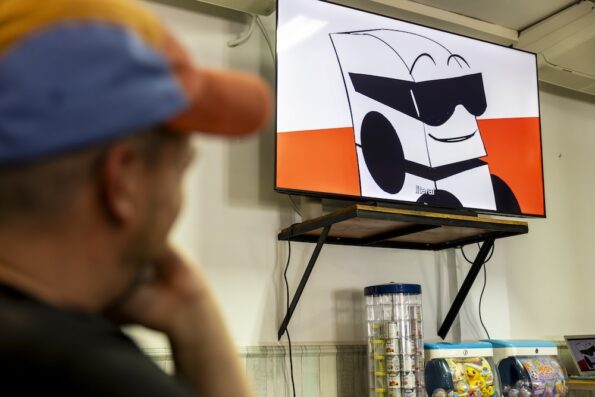
If the large, sun-faded billboards embody an aesthetic of institutional dependence and extractivism, Non plus ultra has sought degrowth, communal, inspiring, and fun forms, culminating in a commission to the artist Francesc Ruiz. After an initial mediation phase involving study sessions excursions, parties, and collaborations with the artists Elan d’Orphium and Mayte Gómez Molina, we issued a commission to which Francesc responded with Los Caños (The Pipes). The name is taken directly from the Zafra industrial park, highlighting the commercial and logistical importance of the area, where a large livestock fair has been held for over five centuries. Los Caños has unfolded over months in interventions in corners and communication channels of the region, using graphic devices that have expanded from a comic strip in which trucks wearing sunglasses cross roads, tunnels, and fences, sharing secret stories.
The black and red pages of the comic have expanded, seeping into the local advertising magazine, El Mensajero, onto posters throughout the streets, as animation on a bar’s television, shaping a communal risograph printing press, El Chorrillo, and even taking over an abandoned gas station. The gas station’s logo, a small red droplet, multiplies and seeps through the cracks in the ground. The drops rub and squeeze against each other, alongside bones and red books, beneath a burning landscape crossed by tanker trucks, irrigation pipes, and cracked floors. The gas station’s windows, adorned with Francesc’s vinyl decals, act as a panorama, reflecting the surroundings. From here, one can make out a plant nursery, photovoltaic panel installations, the new cement factory, and the quarries that supplied the material used to build buildings, dams, and canals.
The little red drop echoes in the black and red of the magazine El Mensajero, in the ink of a dry risograph printer that predated the project, in the stickers of the local antifa collective… It introduces itself to the trucks: “I’m the drop that overflows the cup. What do you prefer? A transfusion or a transfer?” In the narrative of Los Caños, red is blood, it’s ink, it’s sweat, it’s water, it’s the last drop of gasoline in a landscape that rises scorched by the sun, a scaly skin that reveals layer upon layer beneath which something is always flowing.
A large truck with sunglasses leaves the gas station and moves alongside a reservoir toward Brovales, one of the colonization towns of the Badajoz Plan, which aimed to modernize the Spanish countryside by building irrigation systems and towns with grid-pattern streets around new churches. The logo of the National Institute of Colonization can still be found on the manhole covers of these municipalities. The truck travels alongside the dry irrigation canals, intertwining with the ruins of Francoist biopolitics.


Every blocked spring eventually bursts. Non plus ultra has developed around a simple yet radical idea: the drought against which the group rebelled is not a climatic phenomenon to be accepted, but rather the consequence of a weakening of our relationship with the land we inhabit, the result of extractive policies that have abused aquifers, aridified the soil, and decimated its populations. What we perceive as drought and depletion is a precise management of resources; drought is the repression of other possible worlds. Sealed springs that have lost their function as meeting places, springs over which industrial parks have been built, dry bars in the face of depopulation. And everything that is repressed eventually emerges in some way.
The pipes sprout one way or another. Francesc Ruiz’s work, together with the group Concomitentes (recently renamed “Non Plus Ultra Collective”), intervenes in the margins of the extractive company with its imperial heritage, which has designed logistical structures through which water, cement, electricity, etc., flow, creating small disruptions and alternative circuits. The truck folds and unfolds, adapting to the terrain. From the air, it seems to flow. The pipes have generated a visual universe and a collective methodology that continues to expand through the youth collective. They are publishing new fanzines with El Chorrillo to address the problems of photovoltaics and the lack of public cultural policies, and creating meeting spaces in bars and industrial ruins through parties, trying to reverse the internalization of depopulation as a destiny. The pipes confront the whitish and cracked surface of the signs with a circulation of symbols and energy that permeates and regenerates the land.
[Featured Image: Francesc Ruiz, Los caños. Photo: Félix Méndez].
| ↑1 | Los Caños was created as part of the Concomitentes Non plus ultra project, with the support of the Daniel and Nina Carasso Foundation, mediation by Jose Iglesias García-Arenal from Plataforma MAL, and the collaboration of the UHT collective and the Llera Town Council. It was inaugurated in October 2025 and has continued to develop with new devices and activities thanks to the “Grants for the creation, research, and production of artistic projects in residence” from the Ministry of Culture. The journey with the truck mentioned throughout the text was part of the final activity of Los Caños, on April 25, 2026. |
|---|
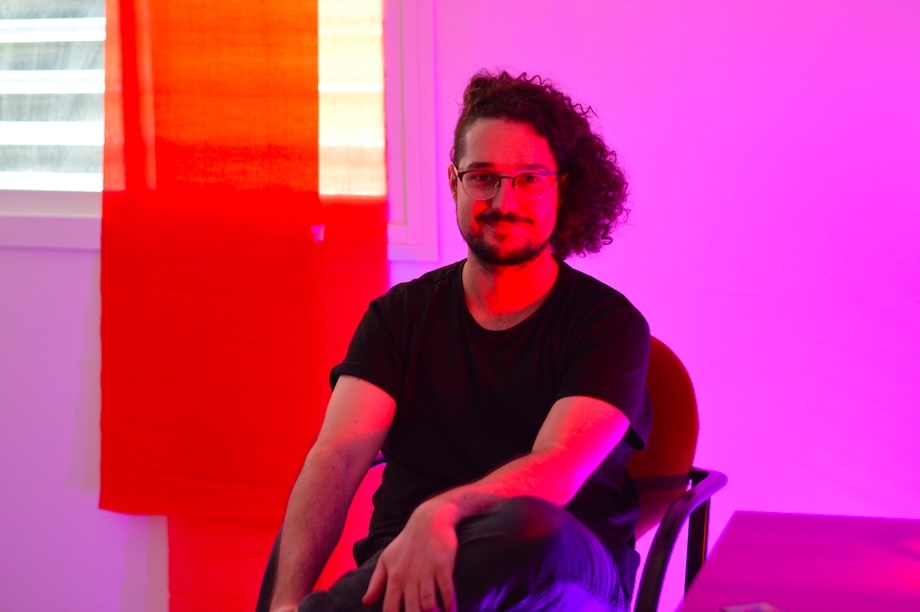
Jose Iglesias García-Arenal works through artistic and curatorial practice on long-term projects addressing issues such as the politics of memory and the technological transformations of non-urban territories. Since 2019, he has directed Plataforma MAL, an association dedicated to research and artistic creation processes within the “diffuse urbanities” of southwestern Iberia, and since 2023, he has been a curatorial mediator for the organization Concomitentes.
Photo Alegría y Piñero
Media Partners:






"A desk is a dangerous place from which to watch the world" (John Le Carré)