Search
To search for an exact match, type the word or phrase you want in quotation marks.
A*DESK has been offering since 2002 contents about criticism and contemporary art. A*DESK has become consolidated thanks to all those who have believed in the project, all those who have followed us, debating, participating and collaborating. Many people have collaborated with A*DESK, and continue to do so. Their efforts, knowledge and belief in the project are what make it grow internationally. At A*DESK we have also generated work for over one hundred professionals in culture, from small collaborations with reviews and classes, to more prolonged and intense collaborations.
At A*DESK we believe in the need for free and universal access to culture and knowledge. We want to carry on being independent, remaining open to more ideas and opinions. If you believe in A*DESK, we need your backing to be able to continue. You can now participate in the project by supporting it. You can choose how much you want to contribute to the project.
You can decide how much you want to bring to the project.
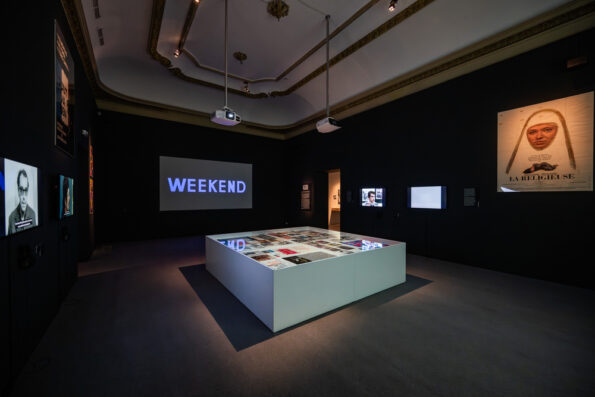
What does it mean to translate the thinking of a figure such as Jean-Luc Godard into an exhibition without domesticating it? The exhibition La fraternidad de las metáforas (The Fraternity of Metaphors) at La Virreina Centre de la Imatge poses an uncomfortable answer, namely, that it’s not about illustrating Godard but about activating his questions. Using war as its central theme, the exhibition offers an interpretation in which images are not documents of the past but devices that continue to operate in the present. We spoke with the exhibition curator about montage, militancy, technique, and the productive failure of images.
Alejandro Alcolea: The title of the exhibition suggests a very Godardian logic, that is, montage as a form of thought. Bringing this language into the exhibition space seems like a very honest gesture toward Godard, but also a risky one. How did you come up with the idea of translating this kind of thinking into an exhibition without simplifying it?
Manuel Asín: The Fraternity of Metaphors introduces quite well one of Godard’s working methods. He used this expression in Histoire(s) du cinéma, in a fragment included in the exhibition, but he is actually quoting a critique by André Bazin of Sierra de Teruel, André Malraux’s film shot during the Spanish Civil War. Godard uses this expression to formulate a beautiful idea, one of the driving forces of the exhibition. When he saw Sierra de Teruel at its French premiere in the 1950s, he was moved not only by the Spanish Civil War itself but also by the capacity of these images to continue to resonate in other present-day contexts, such as the Indochinese and Algerian conflicts. Therein lies a way of thinking about images, not as something confined to their own time but as something that grows, becomes more complex, and enters into a relationship with other conflicts and other historical moments.
Furthermore, the title itself creates a subtle montage, as fraternity and metaphors are not words that are immediately associated. I was interested in this slight estrangement because it reveals something of Godard’s method. On the one hand, the semantic field of fraternity opens up political questions linked in the exhibition to the wars of the 20th century, and on the other hand, the metaphor refers to the image and to a reflection on how images function. The exhibition attempts to relate these two dimensions.
That being said, I also wanted to be cautious. The exhibition is not a work by Godard nor does it intend to imitate him. Godard already faced the challenge of creating an exhibition, with all the complexities and failures that entailed. What we had to do was something else, that is, to open doors, introduce Godard, and propose a path. This is why the exhibition also follows a relatively accessible, even chronological, thread, although there are more conceptual rooms. We chose a very specific angle, that is, war, so as not to fall into a totalizing vision of an unmanageable body of work.
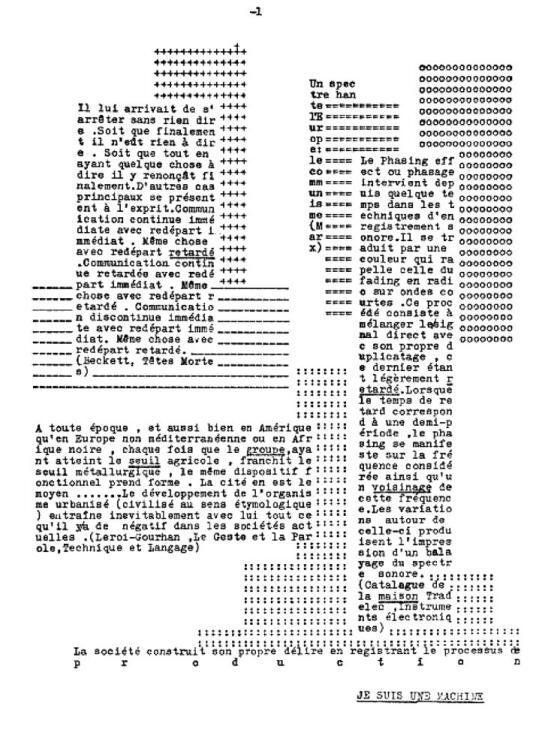
‘Moi Je’ (Jean-Luc Godard, 1973). Image courtesy of La Virreina Centre de la Imatge.
AA: André Malraux appears as a decisive figure in the exhibition, almost as a thread that runs through it from beginning to end. Why was he so important to Godard?
MA: Malraux is a key figure, even more so from the perspective we’ve chosen. In the exhibition, he appears in a very early piece, the copy of Camus’ The Myth of Sisyphus that belonged to Godard when he was a teenager. In the footnotes, Godard adds his own phrases from Paul Éluard, Hitler, and Malraux. This absurd juxtaposition perfectly encapsulates something of his method, namely, clashes, friction, and montage.
Initially, Malraux is for him a model of the modern writer, almost an artistic mirror. His political dimension is also important, since he fought for the Republic during the Spanish Civil War and commanded an air squadron. There is also his relationship with cinema. For Godard, those writers and artists who very early on recognized the importance of cinema as an art form were always important. Malraux wasn’t a filmmaker in a sustained way, but he made Sierra de Teruel, wrote about cinema, and thought about images.
There is yet another crucial dimension, that is, his reflection on art through photographic reproduction. Malraux’s “imaginary museum,” which relates disparate works to one another in books and reproductions, anticipates something that deeply interests Godard. In a way, Histoire(s) du cinéma does something similar with cinema, as it constructs the history of film through a new, malleable technology that includes video. This is why Malraux reappears again and again, from beginning to end.
AA: The exhibition also traces a network of collaborations deeply intertwined with activism and war, including with Adrien Porchet, Raoul Coutard, Jean-Pierre Gorin, and Anne-Marie Miéville. What does this constellation reveal about Godard’s idea of “making cinema politically?”
MA: It reveals, first and foremost, that for Godard, cinema was never a solitary endeavor. He said that to make a film you need at least two people, someone in front and someone behind. Cinema is born from this relationship. Throughout his career, there are privileged interlocutors who pretty much define his different stages. Initially, François Truffaut, then, Jean-Pierre Gorin, and later, Anne-Marie Miéville, an essential collaborator up until the very end. And then there are fundamental figures such as Elias Sanbar and some collaborators from his later years.
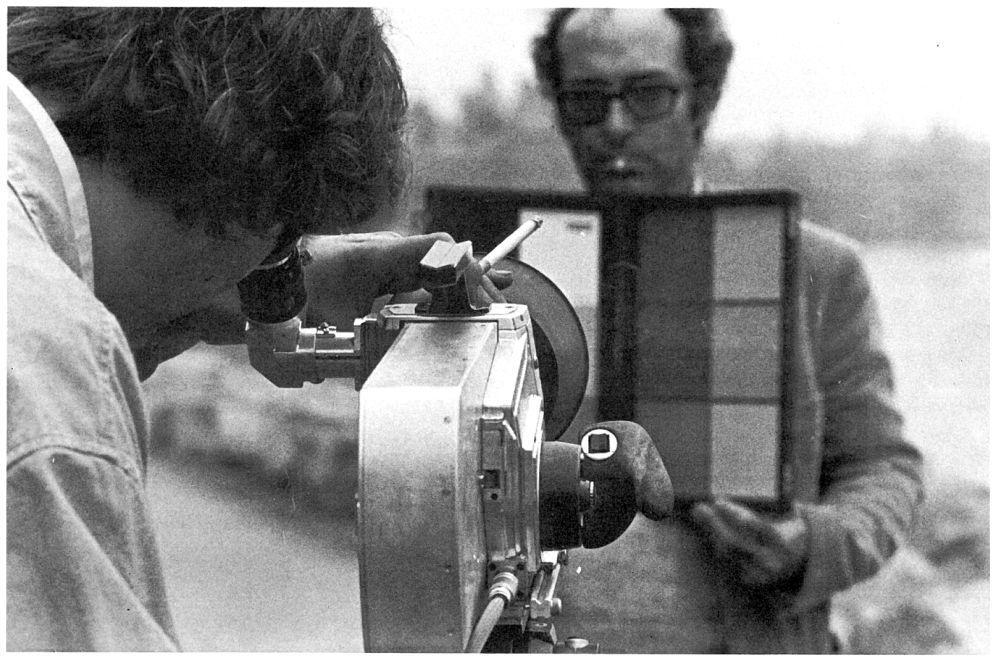
Anne-Marie Miéville, Untitled [Willy Lubtchansky y Jean-Luc Godard testing the Aäton prototype 8-35], 1979. Image courtesy of La Virreina Centre de la Imatge.
When Godard said that it’s not enough to make political films but instead that one must make films politically, he is also referring to his work methods, the production process, the circulation of images, and the material relationships that make a film possible. During the Dziga Vertov Group period this became especially intense, but even then his cinema was never limited to counter-information, there was always a reflection on the image itself, on its limits, risks, and power.
In this sense, his Palestine episode is particularly revealing. In the early 1970s, Godard attempted to film the conflict directly in Jordan and Lebanon, from a perspective akin to militant cinema, that is, as an immediate intervention in reality. The project, however, failed and the film was never completed. Far from ending there, this failure was transformed into working material. Godard revisited these images and subjected them to a process of self-criticism, recognizing the extent to which this “direct cinema” approach was riddled with misunderstandings, limitations of understanding, and a certain false transparency. This shift is key, as he didn’t abandon activism but instead questioned the idea that filming a conflict is the same as understanding or representing it. From then on, his cinema became even more critical of its own conditions of possibility.
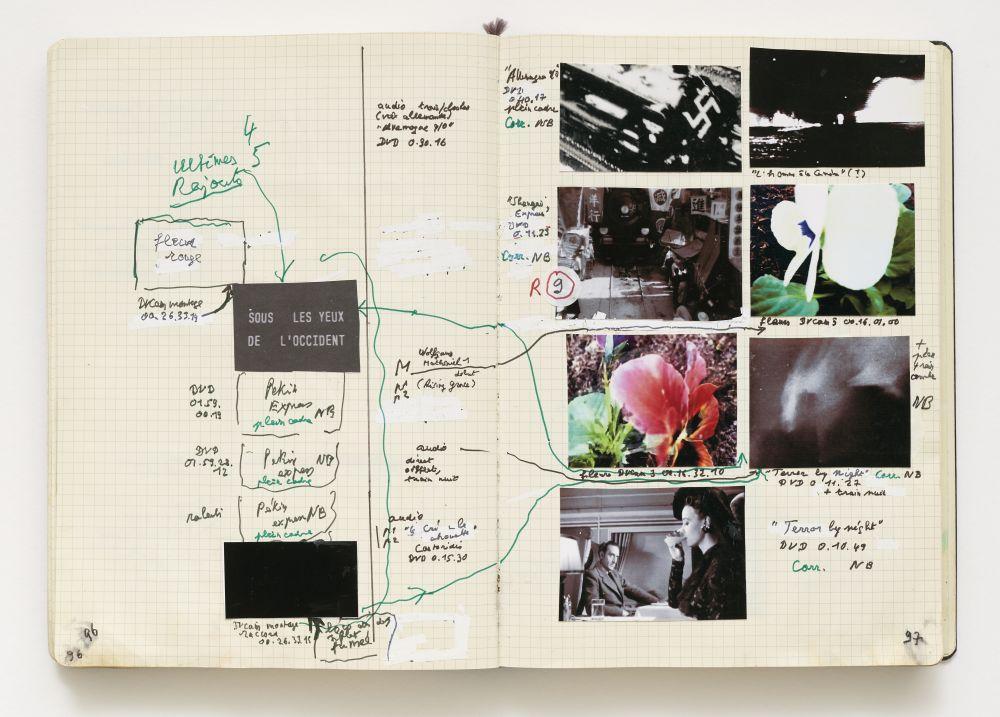
Editing notebook for (Jean-Luc Godard, 2018). Image courtesy of La Virreina Centre de la Imatge.
AA: Throughout the exhibition, the dream of a technical utopia appears repeatedly, in the creation of a new, higher-quality portable camera, improvements in video, sound, formats, and production. To what extent is this technical dimension central to understanding Godard?
MA: It’s absolutely central and I’m glad it’s included in the exhibition because it’s not just a technical matter or formal innovation. In Godard’s work, technique is deeply intertwined with politics. He was a radical technophile, someone passionately interested in all the medium’s mutations, including 35mm film, sound, video, television, 3D, lightweight cameras, and new recording devices. He would surely be working with Artificial Intelligence today. He was a video pioneer and understood very early on that every technical transformation opened up new possibilities for thought.
In this sense, Godard wasn’t simply an auteur at odds with the industry. He engaged with it critically throughout his life. He was also a producer, and he understood cinema as production, something that demands money, resources, organization, and infrastructure. He didn’t insist that cinema should be poor or austere, he knew that the history of cinema had also been built on large investments and industrial developments.
He was obsessed with something else, namely, the matter of who produces the images and for what purpose. There’s a moment, around 1968, when he goes so far as to say that the only true auteur of French cinema at the time was De Gaulle, because ultimately he was the power that organized the conditions of production. This extreme formulation helps us think more clearly about the problem. For Godard, inventing other tools or pushing the boundaries of existing ones wasn’t a technical whim, it was a way of challenging the regime of images. Making other images could literally mean making another world possible.
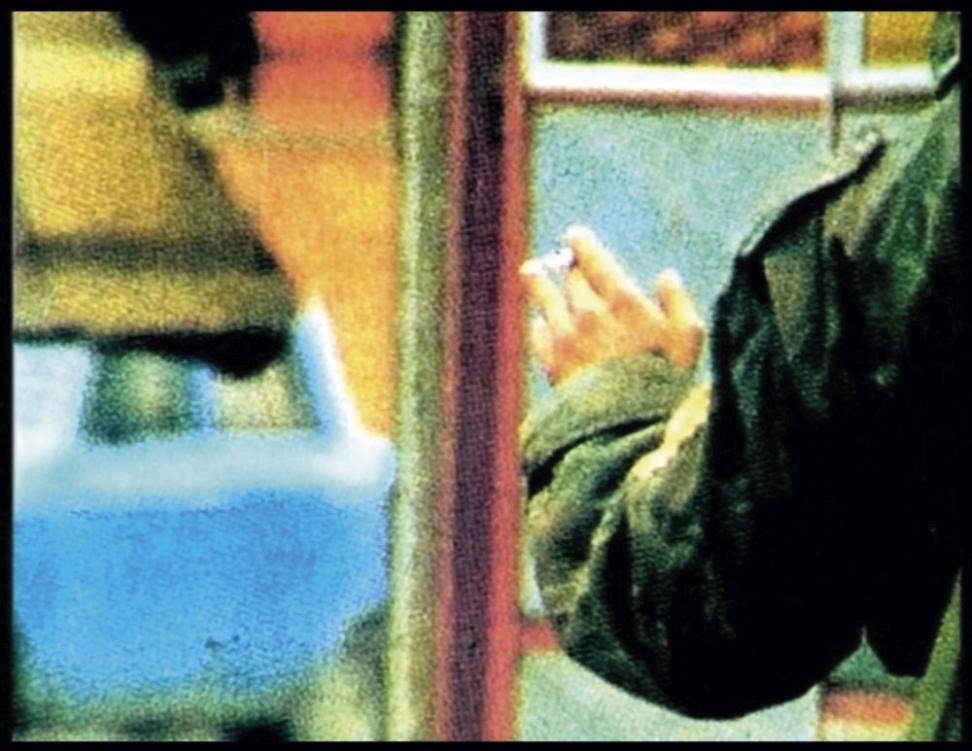
‘Je vous salue, Sarajevo’ (Jean-Luc Godard, 1993). Image courtesy of La Virreina Centre de la Imatge.
AA: Godard is still often seen primarily as the great icon of the Nouvelle Vague. Did this canonization end up creating a reductive image of his work?
MA: Undoubtedly. It’s a kind of curse that haunted him to the very end. Godard’s work in the 1960s is immense, but to reduce him to that is to radically impoverish him. He himself was the first to critically revisit that period. As early as the late 1960s and early 1970s, he spoke of his first films in harsh, provocative terms. This self-criticism, however, isn’t just a simple denial, it’s a way to revisit those works, reread them, reposition them, to work with them again.
This exhibition doesn’t intend to diminish the importance of Godard’s Nouvelle Vague cinema, which is very much present, but rather to remind us that this is only one part of a much longer, more complex, and ever-changing trajectory.
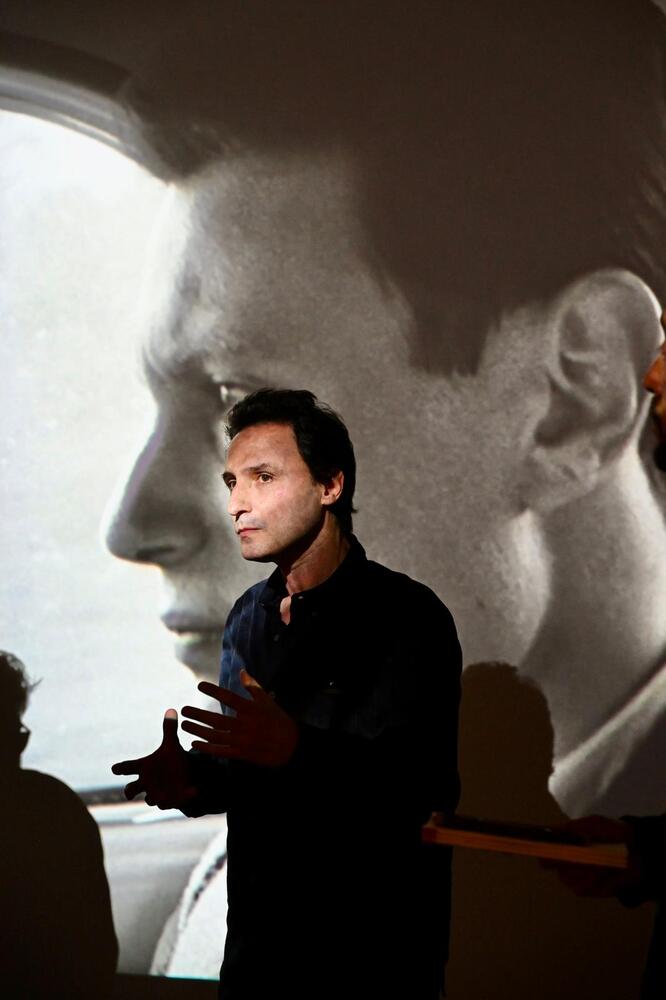
Manuel Asín, curator of the exhibition ‘La fraternidad de las metáforas’. Image courtesy of La Virreina Centre de la Imatge.
(Featured image: View of one of the exhibition rooms. Image courtesy of La Virreina Centre de la Imatge.)
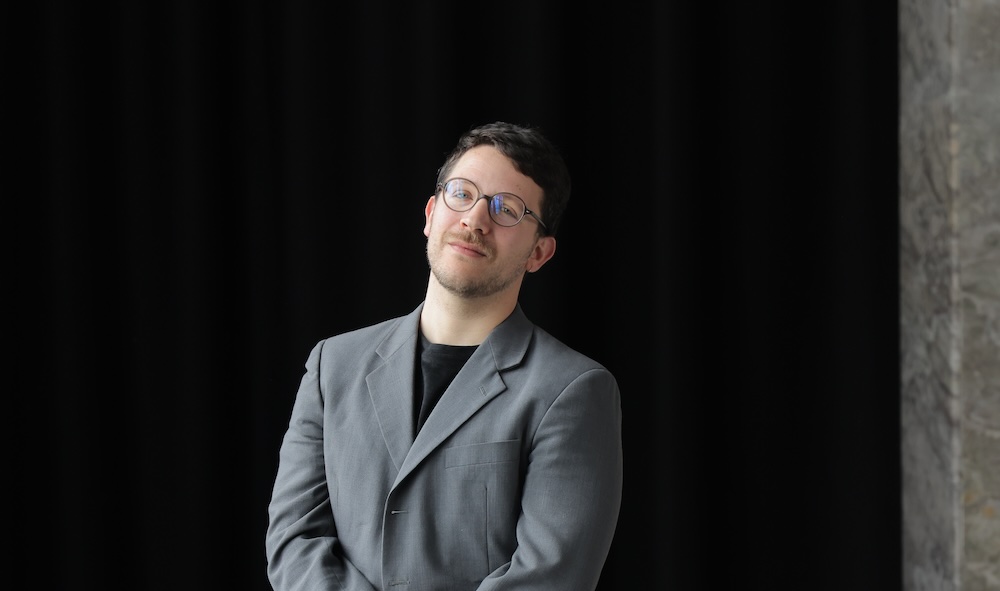
Alejandro Alcolea Marín (Palma, 1990) is a journalist and cultural critic. Throughout his career professional has been dedicated to communication, management and research in different institutions cultural institutions such as the Círculo de Bellas Artes, the Center for Contemporary Culture of Barcelona (CCCB) and Es Baluard Contemporary Art Museum of Palma. He has collaborated with media and publications such as A*Desk, elDiario.es, CTXT or lamarea. He is interested in what happens (and what doesn’t) in the intersection between them fields of culture, power and technologies.
Media Partners:






"A desk is a dangerous place from which to watch the world" (John Le Carré)