Search
To search for an exact match, type the word or phrase you want in quotation marks.
A*DESK has been offering since 2002 contents about criticism and contemporary art. A*DESK has become consolidated thanks to all those who have believed in the project, all those who have followed us, debating, participating and collaborating. Many people have collaborated with A*DESK, and continue to do so. Their efforts, knowledge and belief in the project are what make it grow internationally. At A*DESK we have also generated work for over one hundred professionals in culture, from small collaborations with reviews and classes, to more prolonged and intense collaborations.
At A*DESK we believe in the need for free and universal access to culture and knowledge. We want to carry on being independent, remaining open to more ideas and opinions. If you believe in A*DESK, we need your backing to be able to continue. You can now participate in the project by supporting it. You can choose how much you want to contribute to the project.
You can decide how much you want to bring to the project.

The CCCB is an institution that, consistently throughout its history, has defined itself as “a multidisciplinary cultural center dedicated to exploring the major themes of contemporary society through diverse languages and formats.” In its thirty-two years of history, topics such as artificial intelligence, the brain, suburban culture, and figures from diverse fields—Chris Ware, Agnès Varda, Stanley Kubrick, the Marquis de Sade, and, more recently, Mercè Rodoreda—have shaped exhibition and public programs capable of offering multiple approaches and levels of interpretation.
The Cult of Beauty addresses one of these great universal themes. As Umberto Eco pointed out, beauty is an aspiration shared by all cultures, although it has never been an absolute or immutable category. Its relevance is especially significant today, when it continues to be a social construct profoundly influenced by the beauty industry, the attention economy, and social media. The exhibition stems from a cultural and political stance that doesn’t so much aim to define beauty as to analyze the mechanisms that sustain its cult.
The show is, in fact, an adaptation of the exhibition of the same name presented at the Wellcome Collection in London in 2023. The original curator, Janice Li, has been joined by researchers blanca arias and Júlia Llull, whose contributions expand the initial narrative and incorporate more pluralistic, critical perspectives, open to dissent.
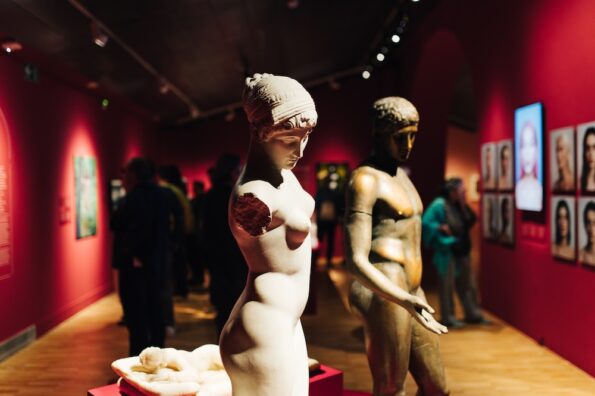
View of the exhibition. Photo Alice Brazzit
The exhibition begins deliberately chronologically, guiding the visitor through classical ideals of beauty, based on principles of proportion, gender, and virtue. However, this seemingly stable narrative is interrupted by artworks that introduce fissures and raise questions. The works of Lorenza Böttner and Carlos Motta, among others, problematize these normative models and demonstrate the extent to which beauty has historically functioned as a device for inclusion and exclusion.
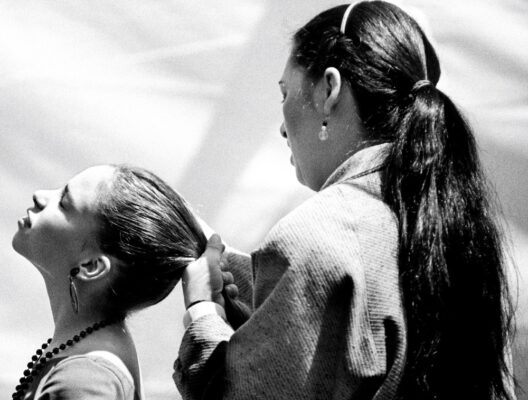
Colita, Madre peinando a su hija [Mother combing her daughter’s hair], 1994. Santa Coloma de Gramenet, Barcelona. Photo duplicate. Colita Fotografía Archive
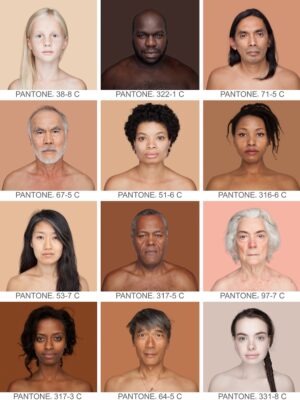
Angélica Dass, Humanae. Work in progress 2012-present. Photo duplicate. Courtesy of the artist
The exhibition then delves into the complex relationship between beauty, medicine, and science. From the cosmetic practices of ancient Egypt to the anatomical ideals of the Renaissance, the journey leads to the present, where the obsession with image—an extreme result of the society of the spectacle—is amplified by the commercialization of pharmaceuticals, aesthetic treatments, and surgical procedures. The new standards are no longer necessarily associated with proportion or virtue, but increasingly with purchasing power. Beauty thus appears as a privilege that can be bought, with consequences that affect both physical health and emotional well-being. How can we identify these forms of control in order to conquer greater spaces of autonomy? Where does individual desire end and collective pressure begin? The works of Marina Vargas and Arvida Byström point precisely to this overflowing of normative limits, making visible the restrictions that underlie any standard.
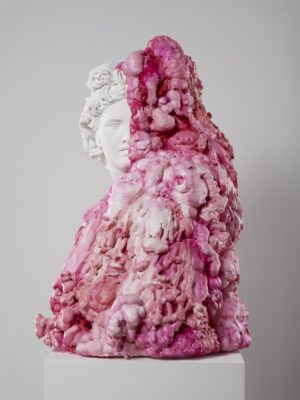
Marina Vargas. Apolo Hile, 2015. Sculpture. Collection Museo Centro de Arte Dos de Mayo (CA2M).
The installation Mirror, Mirror on the Wall, by Xcessive Aesthetics, places the visitor before a distorting mirror that reflects the visual pollution that accompanies our daily experience. An incessant flow of images, filters, algorithms, and aspirational models that we consume through social media, from which it is increasingly difficult to escape, raises numerous questions: Who establishes the standards of beauty today: cultural institutions, the beauty industry, algorithms, or social media? How do filters, artificial intelligence, and digital editing affect our perception of ourselves? Can there be an aesthetic of difference that is not absorbed by the market? Are we witnessing a democratization of beauty or a sophistication of its control mechanisms? Is it possible to imagine a society less obsessed with appearance? What do we lose when we have we turned beauty into an obligation?
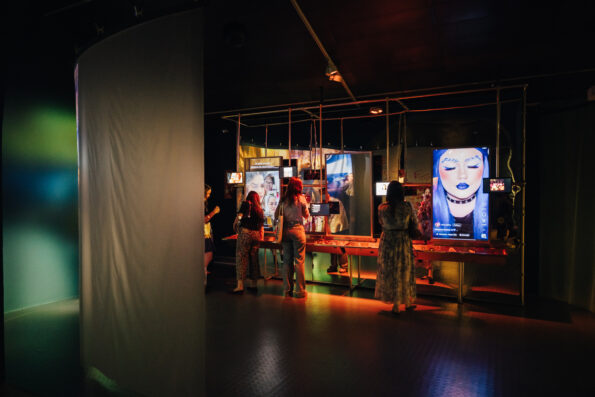
View of the installation Mirror, Mirror on the Wall (2023/2026) , Xcessive Aesthetics. Photo: Alica Brazzit
But The Cult of Beauty is not confined to the exhibition space. As is usual at the CCCB, the project is expanded through a robust public program featuring thinkers and specialists such as Eloy Fernández Porta, Remedios Zafra, and the curators themselves. In addition, there is an educational program for LGBTQ+ youth, coordinated by Cordova and developed in collaboration with artists like ¥E$Si PERSE and Toni Hervás, as well as the film series Beautiful and Eternal, curated by Desirée de Fez for Las Gandules 2026. The selection of fantasy and science fiction films addresses issues such as youth, aesthetic pressure, and the obsession with preserving beauty, extending many of the questions raised by the exhibition onto the screen.
Rather than offering definitive answers, The Cult of Beauty invites us to critically reconsider an idea we often take for granted. Because, if beauty has never been a neutral category, perhaps the real challenge lies in asking ourselves who defines it, who benefits from it, and who inevitably falls outside its boundaries.
The exhibition The Cult of Beauty, curated by Janice Li, blanca arias, and Júlia Llull, along with its accompanying public program, can be visited and followed at the CCCB until November 8, 2026.
[Featured Image: Norma Pérez, “No soy moderna, soy mucho más antigua”, 2022. Exhibition copy. Courtesy of the artist].
Montse Badia has never liked standing still, so she has always thought about travelling, entering into relation with other contexts, distancing herself, to be able to think more clearly about the world. The critique of art and curating have been a way of putting into practice her conviction about the need for critical thought, for idiosyncrasies and individual stances. How, if not, can we question the standardisation to which we are being subjected?
www.montsebadia.net
Media Partners:







"A desk is a dangerous place from which to watch the world" (John Le Carré)