


Search
To search for an exact match, type the word or phrase you want in quotation marks.
A*DESK has been offering since 2002 contents about criticism and contemporary art. A*DESK has become consolidated thanks to all those who have believed in the project, all those who have followed us, debating, participating and collaborating. Many people have collaborated with A*DESK, and continue to do so. Their efforts, knowledge and belief in the project are what make it grow internationally. At A*DESK we have also generated work for over one hundred professionals in culture, from small collaborations with reviews and classes, to more prolonged and intense collaborations.
At A*DESK we believe in the need for free and universal access to culture and knowledge. We want to carry on being independent, remaining open to more ideas and opinions. If you believe in A*DESK, we need your backing to be able to continue. You can now participate in the project by supporting it. You can choose how much you want to contribute to the project.
You can decide how much you want to bring to the project.
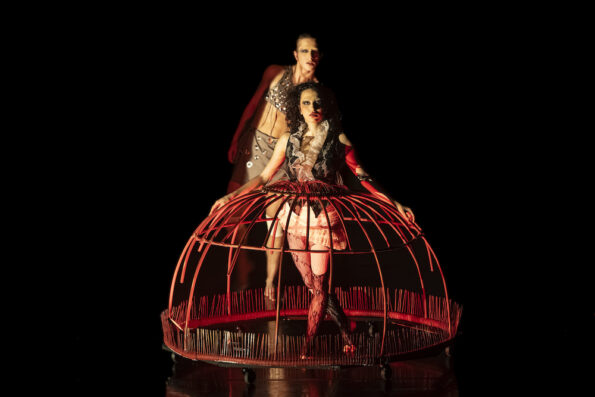
Le Début evokes a response to nihilism, to that overwhelming void when that which sustains our existence collapses: childhood. Through elements that guide us from infancy to the disillusionment of first love and its subsequent grief, we witness this painful process that seems to point to a common truth in all philosophy: a need to gaze into the abyss in order to rise again, like the roots of a tree reaching into the depths.
However, something of the trace along this path remains elusive. A question arises when we witness how one of the bodies is isolated from the rest. While synchronicity marks the center of the image, a single individual remains on the margins, seemingly struggling against something with abrupt movements. The image presents itself as a breach that reveals the unfinished nature of the possible existential answer behind the work. And from there, the questions: Is a ‘yes’ to life enough? What do we do with the wound left after our debut? To answer these questions, it is necessary to understand the nature of first times and where the reading of the piece as a vitalist proposition arises.
There is something in Le Début that seems to indicate the fragility of the constructions of meaning acquired over time. When they all scream in horror simultaneously at their own hand, the image evokes that initial feeling of estrangement at being thrown into the world without yet having an identity. It recalls the emergence of consciousness that places the Self as the starting point and is opposed to all other existing things. Playing and discovering are possibilities that are exhausted, since we must cling to constructions that sustain our existence. However, they collapse, since there are no layers of meaning that unconditionally ground existence. In a way, every idea attempts to define a priori what constitutes a necessity for life, without first having considered all our possibilities. Consciousness is fearful and vulnerable in the face of the absurd.


Faced with this void, what response can we interpret from the artwork? After the frenzy, we witness the embodiment of a child who reassembles his tricycle, reclaiming the space with expansive movements and playing with it. This evokes a Nietzschean vitalism characterized by ‘the child.’ It proposes choosing to love life willingly despite suffering, and treating it as an open field upon which to create. There is no ‘what’ strong enough to sustain us, only a certain gaze that returns some of the magic of yesteryear.
However, we have this tendency to stare into emptiness and be reluctant to face pain. If we return to the image of the isolated body, the question of the wound arises within us. There is doubt about this ‘yes’ to life, for it seems to decorate the outline of something that remains hollow and festering. A concern that has resurfaced in 20th-century philosophy: the question of the essence of things, of something that is substance and attends to that part of us that longs to be held and loved without effort or resistance. But does such a thing exist? A foundation that allows us to continue living without nostalgia for what we were before being forced to exist under specific laws. Or, on the contrary, is there no other option but to accept the pain that will come with our incessant beginnings, in the style of eternal return?
Despite this apparent incompatibility between a ‘how’ and a ‘what,’ there is potential behind this question evoked in Le Début. That is, to transform form and matter into a single, indistinguishable thing; in other words, to be able to love life because it is kind. To achieve this, it is possible to build a world in which the wound does not weigh us down and the ‘yes’ is truly possible. Leaving nothing out: a project that extends beyond ourselves and opens a fight for a dignified life that addresses all aspects of existence.
Le Début by Aleix Colomer Campoy is the winning piece of the 2025 edition of the Premi de Dansa del Institut del Teatre (Dance Prize of the Theatre Institute), an award designed to promote the work of young creators and performers, offering them financial support for production and the opportunity to exhibit their pieces in professional contexts, such as a stage at the Grec Festival of Barcelona.
With the collaboration of the Institut del Teatre, Fabra i Coats: Fàbrica de Creació (Creation Factory), L’Estruch – Fábrica de Creación de las Artes en Vivo (Factory of Creation of the Live Arts), and La Caldera. It was presented on July 28 and 29 at the Mercat de les Flors, as part of the Grec 2026 Festival of Barcelona.
[Featured Image: Le Début. Photo: Luis San Andrés
Images carousel: Le Début at Mercat de les Flors, 28/7/2026. Photos by Anna Fàbrega and Eloi Rodés Aznar]

Sofía Pardo Román is a Philosophy student at the University of Barcelona. Her perspective and interests focus on the intersectionality between philosophy, poetic thought, and the arts. She writes exploring the points of convergence between words and artistic action.
Media Partners:









"A desk is a dangerous place from which to watch the world" (John Le Carré)