Search
To search for an exact match, type the word or phrase you want in quotation marks.
A*DESK has been offering since 2002 contents about criticism and contemporary art. A*DESK has become consolidated thanks to all those who have believed in the project, all those who have followed us, debating, participating and collaborating. Many people have collaborated with A*DESK, and continue to do so. Their efforts, knowledge and belief in the project are what make it grow internationally. At A*DESK we have also generated work for over one hundred professionals in culture, from small collaborations with reviews and classes, to more prolonged and intense collaborations.
At A*DESK we believe in the need for free and universal access to culture and knowledge. We want to carry on being independent, remaining open to more ideas and opinions. If you believe in A*DESK, we need your backing to be able to continue. You can now participate in the project by supporting it. You can choose how much you want to contribute to the project.
You can decide how much you want to bring to the project.
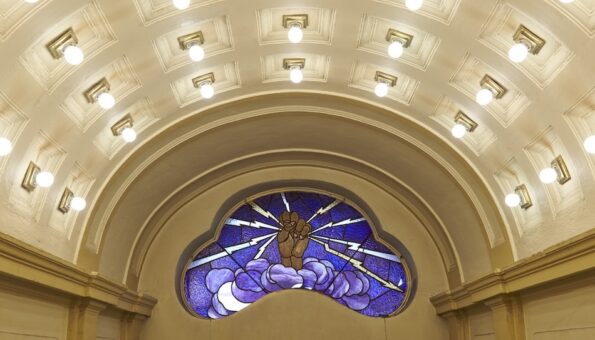
While the art world endlessly curates panels on the climate emergency, E-WERK Luckenwalde bypassed the discourse to build an actual power grid. In 2019, curator Helen Turner and artist Pablo Wendel took over a dormant 1913 brown coal station thirty minutes south of Berlin, transforming it into a hybrid institution: fully functioning, regenerative power plant and contemporary art centre.
This season, electricity is not only what powers the building, but also its subject. Asad Raza’s exhibition Electricity runs until April 2027, alongside a program of films, performances and, a David Lynch marathon in the town’s modernist theatre.
In this conversation, artistic director Helen Turner unpacks the mechanics of Kunststrom, the haunting resonance of what former power station workers called “Cold Light,” and why David Lynch’s electrical disturbances remain essential for rethinking art’s energetic agency.
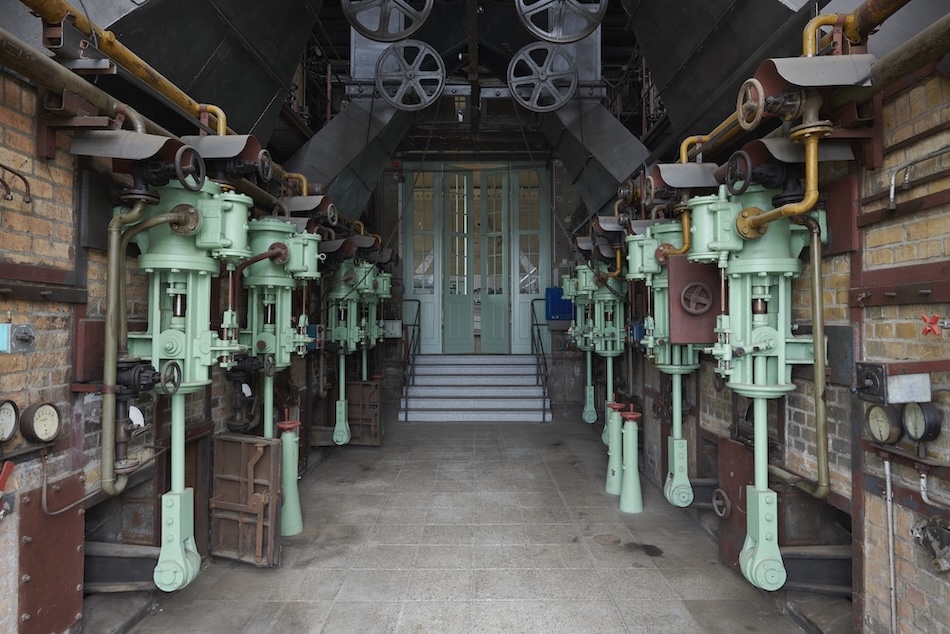
E-WERK Luckenwalde facility © Ben Westoby
Speaking of E-Werk, how do a power station and an art centre function as one institution, and how does art actually produce energy here?
For Pablo and me, the programme and the power are interdependent. When we opened E-WERK in 2019, our ambition was to reactivate its original function, but under new ecological and cultural conditions. We were both frustrated by the art world that talked increasingly about sustainability while continuing to operate in fundamentally unsustainable ways. We wanted to move beyond representing sustainability towards changing the infrastructure of cultural production itself.
Today, E-WERK generates renewable electricity and heat through solar energy and wood-gas pyrolysis. Working with many of the people who had previously operated the power station, Pablo brought the original centennial conveyor belt system back to life; it now carries locally sourced waste woodchips through the building to heat and power the plant. Surplus electricity is fed into the national grid and supplied to Kunststrom clients across Germany, and the revenues help finance our cultural programme. The production of energy and the production of culture sustain one another.
The exhibition text says that rather than illustrating electricity, Electricity attends to the media through which it becomes perceptible. What does that mean for a visitor walking through the space?
Electricity is strangely difficult to represent because we rarely encounter it directly. We experience its effects: through light, heat, sound, movement, magnetic fields, technological devices and our own bodies. The exhibition asks visitors to pay attention to the materials, relationships and conditions through which it becomes perceptible, such as vibrations, amber and radio waves. Instead of looking for an artwork that represents electricity, they begin to notice it as something they are already immersed in. It is not really something you look at, but something you move through.
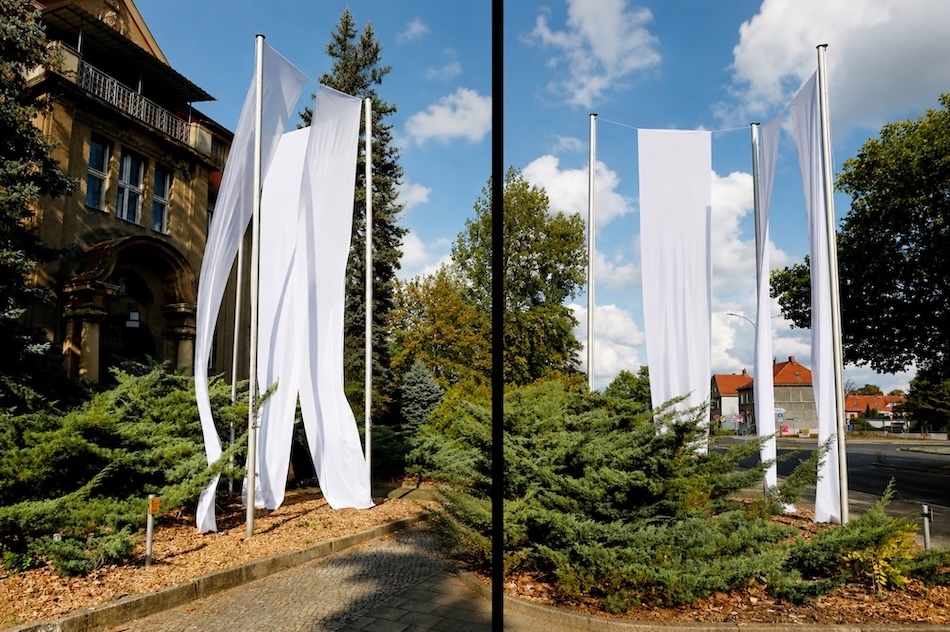
Asad Raza installation at E-WERK Luckenwalde. Courtesy de E-Werkluckenvalde. Photo: Constanze Flamme
Asad Raza describes electricity as earthly, ontological and sublime, a shift from seeing it only as a utility. At the same time, energy is at the centre of today’s climate and economic crises. Does the exhibition address both of these aspects?
Absolutely. One of the most interesting things about Asad’s exhibition is that it does not separate these dimensions. We tend to think about electricity in terms of utility: something as banal as bran flakes, something that comes out of a socket and has a price per kilowatt hour. But electricity is also a fundamental condition of life. It is utterly extraordinary, sublime, and feels to me something close to the unconscious. At the same time, energy is entangled with power. Behind every energy system there are questions of resource, extraction, labour, infrastructure and ownership.
For us at E-WERK, this is not a new discussion. We work with these questions every day, trying to treat energy as something we have a responsibility towards, rather than simply a consequence of activity.
The conductor-led tour is an unusual feature of the exhibition. What does this format make possible that a conventional visit couldn’t?
The conductor-led tours create a much greater sense of intimacy. We limit each group to twelve people, and the format opens up parts of the building that visitors wouldn’t otherwise be able to access.
The Conductors also relay research that informed the exhibition, particularly Asad’s conversations with historian of science Simon Schaffer about the history of electricity, from its early, performative and mysterious manifestations to its industrialisation. Simon will give the keynote at the exhibition’s culminating symposium, A Battery Is an Artificial Fish, on 24 April 2027, alongside performances by Pulitzer Prize-winning musician Raven Chacon and Abbas Zahedi, among many others to be announced.
Importantly, the Conductors also activate the works by Sung Tieu and Tino Sehgal, which depend on their presence. So they aren’t simply mediating the exhibition, they are part of its artistic structure.
Specifically, regarding the works of Tino Sehgal and Sung Tieu. Why these two artists, and how do their works interact with Raza’s?
Asad was really dedicated to including Tino Sehgal’s kWh, first developed for Julia Stoschek in 2019. During the exhibition all the power of the institution is cut, and mediators of Tino’s work sing the amount of power saved. It felt perfect for E-WERK and Electricity.
Sung Tieu presents Song for Radio, part of the installation for which she received the Preis der Nationalgalerie. The Conductors tune a GDR-era radio, manufactured in a former VEB factory, into a live stream from that same factory. The work asks what electrical signals actually carry: how they enable communication and transmission, but also surveillance and control. There is something quite unsettling about this double nature of electricity: its capacity to connect us, but also to monitor and manipulate us.
What I particularly love is that Asad’s practice is built around collaboration, rather than treating a solo exhibition as an opportunity to consolidate his own artistic position. The three practices don’t illustrate one another; they open up different, sometimes conflicting ways of thinking about electricity– as energy, as transmission, as communication and as a form of power.
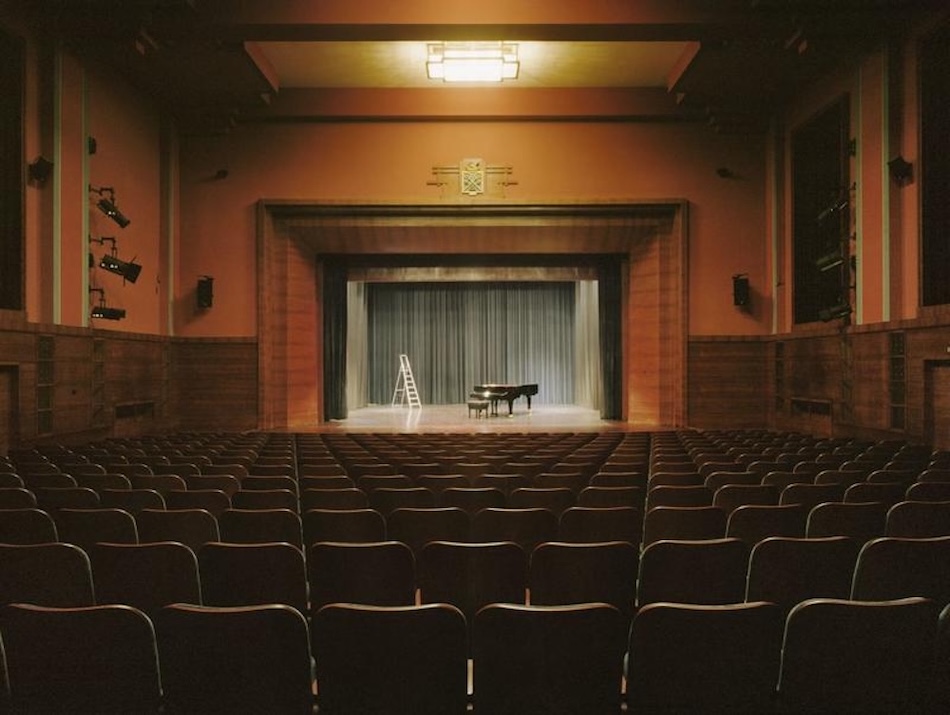
Stadttheater Luckenwalde, headquarters of David Lynch cicle Smoke and Fire and Electricity
Raza treats electricity as something physical, passing through materials like amber, saltwater and plants. The programme also presents Lynch’s electricity as a language of the unconscious. How do these two approaches relate?
Asad’s work is rooted in the materiality of electricity, but it is also deeply concerned with its ontology: its mystery and its resonance with the unconscious. This can be felt in the pace and pauses of the conductor-led tours.
This sense of wonder is amplified by the history of E-WERK itself. Through conversations with former workers of the power station, we learned that electricity used to be called Cold Light. There was a sense of both reverence and suspicion towards it, which resonates with art’s capacity to move us without being fully defined or understood.
David Lynch shared this fascination. In a 2024 interview with Mark Kermode for The Guardian, he said: “I just love electricity. I love smoke and fire and electricity.” This gave the title to our film and music marathon, Smoke and Fire and Electricity, at the Stadttheater in October. Lynch used electricity as a language for what lies just beyond the visible: unconscious forces, supernatural presences and sudden disturbances in the fabric of everyday life.
Lynch and Asad also had a personal connection: Lynch composed music for Asad’s Life to Come exhibition at Metro Pictures in New York in 2019, and photographed Solaris Chronicles for LUMA Foundation in Zurich in 2014.
Alongside the exhibition, a film programme runs in three chapters: “Electric Sublime,” “Electric Power” and “Electric Earth.” What does each chapter explore?
The three chapters give visitors reasons to return over the exhibition’s seven-month run.
Electric Sublime, with Saodat Ismailova, Cecilia Bengolea and Rachel Rose, considers electricity as a force that has inspired wonder, fear and fascination, and its ties to the supernatural and the limits of human understanding.
Electric Power, opening on 21 November with P. Staff, Harun Farocki and David Lynch, shifts to the political, social and technological dimensions of energy: how electricity has organised societies and distributed power, both literally and politically.
Electric Earth, opening on 20 February with Ana Mendieta, Doug Aitken and Raven Chacon, turns to electricity in living systems. Electricity does not begin with human technology; it is fundamental to atmospheric phenomena, biological processes and ecosystems.
The chapters overlap and speak to one another. The idea is to move between the mystical, the political and the ecological, and to show how electricity has shaped not only our technologies but also our imaginations.
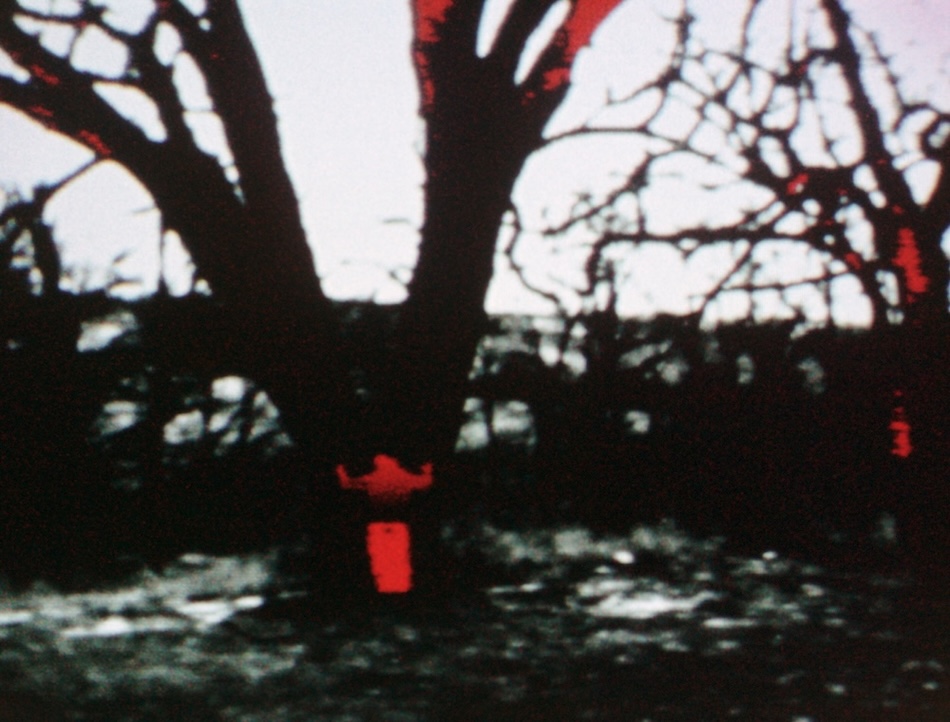
Ana Mendieta, Energy Charge, 1975, film still
The marathon on 16 October showed what this overlap looks like in practice. Olga Hohmann and pianist Yannick Wittman took apart and rebuilt the song from Solo Sunny, Konrad Wolf’s 1980 East German film, drawing on her great-grandfather’s collection of defunct electrical magic tricks. FRANKIE performed with cello and voice, close in spirit to the bodily unease of Fire Walk With Me. Sainkho Namtchylak’s Tuvan overtone singing, set against German Popov’s electronics, brought the sudden break from the ‘ordinary’ that runs through Lynch’s films. Placed between the films, these performances made electricity something heard and felt in the room, not only seen on screen.
(Featured image: E-WERK Luckenwalde entrance, 2019 © E-WERK Luckenwalde & Ben Westoby)
Electricity exhibition by Asad Raza runs until April 25th, 2027 at E-WERK Luckenwalde.
Lynch returns on 21 November, when the film chapter Electric Power opens at E-WERK.
Ana Marinković (b. 1997) is a transdisciplinary artist, researcher and writer based in Barcelona, Spain. She holds a BFA and MA in Sculpture and is a PhD candidate in Transdisciplinary Studies of Art & Media Theory. Her research examines transitional states and liminality, non-linear cartographies, knowledge production via mapping, synthetic cognition, algorithmic structures, and biological sensing. She works as an independent writer, journalist and art critic since 2024. She is currently MACBA research resident and researcher at The New Centre of Research and Practice.
Media Partners:





"A desk is a dangerous place from which to watch the world" (John Le Carré)