Search
To search for an exact match, type the word or phrase you want in quotation marks.
A*DESK has been offering since 2002 contents about criticism and contemporary art. A*DESK has become consolidated thanks to all those who have believed in the project, all those who have followed us, debating, participating and collaborating. Many people have collaborated with A*DESK, and continue to do so. Their efforts, knowledge and belief in the project are what make it grow internationally. At A*DESK we have also generated work for over one hundred professionals in culture, from small collaborations with reviews and classes, to more prolonged and intense collaborations.
At A*DESK we believe in the need for free and universal access to culture and knowledge. We want to carry on being independent, remaining open to more ideas and opinions. If you believe in A*DESK, we need your backing to be able to continue. You can now participate in the project by supporting it. You can choose how much you want to contribute to the project.
You can decide how much you want to bring to the project.
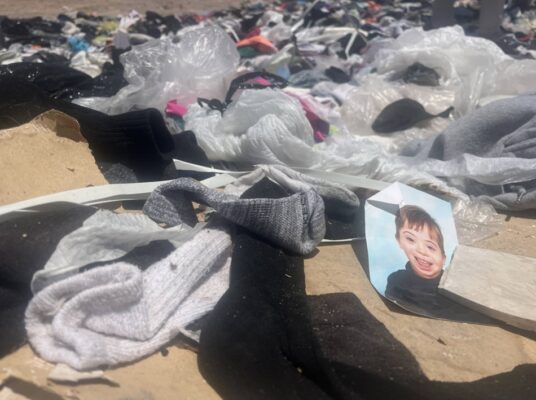
Emptiness is not only a means
to refuse to acknowledge those who live in the deserts (…)
it is also a means to affirm and demonstrate
dominant cultural ideas. [1]Samia Henni (ed.). Deserts are not empty, 2022, p. 39. This quote belongs to the scholar, writer and one of the coordinators of Desert Futures Collective, who in conversation with other members of … Continue readingFrancisco E. Robles
The world’s cold, temperate, or hot deserts continue to face recurring colonialist studies that define them as empty zones and that have historically justified their exploitation.
Furthermore, in various histories and countless novels, these geographies have been presented as the place that has accumulated, on the one hand, the despair of its conquerors and, on the other, the most delusional thoughts about its industrialization.
If we think about South America, there is no doubt that the landscapes surrounding Atacama (northern Chile) and its unique characteristics have changed considerably as part of the violent anthropogenic domination in which we live. Atacama is vast, so vast physically and poetically, that it constantly prompts us to revisit the dilemmas its imprint has inspired in humanity. Considering the geotraumas caused by desertification, urbanization, and industrialization, I would like to reformulate a series of ideas that define these areas. However, the simple act of observing the area surrounding the city of Alto Hospicio, marked by thousands of tons of textile waste, leaves me with strong feelings.
Faced with this panorama, the variety of emotions and perceptions that I experience comes from the image of this waste, which we have collectively generated and reproduced, that has produced a garbage dump in the desert. In this way, I interpret part of the cosmogony of these waste landscapes and their influence on contemporary culture to synchronize with a new perspective that confronts future ecological dilemmas. Likewise, thinking more expansively about deserts requires a shift towards epistemological and ontological frameworks that honor and prioritize a future for arid environments that is anticolonial, socially and environmentally just, and multidimensional. [2]Ibid, p. 99.
These remnants of fabrics, both natural and synthetic, on the Atacama plains will continue to expose physical and abstract traces that have marked their evolution. Moreover, these garbage dumps project a visuality associated with the symbolic and with the extreme symbolization and exoticization we have created around them. Thus, I recognize that these landscapes give rise to a picture and frame it within the junk from our globalized culture.
For this analysis of Alto Hospicio, I can say that these landscapes, intervened upon, shaped, and sculpted by garbage, entail new reflective and critical acts regarding ecocide. In this sense, the communities bordering these sacrifice zones have already internalized the idea that the desert is not empty and that, at the same time, it does not belong to them. Although for us these characteristics may be deeply rooted in desert culture itself, they still present a contextual indeterminacy for research in the visual arts.
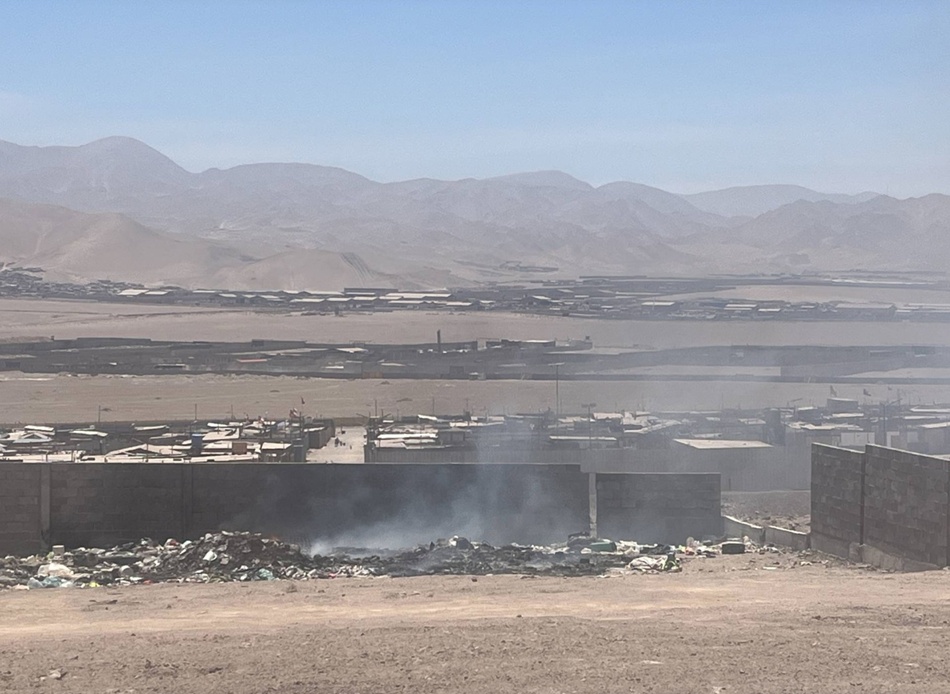
Photo: Martinka Brobikova
Thus, the archetypes I have acquired from the textiles depicting the aridity of Alto Hospicio have been assimilated from various perspectives, developed by artists and researchers, and which, incidentally, are observed in some art work and are discussed within contemporary art circles. These have been used to interpret the landscape from the concepts of Situationism. [3]See http://situaciones.info/revista/la-vanguardia-no-se-rinde-guy-debord-y-el-situacionismo/. This leads us to the concept of “drift,” which is the basis of psychogeographical studies. It is with this term that the Situationists presented the landscape as a space of static unreality in such a way that an entire landscape is transformed into a fabric containing different psychic atmospheres. Here, beyond the distortion that dominates a particular landscape, the play of détournement [4]Détournement (diversion/reappropriation) is the situationist visuality that integrates pre-existing media elements into a proposal that invokes social and political issues. From this concept, the … Continue reading emerges, injecting a unique way of exploring what we interpret and witness.
It is also worth highlighting the Bolivian philosopher Oscar Ichazo who, around the same time, proposed a pioneering program in the Chilean city of Arica (Arica and Parinacota Region). Beyond his theoretical proposals on protoanalysis, he invited various thinkers, scientists, and artists to participate in psychophysical exercises, focusing his philosophical work on the geography of the desert and the ravines that traverse it. However, according to Ichazo, deserts (in this particular case, the Atacama desert) inevitably invite us to a certain introspection about the landscape that leads to our self-knowledge. [5]Oscar Ichazo published in 1976 his experiences in Arica and captured them in the publication Arica Psycho Calisthenics.
According to the criteria set forth, the basis of the proposal by the research and creation collective made up of Martinka Bobrikova, Oscar de Carmen and María Alejandra Gatti translates and intercepts the détournement and the psychophysical exercises to visibilize, from these landscapes and under the title re-(t)exHile, the exploration of other edges of the so-called emptiness regime and the environmental dislocation caused by textile waste on a global scale.
During these tours, this group proposes a series of questions, such as, What is the psychopolitical experience of the communities that surround Alto Hospicio? What happens when a marginalized population lives with garbage? What are the effects of the geotrauma that transform the landscape and daily practices of these sites? From these questions and background, the frameworks constructed to objectify the landscape in re-(t)exHile interpret opposing aesthetic and historiographical currents and diametrically enter into other disciplines, as well.
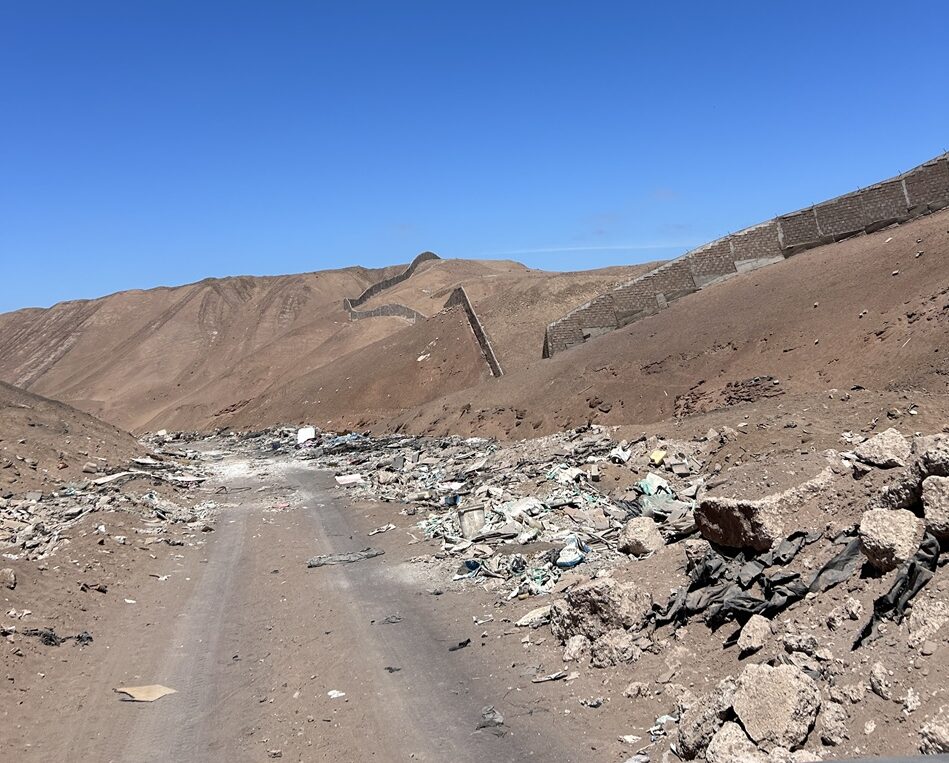
Photo: Rodolfo Andaur
From another approach, re-(t)exHile interprets the so-called glocal (Free Zone) [6]See https://www.zofri.cl/es. that promotes the consumption-waste binomial and configures human and non-human bodies and relationships. Here it is obvious that the impact of the free zone system has triggered an irresponsibility that puts the differences of these textile dumps at the center of the debate.
In line with this idea, re-(t)exHile displaces to the surroundings of this action and installation the situated traumas of a city that aims to attract new ideas to confront, among many other issues, the epistemic trance of human excesses.
The proposal is a milestone for the practice of visual arts since it displays and installs abstract banners made of fabrics with slogans that mix conceptual and the ecogeopolitical issues that enunciate the despair of the surrounding communities, in this context Alto Hospicio. The proposal also strengthens interregional links, production, circulation and the promotion of critical thinking in the face of a rough terrain made up of a geography already sold to the interests of transnational companies.
The semantic elements I try to define above, evident in the practice of this group of thinkers and visual artists, assimilate the desire to observe other ways of co-inhabiting our geographies. At the same time, this ideology of the cutting of and working with discarded fabrics begins to structure a narrative subjectivized by the creation of a contemplative and analytical visual culture, presenting a landscape that is a mere object for nature and a subject for current techno-feudalist culture.
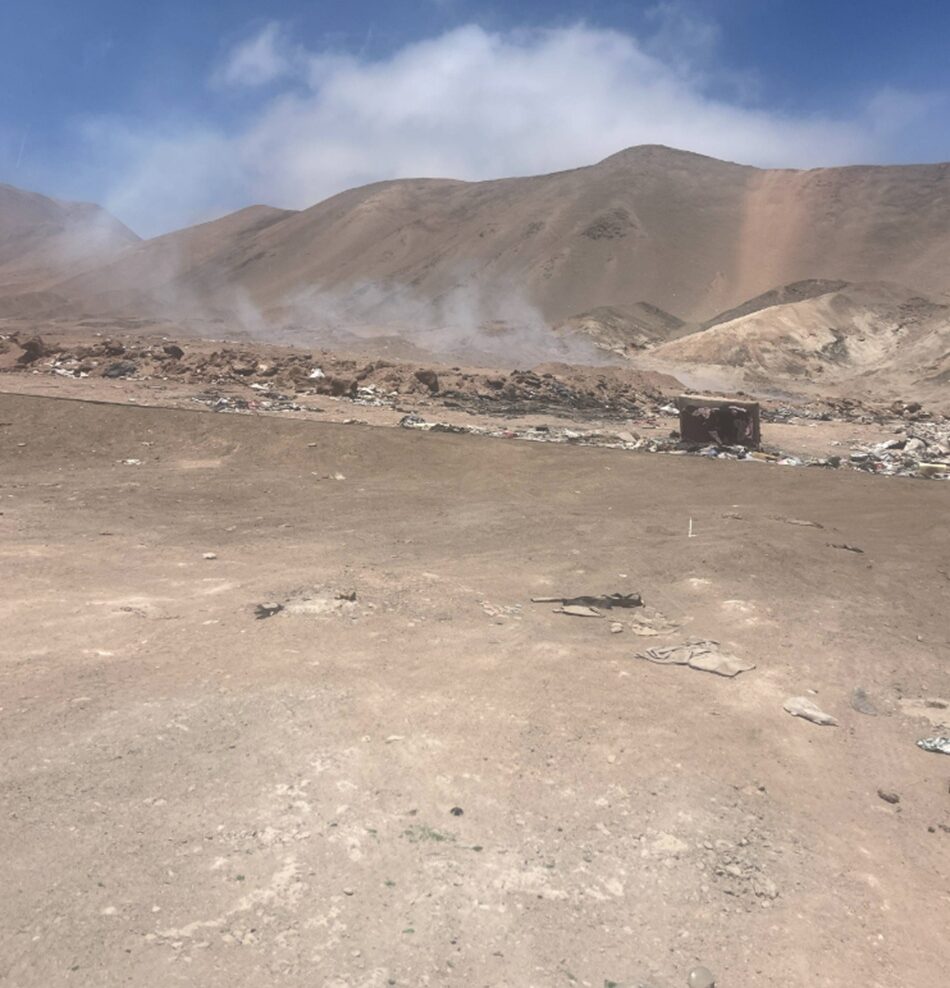
Photo: Martinka Brobikova
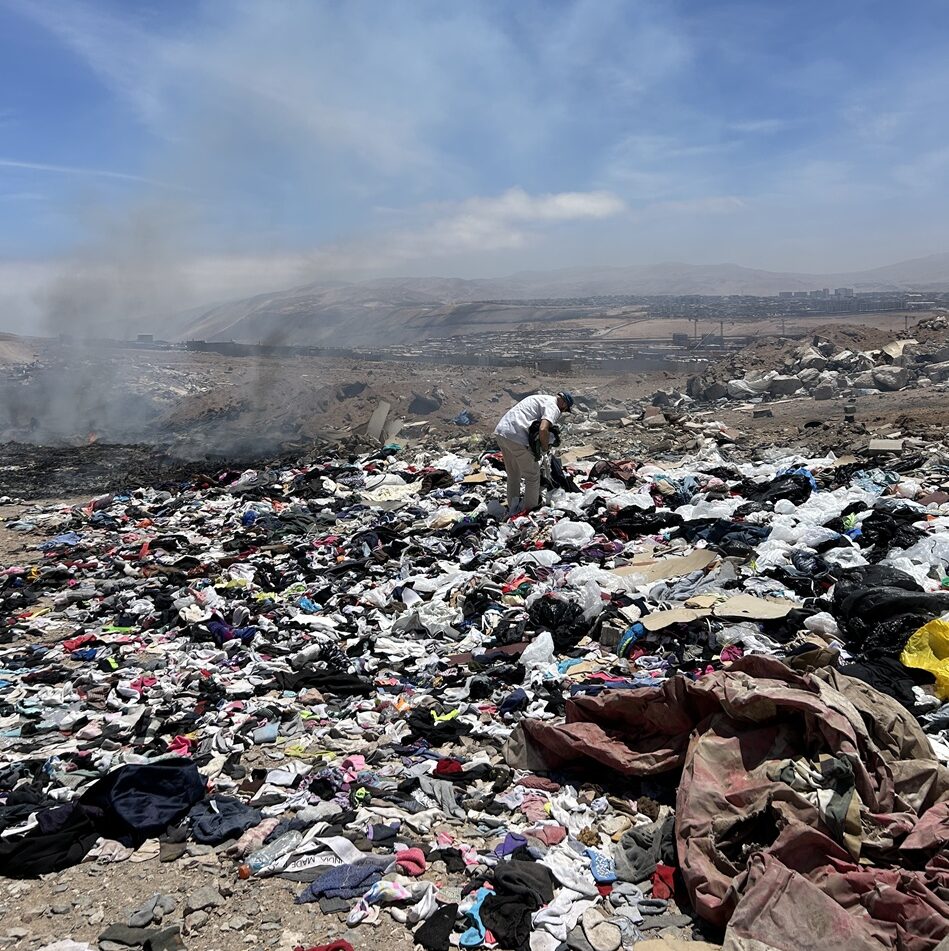
Photo: Rodolfo Andaur
[Featured image: Martinka Brobikova]
| ↑1 | Samia Henni (ed.). Deserts are not empty, 2022, p. 39. This quote belongs to the scholar, writer and one of the coordinators of Desert Futures Collective, who in conversation with other members of the collective, such as Brahim El Guabli and Jill Jarvis, answers some questions from Samia Henni, editor of Deserts are not empty. |
|---|---|
| ↑2 | Ibid, p. 99. |
| ↑3 | See http://situaciones.info/revista/la-vanguardia-no-se-rinde-guy-debord-y-el-situacionismo/. |
| ↑4 | Détournement (diversion/reappropriation) is the situationist visuality that integrates pre-existing media elements into a proposal that invokes social and political issues. From this concept, the garbage dump is part of the hegemonic political system and the effects of a political attitude that ultimately ends up trivializing the drama of the image in question in society are highlighted. |
| ↑5 | Oscar Ichazo published in 1976 his experiences in Arica and captured them in the publication Arica Psycho Calisthenics. |
| ↑6 | See https://www.zofri.cl/es. |
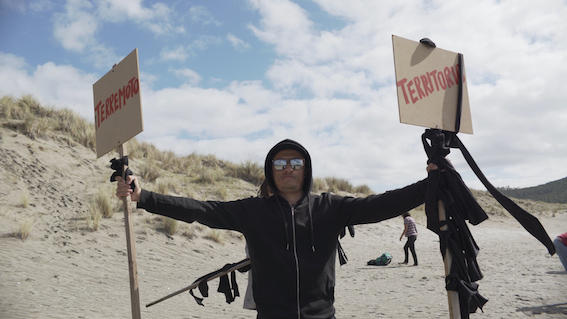
Rodolfo Andaur is a curator and manager and has therefore carried out several projects whose main objective is to ‘desertify’ unpublished stories. He is also constantly invited by recognized institutions to organize eco-territorial trips in different places in Latin America
www.rodolfoandaur.cl
Media Partners:






"A desk is a dangerous place from which to watch the world" (John Le Carré)