Search
To search for an exact match, type the word or phrase you want in quotation marks.
A*DESK has been offering since 2002 contents about criticism and contemporary art. A*DESK has become consolidated thanks to all those who have believed in the project, all those who have followed us, debating, participating and collaborating. Many people have collaborated with A*DESK, and continue to do so. Their efforts, knowledge and belief in the project are what make it grow internationally. At A*DESK we have also generated work for over one hundred professionals in culture, from small collaborations with reviews and classes, to more prolonged and intense collaborations.
At A*DESK we believe in the need for free and universal access to culture and knowledge. We want to carry on being independent, remaining open to more ideas and opinions. If you believe in A*DESK, we need your backing to be able to continue. You can now participate in the project by supporting it. You can choose how much you want to contribute to the project.
You can decide how much you want to bring to the project.
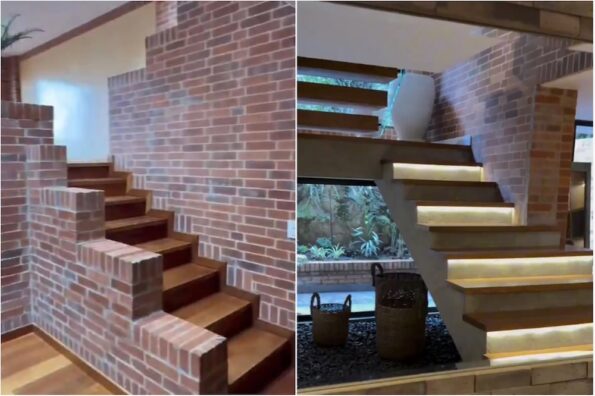
Amidst all the disasters that seem to accumulate daily in the news, whether in the form of rubble, ash, mud, and, most tragically, corpses piled on top of each other, there is one story that, were it not for the visibility sought by the social media platforms where it was published, would surely have gone unnoticed. An Instagram post from August 30, 2026, published by the design firm deconama.estudio (which, according to its website, “combines functionality, history, and aesthetics”) proudly showed how, in one of their most recent projects, they had, in their own words, “knocked down” a staircase in a residential building that was built by architect Rogelio Salmona.
Rogelio Salmona is, without a doubt, one of the leading figures in Colombian architecture and Latin America. His mastery of brick became one of the most recognizable features of a body of work that includes housing projects, public buildings, museums, and libraries. Reducing all of his architectural work to brick, however, would be a superficial analysis. Equally fundamental in his work are the flows of movement, water, the relationship with the landscape, and especially the way light appears and disappears as one traverses its spaces.
As explained in the video, the “dark” apartment needed, in addition to a larger room, the removal of the original staircase to, as the voiceover says, replace it with one that is “lighter and more contemporary.” Among the materials used is glass, which, we are told, “connects the spaces.” Here, one might ask the designer: What is the purpose of a staircase if not to connect? With the intervention, the voice continues, the apartment would feel “much brighter, more open, and lighter.”
While this one-minute post is no different than many others that promote a service, it is precisely the brevity of this format that is worrisome. More than an isolated attack, this is a stark and clear wake-up call about how architecture schools and the current real estate market are failing new professionals by teaching them more about advertising with empty slogans than about reflecting on the practice of architecture. Architecture should begin with a deep understanding of the environment and context, that is, with a genuine, sensitive, and profound concern for what the craft of building truly entails, but also with respect for what has already been built, which represents not only a legacy, but also resources, time, and knowledge that we must take into account.
The defacement not only of a staircase but of the internal coherence of a work by Salmona, inevitably evokes his well-known critical relationship with Le Corbusier, in whose studio he worked for several years. Le Corbusier had first visited Bogotá in 1947 and would later develop a Pilot Plan for the city, a project in which Salmona participated from his Paris studio. As in other urban plans by the Franco-Swiss master, such as the Plan Voisin for Paris, the existing city was discarded to make way for modern ideals of transformation, circulation, openness, and light.
For Le Corbusier, modernity (a word that at the time carried a weight similar to what “contemporary” means today for so many designers) implied a new way of living. In both his urban plans and his “machines for living,” opening up views, allowing sunlight to enter, and establishing a new relationship between interior and exterior were fundamental elements. Light thus became not only a physical condition but also the representation of a promise of relentless progress.
The association between light and progress, however, appears well before the 20th century avant-garde. In the 19th century, the transformation of Paris by Baron Haussmann created large avenues, perspectives and public spaces where previously there had been a network of narrow streets. The new city improved infrastructure, parks and circulation but its construction involved the demolition of thousands of buildings and histories. Modernization illuminated some things while making others disappear, as each action imposing illumination produced its own dark side, a dialectic that Jacques Tati would immortalize in his film Mon Oncle.
When changes, fueled by the ego of those who believe that novelty is a value in itself (rather than the result of a respectful negotiation with what is pre-existing), are carried out, they end up disfiguring legacies that are extremely difficult to recover. By intervening in a dialogue to adapt to current needs or intervening to impose one’s ego, the history of architecture offers us an uncomfortable but enlightening episode.
Between 1926 and 1929, Eileen Gray, together with Jean Badovici, designed and built the house E.1027 in Roquebrune-Cap-Martin. Faced with the theoretical rigidity of the time, Gray conceived of this house on the seashore as a living organism, carefully attending to the wind, the sun and, in a very special way, the privacy and sensibility of those who lived there. Years later, Le Corbusier, fascinated by the space and inspired by an idea that the white walls needed to be “spiritualized,” painted (while naked) a series of noisy abstract murals on the walls of the house without consulting Gray. Gray, who had designed every corner for reflection, considered that visual intrusion an act of vandalism. The episode is a warning that transcends the purely legal sphere and enters into an ethical one. Intervening in a work does not necessarily mean understanding it, and inhabiting or operating another’s work does not grant the right to silence the original intention of the person who created it.
In great architecture, light works differently. Logically, something intensely illuminated produces an equally deep shadow. Whoever handles light well will also know how to work with darkness, something that Salmona mastered. One of the qualities of his buildings is precisely that mysticism of darkness, of light that is announced from afar and accompanies a sequence of spaces that are discovered slowly. Salmona learned from his visits to the Alhambra about extensive circulation, transitions that invite contemplation, changes in height that develop a narrative of living, and places for reflection that lead to large rooms. By destroying the solid staircase and transforming it into a transparent element using glass and LED lights, the mystery of passages is annihilated.
This text is not an attempt to naively sacralize or museify private heritage. The decision about what deserves to be preserved and what can be adapted to current times is complex. The right to decent and habitable housing is undeniable, and looking forward demands changes. However, architecture has a double dimension, for it is both private property and shared culture.
This small event brings up for debate (which is surely repeated daily behind closed doors) a fundamental problem, that is, the troubling idea that property rights and money grant absolute power to dismantle the aesthetic memory of a society. When we purchase a piece of historical value, we become its custodians, not its destroyers. This is a discussion that exceeds the limits of architecture and includes all those resources it uses, such as forests, ravines, air and landscape, worlds that we inhabit by right but that do not belong to us.
The logic that those who, from the deck of their mega-yachts, assume that their position gives them the right to privatize the horizon as seen from the beach, forgets that there are forms of beauty whose only legitimate property is the gaze of others.
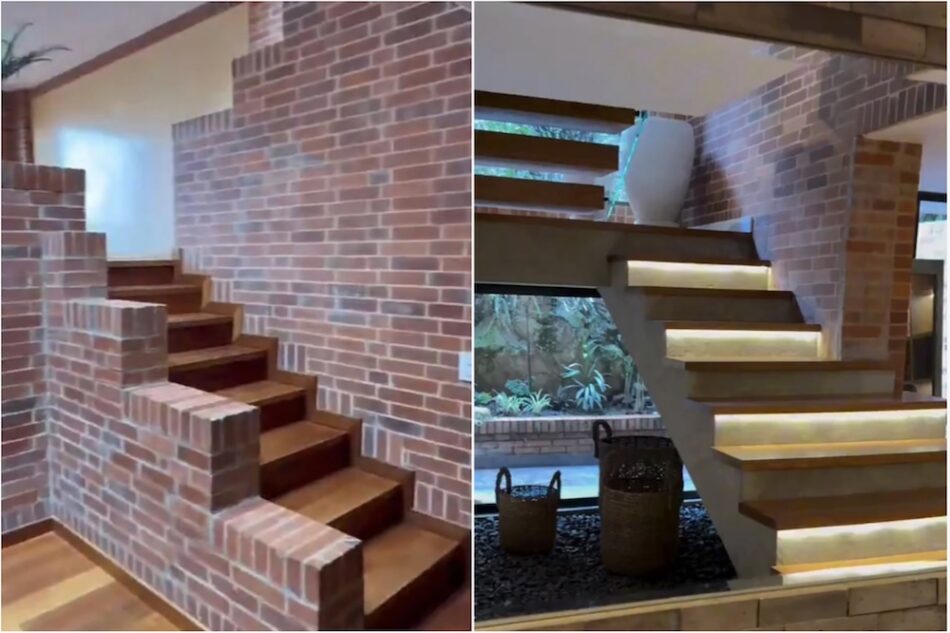
“Before and after the staircase designed by Rogelio Salmona, which was demolished during the flat’s refurbishment. Photo: Screenshot from a video shared on social media.
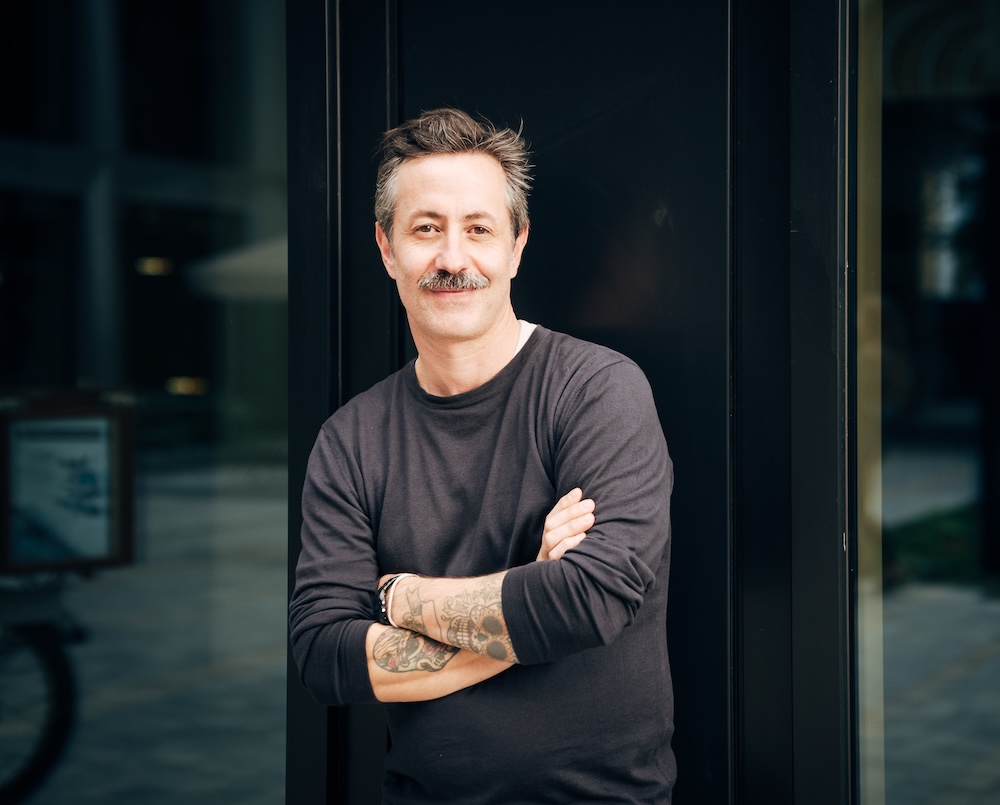
Roberto Uribe-Castro is a Colombian artist and architect based in Berlin. Having studied architecture at the Universidad de los Andes in Bogotá and spatial strategies at the Weißensee Academy of Art in Berlin, his practice explores the relationships between colonial history, public space, collective memory and contemporary forms of extraction and territorial control. Through archives, landscapes and infrastructure, he traces connections between Latin America, Africa and Europe. He was the founder of CALLE22 in Bogotá and co-founder of CC Berlin, platforms dedicated to public space, memory and socially engaged artistic and architectural practices. His current research focuses on colonial image regimes, lithography, extractive economies and transatlantic cultural histories linking South America, Africa and Europe.
Media Partners:









"A desk is a dangerous place from which to watch the world" (John Le Carré)