


Search
To search for an exact match, type the word or phrase you want in quotation marks.
A*DESK has been offering since 2002 contents about criticism and contemporary art. A*DESK has become consolidated thanks to all those who have believed in the project, all those who have followed us, debating, participating and collaborating. Many people have collaborated with A*DESK, and continue to do so. Their efforts, knowledge and belief in the project are what make it grow internationally. At A*DESK we have also generated work for over one hundred professionals in culture, from small collaborations with reviews and classes, to more prolonged and intense collaborations.
At A*DESK we believe in the need for free and universal access to culture and knowledge. We want to carry on being independent, remaining open to more ideas and opinions. If you believe in A*DESK, we need your backing to be able to continue. You can now participate in the project by supporting it. You can choose how much you want to contribute to the project.
You can decide how much you want to bring to the project.
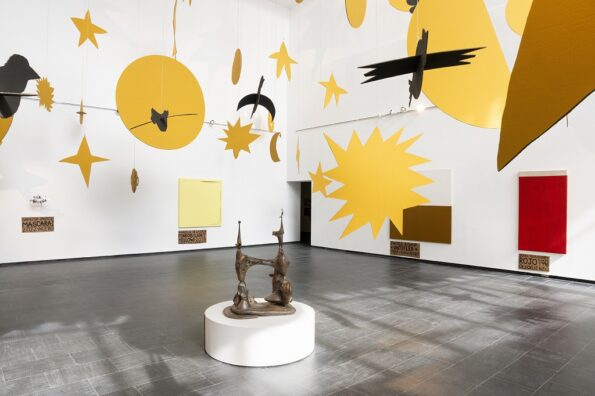
It’s curious how, although Benno von Archimboldi was so connected to nature from birth that he seemed to resemble seaweed, he didn’t like the land or the forests, nor the sea, or rather its surface, where “waves bristling with wind” rise. He was drawn to a kind of negativity in the landscape. “What he liked was the seabed, that other land, full of plains that weren’t plains and valleys that weren’t valleys and precipices that weren’t precipices.” Because of how unusual this child seemed, he found a way to contemplate that world: he would open his eyes underwater, risking reddening them and receiving a scolding from his mother, who feared that people would think he spent his days crying. Archimboldi, quite naturally, in my view, resembles that third bird added to Pliny the Elder’s story about the competition between the Greek painters Zeuxis and Parrhasius to determine who had created the most realistic work. While, in the original version, Zeuxis manages to trick the birds, which descend to try to peck at the painted grapes, a later narrative imagines a third bird captivated by the painting: motionless, staring intently at the image, as if absorbed in its own thoughts. Antonio Ballester Moreno (Madrid, 1977) told me about this third bird and the order that bears its name, including the research collective ESTAR(SER) and the Princeton University historian D. Graham Burnett, as well as the influence both have had on his artistic practice and on the beautiful exhibition Sky and Earth, which he has curated at CA2M.
However, her influence is not limited to this latest project. Echoes of it already appear in No School, the exhibition she held at La Casa Encendida in 2011, where she addressed the need to unlearn in order to recover the purity of a child’s gaze. It can also be traced in her participation in the 33rd São Paulo Biennial in 2018, when she incorporated educational toys and teaching materials designed by Friedrich Fröbel, the German pedagogue who developed the concept of kindergarten. More specifically, it appeared in the work of Rafael Sánchez-Mateos Paniagua, coordinator of Atenta (atenta.net), a “group dedicated to deep attention and radical aisthesis in art,” made up of a team of people from different disciplines (such as art, ecology, science, spirituality, magic, poetry, and education), which materialized, for example, in a space for rest and in 32 publications with string and poems presented at the Biennial. On that occasion, visitors were greeted with a text by Ballester that seemed almost written for young Archimboldi: “We are all different. Each of us sees the world in a different way.” It is no coincidence that the text regains a disconcerting prominence, marked by its singularity, on the large-format cardboard panels handwritten by the artist himself, which precede the entrance to the exhibition at CA2M. This is an artistic and educational project centered around the perception of landscape, exploring how we incorporate the outside world into our own bodies and lives through a contemplative gaze. To this end, Ballester designed a collaborative process of continuous support, structured in stable groups of participants: the students of the CEIP Federico García Lorca school in Móstoles and their families, ranging in age from 5 to 50. With them, mindfulness walks were undertaken through natural landscapes in Móstoles, applying a version of the mindfulness and radical aesthesis protocols of BEING and the Orden del Tercer Pájaro [Order of the Third Bird]. Subsequently, the process moved to the artist’s studio, where participants actively engaged in the exhibition design and the discussion of the spatial model. Finally, the collective production sessions took place between the school classrooms and the museum, where participants cut out and painted all the sculptural figures that make up the suspended installation that envelops the visitor. This makes it difficult not to think of Timothy Morton’s concept of mesh, in which nature ceases to be a decorative backdrop or a distant object, becoming instead a network of ecological relationships where everything is co-present and inextricably connected. Sometimes, these cardboard cutouts obstruct the view of the artworks so naturally that they made me reflect on how effective it is, in the hands of curatorial artists (such as Philippe Thomas, Goshka Macuga, Hélio Oiticica, Marcel Broodthaers, John Cage, among others), to expand the very possibilities of curating. To think that works as well-known as Alberto Sánchez’s sculpture Monumento a los pájaros [Monument to the Birds ](1957–58), Perejaume’s video Gustave Courbet (2000), or even Rodney Graham’s photograph Tree with Bench (1996), can be perceived in a very different light thanks to this kind of staging. Perhaps we should be thanking Ballester’s father, since this entire universe is nourished by his early aesthetic experiences building the Nativity scene with him, who made them with mountains of plaster and water moving thanks to a washing machine pump. Ballester remembers that, when he helped him, he could spend hours contemplating it. He himself often says that his exhibitions are nativity scenes on a different scale. In the end, he doesn’t consider himself a painter, but rather someone who makes nativity scenes. I feel that it is precisely in Sky and Earth where Ballester’s “network” reveals its most poetic dimension. Even in what we don’t see, in all those processes that occurred hidden from the public, one perceives a suspension of utilitarian judgment, which allows us to inhabit, in a prolonged and fascinated way, the mystery of interconnection.


The exhibition Sky and Earth de Antonio Ballester Moreno can be visited at CA2M until September 27, 2026
[Featured Image: Antonio Ballester Moreno, “Sky and Earth”. Photograph: Roberto Ruiz]
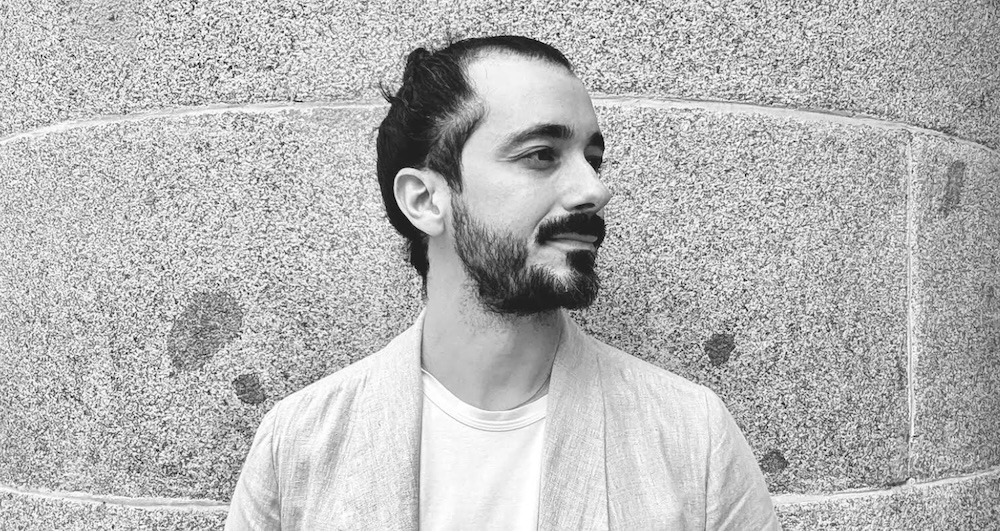
Tiago de Abreu Pinto is a curator and writer. He holds a PhD in Art History from the Complutense University of Madrid, with a thesis focused on the public relations agency Readymades Belong to Everyone. He has curated exhibitions in galleries, institutions, and biennials, and has participated in numerous international curatorial programs. In Spain, he was awarded the Se Busca Comisario [Curator Wanted] from the Community of Madrid. As a writer, he has published several short novels focused on artists, as well as a series of narrative texts in catalogues.
Media Partners:







"A desk is a dangerous place from which to watch the world" (John Le Carré)