Search
To search for an exact match, type the word or phrase you want in quotation marks.
A*DESK has been offering since 2002 contents about criticism and contemporary art. A*DESK has become consolidated thanks to all those who have believed in the project, all those who have followed us, debating, participating and collaborating. Many people have collaborated with A*DESK, and continue to do so. Their efforts, knowledge and belief in the project are what make it grow internationally. At A*DESK we have also generated work for over one hundred professionals in culture, from small collaborations with reviews and classes, to more prolonged and intense collaborations.
At A*DESK we believe in the need for free and universal access to culture and knowledge. We want to carry on being independent, remaining open to more ideas and opinions. If you believe in A*DESK, we need your backing to be able to continue. You can now participate in the project by supporting it. You can choose how much you want to contribute to the project.
You can decide how much you want to bring to the project.
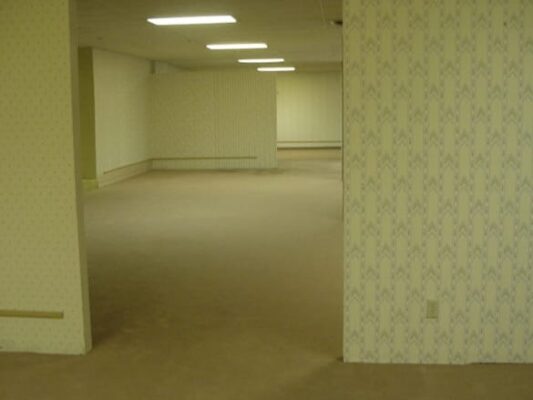
Backrooms are a new horror genre weaned on the aesthetics of post-capitalist liminal space and the pervasive anomie in today’s global society. Within this genre, the human figure largely disappears, leaving architecture to take center stage. This architecture is spacious, repetitive, and imbued with a subtle absurdity, as familiar as it is unsettling. In these places, fear is not provoked by a specific object but instead by its absence, an unidentifiable threat experienced through anxiety.
Backroom architecture is composed of unoccupied spaces in different states of decay. These are not the romantic ruins that evoke a distant past but rather an abandoned, yet still functional, architecture that places a subject in a suspended temporality, condemned to wander aimlessly. Traces of human presence can still be identified within these spaces, such as electric light. This quality is linked to kenopsia, the melancholic and often disturbing feeling of being in a place usually teeming with life but that now appears deserted. In backrooms, as in much of science fiction, the absence of the Other is replaced by strange creatures that lurk around but never fully reveal themselves.
The genre’s origins can be traced back to May 2019 from a post on a 4chan thread dedicated to disturbing images. The image in question showed an interior space with yellow wall paper, fluorescent lights, and a carpeted floor. The accompanying text described “backrooms” (the first use of the term) as places outside of reality in which one is trapped. Since then, this aesthetic has spread virally in video games, stories, and videos. On platforms such as Reddit, YouTube, Tumblr, and TikTok, thousands of users share images of empty corridors, stairwells, and parking lots, and everyday scenes that seemingly reveal nothing have come to define horror for an entire generation.
Backrooms have been classified, or denigrated, as creepypasta. This term encompasses a wide range of horror stories that circulate online, with repetitions and recontextualizations, adopting multiple formats of spaces that are cursed or possess a disturbing origin. Although backrooms were initially presented within this category, their scope now extends well beyond. Within this framework, the backroom narrative describes a space outside of reality, accessed involuntarily and suddenly, through a phenomenon known as noclipping. Originating in the world of video games, noclipping or doing noclipping refers to the ability to pass through walls or solid objects as if they didn’t exist, often used as a technical tool to explore inaccessible areas within a virtual environment. Translated into the realm of backrooms, the noclip becomes a powerful metaphor for systemic error, a kind of “glitch in the Matrix” that suggests the simulated nature of the real world.
This abrupt access not only represents a transgression of the laws of physics but can also be interpreted as access to the unconscious, in line with what psychology has conceptualized as katabasis. Traditionally associated with the descent of the classical hero into the underworld, katabasis has been reinterpreted as a symbolic immersion into the deepest layers of the psyche, especially in the context of crisis or destabilization of the individual. In this sense, backroom environments can be understood as a contemporary reformulation of the original descent, a liminal space that materializes psychic disorientation through a distorted and unstable architecture.
Beyond their dramatic dimension, backrooms can be interpreted as a reflection of a contemporary society profoundly inundated with digital environments and the consequent discrediting of the image as a guarantor of truth. In this context, the proliferation of simulations, visual loops, and spaces devoid of reference contribute to eroding trust in reality, generating a diffuse sense of estrangement. In this way, backrooms transcend the mere phenomenology of the digital urban legend and instead articulate a collective narrative that resonates with a young generation particularly influenced by the post-pandemic experience. Within them, an atavistic fear is reactivated, that is, the suspicion that the world, stripped of purpose and structure, may reveal itself as a meaningless space.
In this sense, various interpretations link backrooms to the alienating logics inherent in late capitalism. The repetition of endless offices and identical corridors evokes work environments dominated by repetition and depersonalization, where the illusion of infinite continuity disorients and dilutes workers’ agency. These scenarios evoke an architecture of endless productivity in which the individual is trapped in circular dynamics. Thus, backrooms can be understood as a metaphor for an economic system that has colonized not only physical space but also time and subjectivity. In this sense, the series Severance is particularly pertinent, exploring as it does the dissociation between work and personal life through an aesthetic of closed, repetitive, and profoundly alienating corporate spaces, clearly tied to the imagery of backrooms.
Backrooms can also be linked, in a particularly eloquent way, to Freud’s notion of “The Uncanny” (das Unheimlich), understood as the unpleasant experience of an object perceived as simultaneously familiar and strange. This disturbance does not come from a supernatural or fantastic realm but rather from the irruption of repressed trauma into the everyday. In this sense, the uncanny is configured in Freudian thought as a source of anxiety that emerges from the friction between the visible and the invisible. Backrooms, with their recognizable spaces devoid of presence and context, translate this concept into a stage setting.
It is precisely from the uncanny that Freud proposes the “aesthetics of anxiety” as a product of the experience of negative emotional tension. From this perspective, artistic creation is presented as an escape route for managing anxiety and guilt. In his analysis, Freud also emphasizes the recurrence of certain motifs associated with the uncanny (the double, mirrors, repetition), elements that generate profound instability by calling into question identity and the consistency of reality. In backrooms, these dynamics translate into the reiteration of identical spaces, the inability to orient oneself, and the feeling of being trapped in an endless loop, thus intensifying the experience of alienation and loss of self.
At this point, I should point out that backrooms are much more than a trendy internet horror genre. For me, their power lies in the fact that they condense some of the fundamental concerns of contemporary thought, such as simulacrum, liminality, alienation, disorientation, and anxiety. This imaginative world, in my view, has little to do with the Gothic or with the recently proposed institutional Gothic, understood as a horror genre based on the influence of the past on the present.
Understanding the power of backrooms implies appreciating their connection to the contemporary collective psyche and their liminal nature. In an era marked by abstract structural uncertainties, such as the climate crisis, economic instability, and the advent of AI, fear no longer needs to be embodied. As in backrooms, contemporary fear is experienced as a latent, ubiquitous presence, difficult to name but impossible to ignore. Thus, these spaces not only represent an aesthetic of the liminal but also condense a historical sensibility of a time in which inhabiting the world increasingly involves traversing scenarios that offer neither refuge nor escape.
In this search for a genealogy of the representation of architecture with a markedly psychological dimension, this text serves as an introduction that attempts to define the phenomenon of backrooms, their cultural context, and their generational impact. In the following installments, I will develop in greater depth the theoretical framework that allows us to approach these images and to propose a journey through artists and work that engage with this imagery. I will begin with liminal spaces, understood as ambiguous thresholds where certainties are suspended and normal limits are blurred.
[Featured image: Popular Internet meme known as “The Backrooms”. The photograph originates from a building located at 811 Oregon St., Oshkosh, Wisconsin, United States, and was taken before a renovation. The image was first published on 4chan in 2011. In 2019, the photograph was included in the first post that introduced “The Backrooms” myth. It was not until 2024 that the photograph’s true origin was conclusively identified. Author: Bill Magritz. Source: Wikimedia]
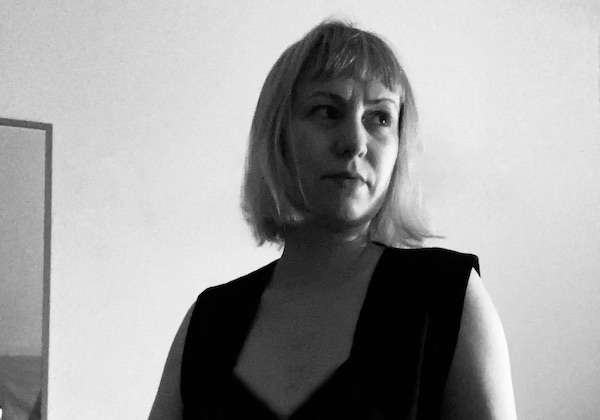
Rosa A. Cruz is a Catalan-Andalusian art historian and cultural communicator. She has worked at the Museu d’Art Contemporani de Barcelona, at ADN Galeria and at the University of Barcelona, where she was part of the AGI Art, Globalization, Interculturality Research Group. She is particularly interested in questions about the double, psychology and biographical discourse. She is currently conducting research on the intersection between contemporary sexual and artistic practices.
Media Partners:







"A desk is a dangerous place from which to watch the world" (John Le Carré)