Search
To search for an exact match, type the word or phrase you want in quotation marks.
A*DESK has been offering since 2002 contents about criticism and contemporary art. A*DESK has become consolidated thanks to all those who have believed in the project, all those who have followed us, debating, participating and collaborating. Many people have collaborated with A*DESK, and continue to do so. Their efforts, knowledge and belief in the project are what make it grow internationally. At A*DESK we have also generated work for over one hundred professionals in culture, from small collaborations with reviews and classes, to more prolonged and intense collaborations.
At A*DESK we believe in the need for free and universal access to culture and knowledge. We want to carry on being independent, remaining open to more ideas and opinions. If you believe in A*DESK, we need your backing to be able to continue. You can now participate in the project by supporting it. You can choose how much you want to contribute to the project.
You can decide how much you want to bring to the project.

Recently I was in Italy, in a small city by the sea, and found myself in the company of some locals. We were speaking in English, while one among the group could not speak any at all, and remained excluded. For twenty odd years I’ve lived outside of Ireland, outside of English, and I’ve grown used to how English follows me in such a setting. People will apologise however they can. What do they apologise for? Their English, whether it be a total inability to speak it at all – smiles, upward turned hands, eyes shining forgiveness – or for a self-declared low quality. I grow uncomfortable: people shouldn’t apologise for not speaking English to me, in their own country. What’s more, they shouldn’t then end up being excluded from a conversation. But it happens. English rushes in, like a river current, ignoring the mute rock, and gurgling past, ever onwards.
A line by the journalist Mathieu Aikens: “The white noise of English pervades the entire world,” written while following refugees, of many nationalities, as they traversed continents to reach west Europe. It’s an apt description: English is pervasive, in various frequencies and pitches, and why it fits the Deluezian concept of a minor language/literature: A minor literature is not one written in a minor language – rather it’s a minority working with a major one.
English has long been deterritorialized. First by Empire as a colonial force, then as “the empire speaking back” and now, in today’s world, as a supra-national lingua franca, powering webspeak, cultural sharing or dodging advertising. And if the image has captured every corner of the world, and smartphones have published them, English gives voice to many as they move around the world, allowing mediated handshakes. To communicate with one another we speak, we apologise and make do with just one or two incorrect words (okay, yes, please).
Standard English is over; the Queen is dead. Translated English is standard now. Vincenzo Latronico, a writer who has written his generation’s pan-European novel, should know. Our conversation covers the ins and outs of the role English has in literary, artistic life today. Also its role in Proust’s conception of literature as being invariably written “in a kind of foreign language”: he admits to thinking often of an impossible work of literature that is written in English as a second language. Like Beckett perhaps, renouncing English to attain the pureness his art required.
Literature can sometimes play catch up. Kári Páll Óskarsson writes how English is pervasive in everyday life in Iceland. Giving a dispatch from a fascinating language region of just 370,000 speakers of one of the continent’s oldest written languages (Vincenzo pointed out, via Kundera, that the Eddas and Sagas are possibly the start of modern Euro-literature), we hear how English is working its way into Icelandic literature.
Ana Schnabl, one of Slovenia’s most exciting writers, looks at the speed of Internet English’s ability to influence other languages: how the borrowing and loaning of the Internet’s vocabulary and phrases means Slovenia is changing faster than ever.
(Featured image: © Juliet Barbieri)
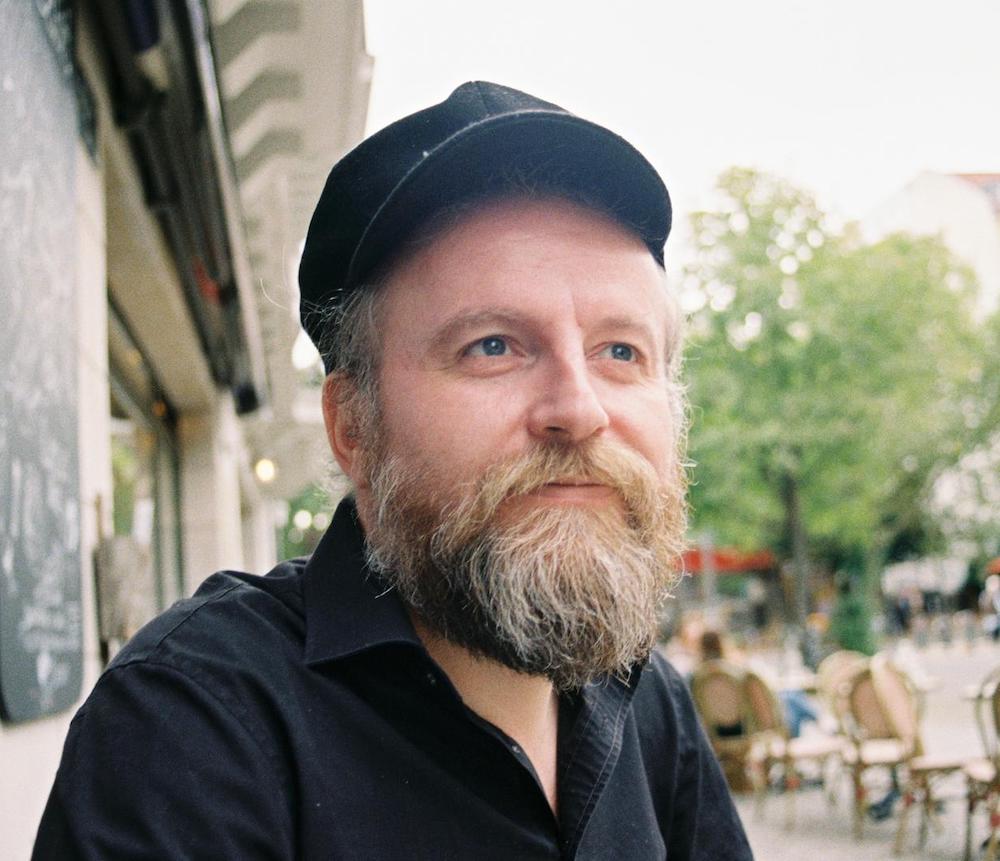
John Holten is an Irish born, Berlin-based novelist and publisher, whose most recent novel is The Trains of Europe (2024). www.johnholten.eu
Portrait © Juliet Barbieri
Media Partners:








"A desk is a dangerous place from which to watch the world" (John Le Carré)