Search
To search for an exact match, type the word or phrase you want in quotation marks.
A*DESK has been offering since 2002 contents about criticism and contemporary art. A*DESK has become consolidated thanks to all those who have believed in the project, all those who have followed us, debating, participating and collaborating. Many people have collaborated with A*DESK, and continue to do so. Their efforts, knowledge and belief in the project are what make it grow internationally. At A*DESK we have also generated work for over one hundred professionals in culture, from small collaborations with reviews and classes, to more prolonged and intense collaborations.
At A*DESK we believe in the need for free and universal access to culture and knowledge. We want to carry on being independent, remaining open to more ideas and opinions. If you believe in A*DESK, we need your backing to be able to continue. You can now participate in the project by supporting it. You can choose how much you want to contribute to the project.
You can decide how much you want to bring to the project.
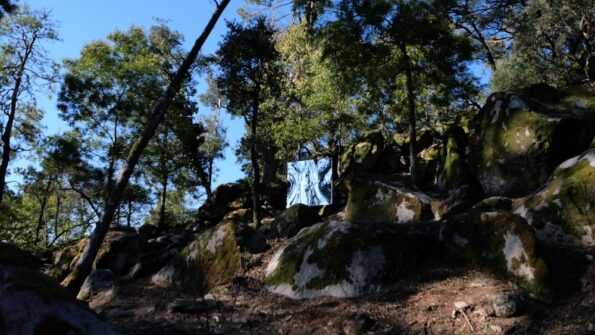
Since its appearance in Gayatri Spivak’s 1997 lecture “Imperatives for Reimagining the Planet,” planetariness has been a concept that attempts to conceive of a relationship with Earth that transcends globalization and colonialism. It is a powerful term that has been used several times (up until today) to label the contemporary “polycrisis” but which, far from constituting a homogeneous field, operates as a space of friction.
The planetary is always a figure of multiplicity. For Bratton, it is an accidental megastructure. For Avanessian, it is an active condition that co-evolves with life and technology. For Hui, it is a perspective for addressing current challenges. For Likavčan, it is a problem of scale whose tensions define the geopolitical terrain. And so on. A particularly fruitful perspective is that of Jennifer Gabrys, for whom the planetary implies thinking with sensors. But what is a sensor? A sensor is a means to generate surroundings and environmental relationships. In texts such as Program Earth and projects such as Citizen Sense, Gabrys has explored how sensory technologies and “technogeographies” modulate forms of environmental citizenship.
To articulate the material unity of the planet within the irreducible multiplicity of worlds that inhabit it, we must destabilize the figure of total domination. In Latin America, this tension is not abstract since the planet that serves the Global North clashes head-on with exploited bodies, territories, and knowledge that cannot be reduced to a single meaning. We can make friction tangible by thinking about scale interfaces, that is, technical operations that connect the local with the planetary and perception with infrastructure, though without resolving contradictions. The sensor, seen in this way, is a paradigmatic interface, a kind of collective prosthesis (though not an inert extension) of perception.
Luciano Piccilli, in MONTE, has deployed a specular interface that operates as a sensor of territorial memory. The rainforest on the border between Argentina, Brazil, and Paraguay is an important remnant of the Atlantic Forest (which has lost 95% of its area in the last 120 years, primarily to foreign companies). Faced with this extractive disaster, Piccilli uses a device that allows the voices of the Mbyá-Guaraní people to sound off in a sonic canon. This work doesn’t “represent” a lost landscape but instead generates a vibrant new reality based on people’s own testimony, whose voices operate as a retroactive sensor (folded in on itself by means of a mirror) that generates an altered image and an emotional space. The interface creates a portal of constant resignification.
In Resonancia de partículas (Particle Resonance), Gabriela Munguía developed a skin sensor. At the center of this robotic installation, four machines smash rocks while dust particles float in the air. The dust amplifies a geological process that has been occurring for millennia. The work produces a deafening noise as the ground vibrates, and the almost absurd gesture of the machines breaking rocks returns us to the time of the strata, to the slow pace of the Earth.
In Cenizas del Paraná (Ashes from Paraná), Munguía worked with Guadalupe Chávez to deploy an arsenal of tools (aerial photogrammetry, satellite and microscopic images, field recordings) that serve as an interface to bears witness to the fires that burn grass, vaporize roots and destroy organic soils that took centuries to form. Plant and rhizospheric communities that still survive, however, are also identified, rescuing that which maps of the disaster usually ignore. The result is a mechanical-acoustic transmedia installation that embraces the life that survives within the ash. Faced with extractivist necropolitics that turns wetlands into cannon fodder for livestock speculation, the artists listen to the breathing sounds underground.
Noise becomes as a central element. In classical information theory, noise is an unwanted disturbance, something that prevents clear communication. But what if that failure, more than an error, creates new possibilities? The materiality of the world is never fully translated into a single, clear signal. There is always a remainder, an irreducible excess. As the mathematician Edward Ng wrote in 1990, one man’s noise is another man’s signal, and what is considered noise today can be information tomorrow. This reminds me of Cogito in Space by the artist Daniela de Paulis, a work that brought together neuroscience and radio astronomy in an inverted listening operation. First, the audience sits with a virtual reality headset and views images of the universe. While they watch, an electroencephalogram translates their brain activity into a stream of sound that is sent, in raw form, to unspecific points in the sky using a radio telescope.
Without an interface there is no link to the world, but without being aware of the noisy opacity of matter we fall into a technological idealism where everything is moldable information. Sensors, in essence, capture what is strange. They collect unexpected movements, changes, and wrinkles, all of which require recalibrations. A sensor might generate reality but who programs the sensor? The Brazilian artist Guto Nóbrega has been working with plant/machine systems for some time. In works such as BOT_anic, Nóbrega hybridizes living organisms with low-cost robotic systems. Plants act as natural organic sensors that, affected by public interactions and environmental alterations, react and generate movement or sound. Nóbrega, however, does not expect efficiency from cyborgs. Instead, he explores unlikely alliances in the vegetal slowness that dialogues with the precariousness of circuits. The installations often fail, get stuck, need to be watered, or they need to be recalibrated, and this vulnerability presents a geography in which undisciplined use of technology can prioritize dissent over productivity, bifurcation over optimization.
In the face of extractive entropy (which transforms territories and bodies into flat and disposable data), we need to think about a politics of care that does not reject technology. The Neguentropic Atlas (a project that I developed together with Claudia Valente and Gonzalo Silva) is an activist ecology of the interface, a distributed infrastructure of biomimetic sensors for bodies of water. Inspired by extinct aquatic organisms and diatoms, these devices do not seek laboratory precision but rather a transduction of the vitality of water that resists extractivist logic. The Atlas is a platform that seeks to be occupied in a shared place between a “here” (the body, the territory, the community) and a “there” (the planet, data system, global flows) that are never completely separate. This, however, is not a bridge but, rather, an artifact of friction, a field of forces where diverse things touch but don’t merge.
As Felipe Rivas San Martín claims, unlike the ubiquitous mediations of cognitive capitalism designed to be invisible and utilitarian, this work aspires to make audible the friction, noise, and everything else that comes before meaning. The purpose of the interface is to be less and less itself, to be the perfect coupling between the person and the machine, but at the same time it is the only thing that the person can see of the system. Rivas San Martín criticizes the ideal of transparency in an ideological operation that neutralizes any possibility of dissidence. In the face of the perfect coupling between “human”, “nature” and “technology”, however, the practices shown here prefer noise and mistakes, all that which prevents fusion and highlights conflict.
This idea is key to overcoming a certain linguistic constructivism that does not know how to deal with the stubbornness of the subject. If everything is constructed by discourse, what room is there for real resistance, for the noise that does not fit? In the face of the empire of reality, imagination represents the stubborness of inventing what is not yet noise or signal. By working with the materiality of sensors, data, and circuits, one can discover a space in which matter itself has agency and opacity. We cannot capture the world that is out there but we can perceive it through artifacts that modulate it without exhausting it.
[Featured Imagen: Luciano Piccilli, MONTE, Courtesy of the artist]
Hernán Borisonik holds a PhD in Social Sciences from the University of Buenos Aires and is a researcher at Conicet (National Council of Experts). He is an adjunct professor at the School of Humanities at the National University of San Martín, where he directs the Center for Science and Thought. He coordinates various projects in philosophy and political theory that explore issues related to money, sacredness, politics, and the arts. He occasionally curates, performs, and art criticism. He won second place in the Argentine National Prize for Philosophical Essays in 2020. He has edited several academic and popular volumes and published the books “Dinero Sagrado” [Sacred Money], “Soporte” [Support], and “Persistencia de la pregunta por el arte” [Persistence of the Question of Art], among others.
Media Partners:






"A desk is a dangerous place from which to watch the world" (John Le Carré)