Search
To search for an exact match, type the word or phrase you want in quotation marks.
A*DESK has been offering since 2002 contents about criticism and contemporary art. A*DESK has become consolidated thanks to all those who have believed in the project, all those who have followed us, debating, participating and collaborating. Many people have collaborated with A*DESK, and continue to do so. Their efforts, knowledge and belief in the project are what make it grow internationally. At A*DESK we have also generated work for over one hundred professionals in culture, from small collaborations with reviews and classes, to more prolonged and intense collaborations.
At A*DESK we believe in the need for free and universal access to culture and knowledge. We want to carry on being independent, remaining open to more ideas and opinions. If you believe in A*DESK, we need your backing to be able to continue. You can now participate in the project by supporting it. You can choose how much you want to contribute to the project.
You can decide how much you want to bring to the project.
There is probably no other term that does as much work as ‘modern’ in the presentist humanities. The Museum of — Art, —ism, —ist, post—, early —, pre—, and the list goes on. Institutions, careers and fields are premised on the meanings of the modern. While it feels like a copout to define something by what it is not, here we are. If one understanding of modern is defined by rationalism, capitalism and scientific progress, then the anti-modern would be irrational, anti-capital and against progress. In a related vein, Bruno Latour (1991) once conceptualised the non-modern to reject the split between nature and culture. He argued that we cannot control nature as it is part of us. Rather than being completely free of notions of the modern, modernism and modernity, we find that artists of the three biennials under review here deploy different methods to confront and reject the modern.
Nadja Argyropoulou’s Thessaloniki Biennial, Everything must change: radical intelligence, offers a coherent articulation of the anti-modern. The slogan ‘everything must change’ itself reeks of capitalist rhetoric the failings of which continue to multiply. Argyropoulou reclaims this mantra and proposes what she calls ‘radical intelligence’ as a method for committing oneself to mutability and transformation. This too counters the rising artifice of intelligence today.
Dionisis Kavallieratos, The Chivalrous Quest, 2020–2026, Thessaloniki Biennial, photo: Denis Maksimov
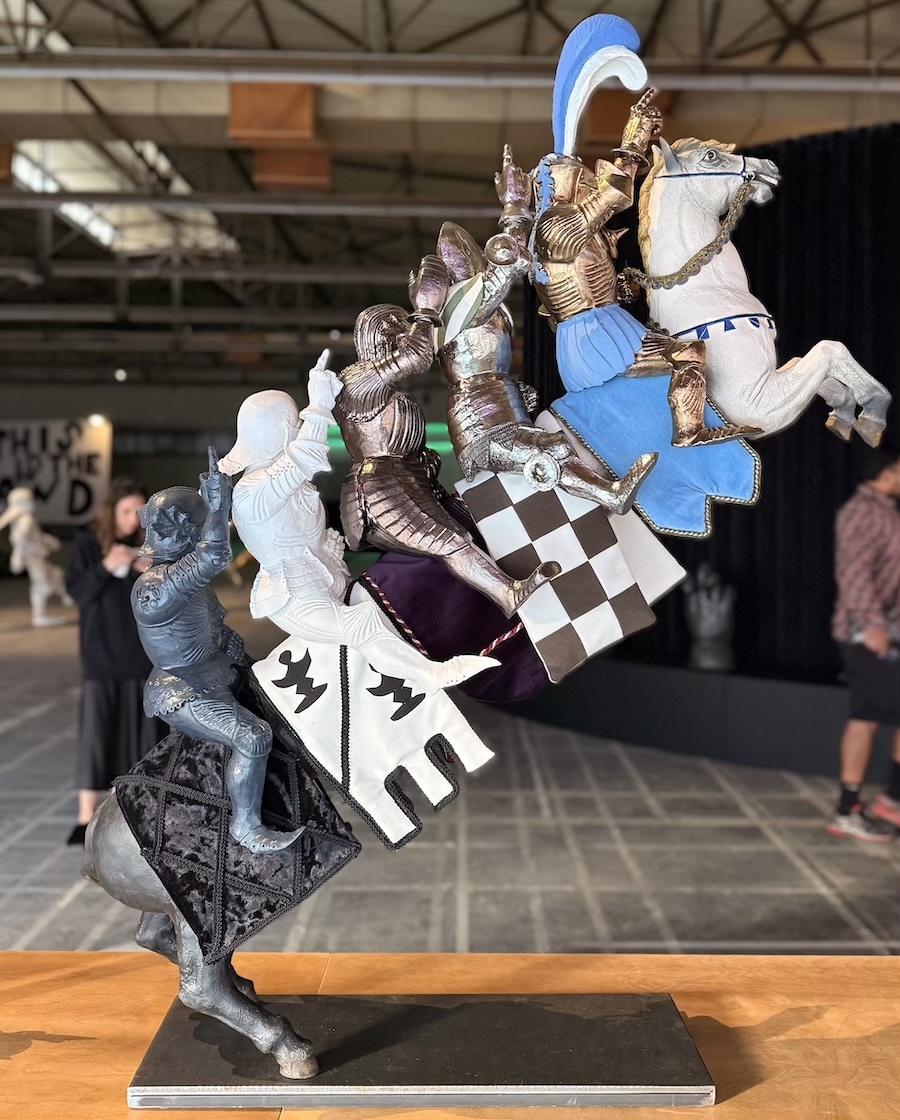
Shown in Thessaloniki, The Chivalrous Quest (2020–2026) by Dionisis Kavallieratos (b. 1979, Athens) emerges as a searing critique of modernity’s discontents. With a satirical multimedia display of sculpture, drawings and film, Kavallieratos takes the political heraldry and arms and armour of medieval European court culture as an idealised field for class struggles that permeate modern life. He queers medieval systems of power by exaggerating the animal symbols used for heraldry. In his film, his characters parodise the Latin language of emperors with bizarre and flagrant gibberish. Through a ‘medieval’ visual language, Kavallieratos confronts arbitrary mechanisms of control by uncovering their irrational and shaky foundations.
Arthur Jafa, Love is the Message, The Message is Death, 2016, installed at the Thessaloniki Biennial, photo: Vivek Gupta
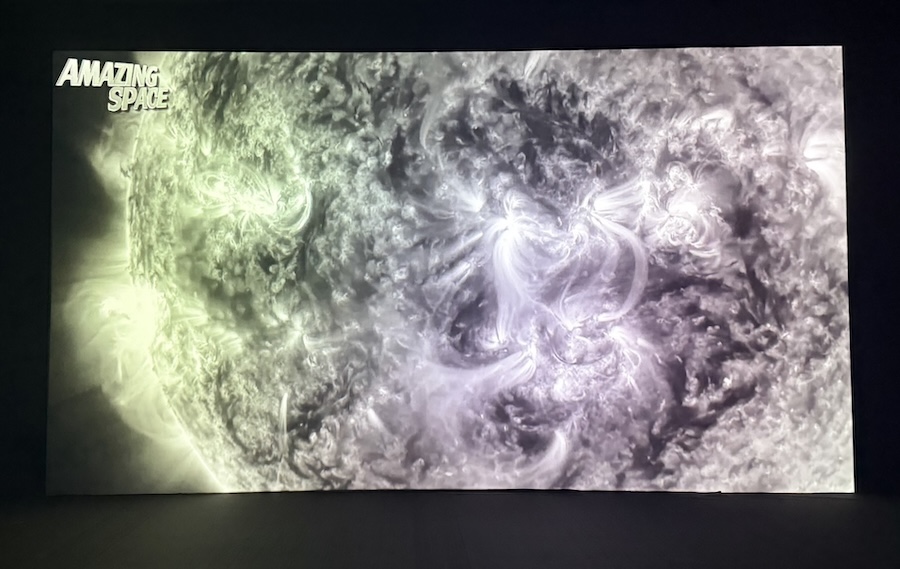
Whereas Kavallieratos’s work is a fiction that exposes modern processes of rationalising social power, Love is the Message, The Message is Death (2016) by Arthur Jafa (b. 1960, Tupelo)–a centrepiece of the Argyropoulou’s biennial–is an ode to the irrationality and vitality of blackness. By juxtaposing seminal moments in black history with images of explosions on the Sun, Jafa throws into question whether such socio-political realities can be reasoned. Some anthropologists (and a fair share of conspiracy theorists) speculate that such flareups on the Sun correspond with outbreaks of human violence on earth.
In light of critical writing about Jafa and this work, particularly by Tina Campt, Love is the Message, The Message is Death speaks to how powerfully black life has channeled a radical intelligence to produce everything from music to literature to politics. Black joy and survival in the face of the push and pull of modernity speaks to broader currents within black studies. For instance, Saidiya Hartman (2022), a key scholarly inspiration for Argyropoulou’s and Koyo Kouoh’s biennials, has stated, ‘there was an irreparable violence of slavery…It is just to acknowledge the enormity of that violence that was part of the making of modernity. And it is irreparable and we are still living in the damage of that making’. In Anteaesthetics Rizvana Bradley (2024), proposes that ‘blackness cannot be represented in modernity’s aesthetic regime, but is nevertheless foundational to every representation’. In other words, modernity simplifies things to control them and diminish their rich complexity, a sentiment poignantly felt in Jafa’s work. And it resonates throughout the Thessaloniki biennial in the pressures of other political struggles. We see it in the survival of Palestinian worldmaking in Morgenkreis (Morning Circle, 2025) by Basma al-Sharif (b. 1983, Kuwait). Throughout al-Sharif’s video work the modern German state executes acts of bureaucratic violence to squash non-German identities and mould ideal mono-cultural citizens.
Zarina Muhammad, Omens Drawn by Lightning, 2025, Aspinwall, Kochi, photo: Denis Maksimov.
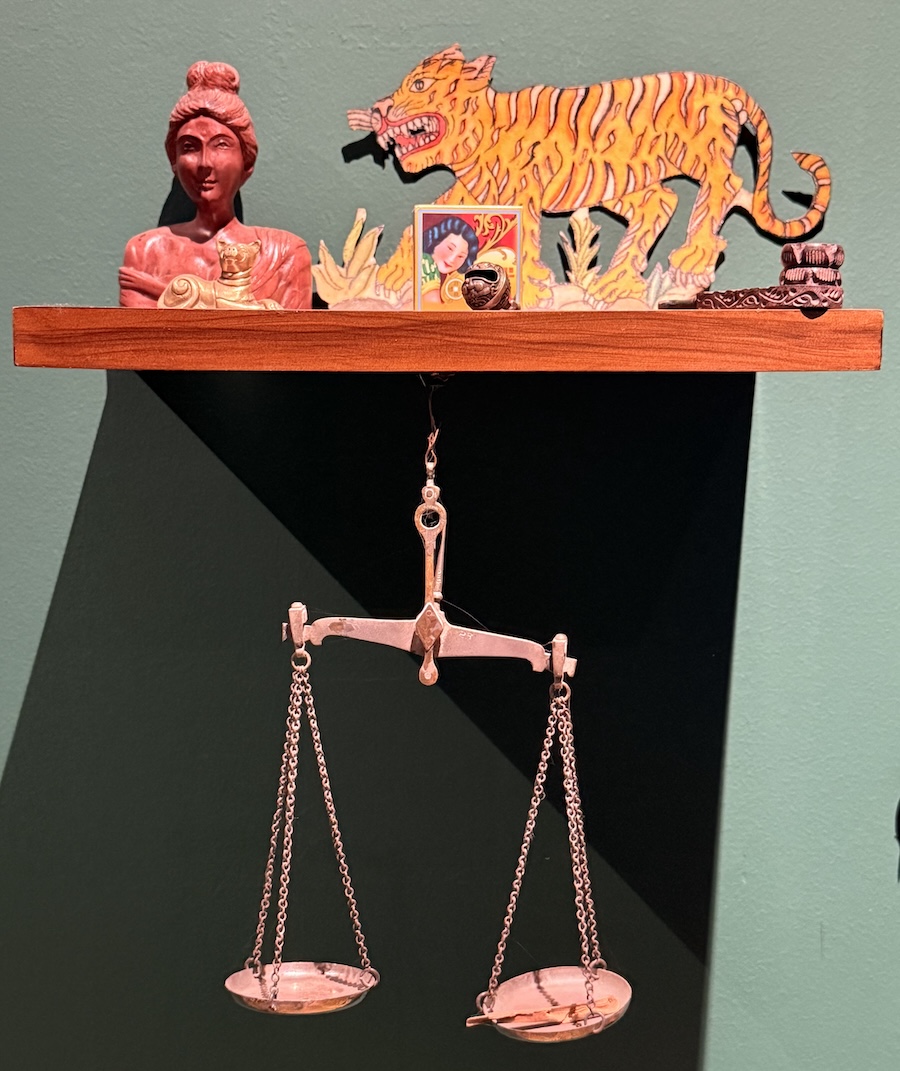
Here, it is also worth noting how the artists of these biennials are increasingly drawn to reactivating the magical, therapeutic and occult histories of objects that transcend the modern. Spiritual and esoteric practices have lived on despite modernity. This is especially pertinent in consideration of our last two essays on the mutable object and material mythologies. In Omens Drawn by Lightning (2025), Zarina Muhammad (b. 1982, Singapore) stages shrines of everyday objects ranging from foodstuffs to puppets from the Indian Ocean ports of Kochi, Colombo and Singapore. Muhammad invites her viewer to practice ‘ceraunoscopy’, that is, the divination of omens from thunder and lightning for predicting the future. This prompts the visitor to have their own intimate experience of the objects of the three culturally entangled ports that are now torn apart by modern nation-states. Omens Drawn by Lightning thus emphasises the unregistrable resilience of culture notwithstanding forms of modern knowledge that are absolute.
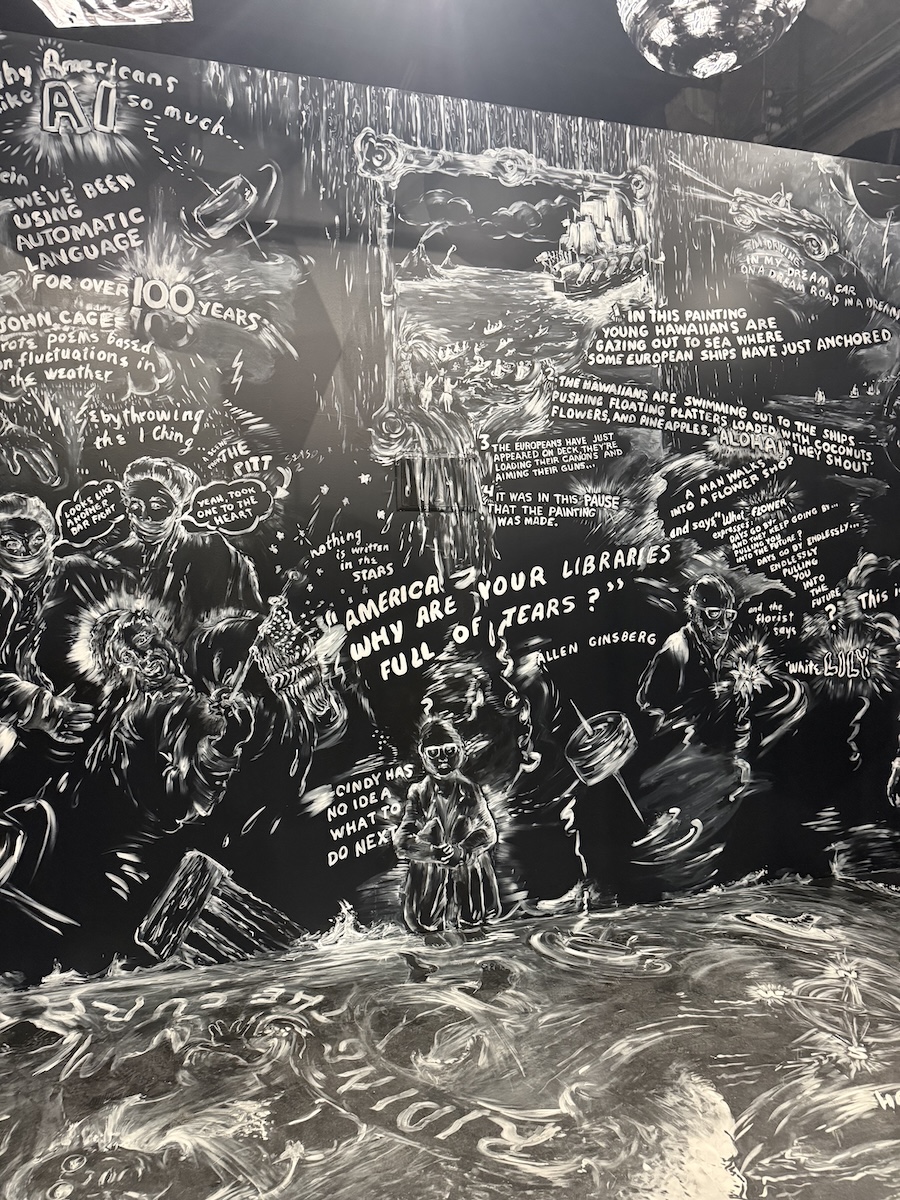
Laurie Anderson, Notebook, 2026, Arsenale, Venice Biennale, photo: Vivek Gupta
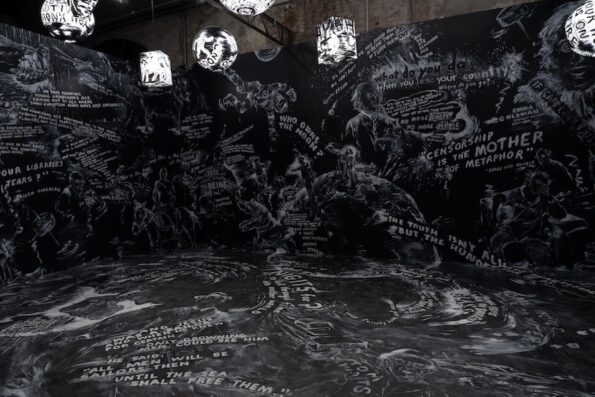
In Venice, Laurie Anderson (b. 1947, Chicago) has made a shrine for performance of a different sort. In her work Notebook (2026), Anderson has invited audiences inside of her head in a room of her signature painted murals and quotes evocative of a chalkboard. The quotes span from the American intellectual and activist Cornel West to memories of her late husband, the musician Lou Reed (1942–2013). We witness apophenia—a human tendency to perceive unrelated patterns in random data—as a logical system. Anderson reminds us that the human mind is not wired as a computer, but a radically intelligent system that consistently achieves the unpredictable. In a second work that one could easily miss in Venice’s Arsenale, All In Your Head (2026), Anderson offers an audio installation of her inner voice speaking. Her mind wanders off and loses focus as she mumbles and chews. She procrastinates getting to the point. Crucial for innovation, this processual intelligence is non-registrable by capitalist or modern systems.
Indeed, the discourse of the modern, modernity and modernism is here to stay. And yet, its limitations are continuing to reveal themselves. The artists and curators of the Kochi, Thessaloniki and Venice biennials present themselves as blissfully negligent of trying to control the nature of art and artmaking. Through their attention to the object’s defiant mutability and magical mythologies, they reveal the radical intelligence of worlds we cannot comprehend but can continue to feel and draw inspiration from.
(Front image: Laurie Anderson. Notebook, 2026, Arsenale, Venice Biennale. Photo: Luca Zambelli Bais. Courtesy © La Biennale di Venecia)
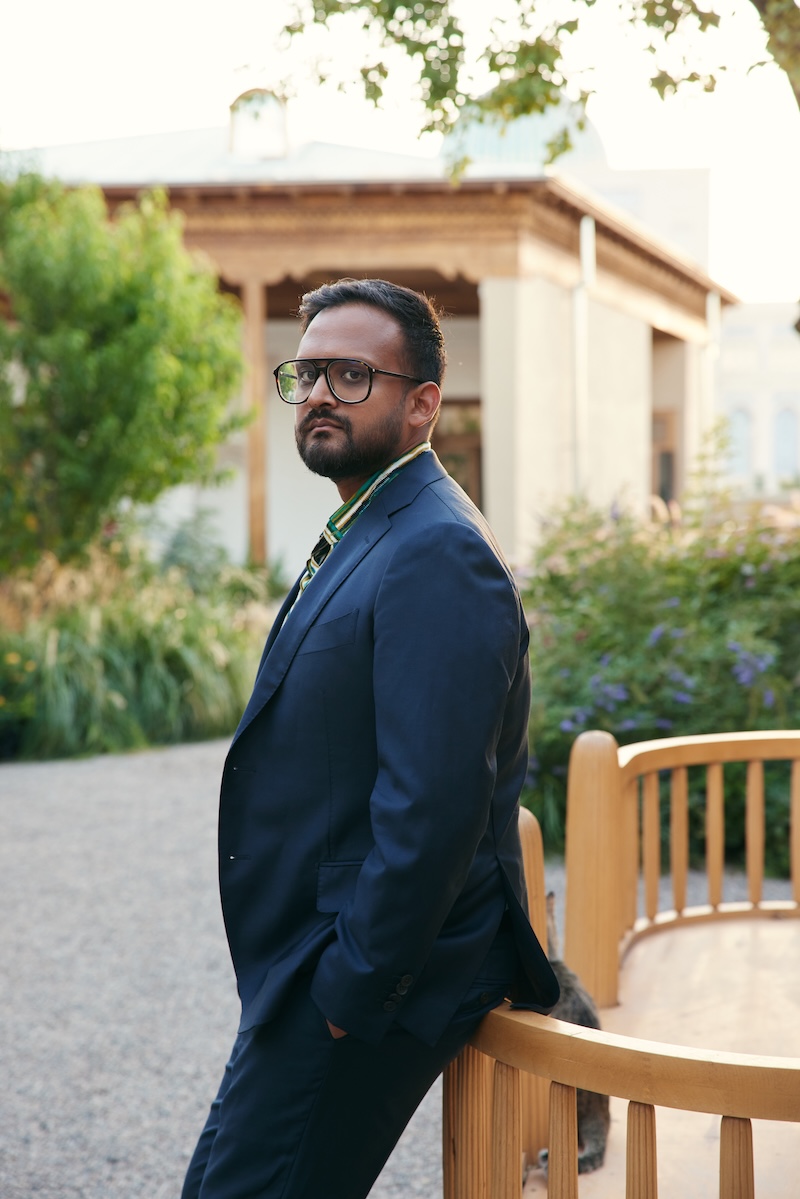
Dr Vivek Gupta is an art historian and curator of the Islamic, South Asian, and Indian Ocean worlds. He specialises in the art of the book, painting, calligraphy, and connections between portable objects and architecture. In recent publications, he has written about transregional circulation, cultural exchange, intersections between art and science, and transmediality. He is the author of Wonders of Hindustan: Artists and books in the early modern world (UCL Press) and curator of A Mughal Songbook: Art, Music, and Empire at the Fitzwilliam Museum, Cambridge (2026–27). He is currently a British Academy Postdoctoral Fellow in History of Art at University College London (2023–26) and previously was a Postdoctoral Research Associate at the University of Cambridge (2020–23).

Denis Maksimov is a historian of art and knowledge. His work focuses on aesthetics of epistemology, the relationship between heritage and future-making, and lecture performance. He is a guest curator at NYU Abu Dhabi Art Gallery and has curated exhibitions and programmes for institutions globally, including Helsinki Art Museum, Glyptoteket in Copenhagen, Pushkin House in London. His research and curatorial work have been presented in the Venice Biennales of Art and Architecture (2015, 2016, 2017, 2019 & 2022), Documenta 14 (2017), Ural Industrial Biennial (2017), São Paulo Biennale (2016), Art Basel, London Art Fair, Cosmoscow, etc. He is a lecturer at Backstein’s Institute of Contemporary Art, Salzburg International Summer Academy of Fine Arts, and was a visiting lecturer at the University of Applied Arts in Vienna. His writing has been published by MIT Press, Edward Elgar Publishing, MoMA, Ocula, Conceptual Fine Arts, Moscow Art Magazine, Obieg, Arts of the Working Class, among others.
Media Partners:






"A desk is a dangerous place from which to watch the world" (John Le Carré)